Most traders that join a prop firm challenge believe the hardest part is meeting the profit target.
Actually, the total drawdown is the rule that usually closes the account first.
The overall drawdown rule of a prop firm is the maximum loss the trader can lose before the account is closed. Each prop firm has a different structure which is why a lot of traders misunderstand the risk they are actually taking.
This article is for beginner and intermediate traders trying to understand prop firm risk rules before paying to challenge. For traders already running big personal accounts or institutional-style portfolios with flexible capital, it matters less.
Many competitors explain drawdown using simple textbook definitions. What they often miss is the way these rules change the behaviour of traders in real conditions.
What Is an Overall Drawdown?
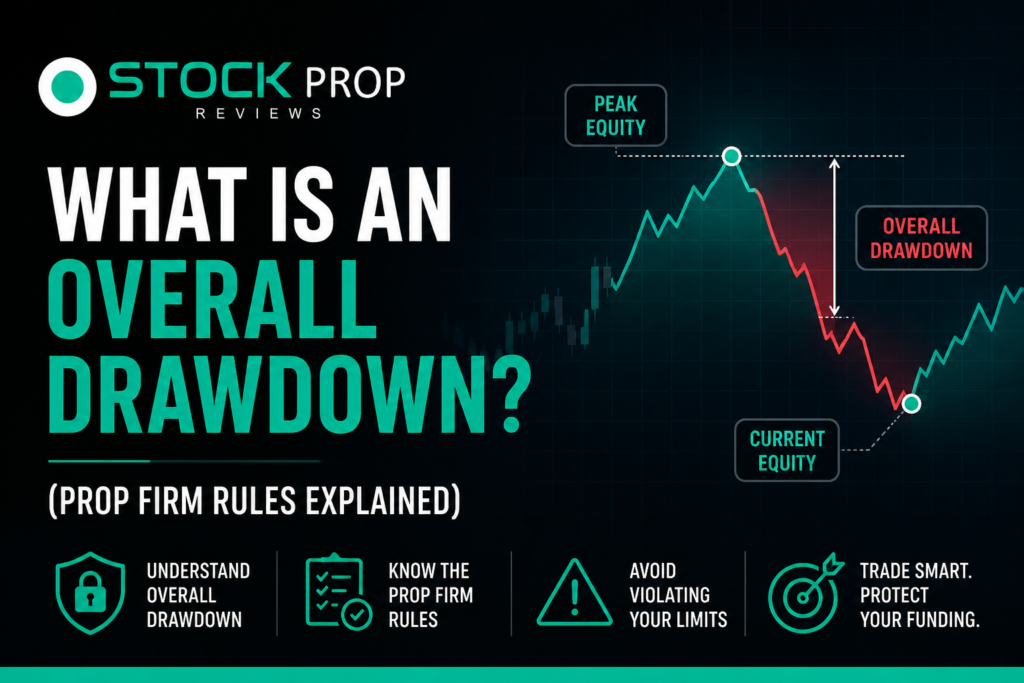
An overall drawdown is the maximum amount a trading account is allowed to lose from a defined reference point.
That reference point could be:
- The starting balance
- The highest account balance reached
- The highest equity level reached
Once the account falls below the allowed threshold, the account is breached.
Simple example:
A trader buys a $100,000 evaluation account with a 10% overall drawdown.
That means the account cannot drop below $90,000.
If losses push the account under that level, the challenge ends.
The rule exists because prop firms are not looking for traders who can produce one good week. They want traders who can control downside risk consistently.
Why Overall Drawdown Matters More Than Profit Targets
Most traders pay attention to the profit target first because it is heavily advertised.
A challenge might require:
- 8% profit target
- 10% overall drawdown
- 5% daily loss limit
At first glance, the numbers seem manageable.
What traders often realize too late is that the available risk is actually very small once normal losing streaks appear.
A strategy can be profitable long term and still fail inside a prop firm environment.
That is one of the biggest gaps in most online explanations.
A trader risking too aggressively can destroy the account in a few trades even with a decent strategy.
The issue is rarely just strategy quality. It is usually position sizing combined with emotional pressure.
Different Types of Overall Drawdown
Not all prop firms calculate drawdown the same way.
Understanding this before buying a challenge matters more than the profit split in many cases.
Static Drawdown
Static drawdown does not change.
E.g.
- Opening balance: $50,000
- – Maximum drawdown: 8%
- Minimum balance in the account: $46,000
Loss floor remains $46,000 no matter if the account hits $55,000.
Usually this model is less psychologically burdensome; profits give you some room to breathe.
Slower traders and swing traders generally prefer static models.
Trailing Drawdown
Trailing drawdown increases with rising account.
Such as:
- Beginning balance:$100,000
- 6% Max Drawdown
- First minimum level: $94,000
The floor could fall to $99,000 if the account reaches $105,000.
That’s a problem that many beginners don’t expect.
Even when a trader makes money overall, they can still lose the account.
That’s why many futures traders get frustrated with trailing drawdown models.
Early leads can be reduced by a quick beginning.
End-of-Day Drawdown
Some firms measure losses on end-of-day balances, not real-time equity.
This means that temporary intraday drawdowns may not matter if the account recovers before the market closes.
This model might be suitable for traders who scale positions through volatile sessions.
Overall Drawdown vs Daily Drawdown
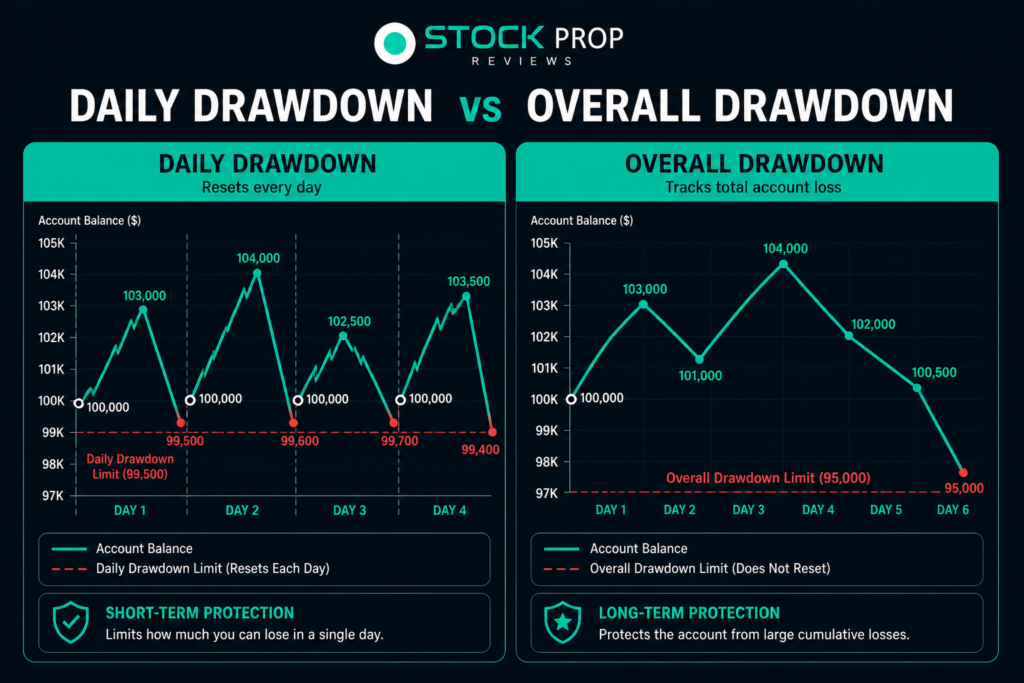
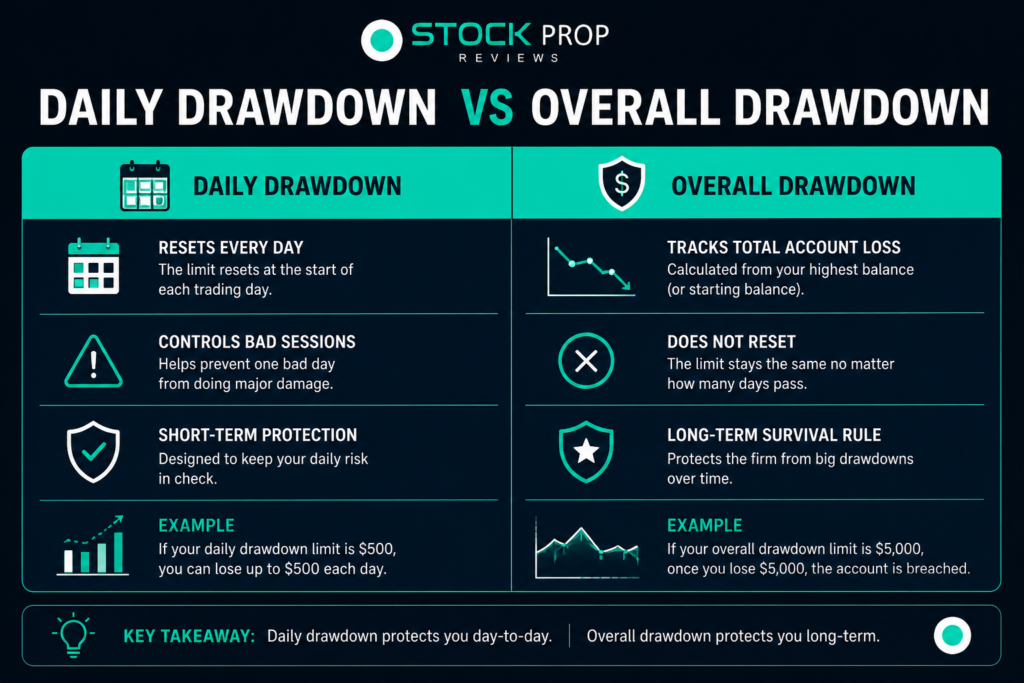
These rules are connected but they are not the same.
| Rule | Purpose | Reset? |
| Overall Drawdown | Protects total account capital | No |
| Daily Drawdown | Limits damage from one bad session | Yes |
A trader can stay inside the daily limit and still slowly fail the overall limit over several sessions.
The opposite also happens.
Many traders do not realise how tight these combined rules get.
Example:
- 10% total drawdown.
- Max Daily Drawdown 5%
Two days of maximum losses could erase the entire account.
This is why experienced traders usually tend to focus more on surviving than on finishing challenges quickly.
Real Trading Example
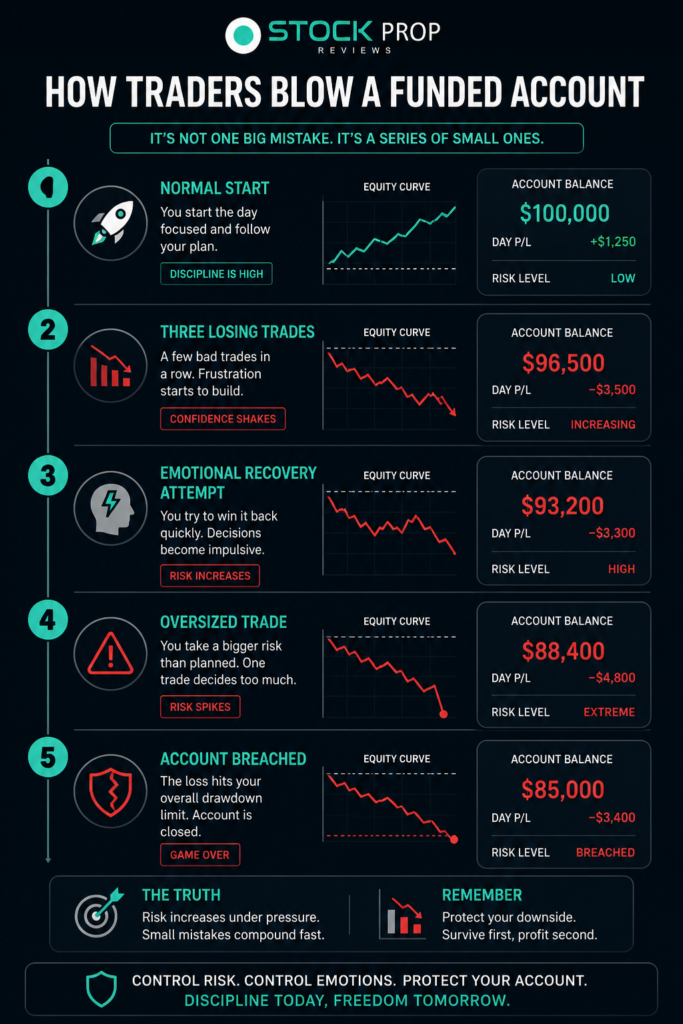
Let’s say a trader has a $100,000 challenge account.
The account contains:
- Overall drawdown 8%
- Daily drawdown 5%
- 10% profit taking
The trader is risking 2% per trade, because he wants to go fast.
First three are losers.
The account is down 6% now.
At this time a lot of traders start to force trades because they feel the pressure to get back.
The next trade is oversized.
Another loss is a blow.
Challenge fail.
This is something that happens all the time in prop trading.
The trader may in fact have a profitable system over 100 trades. The problem is that the risk structure leaves little room for emotional errors.
What Most Competitors Miss About Drawdown Rules
Most articles explain what drawdown is.
Very few explain how it changes execution quality.
That part matters.
Tight Rules Change Trader Behavior
A trader managing personal capital usually thinks differently than a trader inside a tight evaluation.
In a challenge, traders tend to:
- Exit winners too soon
- Don’t take good setups after losses
- Enlarge emotionally size
- Overemphasis on account balance
It is a real psychological pressure.
This is one of the reasons why traders can sometimes trade worse in funded accounts than when trading their own money.
Some Strategies Naturally Need More Room
Trend following systems usually have several small losses before a bigger winning trade comes along.
Swing strategies can pull back several percent for a period of time before moving into profit.
When the drawdown allowance is extremely tight, traders might begin to adjust strategies simply to survive the evaluation.
That can destroy the original edge.
Trailing Drawdown Can Punish Profitable Traders
That’s pretty standard for futures prop firms.
For example:
- Trader increases account from $50,000 to $57,000
- Trailing threshold increases
- Slow the market conditions
- Trader returns a portion of the profits
Even if your balance is above where it began, the account could still be in violation.
Newbies don’t realise this often until they’ve failed a few evaluations.
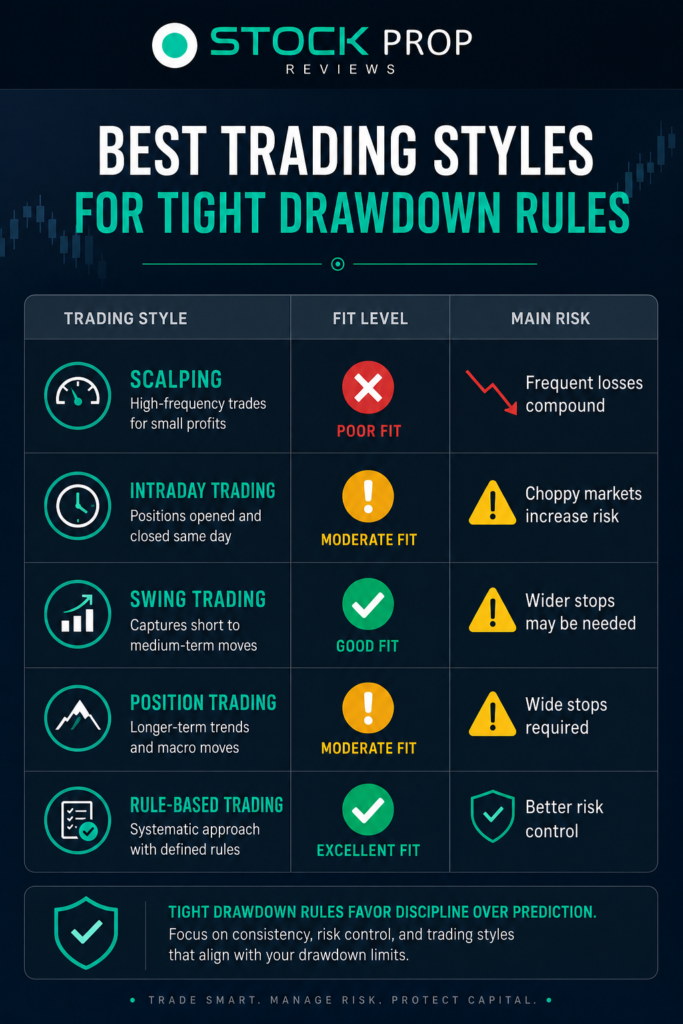
Which Trading Styles Struggle Most?
Different drawdown models favor different styles.
| Trading Style | Fit With Tight Drawdown | Main Issue |
| Scalping | Weak | Frequent losses compound quickly |
| Aggressive intraday | Weak | Emotional overtrading |
| Swing trading | Moderate | Wider stops required |
| Position trading | Poor | Large market fluctuations |
| Low-risk intraday | Strong | Controlled exposure |
| Rule-based systems | Strong | Consistent risk management |
Scalpers often underestimate how quickly commissions, spread costs, and execution mistakes can damage the account.
Swing traders usually prefer firms offering static drawdown instead of aggressive trailing structures.
How Experienced Traders Manage Drawdown
A professional trader will rarely use his full risk allowance.
Many experienced traders psychologically limit themselves to 3% or 4% if a prop firm allows 10% drawdown.
That sounds conservative but it allows for normal losing streaks.
Common practices are:
- Reduced position size
- Less exposure following bad sessions.
- Weekly loss limits (hard)
- Avoiding correlated trades
- Stop trading when emotional
Most long term funded traders survive because they protect capital first.
Traders trying to get through in a few days generally take much more risk.
Static vs Trailing Drawdown
There is no perfect model.
The better option depends on trading style.
| Drawdown Type | Better For | Weakness |
| Static | Swing and slower traders | Less common at some firms |
| Trailing | Consistent intraday trading | Punishes profit pullbacks |
| End-of-day | Futures traders | Risk during volatile sessions |
Static models usually feel easier because profits create additional cushion.
Models that lag reward consistency but can be constrictive after strong account growth.
That’s why traders should pay close attention to risk rules, not just discounts or payouts.
Common Beginner Mistakes
Risking Too Much Per Trade
A trader risking 3% to 5% per trade can fail very quickly.
Even strong strategies experience normal drawdowns.
Ignoring Correlation
Holding several positions tied to the same currency or market theme increases exposure.
A trader long EUR/USD and GBP/USD may effectively be doubling the same directional risk.
Confusing Equity and Balance
To calculate drawdown some firms use floating equity.
That means open losses are now counted.
A trader can breach overnight with positions without closing trades.
Trying to Recover Fast
Many accounts are blown up by traders trying to aggressively recover losses.
This often leads to emotional decisions rather than structured execution.
How to Calculate Overall Drawdown
The formula itself is simple.
Percentage Drawdown = (Loss ÷ Reference Balance) × 100
Example:
- Starting balance: $200,000
- Current balance: $186,000
- Total loss: $14,000
The drawdown equals 7%.
The important part is understanding what balance the firm uses as the reference point.
Some use the initial balance.
Others use the highest balance or highest equity reached.
That detail changes the difficulty significantly.
Best Practices for Staying Inside Drawdown Limits
The safest game in prop trading is usually a slower, less exciting game.
Long-term surviving traders usually:
- Trade less than you should
- Accept slower account growth
- Cut back trading after emotional sessions
- Choose consistency over fast payouts
- Never revenge trade period.
Someone who tries to pass in a week is normally taking on a lot more risk than someone who tries to improve steadily over a month.
It matters.
And some traders like firms with simpler and clearer rules.
For example, regulated prop firms such as TradeThePool are often talked about because the risk structure is easier to understand than highly aggressive trailing systems.
TradeThePool Link For Readers To Get Up To 10% Discount
The attraction is not a sure thing. Most traders lose money due to poor risk management.
The appeal is mainly for clearer rules and conditions for trading focused on stock.
Who Should Avoid Tight Drawdown Firms?
Some trading styles simply don’t fit well in strict evaluation models.
These firms may not be right for you:
- News traders
- Traders employing martingale systems
- Scalpers who are very aggressive
- Traders lacking strong risk controls
- Position traders who require wide stops
This does not necessarily mean that the trader is bad.
Sometimes the evaluation structure is just inconsistent with the strategy.
Even a profitable long-term system can lose in a short-term prop challenge.
Comparison of Common Prop Firm Structures
| Firm Type | Typical Drawdown Style | Better For | Main Weakness |
| Forex challenge firms | Static or trailing | Intraday traders | Tight pressure |
| Futures prop firms | Trailing drawdown | Active scalpers | Profit giveback risk |
| Stock prop firms | Structured risk models | Disciplined traders | Slower scaling |
| Instant funding firms | Fixed smaller drawdown | Experienced traders | Higher entry cost |
This is why experienced traders often compare risk models before looking at profit splits.
Two firms with similar marketing can feel completely different once the drawdown rules are applied.
That becomes obvious when reading partial anchor breakdowns like FTMO review analysis or The 5%ers review comparison.
The Psychological Side of Drawdown
Most traders don’t understand how emotional drawdown can be.
1% loss to your personal account doesn’t seem like a lot.
A similar loss inside a funded challenge can trigger panic as there is not much space left in the account.
That pressure often results in:
- hesitance
- Breaking and entering
- Early exits
- Over emphasis on PnL
- Less discipline,
- The math of drawdown is straightforward.
The tricky thing is to control the emotions and follow the rules.
Are Strict Drawdown Rules Fair?
There are good points to both sides.
Supporters say strict limits:
- Capitale schützen
- Filter out the crazy trading
- Encourage self-discipline
- Restrict gambling behaviour
Some firms, critics argue:
- Use ridiculous thresholds
- Punish normal market corrections
- Unnecessary psychological pressure
- force traders to do things unnaturally
There are good points on both sides.
Strict rules can be good for the disciplined trader.
In addition, some evaluation frameworks obviously reward low-volatility trading styles over aggressive growth styles.
Alternatives to Tight Drawdown Challenges
Not every trader needs a traditional evaluation model.
Some traders eventually move toward alternatives that better fit their strategy.
Regulated Stock Prop Firms
Some traders prefer regulated stock-focused environments because the rules tend to be clearer.
TradeThePool is frequently mentioned for that reason.
Readers can get up to 10% discount when purchasing through our TradeThePool link.
That does not reduce trading risk.
It simply means the structure may feel more transparent for traders uncomfortable with complex trailing systems.
Personal Capital Trading
Eventually some experienced traders decide to develop smaller personal accounts.
There is a growth but it may be slower:
- No pressure to rate.
- No withdrawal limits
- Full flexibility of strategy
Allocation Programs
Some companies assign capital based on proven trading records rather than short test periods.
Such programs may work for experienced traders who have shown consistently good results.
Final Thoughts
Most traders focus too much on payout percentages and account sizes and ignore drawdown rules which are the real determinants of survival. A trading style that works well under one model may fail completely under another.
The general rule for drawdown is easy to understand, but it is the pressure of having little room for error which leads to the failure of most accounts. The traders who succeed typically are more focused on risk control than on quick profits.
Many seasoned traders eventually prefer firms with more simple, transparent rules. One such example often mentioned is TradeThePool, which focuses on stock trading and has regulated access to the market. You can also get up to 10% off as a reader through our TradeThePool link.
At the end of the day, it’s about disciplined execution and risk management, not about the platform.
FAQs
What does overall drawdown mean in a prop firm?
The overall drawdown is the maximum loss that a trader can take on a prop firm account before violating the account. Typically, the company will close the account when the balance drops below the acceptable level.
What is the difference between total drawdown and daily drawdown?
The daily drawdown limits the amount that can be lost each trading day and is reset each day. Overall drawdown follows the total account decline and is generally active during the evaluation or funded phase.
Static drawdown vs Trailing drawdown – better?
Static drawdowns are usually easier to deal with because the cap on losses does not change. As the account grows, the trailing drawdown moves up, making it more difficult to manage risk after profitable trades.
Most traders fail prop firm drawdown rules because they cannot trade consistently and profitably.
Most traders are not successful because of poor risk control, not poor market analysis. Common problems include: overleveraging, revenge trading and trying to recover losses too quickly.
Is it possible for a profitable trader to fail a prop firm challenge?
Yes. The trader might have a profitable long-term strategy but still lose if the strategy has temporary drawdowns bigger than the firm permits.