
You are probably looking to trade larger size without putting your own capital at risk, so if you are looking for the best futures prop firms, This guide is written from a trader’s point of view, not a marketer’s.
It is aimed at traders who already understand basic execution, risk per trade and how drawdown works in practice. If you’re still trying out strategies, or changing systems every week, these firms will know that very quickly.
It’s not for traders looking for shortcuts. An evaluation is in progress. Most people don’t have a funded account. .
What a futures prop firm actually is
A futures prop firm lets you trade with a funded account after you pass an evaluation. You are trading under certain rules and the profits are split between you and the firm.
Most companies look the same on paper. Small differences in rules can change your day to day trading in practice. Profit splits are less important than drawdown type, daily loss limits and consistency rules.
Futures prop firms comparison table
This is a simplified comparison of rules that directly affect trading behavior.
| Firm | Evaluation | Drawdown Type | Daily Loss | Profit Split | Key Constraint |
| Apex Trader Funding | One-step | Trailing | Yes | Up to 90% | Drawdown follows profits |
| Topstep | Two-step | Static (funded) | Yes | Up to 90% | Consistency required |
| Earn2Trade | Two-step | End-of-day | Yes | Around 80% | Scaling rules |
| Bulenox | One-step | Trailing | Yes | Up to 90% | Fast but risky |
| Take Profit Trader | One-step | Static | Yes | 80–90% | Simple structure |
Apex Trader Funding
Quick take
Flexible and popular, but it is the trailing drawdown that most traders get out of control.
What the rules mean in practice
Trailing drawdown sounds good, until you are in profit. As your account grows, your allowable loss gets smaller. That changes the way you handle winners.
A typical case:
You make a quick profit then a normal pullback hits your trailing stop. It’s not about losing, it’s about how close you get after you’ve won.
Where traders go wrong
The biggest mistake is increasing size after a good start. The trailing rule punishes that behavior immediately.
Who it suits
Short term traders who are already disciplined and do not change position size emotionally.
Better alternatives
If you want a little more breathing room after profits, Topstep or Take Profit Trader will be less restrictive.
Topstep
Quick take
Slower to move but more structured and closer to how risk is managed professionally.
What the rules mean in practice
Topstep makes you consistent. You can’t get through with one big trade. You need to spread your profits over sessions and this alters your mindset from aggressive to controlled.
Where traders go wrong
Traders attempt to force the process. They push size early and hit the daily loss and reset progress .
Who it suits
Traders who already have a plan and aren’t taking high risk setups.
Better alternatives
If you want a faster evaluation Apex or Bulenox will feel easier but also less forgiving.
Earn2Trade
Quick take
Structured path with slightly more flexibility during the trading day.
What the rules mean in practice
End-of-day drawdown gives you room intraday, but it doesn’t save you from bad decisions. Losses Still losses count all at the close.
Where traders go wrong
Holding losing positions longer than planned, assuming there is more flexibility than there actually is.
Who it suits
Traders who actively manage positions and close trades within set limits.
Better alternatives
Once funded, Topstep has a more long term stability.
Bulenox
Quick take
Fast to evaluate, easy to set up, but prone to attract undisciplined trading. .
What the rules mean in practice
It is a shortcut and traders do it because it is faster. That mindset translates to the funded phase where mistakes are costly.
Where traders go wrong
Strategy’s changing, passing. Traders, once they feel “funded”, often become aggressive and lose quickly.
Who it suits
Experienced traders that already treat evaluations like live accounts.
Better alternatives
Topstep if you want structure, or Earn2Trade if you want to go slower.
Take Profit Trader
Quick take
Cleaner rule set, easier to understand, but still strict where it matters.
What the rules mean in practice
Static drawdown is more predictable. You always know your risk limit, which helps with planning trades.
Where traders go wrong
Thinking easy rules mean easy money. What you do is still less important than how you do it.
Who it suits
Clarity, not flexibility, for traders.
Better alternatives
Apex if you’re looking for aggressive scaling. Topstep if you want enforced discipline.
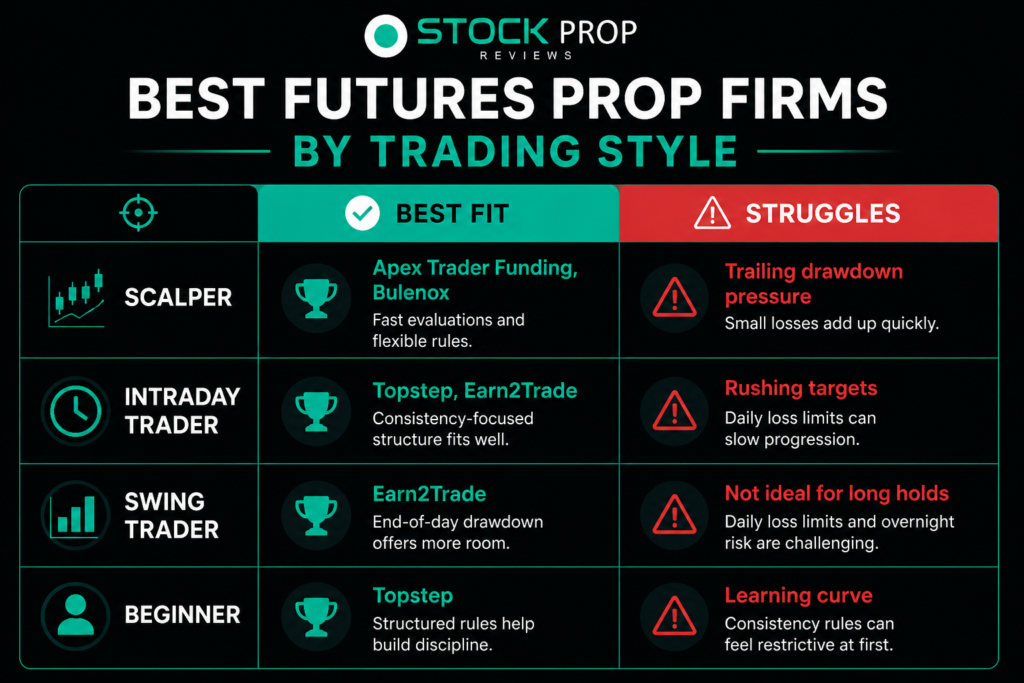
Strategy fit matters more than the firm
Most comparisons end with features. The truth is your trading style determines which firm works.
Scalping
Trailing drawdown can be a problem because more trades means a higher chance of hitting limits. Apex and Bulenox only work if risk per trade is tightly controlled.
Day trading
Topstep and Earn2Trade are usually a better fit because they reward consistency over speed.
Swing trading
This is not what futures prop firms are built for. Position holding is inconsistent with daily loss limits and drawdown restrictions.
New arrivals
Structured firms like Topstep control reckless behaviour but they don’t fix bad habits. Most new guys fail due to inconsistency not rules.
What most reviews don’t tell you
Passing is the easy part
A lot of traders pass the evaluation at least once. The real problem is to remain funded. “The rules are manageable when you’re evaluating but they become limiting under pressure.”
Drawdown shapes your decisions
Trailing drawdown forces you to take profit. Static drawdown is a waiting game. Neither one is better. They just show different weak points. .
Psychology is the real filter
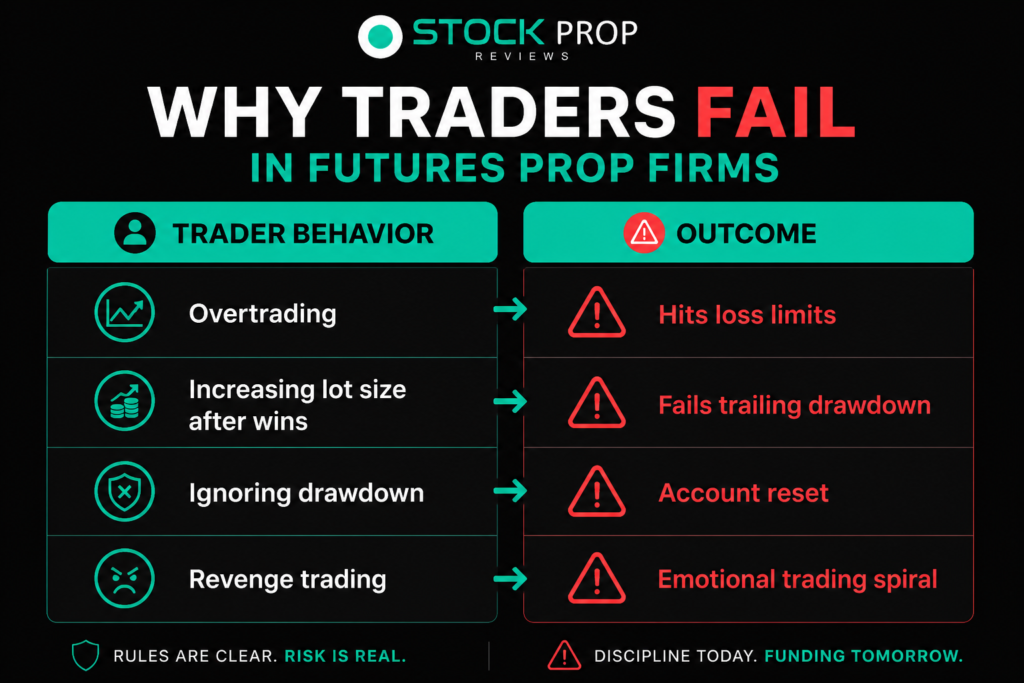
The same trader behaves differently after a win or a loss. That behaviour is amplified by prop firm rules.
A familiar pattern:
- Small victories lead to bigger positions.
- One loss wipes out progress
- Trader blames execution not rules
Real trading example
A trader passes a one step evaluation in a few days. Confidence is high. size of the position increases a bit.
A regular losing trade hits the trailing DD.
Account deleted.
The issue isn’t the company. It’s the speed of behaviour change after early success.
Common mistakes traders repeat
This is a pattern across all the firms. Different rules, same results.
Traders usually:
- Size increase after a winning streak
- Ignore how drawdown works
- Trade with no fixed risk on each trade
- Emphasis on survival not payout
These are not first-timer mistakes. Even experienced traders succumb to them under pressure.
TradeThePool as an alternative path
Equities are an alternative for those who feel constrained by futures volatility and tight drawdowns.
TradeThePool is a regulated stock prop trading firm with risk limits. For traders who prefer slower markets to futures firms, the structure may be attractive.
When customers buy via our TradeThePool link they get a discount of up to 10%.
It is not better, not worse, just a different environment, different constraints.
Choosing the best futures prop firm
There’s no one best choice. Each firm is constructed around a particular type of trader behaviour.
If you like flexibility you will probably choose trailing drawdown models.
If you like structure, static models will feel stabler.
It’s not about who will pay more or who will go faster. It is if your trading behaviour is according to the rules over time.
Most traders go wrong not because of the company. They fail because the rules bring out vulnerabilities they weren’t previously dealing with.
FAQs
What is the best all around futures prop firm?
There isn’t a best one. Topstep is all about structure; Apex is all about flexibility. It is how you trade that determines which is right.
Are one step evaluations better?
They go by faster but can often hurt discipline. “Two-step models tend to impose consistency.
What is the safest style of drawdown?
Static drawdown is easier to control since it is not moving. Trailing drawdown means more control after you have made profits.
Can Futures Prop Firms Be Good for Beginners?
Only when they are already under tight risk management. Most stories are gone quickly without that.
Are payout percentages important?
Less than people think. It’s not so much 80/90% split, it’s more survival and consistency.