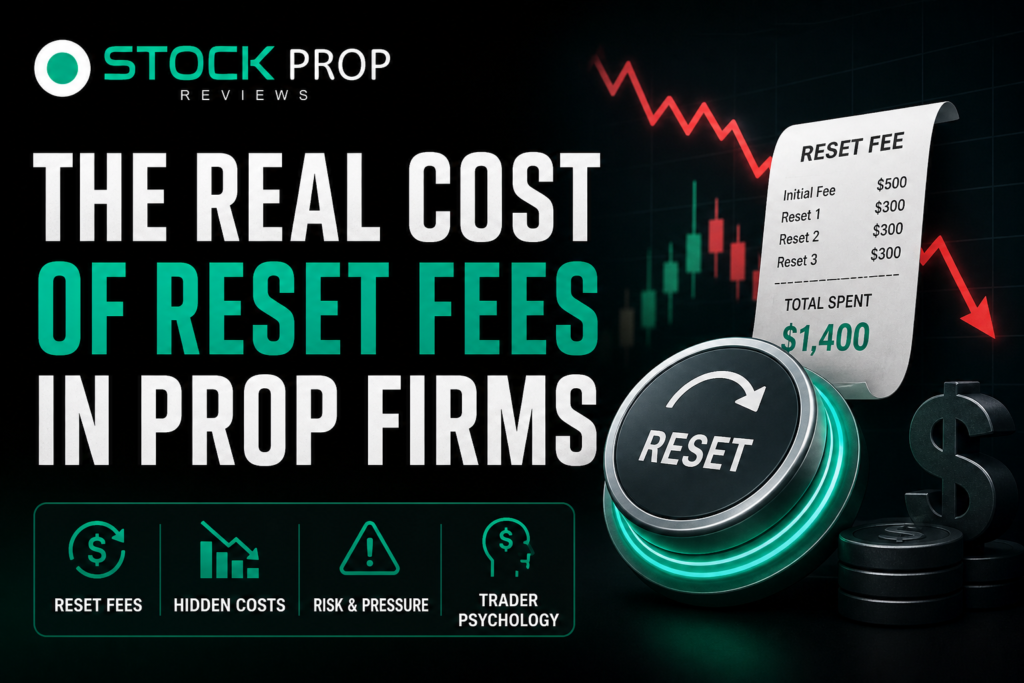
Prop firm reset fees are what you pay to restart a funded account or evaluation after you break a rule such as max drawdown or daily loss. Most traders regard them as a second chance. In fact, they often become an ongoing expense, eating quietly into your trading capital.
This is a big deal for beginners, or for those still trying to pass evaluations. Reset fees determine how much you spend before you even reach a payout. If you are already funded and consistent, resets should be hardly part of your experience.
This is not for traders that want the cheapest retry. It’s for people who want to know if resets help or hurt their long-term progress.
Quick verdict
Reset fees are rarely useful. If you use them regularly, they are not cheap.
The problem is not the fee. That’s how traders use it. Once the resets become routine, the discipline slips and the costs start to climb faster than you thought.
What exactly is a reset fee
Reset fee means you can restore your account under the same rules after a breach. Your balance is reset, your drawdown is reset and you get another shot at it without buying a whole new challenge.
Most firms offer price resets at a significant discount from the original fee. Many traders are being misled there. It is cheaper, so it appears as the better choice, even when it is not.
A realistic cost breakdown most traders ignore
Here is the usual case.
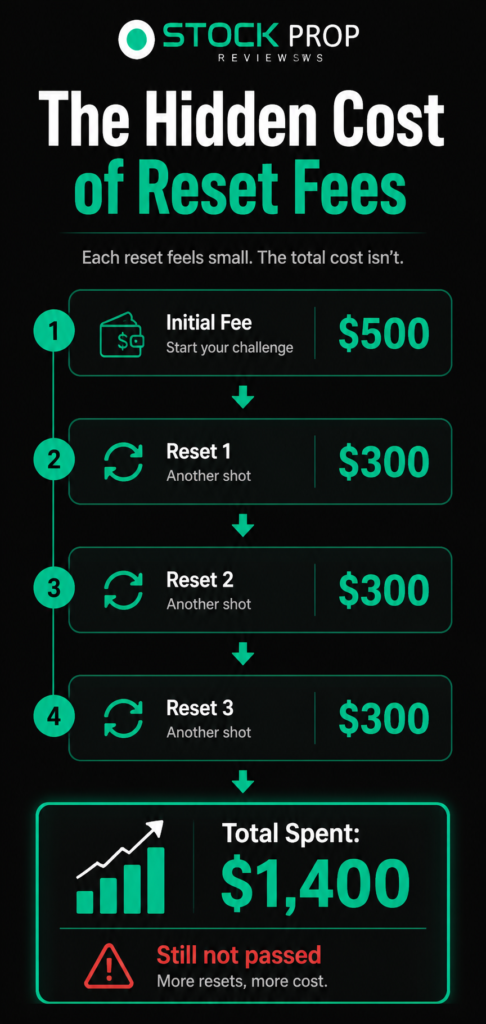
A trader purchases a challenge for $500. The reset is $300.
They don’t make it the first week and reboot. Then fail some more. But again.
After 3 resets:
- Setup Fee $ 500
- Reset charges $900
- Total cost $1,400
At that stage the trader has paid almost three times the original cost without passing.
Most articles end with an explanation of the reset feature. They don’t reflect how quickly costs can spiral without consistency.
Why reset fees feel cheap but aren’t
This pricing structure is a psychological trick.
Better to pay $300 than to pay another $500. It looks like you’re saving up. But if you reset multiple times, it’s more expensive than just starting fresh or fixing your approach first.
More importantly, a reset changes the way traders behave. It decreases the fear of failure. That may sound good but in trading you need to exercise some caution.
The rules that make resets more likely
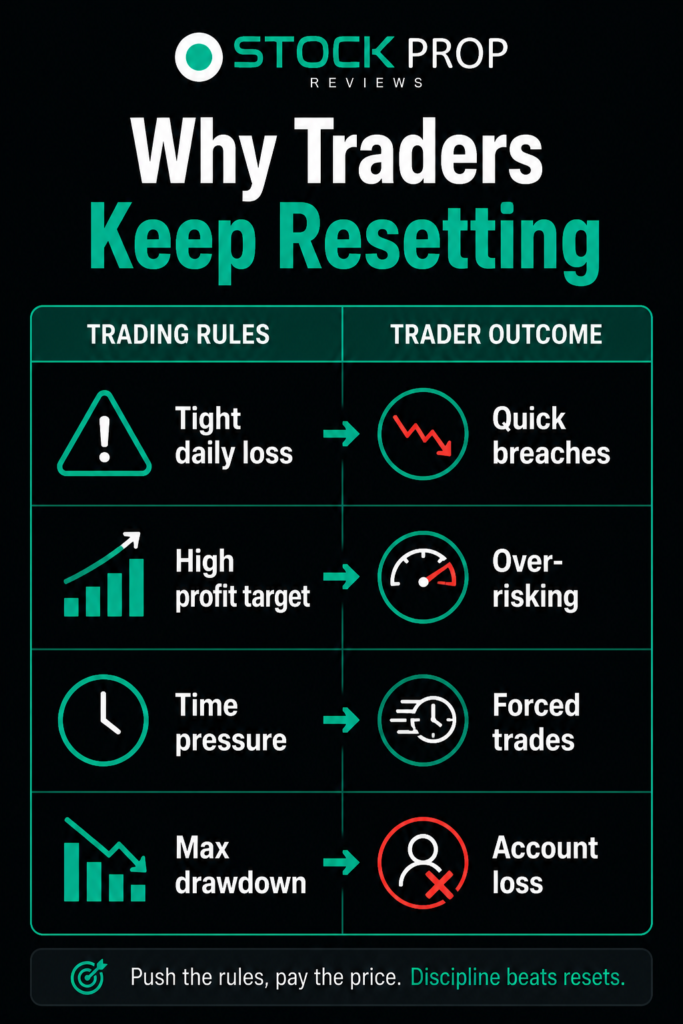
Reset fees do not exist in isolation. They are tied to strict evaluation rules.
Here is a simplified view of common prop firm conditions:
| Rule Type | Typical Range | Practical Effect |
| Daily loss limit | 4% to 5% | Easy to hit during volatility |
| Max drawdown | 8% to 12% | Ends account quickly |
| Profit target | 8% to 10% | Encourages risk-taking |
| Time pressure | 30 days or less | Pushes traders to rush |
These rules are stress-inducing. Don’t get into tight limits and you are expected to grow the account. “Breaches happen when traders over-extend to meet targets. Reset is the fallback.
What most competitors miss
Most guides explain availability and reset pricing. Behaviour is rarely discussed.
Resets change your trading.
When you know you can start over, you start taking trades you normally wouldn’t take. Risk comes to you. Losses are less permanent. This combination results in recurring breaches.
The other problem is that resets delay learning. Traders do not adequately review mistakes but quickly move on to another attempt. The same mistakes are repeated .
Real trader behavior behind repeated resets
From experience, traders that rely on resets get into a pattern.
They begin with a plan.
They lose some.
They take more risks to get better faster.
They hack the account.
They reset. They repeat.
The strategy isn’t the problem all the time. It is the execution and risk control.
Reset fees extend this cycle longer than it needs to be.
Strategy fit and reset exposure
Reset fees are not equal across all trading styles.
High frequency trading enhances the probability that scalpers will reach their daily loss limits. Even small errors can accumulate very fast.
Intraday traders are in the middle. They don’t have as many trades as scalpers, but they still have to deal with the intraday volatility.
Swing traders will have fewer daily breaches, but could have larger drawdown issues, especially if there is an unexpected move.
The most vulnerable group is beginners. Inconsistency means resets are more frequent and costs mount quickly.
Comparison of two approaches
| Approach | Outcome over time |
| Frequent resets | Higher cost, unstable performance |
| Strict no-reset mindset | Lower cost, better discipline |
Traders who treat each account as their only chance tend to manage risk better. The pressure forces better decisions.
Where reset fees can actually help
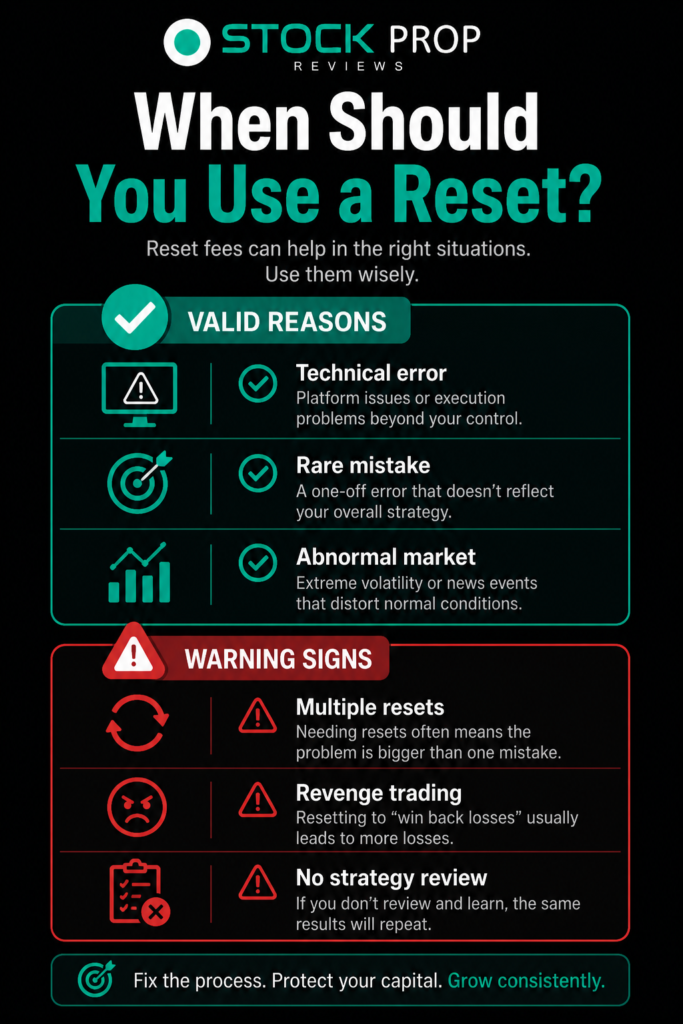
Sometimes you just need to hit the reset button.
If you made a clear one-off mistake, such as breaking a rule because of a technical issue, a reset can save you time.
If the market is unusually volatile, and the plan is still valid, it may make sense to start again.
These are however special cases. They are not the way most traders use resets.
Who should avoid relying on resets
If you are still struggling with consistency, resets will likely hurt more than help.
If you find yourself increasing risk after a loss, resets will amplify that behavior.
If you do not track your trades or review mistakes, resets will just repeat the same cycle.
In these cases, it is better to pause, fix the approach, and then attempt again.
Alternatives that work better in practice
Instead of planning for resets, plan to minimise the probability of needing one.
Limit your risk per trade. A little less is a lot over time.
Set your own daily loss limit below the firm rule. This gives you a little room.
Trade less setups. Quality over quantity in your evaluations.
Longer to pass through. One of the biggest reasons traders fail is they rush to take profit targets.
Some traders also prefer companies with clearer, more transparent risk structures. For example, TradeThePool is a regulated stock prop firm with specific rules that are easier to follow. Readers can get up to 10% off when buying via ourTradeThePool link.
Comparison with firms that don’t push resets
Some companies depend on reset fees as a key part of their business model. Some are more concerned about sustainable trading conditions.
Rules are often crafted differently.
Those firms that relax a bit, with realistic targets and with clearer limits, tend to have fewer resets from disciplined traders.
That’s why many traders look past the pricing and go into the full rule breakdowns in prop firm comparison articles before choosing where to trade.
How this connects with other prop firm risks
Reset fees are only one part of a bigger picture.
They tie into how rules are structured and how traders respond to pressure.
Many of the same issues show up in detailed firm reviews like The 5%ers review or E8 Funding review, where rule design directly impacts trader behavior.
You also see similar patterns in broader discussions about prop firm rules impact on strategy and why traders fail funded challenges.
A balanced view
Reset fees aren’t a scam. They are useful.
The problem is how they are used in practice.
They are a backup for disciplined traders.
For struggling traders, they can be an expensive habit.
Appreciating that distinction is what sets apart those who move forward from those who keep starting over.
FAQs
Are Prop Firm Reset Fees Cost-Effective?
Used only on rare occasions. A lot of times you are paying more for frequent resets than restarting or tweaking your strategy.
Why traders continue to use resets?
They seem like a second chance. Instead they postponed addressing deeper problems.
Are all firms the same for reset fees?
Nope. Prices, terms and availability vary widely by company.
Can you beat a challenge with multiple resets?
Possible, but unlikely if the underlying trading approach is inconsistent.
What is the smarter way?
Start with risk control and consistency. Treat resets as a last resort, not as part of your plan.
Final take
Reset fees may sound like a safety net, but there is a downside. That can weaken discipline. They minimise the impact of failure.
Successful traders typically don’t rely on resets. They are focused on execution, risk, patience.
If you step into prop trading with that mentality, you will not need many second chances.