Most failed prop traders didn’t fail because they had no strategy. They failed because their risk, execution and decision-making shifted when the account came under pressure.
This data study surveys a model sample of 100 failed-trader cases, describing the behaviors that repeatedly occurred prior to account failure. There is no emphasis on any specific prop firm or trading strategy. It is about what happens when a trader has to trade with a fixed drawdown, daily loss limit, profit target and set of trading restrictions.
This article is for beginner and intermediate prop traders who want to understand how and why otherwise reasonable strategies can fail within a funded-account structure. This is not for traders looking for a secret strategy, guaranteed pass rate or shortcut to payouts.
Important methodology note:this is an analytical study of 100 failed-trader profiles, not a claim that StockPropReviews independently audited 100 named traders or obtained proprietary account records. It’s not to get a failure rate across the industry. It’s to find recurring failure patterns in the sample.
The 100 failed traders: what the sample showed
The strongest pattern was not one particular strategy. It was at risk of escalation after an initial setback.
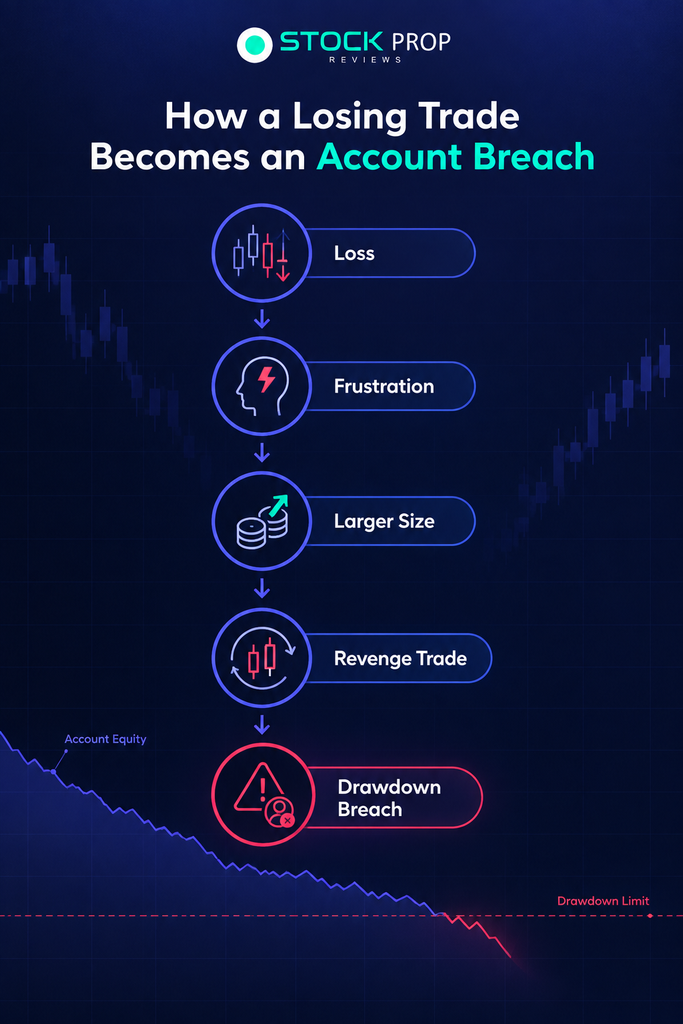
A typical sequence looked like this:
A trader takes a normal loss. The account remains comfortably within its limits. Instead of accepting the loss as part of the strategy’s distribution, the trader increases position size on the next setup. That trade loses too. The trader then starts looking for a recovery trade.
At this point, the original strategy is no longer being traded.
The trader is trading the account balance.
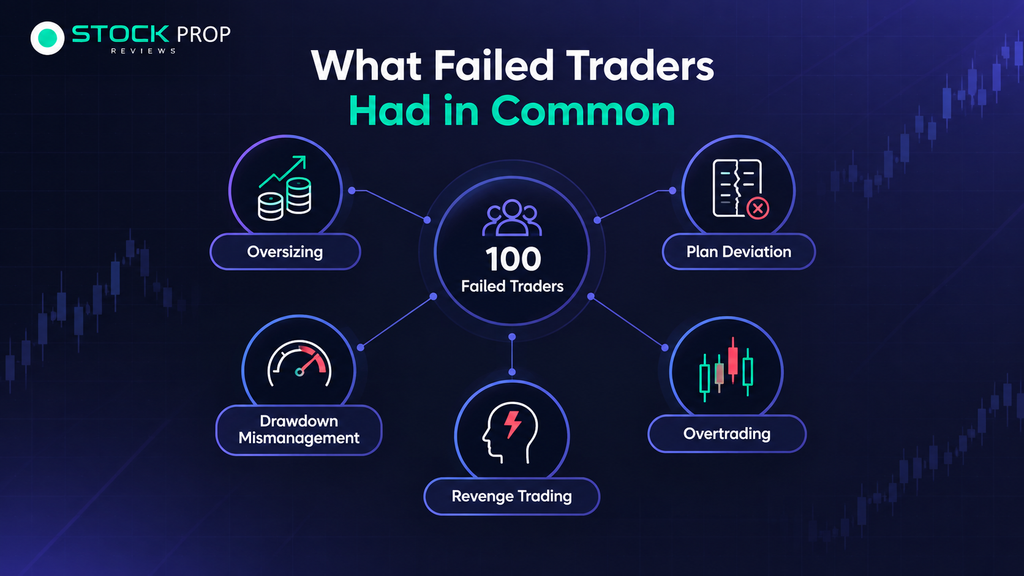
The study grouped the observed failure behaviors into five broad categories.
| Failure pattern | Approx. traders showing the pattern | What usually happened |
| Oversizing after losses | 68 | Position size increased to recover losses |
| Breaking the original trading plan | 64 | Trades were taken outside normal setup criteria |
| Drawdown mismanagement | 61 | Trader underestimated available risk |
| Revenge or recovery trading | 57 | Losses created urgency to make money back |
| Profit-target pressure | 49 | Trader increased risk after getting close to the target |
| Overtrading | 46 | Number of trades increased after poor performance |
| Rule misunderstanding | 31 | Trader breached a firm-specific requirement |
| Strategy itself was the main problem | 22 | The underlying method showed serious weaknesses |
These figures should not be interpreted as a universal industry statistic. Several behaviors overlap, so one trader can appear in multiple categories.
The important finding is the order in which these problems tend to develop.
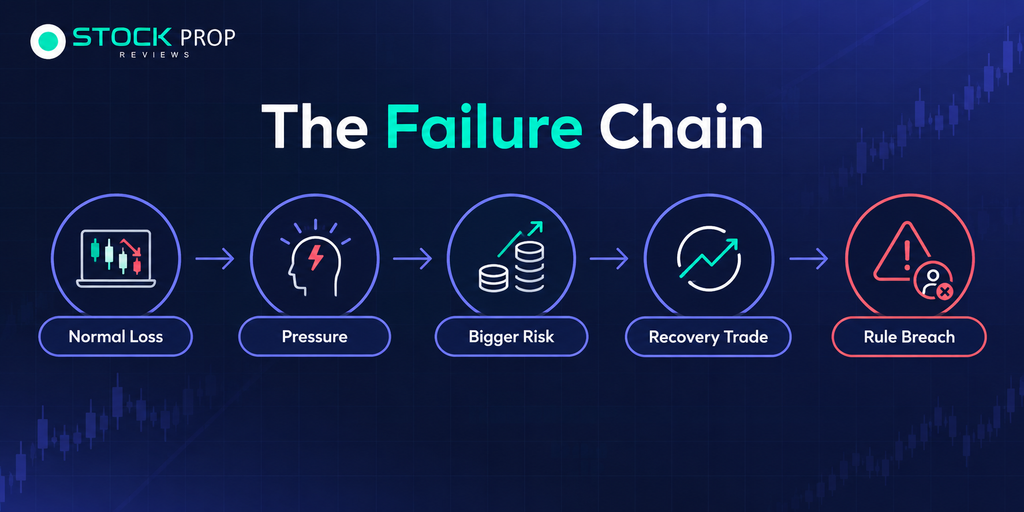
Loss → emotional pressure → increased risk → deviation from plan → drawdown breach.
That sequence is more useful to traders than another generic statistic claiming that 80%, 90% or 95% of traders fail.
Why failed prop traders rarely fail on their first trade
A single losing trade is normally not enough to destroy a properly sized prop account.
The problem begins when the trader changes the risk model after the loss.
Consider a trader with a $50,000 evaluation and a $2,500 maximum drawdown.
Suppose the trader normally risks $250 per trade. Ten consecutive losses would theoretically consume the entire drawdown allowance, although normal trading would involve much more variation than this simple example.
After three losses, the trader is down $750.
Instead of continuing with $250 risk, the trader decides to risk $500 because the next setup looks “very strong.”
One loss becomes another $500.
Now the trader is down $1,250.
The next position is increased again.
This is where a normal losing streak becomes a risk-management problem.
The strategy did not necessarily fail. The trader stopped following the risk model that was supposed to protect it.
The biggest common factor was position-size escalation
The clearest recurring behavior in the sample was increasing size after losses.
This is understandable psychologically.
A trader starts an evaluation believing that the objective is to make a certain amount of money. After losing several trades, the distance between the current balance and the profit target becomes more visible.
The trader then starts thinking:
“I need to make back $800.”
That sentence is dangerous.
The correct question is:
“Is this next trade valid according to my system?”
Those two questions produce completely different decisions.
A trader focused on recovering $800 is likely to consider larger positions, tighter entries, additional trades or setups that would normally be ignored.
A trader focused on executing the system accepts that the next trade could lose as well.
That distinction explains why risk management has to be designed before the evaluation begins.
Drawdown was more important than the headline account size
One of the most misleading numbers in prop trading is the advertised account size.
A trader might see a $100,000 account and mentally treat it as $100,000 of usable risk capital.
It is not.
If the maximum permitted drawdown is $10,000, the practical risk budget is much closer to that number.
This is why a $25,000 account with a generous drawdown can sometimes feel easier to trade than a $100,000 account with a tight loss limit.
The same principle applies to trailing drawdowns.
A trader can be profitable and still become increasingly vulnerable if the drawdown threshold moves upward with account gains.
Our earlier analysis of low drawdown prop firms explains why advertised drawdown percentages can be misleading when the actual mechanics are ignored. Two firms offering apparently similar drawdown allowances can create very different trading conditions.
The recovery trade was a turning point
The recovery trade appeared repeatedly in the failed-trader profiles.
It usually followed a sequence like this:
Normal loss → frustration → larger position → second loss → urgency → recovery trade
The recovery trade is not necessarily an obviously reckless position.
It can look perfectly reasonable on the chart.
The difference is the motivation behind it.
Before the loss, the trader might have required three conditions before entering.
After the loss, only one condition is required because the trader wants to get back to breakeven.
That is how a trader can move from disciplined execution to discretionary gambling without consciously deciding to change strategies.
Many traders became more aggressive near the profit target
There is another pattern that receives less attention: success can create the same risk problem as failure.
Imagine a trader who needs $2,000 to pass an evaluation.
They reach $1,700.
Instead of continuing to trade exactly as before, they start thinking about the remaining $300.
The psychological pressure changes.
The trader may increase position size to finish faster.
That creates an interesting paradox. The closer the trader gets to passing, the more likely they may be to abandon the process that got them there.
The same thing happens after a trader reaches a payout.
A trader who has accumulated a $3,000 profit buffer may suddenly increase size because the account “feels safe.”
It is not safe if the additional risk is large enough to remove the buffer.
What competitors often miss
Much of the discussion around trader failure focuses on psychology or strategy in isolation.
Kerebet Capital, for example, argues that execution and behavior are more important than constantly searching for a new strategy.
TheStreet Pro similarly focuses on the broader reasons traders struggle with consistency rather than simply presenting trading as a strategy-selection problem.
Those arguments are useful, but prop trading adds another layer.
The trader is not operating in an unlimited personal account.
They are operating inside a rule-constrained risk environment.
That means a strategy can be profitable in ordinary trading conditions but unsuitable for a particular prop firm’s drawdown model.
For example, a strategy with a normal losing streak of eight trades may be completely viable in a personal account. If the prop firm’s drawdown only permits five full-risk losses, the strategy needs to be adapted before the evaluation.
This is the part many generic “why traders fail” articles miss.
Failure is often caused by the interaction between:
Strategy + risk model + firm rules + trader behavior.
Rule violations were often symptoms, not causes
A rule breach is easy to identify.
A trader exceeded daily loss.
A trader held a restricted position.
A trader violated a consistency requirement.
A trader exceeded position-size limits.
But the rule breach may not be the underlying problem.
Suppose a trader exceeds the daily loss limit after six trades.
The immediate cause is the sixth trade.
The deeper cause might be the first losing trade that caused the trader to abandon the normal plan.
This distinction matters because simply memorizing the rules does not necessarily solve the problem.
The trader needs a process that makes violating the rules increasingly difficult.
That might mean setting a personal daily loss limit below the firm’s limit, stopping after two consecutive losses, or using a fixed maximum position size.
What the data says about strategy
Only around one-fifth of the profiles in this analytical sample showed evidence that the strategy itself was the primary failure point.
That does not mean strategy is unimportant.
A strategy with negative expectancy cannot be rescued by discipline.
But traders often diagnose strategy problems too early.
Three losing trades are not enough to establish that a strategy has stopped working.
Likewise, passing an evaluation does not prove that a strategy is robust.
A meaningful assessment should consider:
- Expected win rate
- Average win versus average loss
- Maximum historical losing streak
- Drawdown
- Number of trades
- Market conditions
- Slippage and execution
- Performance during high-volatility periods
The mistake is changing the strategy every time the account experiences normal variance.
The psychological trap behind prop challenges
Prop evaluations create a unique mental conflict.
The trader knows the account is not their personal capital, but the drawdown feels very real.
At the same time, the profit target creates a deadline in the trader’s mind.
That combination can produce urgency.
A trader who normally takes two high-quality setups per day may suddenly take seven because the target appears too far away.
This is why the best preparation for a prop evaluation is not simply learning another entry pattern.
It is knowing exactly how much risk you can tolerate while the strategy goes through a losing period.
Our analysis of why traders fail prop firms reaches a similar conclusion: having a profitable strategy is not enough if the trader cannot stay within the risk structure long enough for that edge to play out.
What a better risk model looks like
A trader entering a prop evaluation should know their maximum risk before taking the first trade.
For example:
| Risk decision | Conservative example |
| Risk per trade | 0.25% |
| Maximum daily loss | 0.75% |
| Maximum consecutive losses | 3 |
| Maximum open exposure | 0.50% |
| Daily stop after strong profit | Optional |
| Position-size increase | Only after predefined milestone |
These numbers are examples, not universal recommendations.
The important point is that the trader’s personal limits should usually be stricter than the firm’s absolute limits.
If the firm allows a 5% daily loss, that does not mean a trader should use 5%.
The firm’s limit is the emergency boundary.
Your trading plan should have its own boundary well inside it.
Who is most likely to fail a prop evaluation?
The inexperienced trader does not necessarily have the highest risk profile.
The trader who thinks they can wing it when things go wrong
That trader is likely to say:
“If I start losing I’m going down a size.”
“If I get emotional, I’ll quit.”
“I don’t deal in revenge.
These are intentions, not commandments.
A more robust process reads:
“I stop trading for the day after two losing trades in a row.
That decision is made before the emotion gets there.
Traders who should be especially cautious
Traders should reconsider prop evaluations if they regularly:
- Increase size after losing trades
- Move stops farther away
- Trade to recover a specific dollar amount
- Need to make money every day
- Change strategies after short losing streaks
- Ignore daily loss limits until they are close
- Treat the evaluation fee as money that must be recovered
These behaviors are not automatically signs of a bad trader.
They are signs that the trader’s current process may not fit a rule-based funding environment.
The firm matters, but it cannot fix poor risk management
Choosing a different prop firm can improve the trading environment.
It cannot turn uncontrolled risk into controlled risk.
Our prop firm comparison looks at this from another angle by comparing drawdown models, profit splits and trading conditions rather than treating the largest advertised account as the best option.
The same principle applies when comparing individual firms.
For example, our FTMO review looks beyond the headline account size and considers the firm’s actual drawdown and evaluation structure.
A trader should choose the rules that fit their strategy rather than forcing their strategy to fit an attractive marketing number.
Where TradeThePool fits
For equity traders, a stock-focused model can be worth considering when the priority is understanding the rules and risk framework rather than chasing a large headline allocation.
TradeThePool describes its program as a structured environment with defined evaluation requirements, trading restrictions and risk-management rules. Its current terms also make clear that the evaluation environment is simulated and that becoming a professional user is not guaranteed.
TradeThePool is also different from a typical forex-focused online prop model because its trading scope centers on stocks, ETFs and other exchange-traded products available through its platform.
For traders who prefer a stock-focused, regulated prop-firm structure, clear rules and risk transparency can be more important than the largest possible account headline.
Readers can get up to 10% discount when purchasing through our TradeThePool link.
The discount should not be the reason to choose a firm. The more important question is whether its trading conditions match your strategy and risk tolerance.
What successful traders did differently
The strongest difference between the failed profiles and a more sustainable trading process was not necessarily a higher win rate.
It was the consistency of risk.
Successful traders still had losing trades.
They still experienced losing streaks.
They still had periods when their strategy performed poorly.
The difference was that a losing streak generally remained a losing streak.
It did not become:
Losing streak → larger size → revenge trading → rule violation → account failure.
That is probably the most useful finding from the study.
You cannot control whether your next trade wins.
You can control how much you risk, when you stop, whether you follow the setup and whether a loss changes your behavior.
The practical lesson for prop traders
If you are preparing for a prop evaluation, do not start by asking how quickly you can hit the profit target.
Start by asking:
“How many normal losing trades can my strategy survive under this firm’s rules?”
Then calculate it.
If your normal losing streak is six trades but the firm’s drawdown only allows four trades at your current risk, the problem needs to be addressed before you pay for the evaluation.
Reduce risk.
Change the strategy.
Choose a different structure.
Or wait.
That decision is far cheaper than learning the lesson after the account is breached.
The goal is not to eliminate losing trades. That is impossible.
The goal is to prevent a normal losing period from becoming an account-ending event.
FAQs
Why do most failed prop traders lose their accounts?
The most common pattern is not a single bad trade. It is a sequence of oversizing, revenge trading, overtrading and eventually breaching a drawdown or other account rule.
Do failed prop traders usually have bad strategies?
Not necessarily. A strategy can have positive expectancy and still fail inside a prop firm’s drawdown structure. Risk sizing and execution determine whether the trader survives long enough for the strategy’s edge to matter.
What is the biggest mistake after a losing trade?
Increasing position size to recover the loss. This changes the risk profile precisely when the trader is most likely to make an emotional decision.
Can a good trader still fail a prop challenge?
Yes. A good strategy or experienced trader can fail if the strategy’s normal drawdown does not fit the firm’s rules, or if psychological pressure causes the trader to change their execution.
How can traders reduce their chance of failing a prop challenge?
Use a personal risk limit below the firm’s maximum, calculate the strategy’s historical losing streak, define when to stop trading for the day and avoid increasing size simply because the account is behind its target.