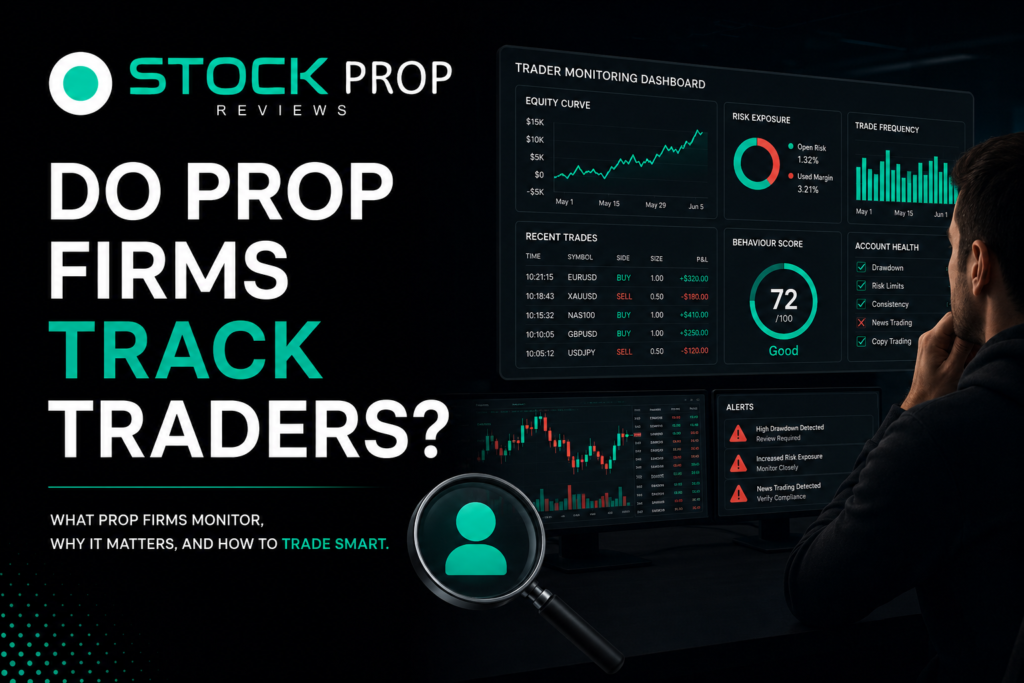
Most traders believe that prop firms care about only two things: hitting the profit target and following the drawdown rules.
that is one part of the story.
The truth is, prop firms are far more cautious about monitoring traders than many novices think. They keep an eye on risk patterns, trade execution, consistency, account behaviour and, in some cases, how traders perform under pressure. This is especially true during payout reviews or when a trader gets funded.
Some traders think this is unfair. For others it is just normal risk management. Somewhere in between is the truth.
This article is for traders who are thinking about prop firms, traders who are already funded, and anyone who is confused about why firms review accounts so aggressively. This is not written for the loophole and ways around the rules crowd.
What Does “Prop Firms Track Traders” Actually Mean?
When traders hear that prop firms track traders, they often imagine firms secretly watching every move looking for excuses to deny payouts.
That is not usually how it works.
Most prop firms monitor trading data to identify risky or suspicious behaviour. They want to know whether a trader is operating with a repeatable process or simply gambling to pass an evaluation.
That monitoring can include:
- Changes in position sizing
- Trading on major news events 15.
- Rapid changes of strategy
- Linked trades between accounts
- Copy trading activity
- Unrealistic profit uplifts
- Revenge trading patterns
A trader with a consistent record and a measured risk profile will generally be less noticeable than a trader with a 12% return on a single day with large positions.
Which surprises a lot of newer traders because social media is usually just about challenge passes and payout screenshots.
Why Prop Firms Monitor Trader Behaviour
Most firms are not doing this out of paranoia. They are protecting their business model.
A prop firm survives through risk management. If too many traders behave recklessly, payout exposure becomes difficult to control.
That is why firms pay attention to how profits are made, not just the final number.
A trader who slowly builds gains over several weeks usually looks safer than someone who passes a challenge through one oversized trade.
This becomes even more important after funding. Evaluation accounts are one thing. Funded accounts create ongoing risk for the firm.
Experienced traders understand this quickly. Newer traders often do not realise it until they experience a delayed payout review or account warning.
How Prop Firms Actually Track Traders
Most firms use automated systems first. If something unusual appears, a manual review may follow.
The monitoring itself is usually straightforward.
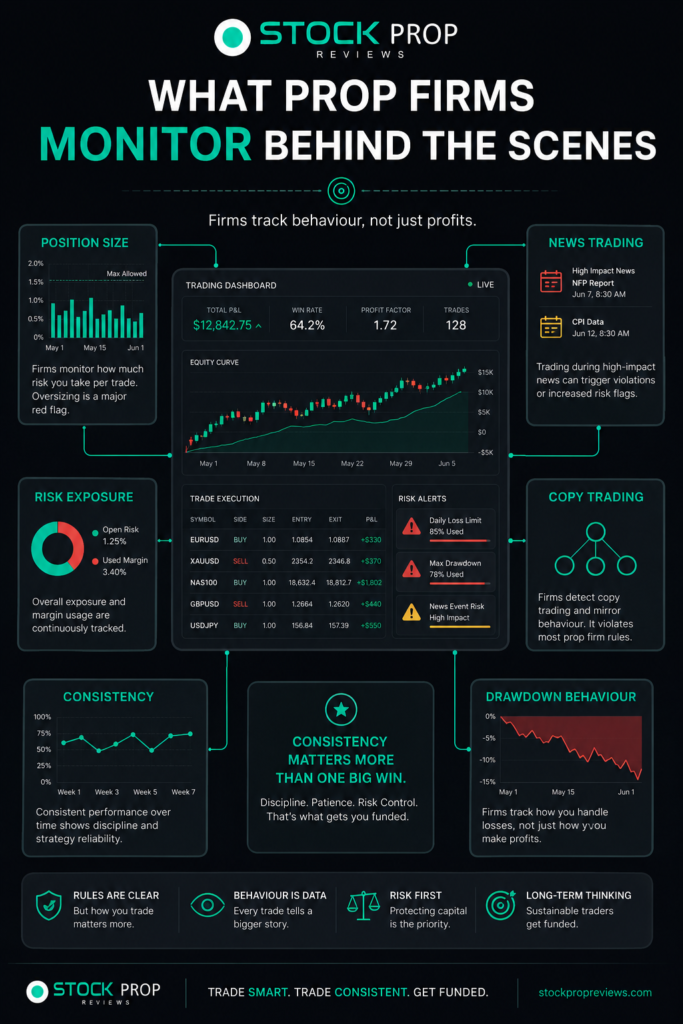
Position Size and Risk Exposure
One of the easiest things for firms to track is lot size behaviour.
For example, a trader may risk 0.5% per trade for two weeks, then suddenly risk 5% trying to recover losses or hit a payout target faster.
That type of behaviour stands out immediately.
Large swings in risk often signal emotional trading rather than structured execution.
Many traders fail funded accounts this way. They trade normally while comfortable, then abandon discipline after a drawdown.
Risk teams see this pattern constantly.
News Trading Activity
Some companies offer news trading at will. Some prohibit it altogether or impose restrictions on high-impact events.
The thing is, a lot of traders don’t read the rules carefully.
Sometimes a trader will open a position just seconds before a major economic release, as the spreads might look temporarily attractive. From the firm’s point of view this behaviour could introduce execution risk or expose flaws in pricing systems.
This is one of the reasons why payout disputes are so common online. Sometimes the traders think they did what was right, but the firm sees the activity differently.
The details matter more than people realise.
Copy Trading and Correlated Accounts
This has become a major focus across the industry.
Firms now monitor for identical trades placed across multiple accounts at nearly the same time. That does not automatically mean cheating, but it can trigger reviews.
Common red flags include:
- Matching entries and exits
- Same stop-loss placement
- Identical timing patterns
- Multiple accounts using the same IP address
- Hedged positions across accounts
This affects traders using public signal groups more than they realise.
Two legitimate traders following the same signals can still appear suspicious if their activity looks too similar.
What Most Competitor Articles Miss
A lot of articles make prop firms sound either completely innocent or completely predatory.
Neither view is accurate.
The reality is more practical.
Most firms are trying to filter out behaviour they consider unsustainable. At the same time, some firms absolutely use broad rule interpretations during payout reviews.
Both things can be true.
Another thing competitors rarely explain is that not all firms monitor traders equally.
Some firms care heavily about consistency metrics. Others mainly focus on obvious rule violations. A few barely review accounts until payout requests arrive.
That is why trader experiences vary so much between firms.
One trader may receive payouts smoothly for months while another faces repeated reviews trading almost the same strategy elsewhere.
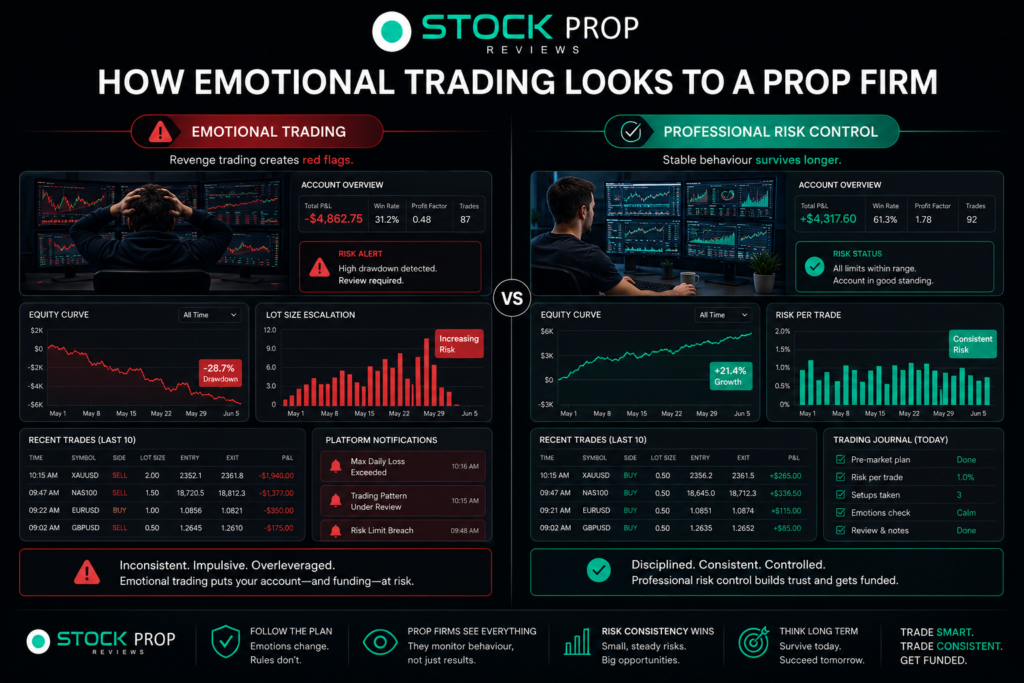
Do Prop Firms Track Emotional Trading?
Not directly, but emotional trading leaves visible patterns.
Risk teams can usually spot behaviour linked to panic, greed, or frustration.
A few common examples:
| Behaviour | What It Suggests |
| Doubling lot size after losses | Revenge trading |
| Huge profit in one trade | Gambling behaviour |
| Random strategy changes | Lack of discipline |
| Excessive overtrading | Emotional decision-making |
| Holding losses too long | Poor risk management |
This matters because prop firms are not just looking for profitable traders. They are looking for traders who can survive consistently.
A trader with controlled returns over six months is usually more valuable than someone producing extreme gains followed by account blowups.
Why Some Traders Get Flagged Before Payouts
This is usually where the frustration begins.
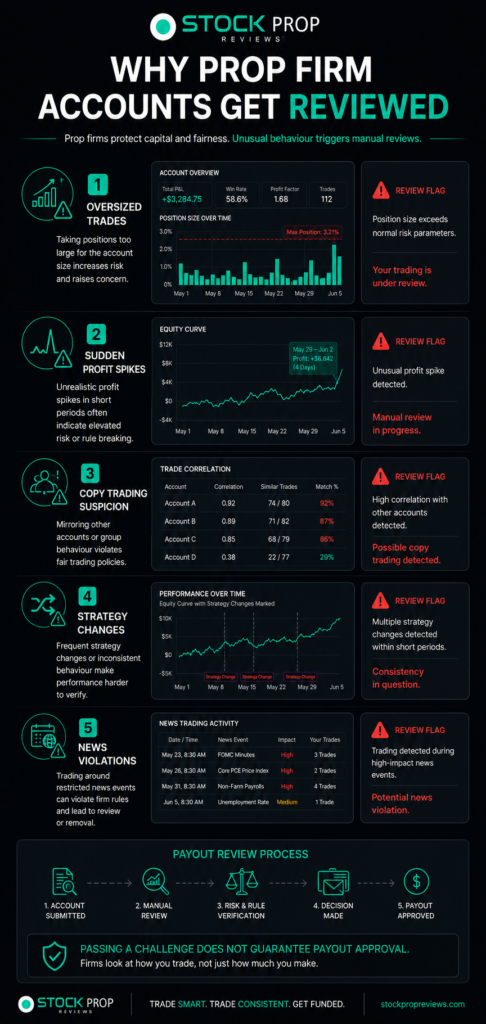
A trader passes the challenge follows the visible rules then all of a sudden he’s under account review before payout.
Sometimes the review is warranted. Sometimes the company’s communication is poor.
Typical triggers include:
- Very aggressive trading.
- Big profits on each trade
- Copy trading suspicions
- Timing of strange execution .
- Funding changes strategy
- Linked account activity
One mistake traders make is thinking that if they pass an evaluation, they will get smooth payouts later.
In a lot of companies, the real scrutiny starts when profit kicks in.
The Difference Between Good Risk and Gambling
This is where experienced traders think differently from beginners.
A beginner often focuses on passing quickly.
An experienced trader focuses on staying funded.
Those are completely different mindsets.
For example, risking 4% on one trade might help a trader pass an evaluation faster. But that same behaviour usually becomes dangerous over time.
Most traders who lose funded accounts do not fail because their strategy stopped working. They fail because their risk behaviour changes under pressure.
That is something prop firms watch closely.
Are Some Prop Firms More Strict Than Others?
Definitely.
Some firms aggressively monitor behaviour and manually review payouts. Others operate with looser oversight.
This is why researching payout experiences matters more than flashy marketing.
Scalpers, high-frequency traders, and news traders usually need to pay closer attention to rule enforcement than swing traders.
Futures prop firms also tend to approach risk differently from forex CFD firms.
There is no perfect model for everyone. The important part is understanding how a firm interprets risk before buying a challenge.
If you are comparing firms, it helps to read both payout reviews and articles discussing firms with strict consistency rules versus firms offering more trading flexibility.
Common Mistakes Traders Make
Most problems begin with impatience.
A trader starts off with a solid plan, takes a few losses and then begins to force trades to recover quicker.
That usually means:
- Big positions
- Breaking the uniformity
- Emotional journal entries
- Disregarding news restrictions
- Overtrading low quality setups
Ironically, the traders who last the longest at prop firms tend to be the least aggressive.
They have smaller returns on their social media posts but their accounts last longer.
That matters more in the long term.
TradeThePool and Transparent Risk Rules
Some traders like firms with clearer risk structures as there is less confusion around expectations.
TradeThePool is often cited by stock traders as an example of a more transparent way to manage risk and account rules.
TradeThePool is a regulated stock prop firm, with an emphasis on consistency and structured risk management, rather than the unrealistic marketing hype.
Readers can receive up to 10% discount when purchasing via our TradeThePool link.
But that doesn’t mean it’s for everyone. Fast moving scalpers and aggressive gain seeking traders may prefer different models. But traders who value clear rules tend to prefer firms with more transparent enforcement.
What Traders Should Take Away From This
Most prop firms are not secretly trying to trap profitable traders.
At the same time, traders should stop assuming that hitting the profit target is the only thing that matters.
How profits are made matters too.
The traders who usually survive longest are the ones who keep their behaviour stable whether they are winning or losing.
They do not suddenly double risk after a bad day. They do not change strategies every week. They treat evaluations the same way they would treat a live personal account.
That approach may look slower, but it tends to last longer.
FAQs
Do Prop Firms Follow Up With Traders After Funding?
Yes Most firms still monitor risk behaviour after traders are funded, especially before approving payouts.
Can prop firms catch copy trading?
That’s often true. Firms can monitor matching trades, execution timing, IP addresses and correlated account activity.
What makes consistency important to firms?
In general, the more consistent a trader is, the less risky he or she is. Profit volatility is often an indicator of unstable trading behaviour.
Do successful traders still fail reviews?
Yes I do. Even successful traders can break behavioural or risk rules.
Are payout reviews frequent in prop trading?
Yes. Many firms manually review funded accounts before paying out, particularly if there is odd or overly aggressive trading activity.