Some traders that hedge aren’t trying to game prop firm rules.
Hedging is simply part of exposure management for many experienced forex traders. A trader can hedge USD risk by hedging correlated pairs, partially hedging positions before big news releases, or hedging swing trades in uncertain sessions.
“The problem is that a lot of companies talk about flexibility around hedging, but then they try to restrict how far traders can go. Some allow direct hedges in a single account but prohibit opposing positions across multiple accounts. Others technically allow hedging, but come down hard on traders who use recovery systems, grid structures or excessive averaging.
That distinction matters more than most comparison articles explain it.
This guide breaks down the best prop firms that allow hedging, where traders commonly run into trouble, and which firms actually fit different trading styles.
It is mainly written for forex traders, swing traders and funded traders who already use structured risk management. Most serious firms will probably make life hard for traders trying to get around drawdown rules with opposite accounts long term.
What Hedging Really Means in Prop Trading
Simply put, hedging is about reducing exposure, not increasing it.
A trader who is long EUR/USD might go short GBP/USD during a volatile session since both pairs have similar dollar exposure. A trader might also balance index positions with gold or safe-haven currencies to reduce portfolio risk.
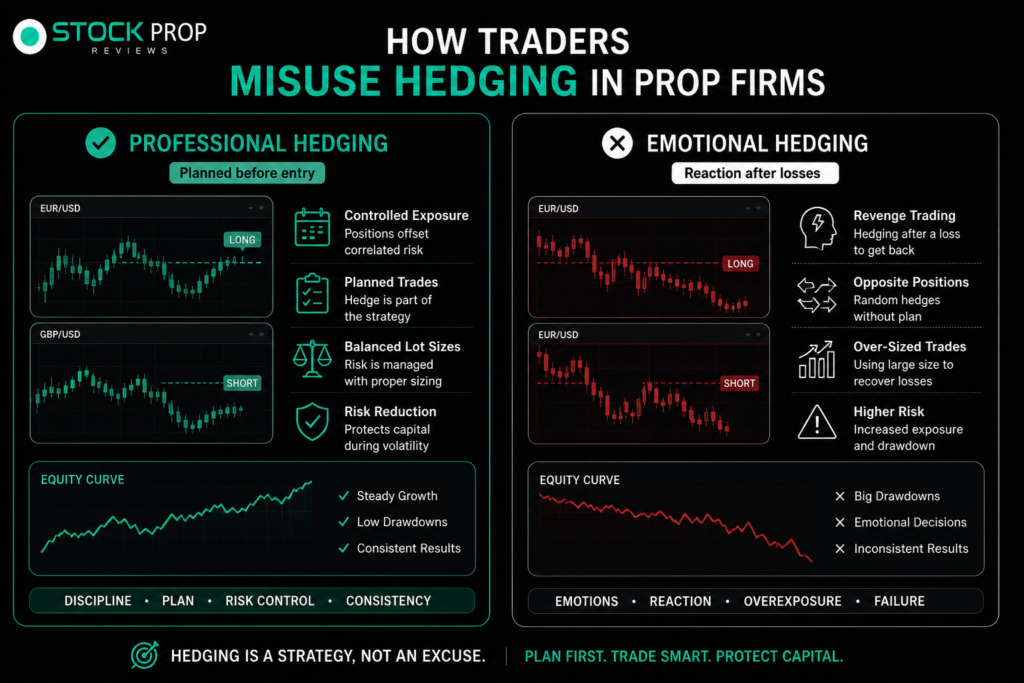
This is very different from panic hedging.
Many retail traders open opposite positions when a trade goes wrong and call it risk management. In practice they often just postpone the loss while adding complexity and spreading costs.
Most prop firms can tell the difference just in time.
The companies that are serious about hedging tend to expect traders to deal with risk professionally anyway. If the exposure becomes irregular or appears to be rule avoidance, payout reviews are much more rigorous.
Best Prop Firms That Allow Hedging Compared
| Firm | Hedging Allowed | Drawdown Style | Best For | Main Weakness |
| FTMO | Yes | Static | Swing and discretionary traders | Cross-account restrictions |
| Funding Pips | Yes | Static | Intraday traders | Aggressive systems monitored |
| The 5%ers | Yes | Relative | Long-term traders | Slower scaling |
| FundedNext | Yes | Mixed models | Multi-style traders | Rules vary by account |
| TradeThePool | Portfolio hedging | Equity-based | Stock traders | Not forex-focused |
| E8 Markets | Yes | Static | Scalpers and hybrids | Consistency reviews |
FTMO
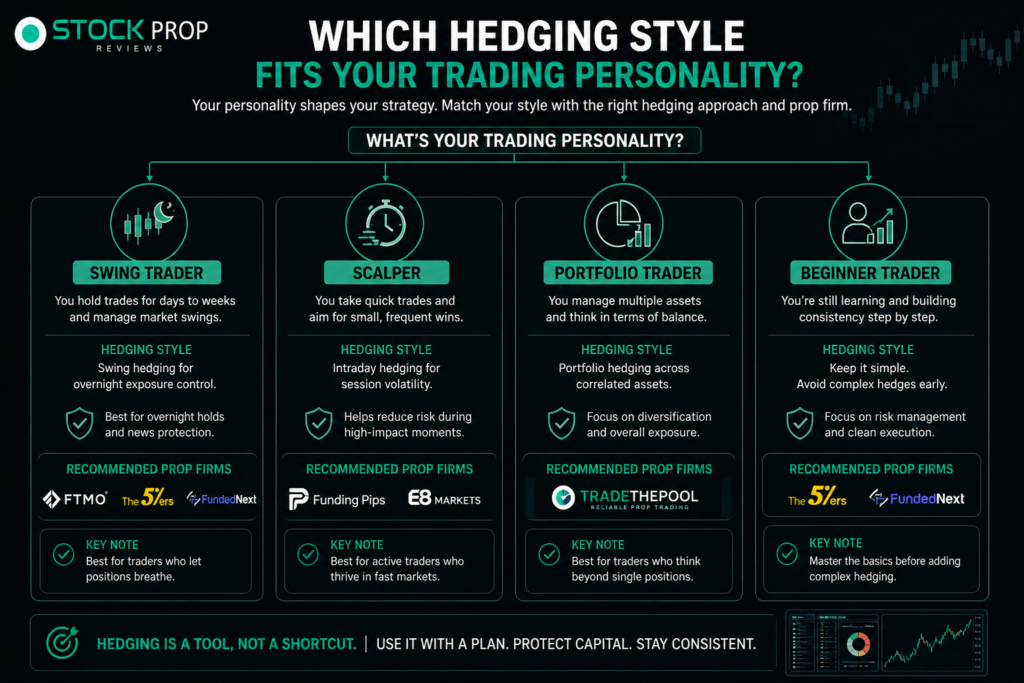
FTMO remains one of the more reliable firms for traders using hedging in a controlled way.
The rules themselves are straightforward. Traders can hedge within the same account, hold positions overnight on certain models, and manage correlated exposure without much friction. The environment suits traders who already have structured execution habits.
Where problems start is cross-account behaviour.
Some traders try to hedge separate funded accounts against each other to reduce the chance of failure. FTMO has become increasingly strict around that kind of activity, especially when patterns suggest traders are artificially managing evaluation risk instead of trading naturally.
That part is rarely explained properly in competitor articles.
A trader can technically follow trade rules while still attracting compliance attention if the overall behaviour looks engineered rather than genuine.
FTMO also reveals a common misconception surrounding hedging itself. Many traders assume that taking opposite positions automatically cuts risk. Sometimes they do Sometimes they are just hiding the exposure temporarily as losses continue to pile up under the surface.
That can be dangerous in news events, when correlations suddenly break down.
FTMO still suits disciplined swing traders well. For traders employing martingale-type recovery hedging it generally turns into a difficult environment very quickly.
If you’re a model-evaluating trader, you may also want to review our breakdown of overall drawdown prop firm rules, because drawdown structure can be just as important as hedging flexibility.
Funding Pips
Funding Pips has become popular partly because traders feel less restricted during active market sessions.
Scalpers and intraday traders tend to like the execution flexibility, especially traders managing multiple forex pairs during London and New York overlap hours.
The firm does allow hedging, but there is an important detail many traders overlook.
Allowing hedging does not mean allowing uncontrolled exposure.
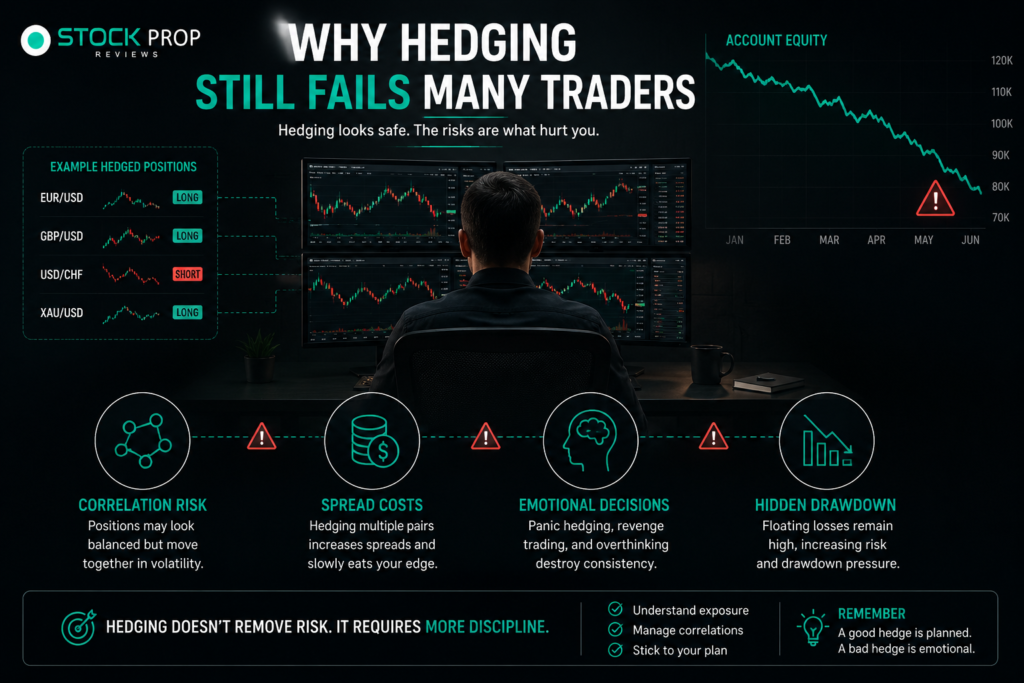
A trader long EUR/USD, long GBP/USD, and short USD/CHF may believe the account is balanced. In reality, the portfolio still carries heavy USD concentration. During high-impact news, those positions can move against each other unpredictably and create much larger equity swings than expected.
This is one reason many funded traders fail even while believing they are trading “safe.”
The problem is not always overleveraging. Sometimes it is misunderstanding correlation.
Funding Pips generally suits traders who already understand exposure management and want more freedom around execution style. It is less suitable for traders using aggressive hedge grids or recovery systems after losses.
If you are comparing flexibility between firms, our FTMO vs Funding Pips comparison covers how the two firms differ under pressure rather than just on paper.
The 5%ers
The 5%ers takes a very different approach from firms built around fast challenge passes.
The structure is slower, more conservative, and generally better suited to traders who think in terms of long-term consistency rather than quick payouts.
For swing traders using hedging properly, that can actually be a major advantage.
The 5%ers model naturally fits with incremental exposure balancing and overall portfolio volatility reduction of positions held across sessions. You don’t need to trade 24 hours a day to meet aggressive targets. .
But many traders underestimate the psychological challenge of slower-growth firms.
The real danger is usually impatience, after several weeks of steady progress. Traders get too big, too fast, force setups, or layer hedges emotionally after a losing streak.
This is where many accounts go wrong.
The 5%ers is best for traders who already understand that prop trading is mostly survival. Traders looking for fast scaling or very aggressive returns tend to get impatient with the speed.
In our detailed The 5%ers review we explain why many experienced traders prefer slower models after blowing multiple fast-evaluation accounts elsewhere.
FundedNext
FundedNext is flexible but traders need to be aware of rules specific to their account.
One area that new traders often get tripped up on. They read a generic policy page, assume all models are the same, and only later discover the differences on payouts or account reviews.
The firm does allow hedging on many account types and is quite good for discretionary traders who combine swing and intraday trading.
What makes FundedNext appealing is variety. Traders can usually find an account structure matching their style rather than forcing their strategy into one rigid framework.
At the same time, flexibility can create confusion.
The more complicated a trader’s system becomes, the harder emotional discipline becomes during drawdown periods. Some traders eventually end up managing multiple partially offsetting positions with no clear idea of actual portfolio exposure.
That is not really hedging anymore. It becomes emotional trade management disguised as strategy.
FundedNext generally suits adaptable traders with already-defined risk systems. Traders still experimenting with unstable execution often struggle because the flexibility exposes weaknesses rather than hiding them.
TradeThePool
TradeThePool deserves a mention on its own as it has a different take on risk than most of the forex focused prop firms.
Traders hedge their exposure via stock picking, sector balancing and portfolio construction rather than direct forex hedging. For the experienced traders this often feels more like real-world prop trading than just opening opposite forex positions.
This is one reason some traders move toward stock prop firms after years in CFDs.
The focus shifts from short-term recovery tactics toward broader exposure management.
TradeThePool is also relatively transparent about risk expectations and account structure compared with many newer firms entering the industry. The rules are usually clearer, which reduces confusion around what is actually permitted.
That does not make it easier.
Stock trading introduces its own challenges through earnings volatility, sector rotation, and sudden market sentiment shifts. Traders who struggle emotionally with overnight exposure may still find the environment difficult.
Readers can get up to 10% discount when purchasing through our TradeThePool link.
E8 Markets
E8 Markets is somewhere between flexible and structured.
The company attracts traders who want modern account models with not very restrictive execution rules. Hedging is generally permitted and scalpers usually find the environment workable.
The hidden problem is monitoring for consistency.
Technically, a trader can follow all the published rules, but can still attract attention by suddenly increasing lot sizes, showing unusual opposite-account behaviour or highly irregular risk patterns.
What a lot of traders get wrong about funded accounts in general.
Passing a challenge does not mean the evaluation process is truly over. Most firms continue monitoring behaviour after funding, especially if trading patterns suddenly change around payout periods.
E8 can work well for disciplined traders with stable execution. Traders constantly shifting strategies or using emotional recovery hedging usually struggle eventually.
What Most Competitors Miss About Hedging
Most papers use hedging as a feature-list item.
But real-life trading is more complex than that.
The main question is not if a company allows hedging. The real question is whether the trader gets the exposure?
Many traders believe that hedging automatically reduces risk because the positions cancel each other to some extent. Sometimes it works. Other times, traders unintentionally increase spread costs, decision fatigue and complexity, while still having concentrated market exposure.
Professional traders usually have a plan in mind when they enter trades and hedge accordingly.
Panic and struggling traders often hedge.
That difference is more important than the prop firm itself.
Should Beginners Use Hedging?
Usually not at the start.
Most newer traders get better faster by learning basic execution first:
- Position sizing
- stop position
- Discipline of session
- Reward/risk management
Hedging adds another layer of complexity before those fundamentals flower fully.
If you open opposite positions without experience, you will tend to emotionally cling to losing trades instead of cutting your losses early. Over time this creates larger drawdowns and inconsistent habits of execution.
Most of the time, funded traders who are experienced simplify their systems, not complicate them.
This will be a constant occurrence that will surprise new traders.
FAQs
Which prop firms permit hedging?
FTMO, Funding Pips, The 5%ers, FundedNext, E8 Markets and TradeHedging is possible on all of ThePool in some form, but restrictions will apply depending on account type and trading behaviour.
Can you use hedging on funded accounts?
Yes, in a lot of cases. However, some firms do not permit cross-account hedging or strategies that are primarily designed to circumvent drawdown rules.
Can traders hedge between several prop firm accounts?
Some traders do this, but many firms have been watching this behaviour very closely. It can lead to payout problems even if no explicit rule seems to be broken.
Best prop firm for swing traders that use hedging?
If you’re looking to swing longer and have a more stable risk profile, the 5%ers and FTMO tend to be better programs for swing traders.
Is hedging a safer strategy compared to stop losses?
Not so much. Poorly managed hedging can simply complicate and delay disciplined exits, rather than actually reduce risk.
The top prop firms that allow hedging tend to be those with clear expectations, consistent rule enforcement, and realistic risk structures.
The real problem for most traders is not finding a firm that allows hedging.
It is learning when hedging really reduces risk and when it is merely postponing a bad trade.