
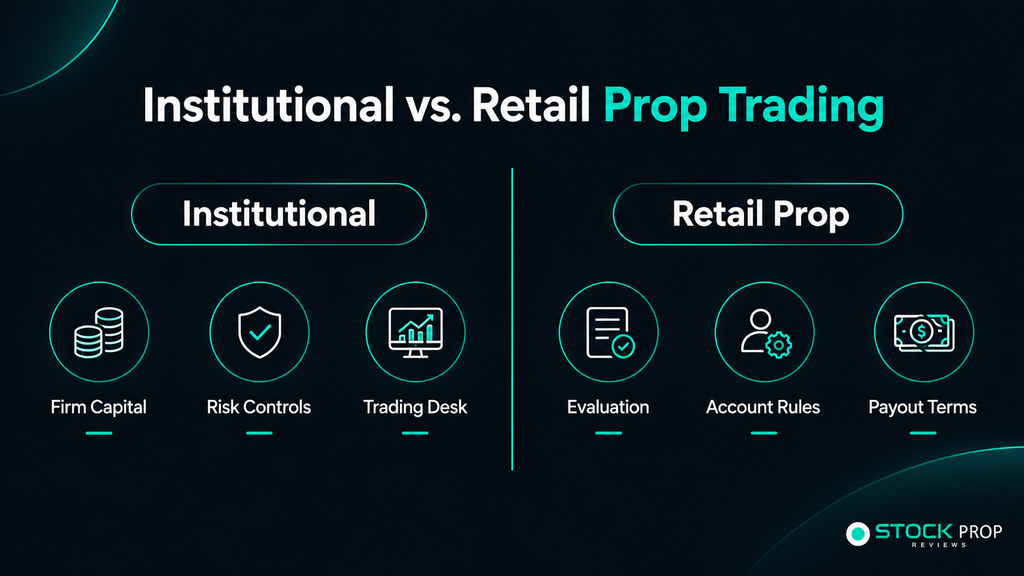
Institutional firms have an entirely different prop trading model for trading the financial markets and for risk management and returns from the firm’s own money. Retail prop firms, however, take a different approach. They offer contracted profit splits, demo accounts with pay, and evaluations for fees. Such knowledge is useful for traders to evaluate the offerings of firms beyond their advertised account sizes or shared profits.
This institutional examination is for new and experienced traders who want to learn how prop firms work, how professional risk management works, and what all this means for retail prop firms. It is not for traders who are looking for fast money, easy money, or a fast track to profits.
Quick Verdict: The Institutional View of Prop Trading Firms
Institutional approach focuses on risk management, execution quality, capital allocation, and repeatable performance. Professional trading operations will consider the risk the trader takes, how losses will impact the portfolio as a whole, and whether the strategy will work in a wide range of market environments.
Retail prop firms have similar risk controls but vastly different business models. Many of them charge fees for evaluations, resets, or subscriptions, and some even trade live.
Neither model is superior. It is necessary for traders to ask the firm what its real trading set-up is, what contracts it is holding or operating in, drawdown rules, and payment terms before they send any of the coins.
The point is that the advertised balance is not something a trader might own and use. The real value of a prop program is in the allowable loss and trading conditions and strength of its contractual arrangements.
What Is Institutional Prop Trading?
Institutional proprietary trading is the practice by which a firm or institution (e.g., a bank) trades an instrument against its own account for its own direct profit instead of its customers. The firm may trade stocks, futures, foreign currency, options, bonds, and other instruments, depending on the firm’s trading strategy.
Traditional prop trading desks typically have risk limits, position controls, performance monitoring systems, and execution. Larger firms may also have risk teams measuring exposure that intervene when losses or the market environment become intolerable.
For example, an equity trading desk may reduce exposure as volatility increases or when there is multiple exposure to the same piece of economic news. The aim is to protect the firm’s capital while still allowing traders exposure to profits.
It is different from asset management, where a firm puts its capital at risk on behalf of clients/investors. It also differs from several types of retail prop programs, in which traders are tested and can be compensated based on paper results.
These differences are significant because the label proprietary trading firm does not mean all providers have the same capital structure, execution model, or compensation structure.
Institutional Prop Trading vs. Retail Prop Firms
| Feature | Institutional prop firm | Typical retail prop firm |
| Main activity | Trading strategies using firm capital | Evaluations and funded or simulated trading programs |
| Entry | Recruitment, experience, or performance assessment | Usually a paid evaluation |
| Capital | Allocated under internal risk controls | May be simulated or allocated under specific contractual arrangements |
| Risk limits | Position, portfolio, and firm-level controls | Daily loss and maximum drawdown rules |
| Compensation | Salary, bonus, or performance-linked pay | Contractual profit share or payout |
| Infrastructure | May include professional execution and analytics | Platform and execution conditions vary |
| Trader’s financial exposure | Depends on employment or contract terms | Often includes evaluation fees and potential loss of eligibility |
These are general differences, not hard-and-fast rules. Although some retail providers have live markets, some institutions may have simulated trading facilities for training and testing purposes.
A retail account should give some indication as to whether it is a simulated or live account and clues as to how rewards may be calculated and what the terms of any applicable contracts may be. Having funded accounts does not mean the account balance is the trader’s money or that all orders are placed on a live market.
How Institutional Firms Manage Risk
1. Capital allocation depends on risk
Professional trading operation takes into consideration the trader’s performance, volatility, and historical drawdown when assigning exposure. In fact, a strategy with great returns but enormous losses may get dedicated less risk capital than a more stable strategy.
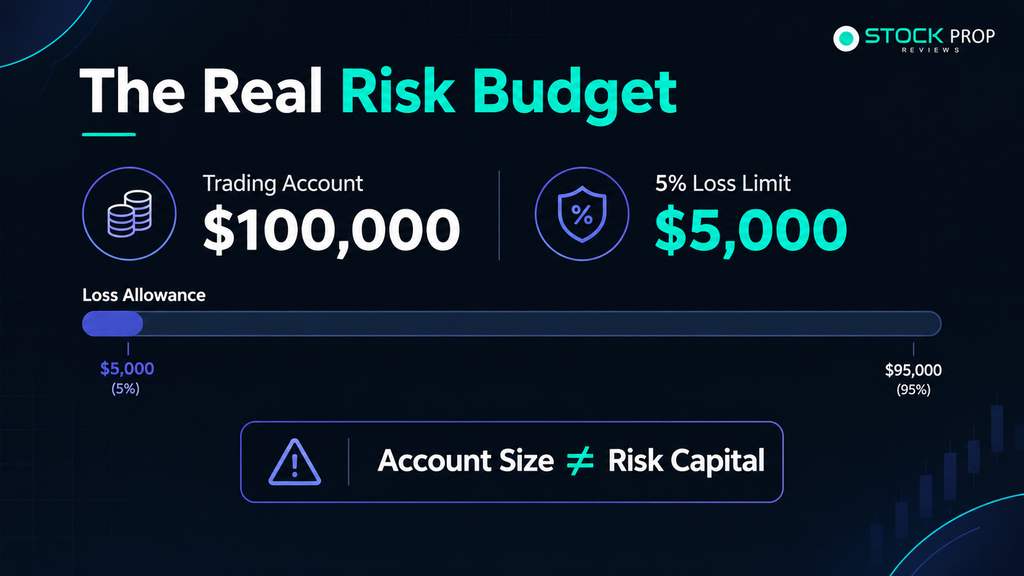
The same goes for retail traders. Program A is trading with $100K in account and max loss 5% or whatever. If the limit is off the front end, then the nominal loss allowance is $5,000 (disregarding any other rules).
You could have 10 losses at $500 each to deplete that allowance. A disciplined trader would normally have used smaller risk amounts that often had a buffer rather than pushing into formal breach limits.
2. Drawdown rules determine the real trading room
Static drawdowns are normally calculated versus a reference balance. A trailing drawdown may rise with new account highs (depending on the provider’s method of calculation). There are a variety of methods for calculating and resetting the daily loss limit.
For instance, if a trader profits $2,000 and then gives back $1,500, the account is still in profit for the amount it started with, but if there is a trailing limit, it doesn’t allow much room for moving losses.
Traders should know whether drawdown is measured using balance or equity, contemplate paper losses, and know whether there is a trailing limit that stops progress at some point. These details may outweigh the size of the advertised account.
3. Position sizing must reflect market conditions
Volatility, liquidity, spreads, and correlations influence the amount of risk a position generates. A strategy that performs well in a quiet session may behave quite differently in a major economic announcement.
Institutional-style risk management can adapt their exposure to the environment. Retail traders must as well: don’t overexpose yourself to correlated exposures, allow for a wider stop distance, and hedge. Don’t forget transaction costs.
4. Risk controls must work under pressure
Written rules only work when they are adhered to. Day-after-loss oversized positions or also ignoring daily stop limits can ruin a perfectly reasonable game plan.
A good personal policy will specify a tolerable risk level for specific trades, a maximum daily loss, tolerable losing streaks, and no revenge trading. These safeguards will prevent your account from being wiped out by a streak of bad luck.
How Prop Firms Make Money
Old-school proprietary trading firms do work a little bit with trading for returns and profits. Performance is based on strategy performance, execution costs, technology, and risk management.
Revenue models may differ for prop firms using retail evaluations. Revenues may vary and include evaluation fees, resets, subscriptions, etc., depending on the provider. In some cases, firms even have affiliated live-trading or other businesses.
Not all retail firms earn most of their income from failed challenges. But traders should consider how much a provider’s commercial interests conflict with its obligations to successful participants.
Good questions to ask include whether the firm’s business model is clear on fees, payouts, account terms and conditions, and dispute resolution. Crystal-clear terms do not necessarily mean financial security, while vague or malleable terms make it difficult to assess risk.
Another important question is the company’s ability to cover payout obligations if a large number of traders qualify at the same time. Marketing materials seldom reflect this, and traders should not take promotional claims as evidence of financial strength.
What Institutional Analysis Reveals About Retail Prop Firm Rules
Profit targets can encourage excessive risk
Take, for example, if a trader has a simulated account of $50,000 and targets to profit $3,000 and risks a loss of $2,000. The target is 6% of the initial balance, and the loss allowance is 4%.
Therefore, the trader should aim to hit the target without going beyond the allowable loss limit. Even a long-term winner can disappoint with a losing streak.
Increasing position sizes to achieve the target more quickly can actually exacerbate the problem. Thus, the target should be tested against historical drawdown, frequency of trades, market volatility, and transaction costs.
Payout conditions can influence decisions
Some programs enforce minimum trading days; some also are consistent requirements or rules about certain types of strategies. These rules may affect when or how profit can be withdrawn.
For instance, a trader’s profits could primarily be due to a good trading session in a month, but some consistency requirement could force establishing these profits for payment. The trader may then trade only to meet the program’s requirements, even when there is no good setup.
The payout terms can be an advantage or a disadvantage depending on the trader’s natural shape of profit curve and trading style, so a trader should consider this before buying an evaluation.
Execution quality affects performance
Strategy results may be affected by spreads, commissions, slippage, data feeds, and order execution. They are especially critical for scalpers, who may only expect a small profit on the trade.
Swing traders may be more sensitive to costs incurred overnight, holding penalties, or weekend gaps. Headline terms may be good but a poor fit if the execution environment is not to a trader’s taste.
Why Traders Fail Even When Their Strategies Are Profitable
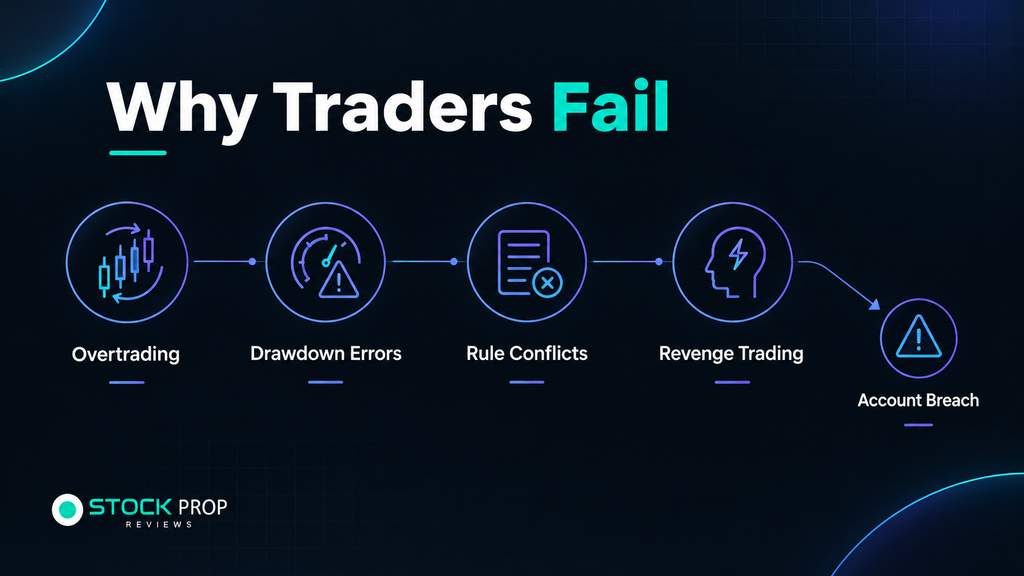
Any strategy no matter how good will not help you pass a prop test. Traders can be losing due to non-compliance with the program rules in terms of risk management or behavior.
Overtrading after losses: A trader has a number of losing trades and raises the position size to recoup the loss, breaching the daily net loss threshold.
Misunderstanding drawdown:The trader focuses on the advertised balance and ignores a trailing limit based on equity or a “high-water” mark.
Choosing the wrong program: A news trader selects a firm with restrictive event-trading rules, or a swing trader purchases an account that prohibits weekend holding.
Changing behaviour near a payout: Fear of losing accumulated profits causes a trader to abandon normal entry criteria or take unnecessary risks to reach a withdrawal threshold.
Repeatedly purchasing evaluations: After failing, a trader buys another challenge to recover previous fees rather than reviewing the strategy and identifying the reason for failure.
These problems reflect weaknesses in risk discipline rather than proof that all prop firms are unfair. However, strict account rules can make their financial consequences more immediate.
Our related analysis of the [hidden incentive problem in prop firms] explores how commercial structures and trader behaviour can sometimes work against sustainable performance.
What Traders Should Check Before Choosing a Prop Firm
An institutional-style review should examine the firm’s operating terms rather than focusing only on its reputation or advertised account size.
| Area | What to verify |
| Drawdown | Static or trailing, balance or equity based |
| Daily loss | Calculation method and reset time |
| Profit split | Percentage, eligibility, and withdrawal conditions |
| Trading restrictions | News, overnight, weekend, and strategy rules |
| Execution | Spreads, commissions, slippage, and platform conditions |
| Payouts | Minimum amount, timing, verification, and review process |
| Legal terms | Contracting entity, governing law, and dispute procedures |
| Rule changes | Whether restrictions can change after account activation |
Pay special attention to the transition from evaluation to the funded stage. There may be further conditions after passing, and a strategy allowed in one stage may not be in another.
Traders should also consider the actual cost of entry, which may take more than one evaluation or reset. A cheap entry cost can explode in expense if repeat attempts are required without evidence the strategy is yet ready.
Alternatives to Consider
Retail prop trading is not the only option available.
- Personal brokerage account:The choice of traders who want full control of their deposits and withdrawals. Con: They lose on the trades.
- Institutional trading employment: May suit experienced traders seeking professional supervision and access to firm resources. Entry is selective, and compensation depends on the employer.
- Stock-focused prop programs: May suit traders specialising in individual equities rather than forex or futures. They should still verify whether accounts are simulated or live and examine the payout terms.
Readers can compare provider-specific conditions through our FTMO review and FundingPips review, alongside our prop firm comparison. Our article on the reality behind the funded trader lifestyle also examines the expectations created by industry marketing.
TradeThePool: A Stock-Focused Option
For equity traders, try out TradeThePool and see if its stock programs suit your strategy. Rules and transparency around risk calculation are useful rules of thumb for any trader, but one would want to stake down funds only after checking current account conditions and commitment to strike.
TradeThePool states in its terms it is not a broker dealer, and the contract reads like a simulated trading program. Don’t believe a stock prop program will be a regulated broker and check any such claim of regulation.
Use our TradeThePool link for up to 10% off buys. No guaranteed acceptance, payouts, or profitability.
FAQs
What is institutional prop trading?
It is a company that will trade for itself, making money for itself, and hedging with own trade for institutional risk purposes.
Prop Trading: Institutional or Retail?
Institutional programs usually trade capital at institutional rates. Most retail programs promote paid trials and simulations (sometimes contractually paying test accounts).
Can a profitable trader pass a prop firm challenge?
Yes. A positive expectancy strategy can still lead to trader failure because of losing streaks, drawdown limits, trading restrictions, and execution costs.
How do institutional traders hedge against this risk?
Position limits, exposure limits, limits to loss, volatility measures, etc. As a retail trader, you can apply those same principles to your trading by using position size and drawdown limits on your account.
What should traders look for before signing up with a prop firm?
Check out drawdown, law conditions, trading rules, execution conditions, live or simulated accounts, payout requirements, etc.
Final Assessment
Institutional prop trading is more about risk, incentives, execution, and contractual obligations than it is about eye-popping account sizes. Retail prop firms can be a proof-of-concept platform for the trader with a proven strategy, but they are in no way guarantors of drawdown capital or a guaranteed route to long-term prop success.
Check actual loss allowance, disclosure of rules in your strategy, and payment terms, as well as transparency before payment. Make your purchase based on program terms, not on sale hype.