
A review of City Traders Imperium should not begin with the ad account size or max profit split. The more important question is how CTI filters traders through its combination of profit targets, drawdown limits, minimum profitable days, and trading restrictions.
In the case of a trader using a controlled risk model, CTI can offer relatively flexible conditions. The same structure can be a fast account filter for a trader that relies on aggressive position sizing, martingale, oversized recovery trades or inconsistent risk.
This article is for traders who have a strategy and want to know if CTI’s rules fit with it. This isn’t for beginners looking for an easy way to get funded or traders expecting the advertised account balance to be money they can freely risk.
Quick verdict on City Traders Imperium
CTI’s current 2-Step Challenge uses a 10% Phase 1 target, 5% Phase 2 target, 10% static maximum drawdown and 5% daily drawdown, with no time limit and three profitable trading days required in each phase. News trading, overnight holding and weekend holding are allowed, while martingale is prohibited.
Its 1-Step model is materially different. It has an 8% profit target and 5% balance-based trailing drawdown, with no separate daily drawdown, while CTI currently allows EAs, martingale, news trading and weekend holding under that model.
That distinction is important because there is no single “CTI rule set.” The program a trader chooses determines the risk environment.
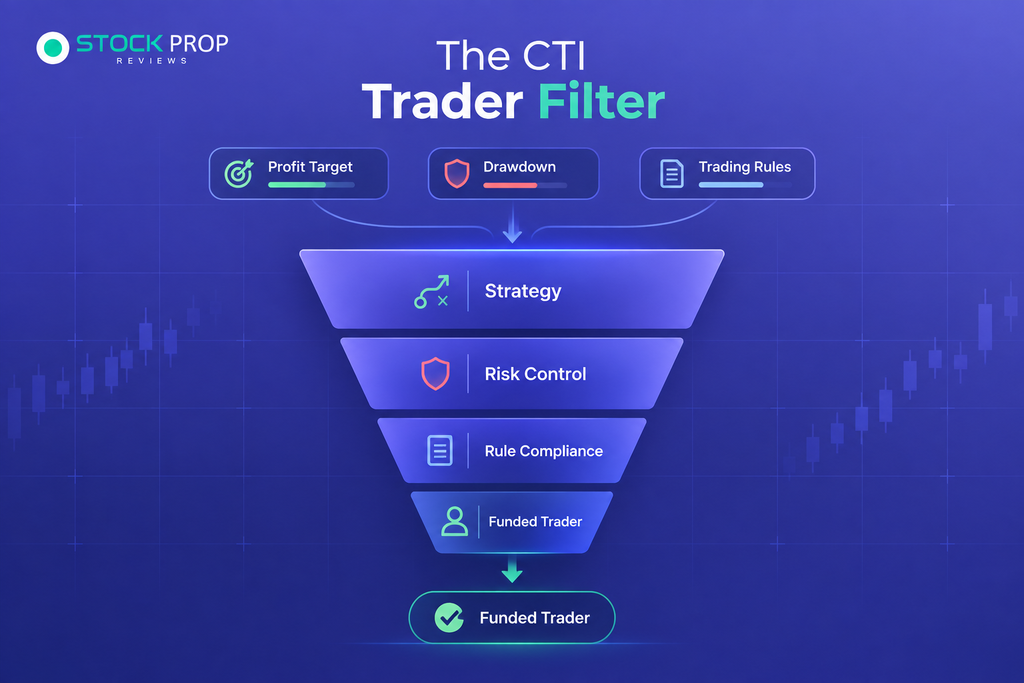
My overall view is that CTI is better understood as a trader filtering system rather than simply a funding provider. The firm is testing whether your strategy can produce the required return without creating a pattern of risk that conflicts with its account limits and trading policies.
City Traders Imperium rules at a glance
The table below focuses on CTI’s current 1-Step and 2-Step structures because these make the filtering mechanism easiest to understand.
| Rule | 1-Step Challenge | 2-Step Challenge |
| Profit target | 8% | 10% Phase 1 / 5% Phase 2 |
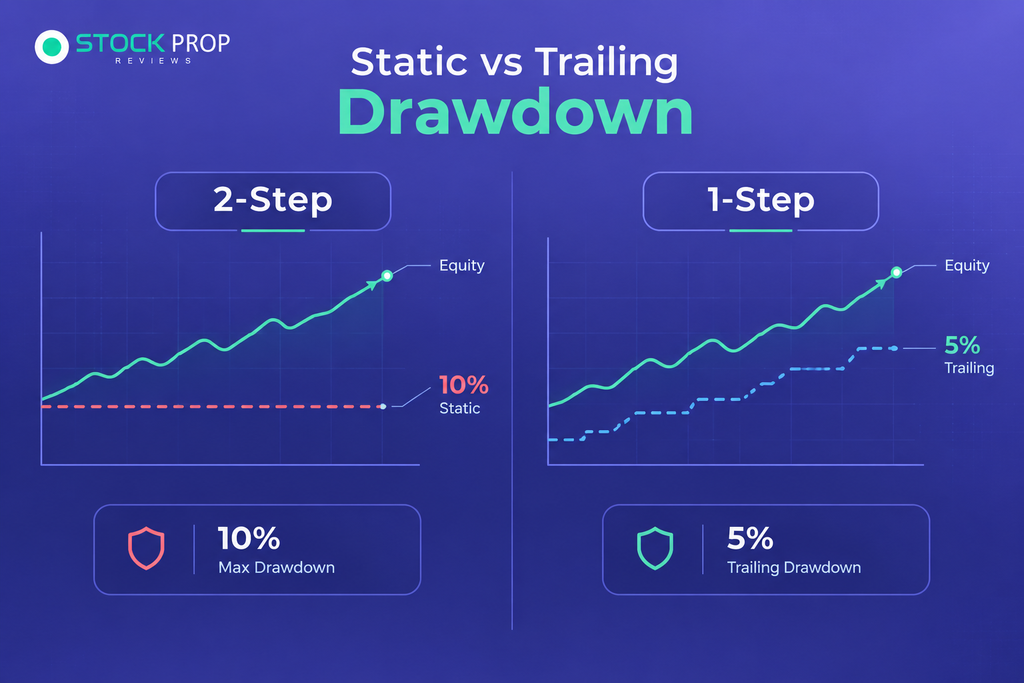
| Maximum drawdown | 5% trailing | 10% static |
| Daily drawdown | None | 5% |
| Minimum profitable days | 3 | 3 per phase |
| Time limit | None | None |
| News trading | Allowed | Allowed |
| Overnight holding | Allowed | Allowed |
| Weekend holding | Allowed | Allowed |
| Martingale | Allowed | Not allowed |
| EAs | Allowed | Personal EAs only |
| Starting profit share | 80% | 80% |
| First payout | 7 days | 7 days |
These figures come from CTI’s current program pages and should be checked again before purchasing because prop-firm rules can change.
The headline numbers look generous, but the important part is how the limits interact.
What CTI’s trader filtering model actually tests
The filtering process is essentially built around three questions.
Can you reach the target?
Can you survive the drawdown while doing it?
Can you trade in a way that remains acceptable under the firm’s risk policies?
A trader can answer the first question with a yes and still fail the other two.
Imagine a trader with a 45% win rate and an average risk to reward ratio of 1:2. This strategy might be positive expectancy. But if the trader typically has four or five losing trades in a row and risks 1.5% per trade, a 5% daily limit can be a major restriction.
The strategy may be profitable on paper while being unsuitable for the account.
This is one of the biggest gaps in typical prop-firm reviews. They compare profit targets and profit splits without asking whether a trader’s normal distribution of losses fits inside the firm’s risk budget.
The 2-Step model is less forgiving than it first appears
The 2-Step structure is attractive to traders who prefer static overall drawdown.
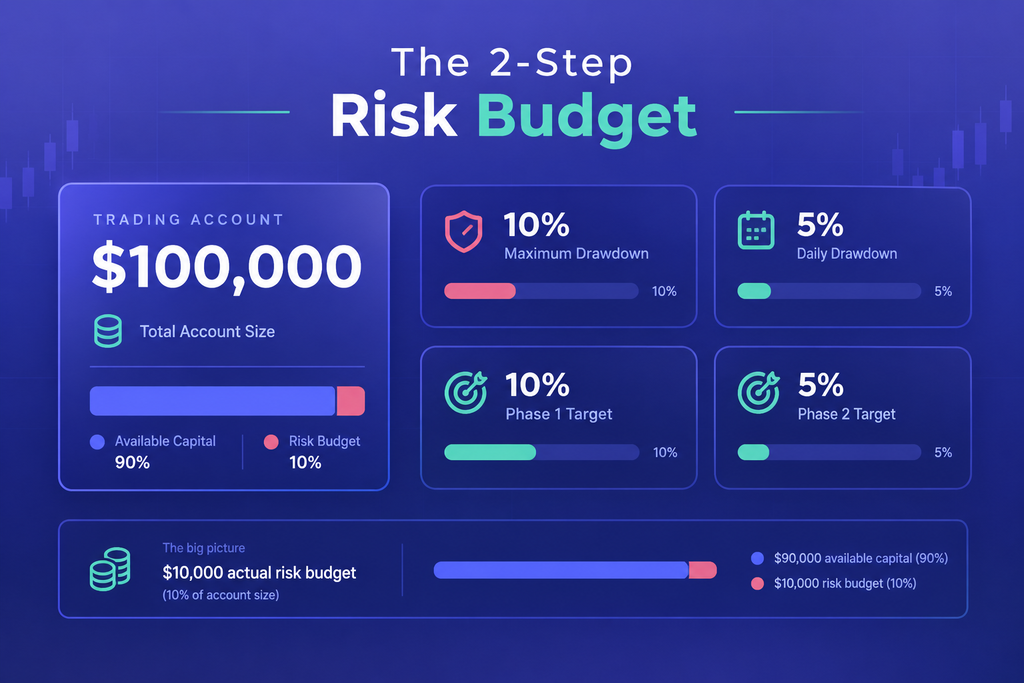
A $100,000 account, for example, has a $10,000 maximum drawdown and a $5,000 daily drawdown under the current 2-Step rules. The Phase 1 target is $10,000, followed by a $5,000 Phase 2 target.
That looks like a substantial room.
But a trader should not think of the $10,000 drawdown as their actual trading budget.
Suppose the trader risks $1,000 per position. Five consecutive losses would consume the entire daily loss allowance if they occurred within the same trading day. Even if the losses are spread across several days, the overall drawdown starts becoming uncomfortable very quickly.
A more conservative trader might risk 0.25% to 0.5% per setup. That gives the strategy much more room to experience normal variance.
The downside is that reaching a 10% target at low risk takes longer in terms of expected trades.
That is not necessarily a problem because CTI has no time limit.
In fact, the absence of a deadline can reduce one of the most common psychological mistakes in evaluations: increasing risk simply because the trader believes they are running out of time.
Why the 1-Step model filters traders differently
The 1-Step Challenge changes the equation.
The target is lower at 8%, but the maximum drawdown is a 5% trailing limit. There is no separate daily drawdown.
That sounds simpler, but trailing drawdown creates a different psychological problem.
Imagine a trader starts with $100,000 and builds the balance to $104,000. A subsequent losing sequence can reduce the available buffer even though the trader is still above the original starting balance.
This is where profitable traders sometimes fail.
They mentally calculate risk from the original account balance while the actual constraint is connected to the high-water mark.
CTI describes the 1-Step drawdown as balance-based, with the floor determined from the highest balance reached.
For a trader who frequently gives back open or recently realized profits, that mechanism deserves more attention than the 8% target.
What competitors don’t explain about CTI
Most CTI comparisons focus on leverage, account size, profit share and headline drawdown.
Those are useful, but they don’t tell you how the firm filters behaviour.
CTI’s terms give the company discretion around practices it considers inconsistent with normal market risk management. Its published terms specifically discuss issues such as overleveraging, overexposure, one-sided bets and account rolling. The terms also allow the company to take action where prohibited practices are identified.
This matters because a trader can technically understand the numerical drawdown limit while still misunderstanding the broader risk framework.
For example, imagine a trader normally takes positions worth $5,000 but suddenly opens a position several times larger after three consecutive losses.
The trade may not immediately breach the account’s drawdown limit.
But the behaviour represents a significant change in risk.
That is precisely the kind of situation traders need to understand when evaluating CTI.
The firm’s own Account Metrix materials also emphasize monitoring drawdown, profit targets and risk metrics.
The practical lesson is simple: do not build your CTI strategy around how close you can get to the maximum permitted risk.
Build it around the risk you can repeat.
How traders actually fail CTI
The most common failure pattern is usually not complicated.
A trader starts with a strategy that normally risks 0.5% per trade.
The first few trades lose.
Instead of accepting normal variance, the trader increases risk to 1% or 2%.
One winner temporarily repairs the account.
The trader becomes confident again and increases size further.
A volatile trade then produces a loss large enough to trigger the daily or overall limit.
The account is gone.
The original strategy may never have been the problem.
The risk adaptation was the problem.
Another common mistake is treating the profit target as a deadline. CTI’s current 1-Step and 2-Step programs have no time limit.
There is therefore little logical reason to double position size simply because the account is taking longer than expected to reach the target.
The trader is effectively creating a deadline that the firm did not impose.
Common CTI trader mistakes
Trading the account size instead of the drawdown
A $100,000 account does not mean you should size positions like someone with $100,000 of personal risk capital.
The relevant number is your permitted loss.
Increasing size after losses
This is particularly dangerous because the trader’s emotional confidence is usually lowest immediately after a losing streak.
Ignoring the difference between static and trailing drawdown
The 2-Step and 1-Step models behave differently. Treating them as interchangeable can result in a risk plan that is inappropriate for the account.
Assuming every strategy is equally compatible
A high-frequency strategy, a swing strategy and a recovery-based strategy interact with the rules differently.
Using martingale logic where it is prohibited
CTI explicitly lists martingale as prohibited on its current 2-Step Challenge.
A trader who depends on increasing size after losses should therefore not attempt to disguise that approach as ordinary scaling.
Who should avoid City Traders Imperium?
CTI is probably a poor fit for traders who need very aggressive recovery mechanisms.
It is also unsuitable for someone whose strategy regularly produces large intraday losses relative to account size.
A trader who routinely changes position size based on emotions is another poor candidate.
The same applies to beginners who have not established a statistically tested risk model. A challenge account is a particularly expensive place to discover that your normal losing streak is six trades rather than three.
Traders who depend on prohibited strategies should also avoid forcing the strategy into an incompatible program.
The better approach is to find a funding model that naturally accommodates the way you trade.
CTI strategy-fit analysis
| Trader type | CTI fit | Reason |
| Conservative forex trader | Strong | Static drawdown on 2-Step can suit controlled risk |
| Swing trader | Strong | Overnight and weekend holding are permitted |
| News trader | Strong | News trading is permitted |
| Aggressive scalper | Moderate | Depends heavily on position sizing and daily volatility |
| Martingale trader | Weak on 2-Step | Martingale is prohibited |
| EA trader | Program-dependent | EA rules differ between 1-Step and 2-Step |
| Beginner | Weak to moderate | Requires a proven risk model |
| Futures specialist | Weak | CTI’s core offering is not a futures-specific model |
The biggest variable is not whether CTI permits your strategy in theory. It is whether your normal trade distribution fits the account.
That is a much better test.
CTI versus alternatives
There are several alternatives, but they serve different traders.
FTMO makes more sense for traders who want a structured multi-asset evaluation with clearly defined risk limits. Our FTMO review looks more closely at how its risk engine affects actual trading behaviour.
The5ers can be worth considering for traders who prefer a longer-term scaling environment. Our analysis of the The5ers scaling model looks at why scaling conditions can matter more than the advertised profit split.
Topstep is the more natural comparison for dedicated futures traders because its model and infrastructure are designed around futures. Our Topstep funding model analysis explains why comparing futures drawdown with forex prop rules can be misleading.
For a broader view, our [prop firm comparison] also makes the case for comparing drawdown mechanics and strategy fit rather than simply ranking firms by account size.
The real advantage of CTI’s structure
One of CTI’s strongest features is the absence of a time limit on the current 1-Step and 2-Step challenges.
That can be valuable for traders with a low-frequency edge.
A trader taking three high-quality setups per week does not need to manufacture trades to meet a deadline.
CTI also permits news trading, overnight positions and weekend holding on the current 2-Step model.
That gives swing and event-driven traders more freedom than firms that impose restrictions around these activities.
But flexibility should not be confused with safety.
A trader who holds positions through major news can experience significantly larger volatility. The fact that a behaviour is permitted does not mean it is automatically sensible for the account.
The psychological side of the filtering model
There is another layer that numbers alone cannot show.
Prop firms create a different psychological environment from personal trading.
When traders see a $100,000 account, they often feel pressure to produce returns that justify the account size.
But the account might have only a $10,000 maximum loss under the 2-Step model.
That means the trader should think of the account as a risk budget, not $100,000 of disposable capital.
This is consistent with a broader point we made in our [prop firm risk management myth] analysis: passing an evaluation does not automatically prove that a trader can manage risk professionally. The evaluation primarily tests whether the trader can operate inside a predefined risk framework.
That distinction is important.
A stock-focused alternative worth considering
If your edge is in individual stocks over forex, futures or CFDs, TradeThePool is worth researching. The published program terms are built around stock trading, position sizing and risk controls. The company is not a financial institution or regulated financial entity and the evaluation environment is also described as simulated in its documentation.
I wouldn’t call TradeThePool a “regulated stock prop firm.” That’s not correct according to its own current filings. What can be said with some certainty is that it is a stock-oriented prop firm with published rules and a relatively detailed risk framework.
When buying through our TradeThePool link, readers get up to 10% off.
Final assessment
City Traders Imperium is best evaluated as a risk-filtering system, not as a contest to reach a profit target as quickly as possible.
The current 2-Step model offers a relatively straightforward combination of 10% static maximum drawdown, 5% daily drawdown, no time limit and flexible holding conditions. The 1-Step model reduces the target to 8% but introduces a 5% trailing drawdown.
That difference can completely change which trader succeeds.
The strongest CTI candidate is someone who already knows their average loss, normal losing streak, position size and expected drawdown. That trader can choose the program based on evidence.
The weakest candidate is someone who enters with a large account balance in mind, increases risk after losses and treats the profit target as a deadline.
The real question is therefore not “Can I pass CTI?”
It is:
“Can I trade this account exactly the way I intend to trade after I am funded?”
If the answer is yes, CTI’s structure can make sense. If passing requires you to change your risk model, increase trade frequency or take setups you normally would skip, the account is probably filtering you for a reason.
FAQs
Is City Traders Imperium good for beginners?
It can be used by beginners but I would not recommend a prop challenge to begin before developing a proven strategy and risk model. Account rules can expose weaknesses very quickly.
Does City Traders Imperium have a time limit?
The current 1-Step and 2-Step programs have no time limit.
What is CTI’s maximum drawdown?
The current 1-Step Challenge has a 5% trailing drawdown. The 2-Step Challenge has a 10% static maximum drawdown plus a 5% daily drawdown.
Can you trade news with City Traders Imperium?
Yes. CTI currently allows news trading on both the 1-Step and 2-Step Challenge models. Overnight and weekend holding are also permitted.
Is City Traders Imperium suitable for martingale traders?
The answer is program dependent. The 2-Step Challenge currently bans Martingale. CTI has the 1-Step model down as allowing it. Before buying, traders should check the exact conditions of the program.