More than the evaluation fee and headline profit split should be considered in an Apex Trader Funding review. The more important question is whether a trader can repeatedly withdraw profits without eventually giving them back via a drawdown breach.
Apex is for experienced futures traders who understand position sizing, intraday risk and the mechanics of trailing or end of day drawdowns. It’s not a natural fit for beginners who require wide stops, swing traders who hold positions for large moves, or traders whose strategy relies on surviving substantial intraday volatility.
The most significant change to watch for in 2026 is that Apex took out the old product line entirely on March 1, 2026. Current evaluations are single purchases with 30 days access. The newer Performance Accounts are either intraday trailing or end of day drawdown structures.
Quick verdict
Apex Trader Funding can be profitable, but for a disciplined futures trader, it is much harder to maintain profitability than to pass the evaluation.
A strong intraday trailing structure is much harder to manage for many traders than the current EOD model. Daily Loss Limit is monitored intra-day and EOD drawdown is calculated at market close. This gives traders more leeway to allow a normal trade to fluctuate without always having to move the drawdown floor of the account.
The catch is that traded funds add a few extra constraints. Apex Performance Accounts use tiered position limits and Daily Loss Limits and payouts are still subject to eligibility requirements such as the 50% consistency rule.
I see Apex as a better managed capital-extraction model than a place to trade aggressively for unlimited account growth.
That difference counts.
Apex Trader Funding rules that actually matter
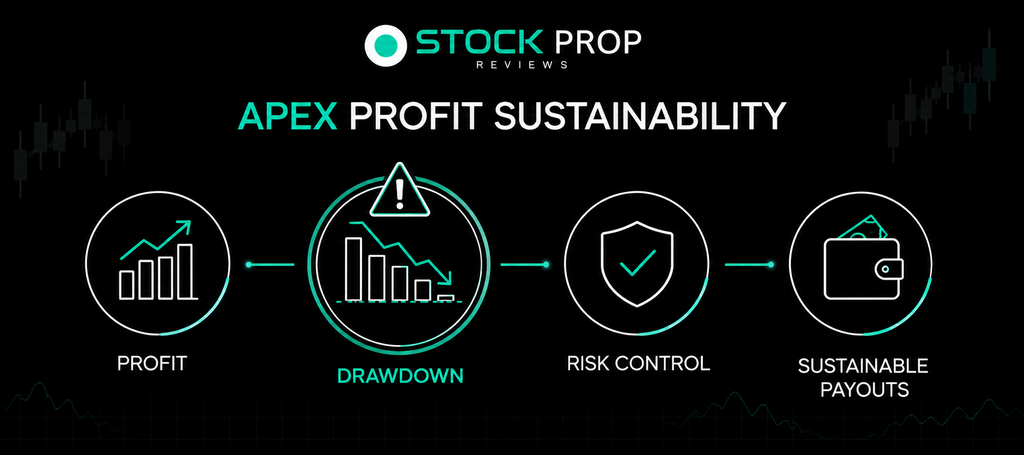
The headline account size is not the amount a trader can realistically lose. The usable risk budget is determined by the drawdown threshold and, depending on the account type, the Daily Loss Limit.
| Rule | Current Apex structure | Why traders should care |
| Evaluation | One-time fee, 30 calendar days | Failed accounts require a new evaluation |
| Profit targets | $1,500 on 25K, $3,000 on 50K, $6,000 on 100K, $9,000 on 150K | Determines the required return |
| EOD maximum drawdown | $1,000 to $4,000 depending on account | Defines the real survival budget |
| EOD Daily Loss Limit | $500 to $2,000 in evaluation | Can stop trading for the session |
| Intraday drawdown | Trails peak balance in real time | Unrealised profit can raise the threshold |
| Funded payout split | 100% on approved payouts under current PA structures | Strong headline economics, but eligibility still applies |
| Consistency | 50% on applicable funded payout calculations | One large winning day can delay a payout |
| PA position sizing | Tier based | Size increases only as the account reaches qualifying levels |
| Active PA limit | Up to 20 | Multiple accounts multiply both opportunity and risk |
The current EOD evaluation does not apply the 50% consistency rule, but the funded Performance Account does. That difference is easy to overlook when reading only the evaluation rules.
The evaluation also expires after 30 calendar days. If a trader does not pass within that period, the account closes and the balance does not carry forward. There are no reset fees under the new model, but another evaluation has to be purchased.
The real issue is not the profit target
A trader looking at a 100K evaluation may think the objective is simply to make $6,000.
That is the wrong mental model.
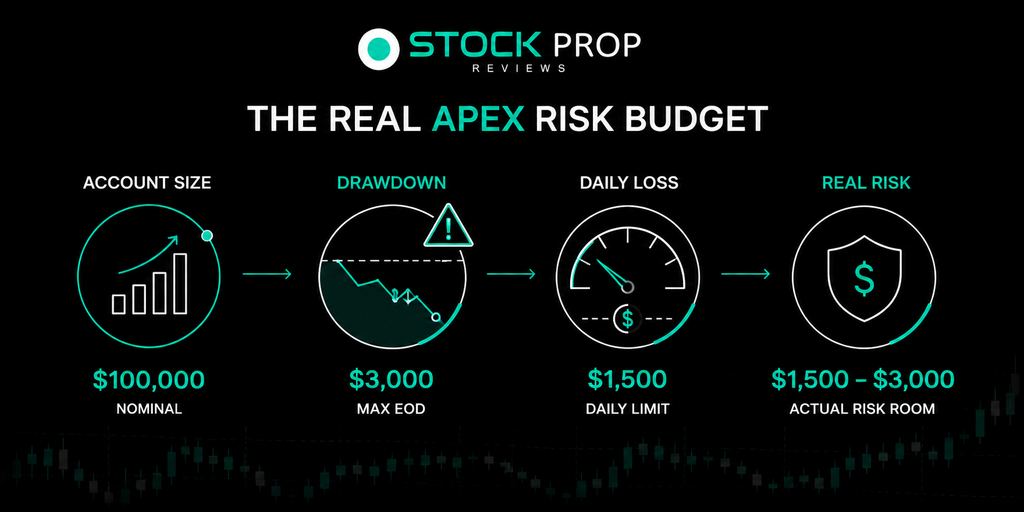
The trader is really trying to generate $6,000 while preserving enough distance from a $3,000 maximum EOD drawdown, while also respecting the $1,500 Daily Loss Limit during the evaluation.
That changes the required trading behaviour considerably.
A strategy producing $400 per trade with occasional $1,200 losses might be profitable in a normal brokerage account. Under a prop structure, the occasional large loss can be disproportionately damaging because the trader has limited room to recover.
This is why account size can be psychologically misleading.
A 100K account does not mean the trader has 100K of practical risk capital.
The drawdown is the number that matters.
EOD versus intraday trailing drawdown
This is arguably the most important choice in the current Apex product range.
With the intraday evaluation, the trailing threshold follows the account’s highest balance in real time, including unrealised gains. If the account touches the threshold, the evaluation fails.
Let’s take one simple example.
A trader opens an account with 50K evaluation and makes an open profit during the trade. The position hits a new high in equity and so the trailing threshold is moved up. Then the trader waits for a deeper pullback before the market eventually returns to the original direction.
This trade could still be perfectly manageable in a traditional brokerage account.
Under an intraday trailing model, that temporary pullback can be enough to end the account.
This naturally favours short-term execution.
The EOD model is different. The EOD threshold is calculated from the closing balance and then enforced during the following session. Losing days do not cause the threshold to move downward.
For traders whose strategies need some breathing room, that is a meaningful structural advantage.
How traders actually lose Apex funded accounts
Most failures are not caused by one mysterious rule.
They usually follow a predictable sequence.
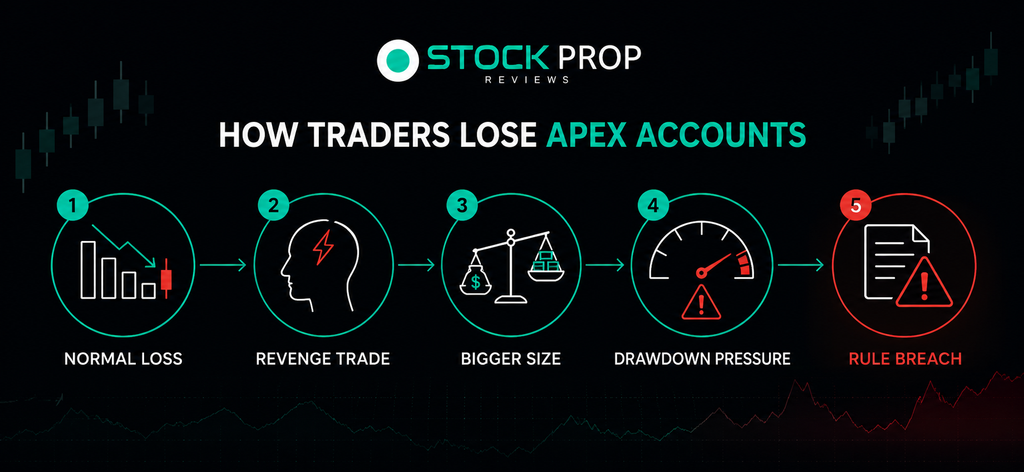
A trader passes the evaluation and feels that the difficult part is over. Position size increases. The trader starts thinking about the first withdrawal rather than the next high-quality setup.
Then a normal losing trade occurs.
Instead of accepting it, the trader takes another setup.
The second trade loses.
Now the trader is close to the Daily Loss Limit or drawdown threshold, so the temptation is to make the money back quickly.
This is where the account can disappear.
The problem is not necessarily the strategy. It is the combination of limited drawdown, increased emotional pressure and the trader’s changing behaviour after funding.
A trader who risks $150 per setup during evaluation may suddenly risk $400 after reaching a funded account because the account feels “real”. That is precisely when the original risk model stops working.
The hidden danger of unrealised profit
One of the most important distinctions in Apex’s rules is the difference between realised profit and account equity.
Under the intraday trailing structure, unrealised gains can move the threshold upward.
This creates a common trap for traders using high reward-to-risk strategies.
Suppose a trader enters NQ with a $300 initial risk and the position quickly moves $1,000 in profit. The trader does not take profit because the strategy targets $2,000.
The market then retraces $700.
The final trade might still eventually become profitable, but the account has already experienced a significant change in its equity-based risk position.
This is why a strategy that performs well in a personal account can behave very differently inside a prop firm.
The entry signal has not changed.
The risk environment has.
Apex payout sustainability
The payout headline is attractive. Current Apex Performance Account documentation states that approved payouts are issued at a 100% payout split, subject to the relevant eligibility conditions.
But a sustainable payout model is not simply:
Profit × payout percentage = trader income
The real calculation is closer to:
Gross trading profit − failed accounts − evaluation costs − activation costs − trading mistakes = sustainable income
That distinction is rarely emphasised in generic Apex reviews.
A trader making $2,000 and withdrawing $1,500 is not necessarily doing better than a trader making $1,200 consistently for several months.
The second trader may actually have a healthier process.
The objective should be repeated withdrawals while keeping the probability of account failure low.
The 50% consistency rule changes behaviour
Apex’s current payout documentation requires that no single profitable day represents 50% or more of the relevant total profit for the payout calculation.
This is not necessarily a bad rule.
It can actually discourage traders from trying to hit the entire account objective in one huge session.
But it creates another psychological issue.
Imagine a trader makes $2,000 on Monday and only $500 over the next several days. The large Monday gain may become a barrier to requesting a payout until enough additional profit is generated.
That can encourage unnecessary trading.
A trader may think:
“I already made the money. I just need a few more trades to get the percentage down.”
That is exactly the wrong reason to trade.
A consistency rule should be treated as a portfolio constraint, not as a daily trading target.
What competitors often miss
Many Apex reviews concentrate on three numbers:
The account size.
The profit target.
The payout split.
Those numbers do not explain whether a trader can stay funded.
The more useful question is how the rules interact.
If your normal daily volatility falls comfortably within that range, then a 50K account with a $2,000 EOD drawdown can be attractive to a trader. For someone whose strategy regularly has $1,500 intraday swings it could be totally inappropriate.
The same account can therefore be excellent for one trader and terrible for another.
That is why comparing firms purely by account size or profit split is misleading.
Our existing TopStep review makes a similar point from a different angle: the practical question is how a firm’s rules interact with the strategy, not which firm has the biggest advertised account.
For a broader look at how prop firm drawdowns influence trader behaviour, our analysis of the truth about prop firm drawdowns is also useful context.
Common trader mistakes
The first mistake is treating the account balance as the risk budget.
The second is increasing size immediately after passing.
The third is allowing a winning position to become too large relative to the drawdown.
The fourth is trading after reaching a personal daily objective.
The fifth is trying to repair a losing day before the session ends.
There is also a less obvious mistake: running too many accounts.
Apex permits up to 20 active Performance Accounts.
That can look like diversification.
It is not necessarily diversification.
If the same trader takes the same NQ trade across 10 accounts, the strategy risk has not been diversified. It has simply been multiplied.
A single emotional decision can therefore affect every account simultaneously.
Strategy fit: who can realistically sustain Apex profits?
Best fit
Apex is most naturally suited to disciplined futures day traders and scalpers.
A strategy with controlled stops, frequent but selective setups, predictable daily risk and limited exposure to large market swings is structurally easier to operate inside the rules.
Traders who can stop after reaching their daily objective also have an advantage.
Poor fit
Apex is less suitable for traders who need wide stops or long holding periods.
It is also a poor fit for someone who routinely adds to losing positions, trades oversized NQ or ES positions, or depends on holding through major volatility.
Swing traders should pay particular attention to the fact that Apex is a futures-focused model with rules designed around its trading sessions and account structures rather than a conventional swing portfolio.
Apex versus other prop firm models
| Trader priority | Apex Trader Funding | More suitable alternative |
| Futures scalping | Strong fit | Topstep |
| Futures with more conservative structure | Reasonable | Topstep |
| Wide-stop strategies | Weak fit | A firm with more suitable drawdown rules |
| Stock trading | Not applicable | TradeThePool |
| Long-term stock swing trading | Not applicable | TradeThePool |
| Multi-asset trading | Weak fit | A multi-asset prop firm |
| Multiple futures accounts | Strong operational flexibility | Depends on risk management |
| Traders who dislike consistency rules | Weak fit | A firm without the same funded-account restriction |
For another perspective, our TopStep review covers a more conservative futures environment, while traders specifically comparing futures firms should also look at our prop firm comparison.
The important point is that an alternative is only better if its rules match the strategy.
Who should avoid Apex Trader Funding?
I would avoid Apex if your strategy needs significant room between entry and invalidation.
I would also avoid it if you regularly increase position size after losses, cannot stop trading after hitting a daily loss threshold, or rely on one or two unusually large winning sessions to generate most of your monthly income.
Beginners should be particularly cautious.
The evaluation may look inexpensive, but inexpensive access can encourage repeated attempts. If a trader keeps purchasing evaluations without fixing the underlying risk problem, the total cost can become much larger than the initial fee suggests.
Is Apex better for survival or aggressive growth?
Survival.
That may sound strange given how attractive the account sizes and scaling opportunities can look.
But sustainable prop trading is mostly about avoiding large mistakes.
A trader who makes $500 every week and protects the account can build a meaningful withdrawal history.
A trader who makes $4,000 one week and loses the account the next week has a much less sustainable process.
This is the part of prop trading that marketing pages cannot communicate very well.
The best trader is not necessarily the one who can produce the largest daily P&L.
It is often the trader who can produce acceptable returns while remaining far away from the account’s failure point.
A note on TradeThePool as an alternative
TradeThePool is a different type of offering for traders who prefer stocks rather than CME futures. Its present program is on US stocks and ETFs, including day trading and swing trading, with preset loss limits and various options for trading-periods.
Important correction for accuracy: I would not describe TradeThePool as a regulated financial institution or a regulated prop firm. The operator describes itself as a technology company in its own language and states on its website disclaimer that it is not a financial institution or other entity under the jurisdiction of financial regulatory authorities.
It is fair to say that TradeThePool has clear trading rules and risk limits for stock traders. Readers can get up to 10% off when buying through our TradeThePool link.
That makes it worth considering for a trader whose edge comes from stocks and not futures but it should not be sold as a like-for-like replacement for Apex.
The bottom line for profit sustainability
If the trader uses drawdown as the main constraint and not the advertised account size then Apex Trader Funding can pay out sustainable withdrawals.
The current EOD structure is particularly important because it reduces one of the major problems associated with real-time trailing drawdown. The Daily Loss Limit still creates a hard intraday boundary, while funded-account consistency and tier-based sizing affect how quickly profits can be withdrawn and how position size develops.
The biggest mistake is to ask, “How much can I make?”
A better question is:
“How much can I withdraw repeatedly without changing my behaviour?”
If the answer is a relatively small amount, that may actually be the sustainable number.
Apex is strongest for traders who understand that principle. It is weakest for traders who see the funded account as an opportunity to suddenly trade much larger than they would with their own capital.
That is the real sustainability test.
FAQs
Is Apex Trader Funding legit?
Apex Trader Funding is an established futures prop firm, and its current program has published evaluation, Performance Account and payout rules. Traders should distinguish the current 2026 products from older Apex reviews because the firm retired its previous product line on March 1, 2026.
Can you make consistent money with Apex Trader Funding?
Yes but consistency is very much down to risk management. Traders who have smaller position size relative to drawdown and who do not trade emotionally around payouts are structurally better suited than traders who rely on large daily wins.
What causes most Apex funded account failures?
The common pattern is excessive position size, drawdown violations, revenge trading and changing risk behaviour after passing the evaluation. Under intraday trailing accounts, unrealised gains can also move the drawdown threshold higher, making ordinary pullbacks more dangerous.
Is the Apex EOD account better than the intraday trailing account?
For many traders, yes. The EOD model calculates the drawdown at market close rather than continuously following intraday equity, although the Daily Loss Limit is still enforced during the session. Traders should choose based on how much normal fluctuation their strategy requires.
Is Apex suitable for beginners?
It can be used by beginners, but I would not consider it an ideal starting environment. A trader should first demonstrate consistent risk management in simulation or a low-risk personal account before relying on a prop firm’s limited drawdown budget.