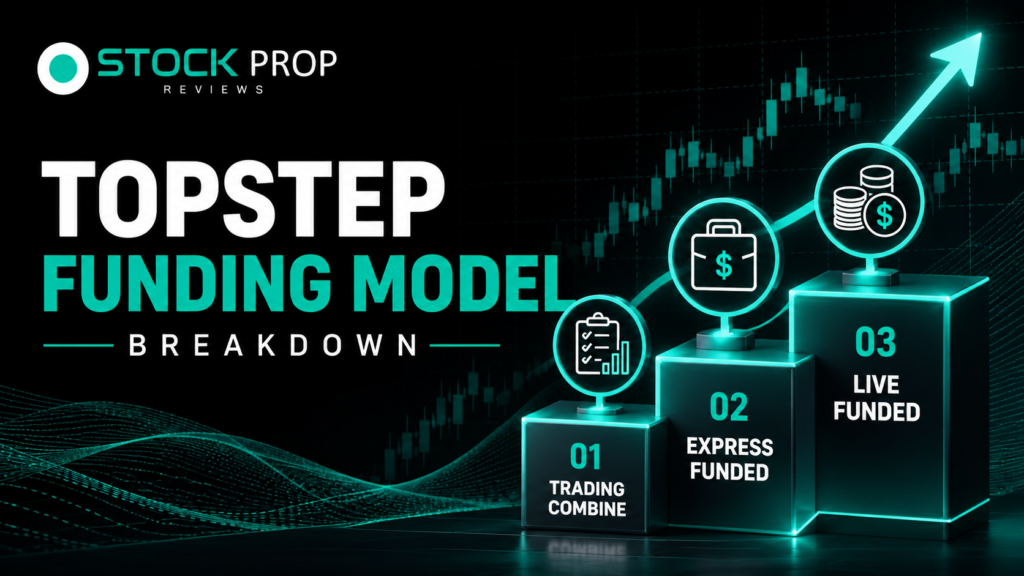
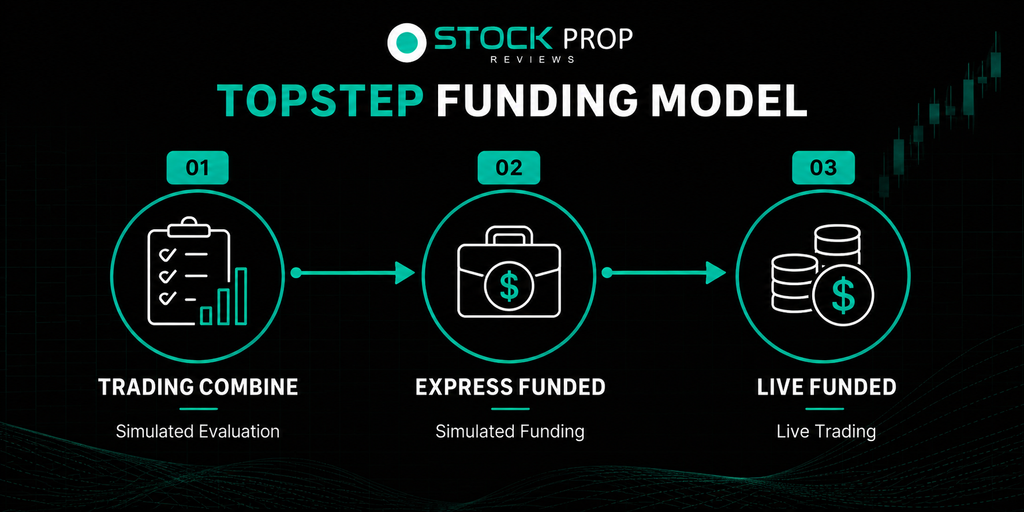
The Topstep funding model is a three-stage futures trading path: Trading Combine, Express Funded Account, and then a Live Funded Account. The important thing is that passing the evaluation does NOT mean you are trading live firm capital right away. The Trading Combine and Express Funded Account are simulations, and the Live Funded Account is where Topstep says traders graduate to real, firm-backed capital.
This model is most suited to futures traders with a repeatable strategy in place, an understanding of position sizing and can work within a relatively narrow drawdown. It doesn’t work well for traders that need a large cushion to handle normal strategy volatility, depend on large winning days, or think that a $50K account label means that they have $50,000 of practical loss capacity.
Quick verdict on the Topstep funding model
Topstep has one of the more clearly defined futures funding structures, but the headline account size can be misleading if you do not study the risk limits.
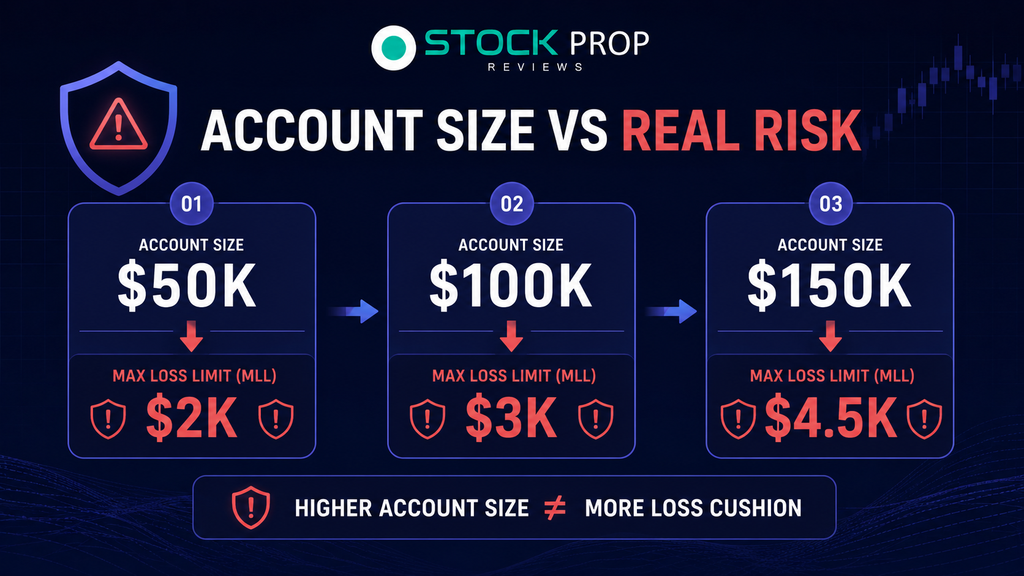
The current model gives traders three account sizes: $50K, $100K and $150K. The Trading Combine has a trailing Maximum Loss Limit of $2,000, $3,000 and $4,500 respectively. Profit targets are $3,000, $6,000 and $9,000. Maximum contract limits are 5, 10 and 15 contracts.
That means the actual trading problem is much closer to managing a small risk budget than managing the advertised account size.
My view is that Topstep makes sense for disciplined futures traders who want a structured route toward funded trading. It becomes much less attractive for traders whose strategy needs deep drawdown tolerance or highly concentrated risk.
How the Topstep funding model works
The structure is easier to understand if you ignore the marketing term “funded” and look at what happens to your account at each stage.
1. Trading Combine
The Trading Combine is Topstep’s evaluation. It is simulated and uses real-time market conditions. You choose a $50K, $100K or $150K account and must reach the relevant profit target without allowing the account to hit its Maximum Loss Limit.
The current targets are:
| Account | Monthly Standard Cost | Profit Target | Maximum Loss Limit | Max Contracts |
| $50K | $49 | $3,000 | $2,000 | 5 |
| $100K | $99 | $6,000 | $3,000 | 10 |
| $150K | $199 | $9,000 | $4,500 | 15 |
Topstep also offers a higher-priced No Activation Fee path. Current listed prices are $95, $149 and $229 per month for the three account sizes. The standard path carries a $149 activation fee when you earn an Express Funded Account.
The subscription automatically renews every 30 days until you pass and earn an XFA or cancel it. There is no fixed deadline for completing the Combine.
2. Express Funded Account
This is where one of the most important Topstep details gets overlooked.
The Express Funded Account is still simulated. You are not immediately trading live market capital after passing the Combine. Instead, you trade the XFA, build qualifying performance and request payouts while working toward the Live Funded Account.
The XFA starts at a $0 balance, with the Maximum Loss Limit allowing the balance to go negative by the applicable amount. For example, a $50K XFA has a $2,000 MLL, while a $150K XFA has a $4,500 MLL.
This is a major distinction from a traditional brokerage account.
A trader passing a $50K Combine does not suddenly receive $50,000 that can be lost. The account’s practical risk boundary is the $2,000 MLL.
3. Live Funded Account
The last step is the Live Funded Account.
In October 2023, Topstep’s Live structure lets a trader start trading with 20% of their eligible starting balance. The rest is held in reserve and released slowly as profit milestones are reached. We review capital growth weekly.
The Live account does not therefore just provide the full account balance advertised on day 1.
This is a reasonable approach from a risk management point of view, but traders should be aware of the difference before assuming that a $100K Live account means that they have $100K readily available to trade.
Topstep drawdown and risk limits explained
The Maximum Loss Limit is arguably the most important part of the Topstep funding model.
For the current Trading Combine, the MLL is:
| Account | MLL | Profit Target | Target-to-MLL Ratio |
| $50K | $2,000 | $3,000 | 1.5:1 |
| $100K | $3,000 | $6,000 | 2:1 |
| $150K | $4,500 | $9,000 | 2:1 |
The MLL trails upward as the end-of-day account balance increases, but it does not move back down. It is monitored in real time, and both realized and unrealized P&L can count toward the limit.
This creates a common psychological trap.
Suppose a $50K trader makes $1,500 early in the evaluation. The account reaches $51,500 and the trailing MLL rises with it. If the trader subsequently gives back a large portion of those gains, the available cushion can become much smaller than expected.
A strategy that looks comfortable when measured against the original $50,000 account size can become uncomfortable once the trader’s actual distance from the MLL is considered.
That is why experienced traders should calculate risk from the drawdown limit, not from the account label.
The consistency rule changes how you should trade
Topstep’s Trading Combine currently uses a 50% consistency target. Your best trading day should remain at or below 50% of the profit target. If it exceeds that threshold, the profit target increases.
For example, the current recommendation is to keep the best day below:
- $1,500 on the $50K account
- $3,000 on the $100K account
- $4,500 on the $150K account
This is important because technically a trader can be profitable and make the assessment more difficult for themselves.
Imagine a $50K trader who earns $2000 on Monday and another $1000 over the next couple of sessions. The total profit is $3,000 but the best day is over 50% of the total target structure. The trader may require more profit than just passing straight away.
This discourages the classic prop firm mistake of trying to get the entire target in one trade or one session.
Topstep payout rules
Once in the Express Funded Account there are currently two payout paths at Topstep.
The standard path requires 5 winning days with a minimum of $150. The Consistency path has three trading days and a consistency target of 40%. The biggest day can’t be greater than 40% of total net profit.
The current XFA payout caps are:
| Account | Standard XFA Cap | Consistency XFA Cap |
| $50K | $2,000 | $3,000 |
| $100K | $3,000 | $4,000 |
| $150K | $5,000 | $6,000 |
The standard profit split is 90/10, meaning the trader keeps 90% of eligible profits. Topstep also notes that traders who joined the new dashboard before January 12, 2026 receive 100% of their first $10,000 in lifetime profits before the 90/10 split applies.
One important detail is that XFA payout caps are not the same as Live account payouts. Topstep says Live Funded Account payouts are not subject to the same dollar cap.
What competitors often don’t explain
The biggest omission in many Topstep funding explanations is the difference between buying power and usable risk capital.
A $150K account has a $9,000 Combine profit target and a $4,500 MLL. You cannot treat the $150K headline figure as though you deposited $150,000 with a broker.
The second issue is that passing is only part of the process.
A trader can pass the Combine and then lose the XFA before establishing a sustainable payout routine. That is where many challenge strategies fall apart. The trader changes behaviour after passing, increases size because the account is now “funded,” and gives back the edge that got them through the evaluation.
The third issue is payout psychology.
A trader who has made $3,000 may feel successful, but if they immediately increase size because they want another $3,000, the risk profile changes. The objective should shift from proving that you can make money to proving that you can repeatedly protect money.
Topstep’s current Scaling Plan also adjusts maximum position size according to the XFA balance. The maximum contract limit does not increase during a trading session when a threshold is reached, which can matter to traders who plan their size around intraday account growth.
How traders actually fail Topstep
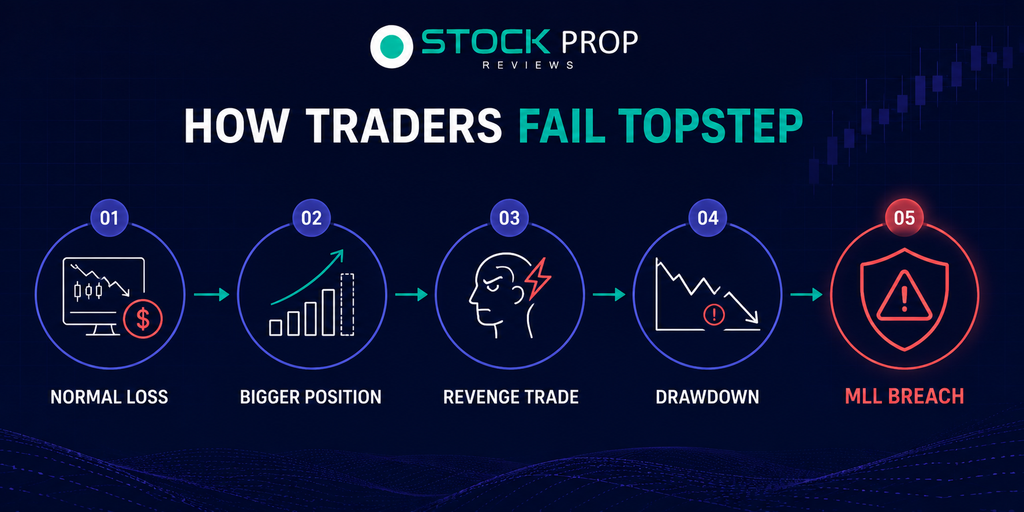
The most common failure pattern is not a single bad trade. It is usually a sequence.
A trader takes a normal $300 loss. They want to recover it quickly, so the next position is larger. That trade loses another $500. The trader moves from following a system to managing the account balance emotionally.
Then comes the revenge trade.
On a $50K account with a $2,000 MLL, four or five oversized decisions can consume most of the practical risk budget surprisingly quickly.
Another common failure is treating unrealized profit as permission to increase exposure. Because the MLL is monitored during the session, an open losing position can matter even if the trader has not closed it yet.
News and volatility can create another problem. Topstep currently publishes product-specific high-volatility restrictions, including limits affecting instruments such as crude oil, gold, silver and copper.
A futures trader therefore needs to understand not just the general rules but the current restrictions on the products they actually trade.
Who should avoid Topstep?
Topstep is probably not the right choice if your strategy regularly needs large drawdowns to recover.
It is also a poor fit if you trade with highly variable position sizes and depend on occasional outsized winners. The consistency requirements make that approach unnecessarily difficult.
Traders who want to hold positions beyond the permitted trading session should also study the specific trading-hour rules before joining. Live Funded Account positions must be closed before the applicable market close, with Topstep currently requiring positions to be flattened by 3:10 PM CT or earlier for products with an earlier close.
Finally, traders should check eligibility before paying. Topstep’s current country policy distinguishes between countries that can access an Express Funded Account and those that can also access the Live Funded Account.
Topstep vs other funding models
Topstep’s biggest advantage is specialization. It is designed around futures rather than trying to serve every trading style.
For a trader comparing models, the better question is not simply which firm has the highest advertised account size. It is which firm’s drawdown, payout and execution rules match your strategy.
| Trader profile | Better fit |
| Futures day trader | Topstep |
| Futures trader wanting a structured evaluation | Topstep |
| Stock day trader | Trade The Pool |
| Stock swing trader | Trade The Pool |
| Trader needing broad overnight stock exposure | Trade The Pool |
| Trader who needs very deep drawdown | Neither without careful risk comparison |
For stock traders, Trade The Pool offers a fundamentally different model focused on stocks and ETFs rather than futures. Its current program terms include separate day-trading and swing-trading structures, defined drawdown controls, position-volume restrictions and risk-management requirements.
One clarification is important here: I would not describe TradeThe Pool as a regulated broker. Its own terms identify Five Percent Online Ltd. as the company operating the service and describe the evaluation as a simulated environment.
For traders specifically looking for a stock-focused prop model with published rules and risk controls, however, it is worth comparing the structure directly with Topstep rather than assuming futures and equities funding work the same way.
Readers can get up to 10% discount when purchasing through our TradeThePool link.
For a broader look at how different prop firms structure drawdown, payouts and trading restrictions, our prop firm comparison article is a useful next step. It is also worth reading our Topstep review and funding model comparison before choosing an account based only on the advertised balance.
My view on the Topstep funding model
I like the basic logic of the Topstep model.
The Trading Combine tests whether you can make money without violating the MLL. The XFA then tests whether you can turn that performance into repeatable payouts. The Live stage introduces real capital and a more conservative release of available funds.
That progression makes more sense to me than simply giving traders a large nominal balance and asking them to survive.
The weakness is that the model can still encourage traders to think in terms of account size rather than risk capacity. A $100K account sounds substantial, but the current Combine MLL is $3,000. That is the number a trader should build their risk plan around.
A sensible futures trader might therefore risk only a small fraction of the available drawdown on a normal setup rather than trying to exploit the full contract limit.
The goal should not be to pass as quickly as possible. It should be to trade the same way after passing.
That is the real test of whether the funding model suits you.
A stock alternative worth considering
If your edge is in individual stocks rather than futures, Trade The Pool is a different type of proposition. Its program is built around stocks and ETFs, with both day and swing structures and detailed rules covering exposure, drawdown, position volume and consistency.
It also publishes its risk framework rather than leaving traders to infer the practical limits from marketing numbers.
Readers can get up to 10% discount when purchasing through our TradeThePool link.
The key point is not that one model is universally better. A futures scalper and a stock swing trader should not necessarily want the same funding structure.
FAQs
Is Topstep actually funded or simulated?
The Trading Combine and Express Funded Account are simulated. The Live Funded Account is the stage where Topstep says traders move into live trading with firm-backed capital.
How much can you lose on a Topstep $50K account?
The current Maximum Loss Limit for a $50K Trading Combine is $2,000. The MLL is trailing and is monitored in real time, including unrealized P&L.
What percentage does Topstep pay traders?
The current standard profit split is 90/10, with the trader keeping 90% of eligible profits. XFA payout caps still apply depending on account size and payout path.
Can you make a living with a Topstep account?
It is possible to generate payouts, but the account should not be treated as guaranteed income. The practical challenge is maintaining consistent performance while staying within the MLL, consistency requirements and payout rules.
Is Topstep good for beginners?
It can provide a structured environment for learning risk control, but a beginner should not assume that paying for an evaluation is a substitute for developing a tested strategy. Topstep’s own program includes specific risk and consistency requirements, so inexperienced traders can burn through subscriptions and resets while trying to learn.