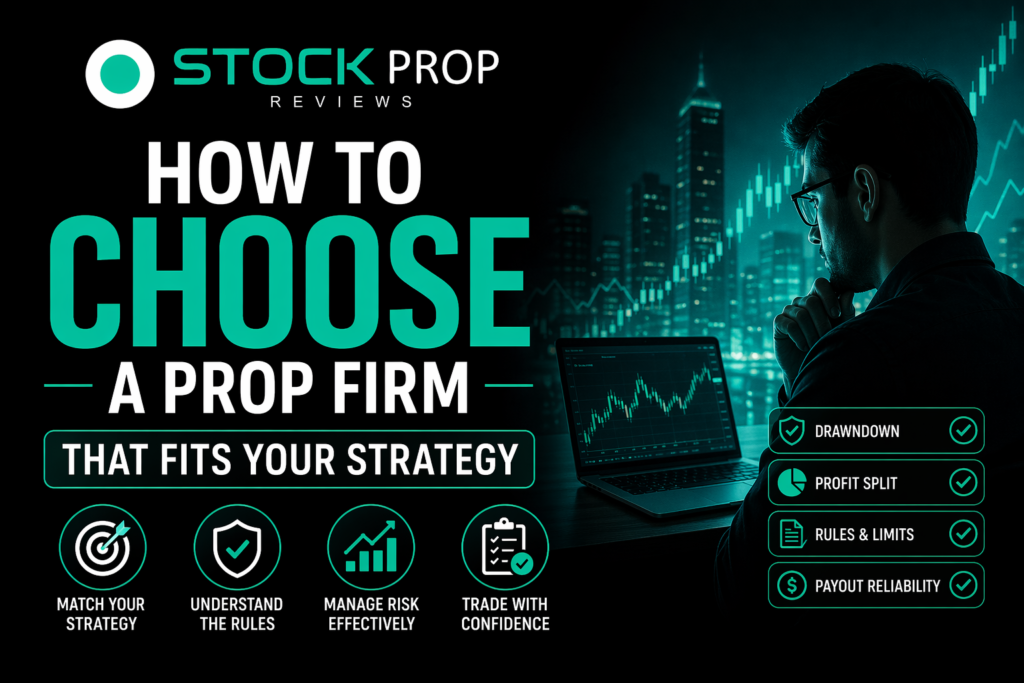
A bad strategy is not the main reason why most traders fail. They fail because they put a good strategy in the wrong prop firm.
If you want to pick the right prop firm, the answer is easy: can you follow their rules without changing the way you trade? If the answer is no, the outcome is already set.
This guide is for traders who have a plan and want to avoid failing at evaluations over and over again. People who want to get money quickly or chase high profit splits without knowing the risks shouldn’t use it.
What choosing a prop firm really means
In simple terms, a prop firm gives you money in exchange for following rules. But in real life, those rules affect how you trade.
They say:
- how much space you have to make a mistake
- how long you can stay in a trade
- how quickly you should do it
So picking a company isn’t the same as comparing brands. It’s a choice about what kind of risk environment your strategy can work in without breaking.
It’s easy to understand: your strategy gives you an edge, but the rules keep you alive.
Why traders get this wrong
Most articles talk about profit splits, discounts, and account sizes. That is the easiest part to compare, but it is also the least important.
A more realistic scenario looks like this:
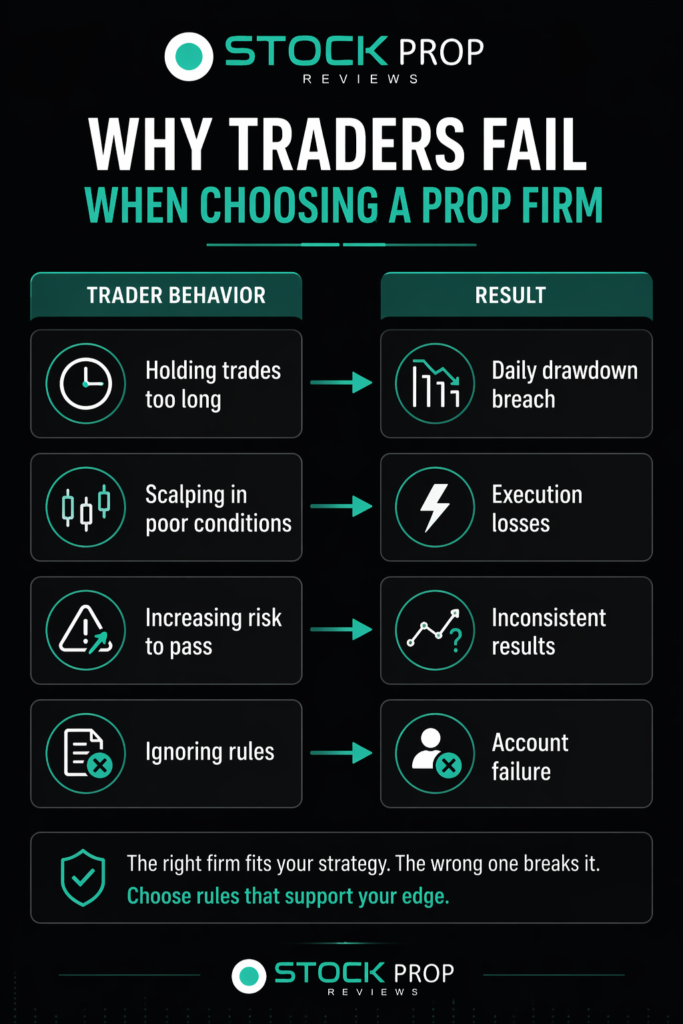
A trader who usually holds trades for two to three days signs up with a firm that has a tight daily drawdown and a trailing equity model. The trade goes slightly negative before moving in the expected direction. The account is breached before the setup plays out.
Nothing was wrong with the idea. The environment didn’t allow it to work.
This is where many traders get stuck. They keep switching firms, thinking the issue is difficulty, when it is actually misalignment.
Start with your own strategy, not the firm
You need to know how you trade before you can compare companies.
You are not ready for a prop firm yet if you can’t answer these questions:
- How much do you usually lose on each trade or session?
- How long do you usually keep your positions?
- How many times a week do you trade?
- Do you depend on quick entries or bigger changes?
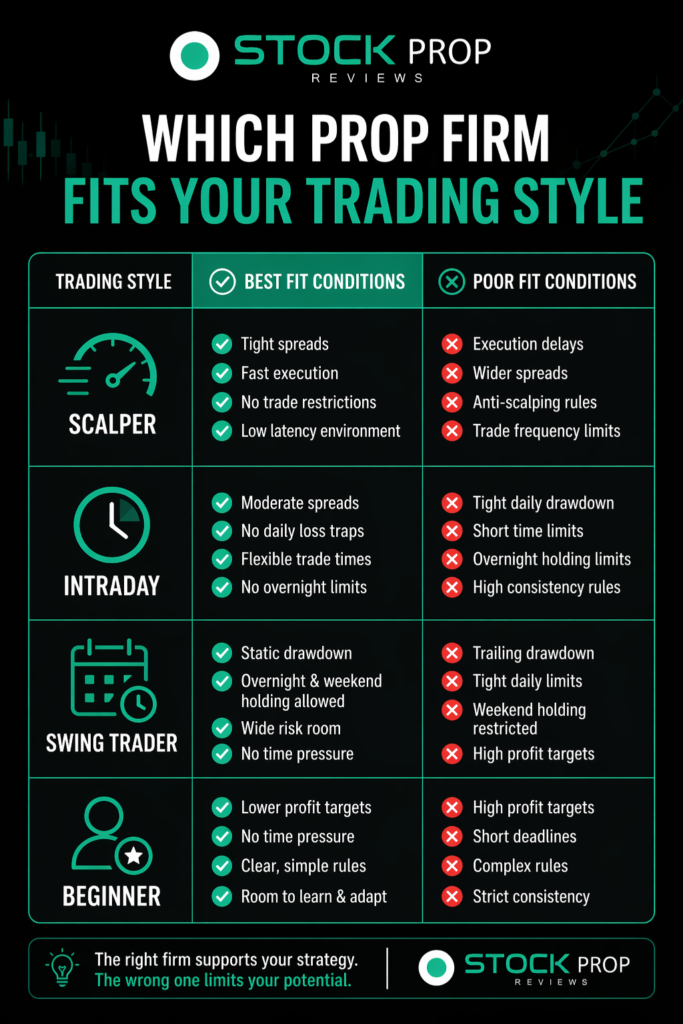
A scalper who makes a lot of trades in a short amount of time will have a hard time at a company that has delays or limits on execution. A swing trader will have a hard time in a structure that punishes short-term losses during multi-day setups.
The company should fit your behaviour, not make you change it.
The drawdown model is where most accounts are lost
Profit split is something that traders often look at first. In reality, drawdown rules determine how long you can last before you get paid.
There are two common ways to build things.
A static drawdown does not change. It doesn’t move if your maximum loss is 10 percent. It’s easier to handle this because your risk stays the same.
As your balance grows, a trailing drawdown moves up. It looks fair on paper. In practice, it can limit how much open profit you can give back. This is a problem for strategies that need space to breathe.
A lot of traders don’t think this is important. They see their profits going up, but the loss they can take gets smaller. One normal pullback could end the account.
You already know why this is important if you’ve ever had a trade go into profit and then go back a little before continuing.
Evaluation pressure changes how you trade
The structure of the evaluation phase can push you into behavior you would not normally follow.
A high profit target in a short time frame creates pressure. Even disciplined traders start increasing position size or taking marginal setups just to meet the requirement.
This is one reason traders pass challenges with aggressive risk and then lose the funded account. The behavior used to pass is not sustainable.
Firms with no time limit or more moderate targets usually allow traders to stay closer to their natural pace.
A simple comparison of rule structures
| Feature | Aggressive Model | Balanced Model | Conservative Model |
| Profit target | High | Moderate | Lower |
| Daily drawdown | Tight | Moderate | Tight but stable |
| Max drawdown | Trailing | Static | Static |
| Time pressure | High | Low | Low |
| Flexibility | Limited | Reasonable | High |
The aggressive model attracts attention because it looks faster. The balanced and conservative models are usually where consistency is built.
What most reviews don’t explain
There are a few things traders only realise after losing a few accounts.
First, rules affect psychology more than expected. A tight daily loss limit can make you close trades early just to protect the account. Over time, this reduces your average win size.
Second, passing an evaluation is not the same as being consistently profitable. Many traders optimise for the pass. They take more risk than usual, hit the target, and then struggle to maintain that approach.
Third, execution quality matters more for some strategies than others. Scalpers are highly sensitive to spread and slippage, but this is rarely discussed in comparison articles.
Common mistakes when choosing a prop firm
One mistake is picking based on price. If you fail a lot, a cheaper challenge won’t lower your overall cost.
Another is thinking too highly of how consistent you are. A lot of traders think they can make a lot of money quickly because they’ve done it before. Consistency is not the same as doing well every now and then.
Another problem is not paying attention to the fine print. If there are rules about minimum trading days, consistency requirements, or position sizing limits, you may not be able to take out your profits.
Matching firm type to trading style
Scalpers need a place where trades go smoothly and there aren’t too many rules. If trades take longer than expected or spreads get wider at important times, the strategy itself stops working.
There needs to be room for swing traders. It’s important to have a static drawdown and be able to keep positions overnight or over the weekend. Without that, a breach can happen because of normal market movement.
Intraday traders have more freedom, but they still need to keep an eye on their daily loss limits. You will always be trading under pressure if your average losing day is close to the limit.
People who are new to something shouldn’t focus on the fastest model. A slower structure with lower goals and no time pressure usually makes it easier to learn.
Evaluation vs funded phase reality
Many traders assume that once they are funded, things become easier. In practice, the pressure just changes.
| Factor | Evaluation Phase | Funded Phase |
| Main pressure | Hitting the target | Protecting profits |
| Risk behavior | Often higher | Needs to be controlled |
| Rule sensitivity | Moderate | Strict |
The biggest shift is psychological. During evaluation, you are trying to prove something. During the funded phase, you are trying not to lose what you have.
If your strategy only works under pressure, it usually breaks when things stabilise.
Who should avoid prop firms
Not all traders gain from this model.
If you don’t have a clear plan and are still trying things out, the limits will slow you down. If you have trouble with discipline or tend to get upset when you lose, the structure will make that worse.
Prop firms value following the rules and being consistent. They aren’t meant to fix behaviour that isn’t consistent.
Alternatives worth considering
It takes longer to grow a personal account, but you have full control. You can manage trades however you want, and no outside rules will tell you what to do.
Some traders would rather work with companies that have more stable conditions, even if they get less of the profit. Stability tends to matter more than headline numbers over time.
There are also companies that only deal with stocks and not currencies. For instance, TradeThePool has clear risk limits and a more organised, regulated way of doing business. This kind of setup can work for traders who value openness over aggressive scaling models.
When readers buy through our TradeThePool link, they can save up to 10%.
How this connects to other prop firm insights
You should have seen how trailing drawdown affects trade management in real life if you read our FTMO review. The FundedNext analysis shows a different way to structure evaluations and payouts.
Our bigger comparison of prop firms shows which models work best with which strategies, and the article on why funded traders fail goes into more detail about the behavioural side.
When you look at these all together, you get a clearer picture. There is more to the rules than just numbers. They have a direct effect on how you trade.
A practical way to decide
Don’t ask which company is best; ask a different question:
If I were already funded under these rules, would I trade the same way?
If you have to change the size of your position, get out of trades earlier than usual, or stay away from setups you usually take, the fit isn’t right.
A good match feels almost like nothing. You stick to your system, and the rules don’t always affect your choices.
FAQs
How do I pick a prop firm that fits my strategy?
First, think about how you trade and how much risk you’re willing to take. Then, look for a company whose drawdown rules and conditions let you trade that way without having to change anything.
Which is more important: rules or profit split?
More important are the rules. If the rules don’t fit your strategy, the profit split doesn’t matter because you won’t always get payouts.
Are trailing drawdown models not good?
Not always, but they are harder to deal with. They need to have more control over open profits, which can limit strategies that need to be flexible.
Why do traders pass tests but not get funded accounts?
They change how they act to pass. Once they get the money, they can’t keep using that higher-risk method all the time.
Is TradeThePool good for people who are new to it?
It can be good for traders who like a structured, stock-based environment with clear rules, but beginners need to have a plan before they join.
When readers buy through our TradeThePool link, they can save up to 10%.
Finding the easiest prop firm isn’t as important as finding one that will give your strategy a stable place to work. Your trading doesn’t need to change if the fit is right. There is no amount of discipline that can make up for when it is wrong.