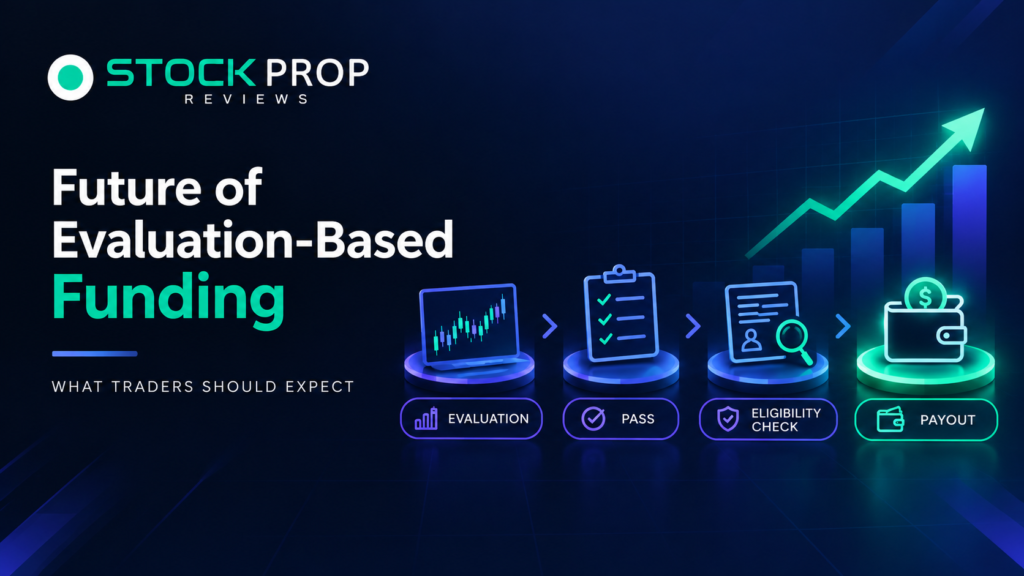
Trader performance, risk management, running costs, and customer trust will be key to the future of funded evaluations. Challenge-based evaluations usually represent the first stage of retail proprietary trading programs, but their sustainability will depend on solid rules, timely payment methods, and workable trading conditions.
Evaluation funding is typically a set of rules regarding a trader’s profitability and risk/capital protection, with a view to progressing to further ‘professional’ trading. Depending on the provider, this can be a one-phase or multi-phase evaluation on trading on new rules post-evaluation.
This model is most suitable for traders with a proven trading system, good risk-reward discipline, and the patience to follow program rules. This is not suited to beginners craving fast moolah, those reliant on oversized positions to hit targets, or anyone without an ability to lose the evaluation fee.
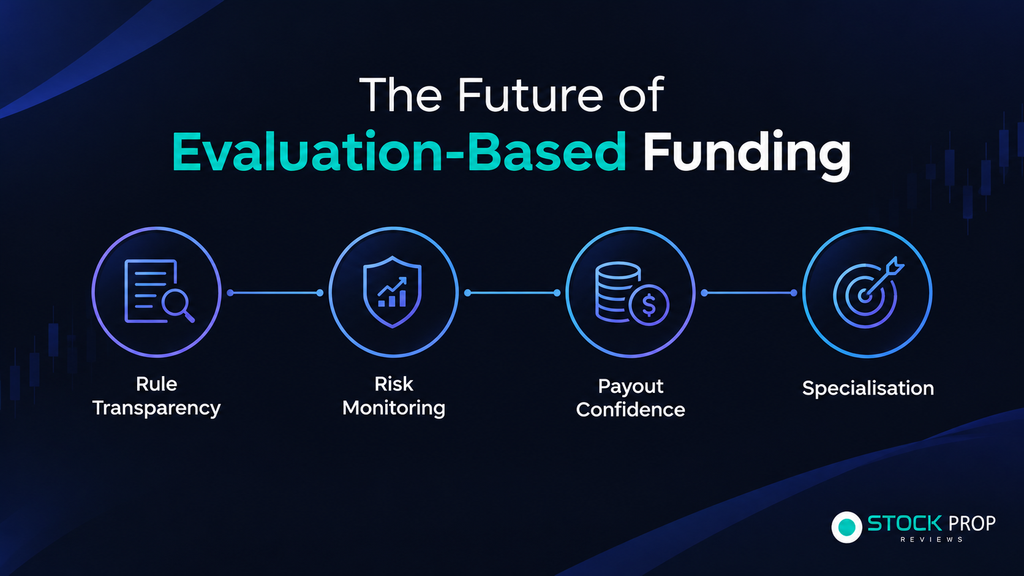
Look for more open rules, targeted programs, improved risk management, and tougher payout conditions by 2027 and beyond. These are reasonable industry expectations, but they are not certainties.
Traders should know better than to chase the biggest advertised account or profit.
What Is Evaluation-Based Funding?
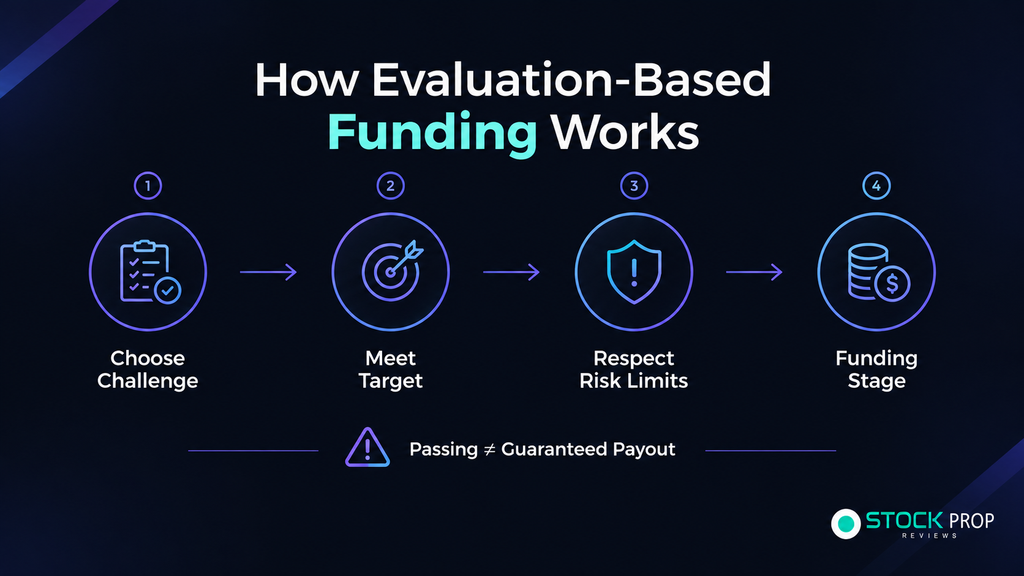
Evaluation-based funding is a proprietary trading program where the trader has to demonstrate that they can trade within the performance and risk parameters to advance to the next level.
Simulations often include a profit target, maximum drawdown per day, maximum drawdown overall, and activity limits, among other parameters. Other programs also include minimum trading days, consistency requirements, position limits, or requirements related to news events and overnight positions.
Read the fine print: They vary by program, account, and market. Drawing down, for instance, may be an apples-to-oranges comparison for futures and stock programs when compared to forex and CFD programs.
One such difference is the lack of an obligation to grant a trader with a live capital after passing an evaluation. Many retail prop programs utilize simulated trading events as well as terms of contracts as to the reward. Traders should not assume the stated account balance is deposited money for them to use but should examine the account structure and pay-out terms.
These differences will continue as business changes. It should be clear to traders what they are buying, how they will be evaluated, and what happens if they succeed.
Five Trends Shaping the Future of Evaluation-Based Funding
1. Greater Transparency in Trading Rules
Transparent rules will likely drive prop firm selection. Profit splits and account sizes in advertisements are not a good proxy for the difficulty of a program.
E.g., two ratings that have the same profit target. One has a fixed drawdown, the other has a trailing drawdown that tracks the account equity or profits. A trader that goes into profit sometimes could pass the first program but fail the second one.
The difference can make or mar a strategy evaluation.
Firms will have a better chance of making traders care about drawdown calculations, payout eligibility, termination conditions, and forbidden strategies. Companies that are upfront about these conditions may have a greater competitive edge over providers that are ambiguous with their marketing claims.
But rules alone will not do. The real question is whether the rules are followed and effectively narrated in borderline cases.
2. More Flexible Evaluation Structures
The co-existence of one and two step challenges with custom trading programs and instant funding is a phenomenon we should expect. The structures are appropriate for different trading styles, and there is no real reason to think that one formula is going to displace the rest.
A successful longer-term trader might prefer an assessment with no cutoff. An intraday trader with a clear trading strategy may prefer a shorter evaluation with loss limits.
Some providers may try experimenting with different profit targets, minimum days of trading, and payout schedules. Such changes could provide traders with more choice, but flexibility does not necessarily mean better value.
A program with many exceptions and complex rules could prove harder to trade than an easier challenge at a fractionally higher price. Traders should read all the rules and should not make their account choice based simply on the ‘headline target.’
3. Greater Focus on Payout Confidence
Industry reputation will focus on payout conditions. However, an advertized profit split that is very high will not get you far if there is a lack of clarity for traders about what makes a trader ‘eligible’ to withdraw (threshold levels, how consistent you need to be, the process to review the trader, etc.) or what might prohibit payout to a trader.
Peer pressure within the industry will likely increase the demand for better comparability of these conditions. However, traders should distinguish a published payout policy or promotional payout announcements from independently verifiable proof of good performance.
A handful of screenshots does not prove an outfit consistently honors all eligible withdrawals. Much more useful is to look at the terms of contract, method of dispute resolution, past major changes in policy, and ease of the withdrawal process.
There is no provider that can promise a pay out to all traders. However, when there are eligibility criteria, the traders at least know what they must do to become eligible, rather than paying for the evaluation entirely blind.
4. More Sophisticated Risk Monitoring
Trading platforms can track account equity, position sizes, exposure, and trading activity. They can also be further refined by prop firms to automate risk checks for violations and Pv servers to monitor trading activity and ensure program rules are followed.
This approach would be more consistent, but the downside would be misunderstanding how traders interpret the assessment of their position(s).
For example, a trader might open three highly correlated positions and believe each one is an acceptable risk. But if the market moves strongly against all three, the total loss may be much larger than anticipated.
A company monitoring overall exposure may look to the three together, rather than trading them separately.
Traders need to be aware of how open and floating positions, correlated instruments, and automated strategies interact with the programme’s limits. These requirements should be clearly communicated by companies and fair appeal processes provided for suspected rule violations.
5. Greater Specialisation by Asset Class
Forex has different market structure, trading hours, margin arrangements and execution characteristics to CFDs, futures and stocks. Benchmarks that traders use for one asset class will not necessarily be appropriate for another.
Take publicly traded companies, for instance. Futures traders may be interested in trailing drawdowns and contraction limits. Stock traders may be interested in liquidity, short-sell limits, and market session rules. Foreign exchange traders may be more concerned with spreads, overnight fees, news barriers, and weekend holding.
Specialization may become more attractive as traders try to find conditions that they can exploit.
Specialization does not make a firm more dependable, however. Traders should, therefore, still check the terms of the contract, trade environment, total charges and payout conditions.
What Competitors Often Miss About Evaluation-Based Funding
Most of the guides that introduce you have sections on evaluation stages, good profit points, and the differences between instant funding and challenge programs. These are good starting points, but they don’t explore the economics and practicalities of account management.
Passing Is Not the Same as Earning Consistent Payouts
Passing an evaluation only proves that a trader met the criteria of an evaluation. This does not mean that a trader will be able to repeat this performance in other market conditions and payout periods.
A strategy may work in a trending market but not against contraction in volatility or some sort of dithering price action. Going forward the trader may be faced with very different challenges as conditions improve.
Traders should rather be judged on something repeatable and somewhat risk-bound across a sufficiently wide range of states of play.
Repeated Challenges Can Become Expensive
The cost of taking a shot at an assessment should be a little more precise than it seems.
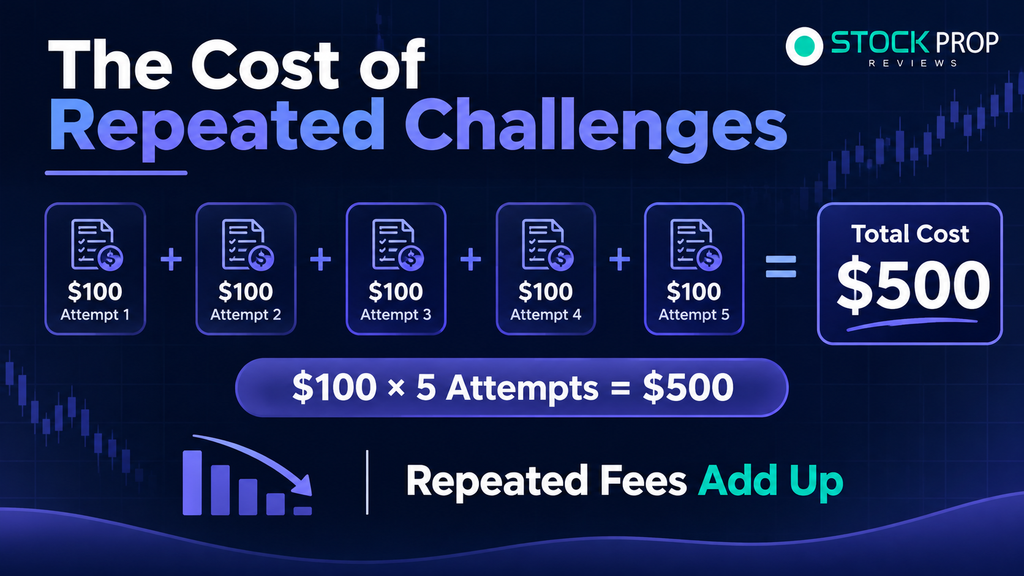
For example, a trader pays $100 to fail at a challenge. Then the trader buys another 4 tries at the same price. That’s $500, ignoring the platform fees, outright resets, and so on.
If all failures are a result of the same behavior (such as scaling your size up after a loss), then buying another evaluation isn’t fixing the root cause of the failures.
If traders want to pay money to challenge themselves again, they need capture of what went wrong in each application, to emphasize repeat mistakes and to take a measurement of improvement:
A Profitable Strategy May Not Fit the Rules
Sometimes a strategy may be profitable in a personal brokerage account but not suitable for a given evaluation.
A hard news-trading limit can hurt a trader who trades on the basis of major economic announcements. A swing trader with a strategy that has deep temporary drawdowns may hit a trailing-loss limit before the trade eventually recovers.
This does not necessarily mean a poor strategy. It could be an indication that the strategy is not compatible with the rules of the program.
Before purchasing an evaluation, traders should ask if their typical entry, exit, holding-period, and risk-management strategies align with the actual rules.
The Business Model Matters
Prop firms have tech, staffing, marketing, platforms, and other expenses and risks to cover. Evaluation fees are able to be a big revenue stream, but the economics can differ from provider to provider.
Without reliable financial disclosures, it is difficult to believe that there are no failed traders at all and that one business model will be victorious in the future.
For traders, the question is pragmatic: can the firm provide its services and communicate changes effectively and honor the contracts it enters? Neither fame nor social media presence is an indicator of financial viability.
Common Mistakes Traders Should Avoid
Changes in industry will not eliminate behavioral errors that can lead to failure of evaluation. Traders should not select accounts based on advertised size alone, ignoring drawdown calculation, or risk repeated reset fees without checking results.
Other mistakes include assuming a large profit split is a better deal. The split is relevant, but withdrawal thresholds, account restrictions, and whether the trader is likely to be able to meet the conditions without excessive risk are also important.
Traders should also retain a copy of the terms of the relevant program and watch for announcements of material changes. They should be aware of the terms at the time they bought their evaluation and if changes are retroactive to existing accounts.
And most importantly, do not mistake simulated profits for guaranteed income. Passing a challenge does not entitle you to enter another program, access more accounts, or receive future income.
Who Should Avoid Evaluation-Based Funding?
Evaluation-funded accounts may not be ideal for traders in need of cash on the spot, those who can’t pay an entry fee they’re liable to lose, or traders who are not well-versed in back-testing their strategies.
Evaluation-based funding may also be unsuitable due to strategy restrictions. A strategy that depends on rare news events isn’t going to be suddenly suitable just because it backtests outstandingly.
Revenge traders bring additional risks. Wanting to make a target amount of profit after a losing session can foster bigger and lower-quality setups. Rather than correcting these habits, a rigid evaluation framework can work against them.
Prior to making a challenge purchase, traders would do well to question whether they’d be able to follow the rules comfortably under normal market conditions. If the program requires them to abandon their normal method of managing risk, then another funding model or private brokerage account may be warranted.
Alternatives Worth Comparing
The three providers illustrate different options for traders to consider. Compare their existing program terms.
The5ers: This could offer alternatives to forex traders who are seeking structured evaluation programs. Company-specific payout terms, profit targets, including drawdowns.
FTMO: If you have a specific evaluation process in mind, compare it with your requirements. Account type, allowed instruments, loss limits, and trading conditions.
TradeThePool: A stock-focused alternative for traders whose strategies centre on equities rather than forex or futures. Its programme terms describe simulated evaluation trading, eligibility reviews, and conditions for receiving rewards. Its terms also state that the company is not a financial institution operating under the supervision of financial regulatory authorities. Traders should not assume that a stock-focused programme is a regulated investment service.
For further research, readers can compare the StockPropReviews articles on the FTMO review, the FundingPips review, and the reality behind the funded trader lifestyle.
For readers considering TradeThePool, readers can get up to 10% discount when purchasing through our TradeThePool link. Check the current offer and programme conditions before paying. A discount reduces the entry cost, but it does not eliminate the risk of losing the evaluation fee.
FAQs
1. How long will evaluation-based funding last until 2030?
It is likely to be a big part of retail prop trading, but its longevity and shape will depend on the robustness of the business model, the clarity of the rules, our view of risk, the reliability of payouts, and the level of competition from other business models. No prediction will be guaranteed, and the current model is not destined to dominate.
2. Will prop firms provide easier evaluations?
Some providers will try to sweeten the deal by changing targets, deadlines, or account structure to appeal to a specific type of trader. But easier entry criteria do not always mean easier payouts. Programs must be evaluated based on their overall rules and not just by their target profit amount.
3. Is evaluation-based funding better than instant funding?
The two models are more appropriate for different scenarios. Instant funding is better for traders who don’t want to go through a challenge phase and evaluations are better for those wanting to benchmark their performance first. Your best fit is determined by strategy, payout terms, drawdown metrics, and overall cost.
4. What is the greatest risk of evaluation-based funding?
From a practical viewpoint the biggest risk is accumulating evaluation fees and never ending with a repeatable trading process. A small cost early on can turn into a large amount with multiple drawdown violations, emotional trading, misunderstood rules, and wrong strategies.
5. How to avoid prop firm evaluations in the future?
log your performance and rule adherence, read all program terms, know your risk before you take a trade, and master a winning strategy. Judge providers by contract terms, not marketing, and don’t count on shady review income for your unavoidable expenses.
Final Outlook
The future of the evaluation top-up will be less about the size of the account they tout and more about your ability to get your head around their rules, governance / risk management, and fair treatment under the stated terms and conditions.
Of course the challenges may be a regulated way of demonstrating trading skill, but they are not going to give you a guarantee of getting live capital, payout, or sustainable results. But that also is the dilemma faced by the firms, weighing whom they create as customers to costs, risks, and trust.
Smart preparation of traders is common sense. Select a program that suits your trading style, understand the calculation of losses, and know the full cost of participating. A program with great benefits can be wrong for you before you know it, particularly if the risk of chasing a target from evaluation is too high.
Companies with clear terms and delivering on those terms are designed to earn a higher degree of trust from repeat traders. The next few years of trading funding models will be a great time for traders with reasonable expectations and repeatable returns.