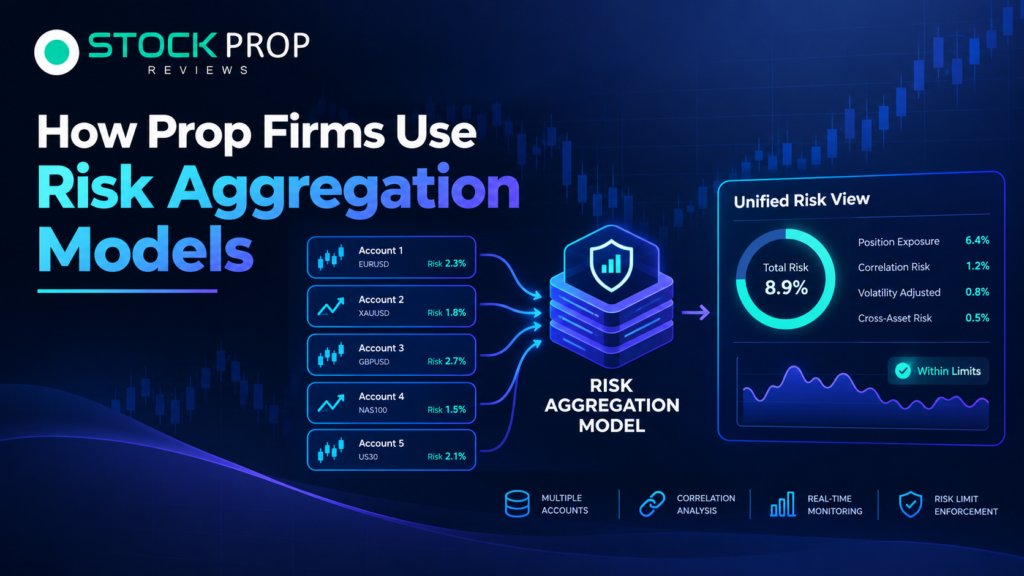
Prop Firm Joint Risk Models: In prop firm risk, models help prop firms aggregate joint risk across multiple traders, accounts, instruments, or strategies. Rather than quantify risk on a position-by-position basis, firms can aggregate risk to see correlated losses, extreme directional exposure, and potential drawdown events.
It is intended for funded traders, challenge participants, forex and futures traders, and anyone interested in the risk management practices of proprietary trading firms. It is not for traders hoping to game the risk controls. The bottom line: Don’t just look at compliance for a single account, but the big picture of firm exposure, especially if a lot of traders are using similar strategies.
The trader, by appreciating risk aggregation, can evaluate the firm guidelines and controls, correlated positions, and the contrast between individual limit control and firm risk management.
What Are Prop Firm Risk Models?
Risk aggregation model Risk aggregation or netting is the process of aggregating multiple positions or funds to view how market changes affect a larger-than-individual portfolio. Depending on the business model of the firm, it may consider position size, leverage, volatility, correlation, margin requirements, and potential losses.
For example, a company may have 100 traders with small positions in a single pair. Each individual account may be within individual risk limits, but a sudden market move may affect multiple positions at once.
Risk aggregation can alert you to such concentration before it becomes a greater problem.
Three key concepts:
- Individual risk: Possible loss on a trade or account.
- Aggregated risk: Total exposure to a combination of positions, accounts, or instruments.
- Portfolio risk: The possibility that several exposures produce losses together.
These measures are related but not the same. The addition of position sizes does not provide a full measure of risk because the sensitivities of the instruments are different, and instruments may offset actual positions.
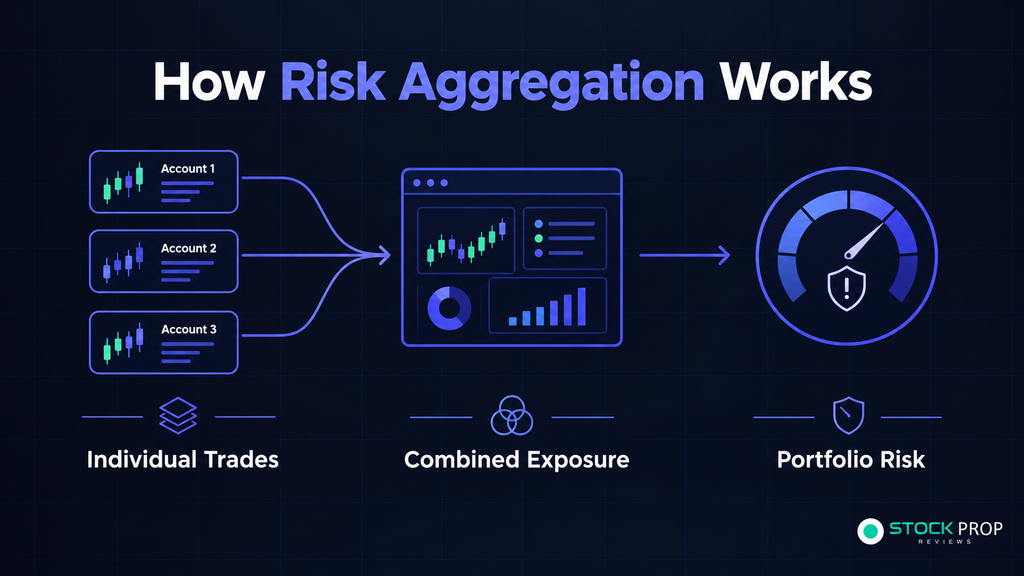
How Risk Aggregation Works Inside a Prop Firm
More broadly, risk aggregation deals with how to aggregate trades, convert positions to comparable measures of exposure, establish concentrations, compute potential loss, and create controls.
This depends on the firm. For example, a simulated assessment firm may rely on account compliance and trader behavior for their assessment, but a firm that had trades picked into the live market may have exposure to execution, liquidity, and other exposure to outside markets.
1. Collecting Trading Data
This begins with data on open positions, open orders, types of instruments, position sizes, account equity, unrealized profit and loss.
A firm may also monitor leverage, margin used, drawdown, and trading activity around major economic releases. These inputs allow risk teams to know where the exposure is and where it can go.
Data quality is crucial. Wrong position, wrong contract specs, and late prices are misrepresenting risk estimates.
2. Measuring Combined Exposure
Position size doesn’t tell you the risk of a trade. The economic exposure from ten lots of one instrument can be different from ten lots of another.
Risk teams can use exposure, price sensitivity, or shared market exposure. Forex positions should consider currencies, and futures positions should consider tick sizes and contract multiples.
Consider two traders: Long EUR/USD and short EUR/USD. They can partially offset each other (subject to size and clearance arrangements). If they are net long versus most traders, the firm may be directionally concentrated.
The key point here is to measure economic risk, not trades.
3. Identifying Correlation
Correlation is a measure of the extent to which assets or strategies move together. It can show when otherwise disparate positions are subject to the same underlying market forces.
For example, an investor who owns shares in the Nasdack 100 and the S&PT 500 will be in two separate indexes. But if stocks in the US are down in general, then they will be down.
We would have had the concentration risk if we had assumed 100% independence in the risk model.
Correlated actions. Correlations among instruments do not remain fixed and tend to snap when the market gets really volatile. There is no guarantee that past performance will be repeated in future behavior.
4. Estimating Potential Losses
Through exposure measurement, companies can establish risks under diverse market conditions on a potential loss.
Techniques include VAR, Expected Shortfall, scenario analysis, and stress testing. Stress tests look at hypothetical shocks, such as a surprise drop in the index. Scenario analysis rules out such events as unexpected interest rate changes, no liquidity, etc.
VaR estimates the loss size over the period and at a confidence level. Expected Shortfall estimates the expected loss beyond a VaR cutoff.
No method considers all possible outcomes. Models based on past behavior may not reflect changes in market forces, and hypothetical situations may overlook some eventualities. As such, firms may use multiple measures rather than a single risk measure.
5. Applying Risk Controls
Risk monitoring must feed decision-making if it is to be useful. Each firm has its published operating model and rules on exposure caps, position limits, leverage limits, drawdown limits, any manual reviews, or any changes of trades into copied live markets.
Not all firms use all of these controls. Some focus almost entirely on fixed limits on a per-account basis; others track aggregate risk or particular trader strategies as well.
An internal risk alert is not in itself a rule violation. Traders sometimes must review the relevant contract and published constraints to determine whether an action is permitted.
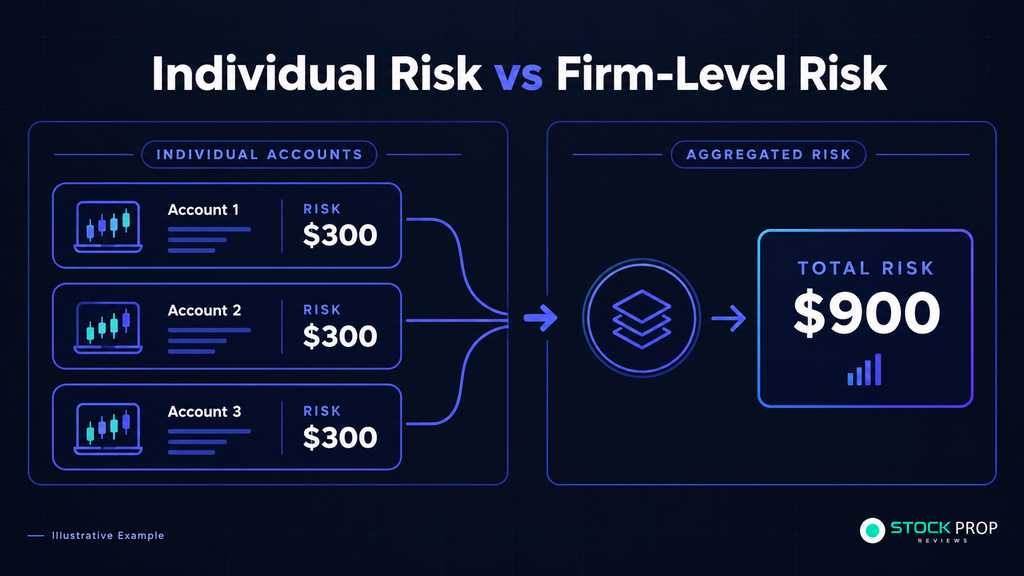
Account-Level Rules vs Firm-Level Risk
Account level rules refer to restrictions on the trader when trading e.g. max draw down, daily loss, positions. Firm-level risk aggregation is aggregation of trades between accounts and strategies.
Let’s say you have 3 traders, all of whom can lose $300 on similar positions in the market. The combined loss potential of all losing positions could be $900.
This is an example of marginal risk, not a statistical buy. The actual risk of the portfolio depends on the direction and correlation of positions, hedges, and executions.
That distinction is important, because a trader may be in compliance with the rules for one account but be responsible for increased concentration of exposure in the firm’s trading as a whole. But mere aggregation is not in itself misconduct or a ground for sanction. Again, the breach has to be assessed under the firm’s policy statements in the contract terms to enforce any.
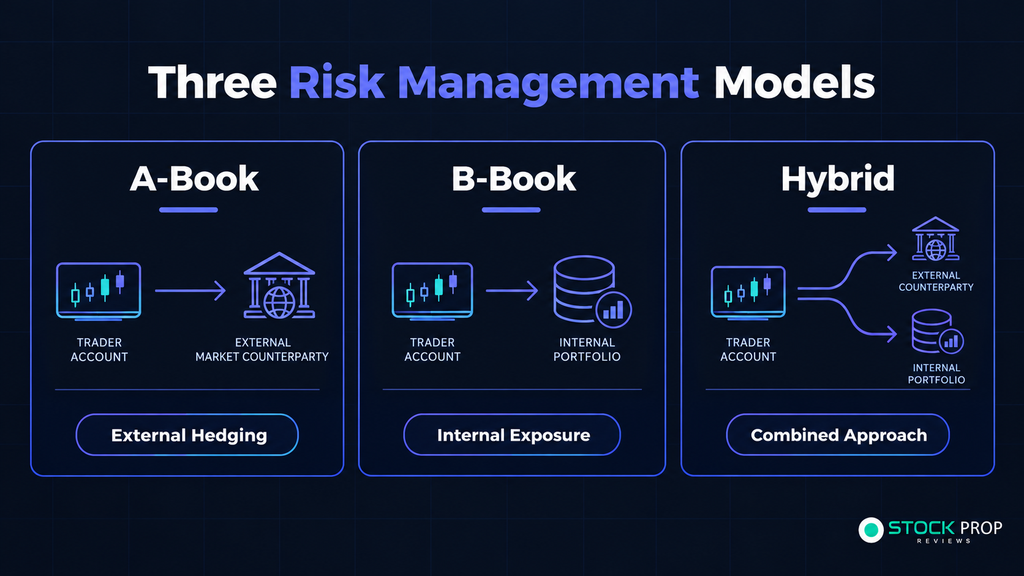
A-Book, B-Book, and Hybrid Risk Models
A firm’s handling of exposure also depends on whether trading activity is passed to external counterparties, retained internally, or managed through a combination of approaches.
| Model | General approach | Key risk consideration |
| A-book | Relevant exposure is hedged or transferred to an external counterparty. | Execution costs, slippage, and residual exposure |
| B-book | Exposure is retained internally rather than fully hedged externally. | Concentrated exposure and adverse market outcomes |
| Hybrid | Different positions or accounts receive different treatment. | Routing decisions and incomplete offsets |
Such are common terms for forex and CFD brokers. In a proprietary trading firm, they mean what they mean, depending on the actual firm setup.
Simulated evaluation accounts may not represent money in real markets. A firm may be obligated under contract to cover the reward and operating costs. Managing risk factors increases for a firm with live copy trading.
So traders shouldn’t assume that all challenge trades are filled or that an old-school A- or B-book model prevails at all prop firms.
What Competitors Often Leave Unclear
Many risk management articles discuss stop losses, position sizing, and personal drawdown limits. These are valuable topics, but they don’t address the relationship of trader risk to business risk.
Trader risk and business risk are different. Drawdowns and strategy exposure are managed on a per account/trader basis. Firms also need to consider payout obligations, technology, liquidity, and correlated results of many accounts.
Simulated funding is not the same as live trading capital. Headline account balances may not reflect the firm’s true market exposure. In practice, the balance implications depend on the account agreement and funding arrangement.
Risk alerts are not proof of rule violations. Public indicators or trading major indices can lead traders to take similar positions in response to common economic phenomena. Not all similarity is concerted abuse.
These differences allow traders to test risk management assertions without assuming that sophisticated portfolio analytics are employed by all firms or that internal reviews are reliable indicators of wrongdoing.
StockPropReviews can support this section with relevant internal links using partial-match anchors, such as how prop firms make money, the FTMO account rules, FundingPips reviews, and the gap between prop firm marketing and reality.
How Risk Aggregation Affects Traders
Risk aggregation has several practical implications for everyday trading.
Correlated positions can increase exposure
Nasdaq 100, S&P 500, and another tech-heavy index all together sounds like diversification. In a broad equity sell-off, however, all three positions could lose money in tandem.
Traders must calculate their total market exposure and not view each instrument as a disjointed trade.
Multiple accounts can multiply risk
You open several accounts for the same strategy, but you are not eliminating any of the risk. If all accounts are opened the same way, move the same way, and are stopped out at the same level, then a bad move goes along with all of them.
But before you add another account, ask yourself if it really represents a diversification of the strategy or whether it just represents a greater amount being exposed to the same market action.
Individual drawdown limits remain important
Firm-level trading statistics do not absorb the norms of the rules of a personal account. So a trader may breach a daily loss limit even when the firm’s aggregate position is acceptable.
The reverse could be the case: A compliant account could contribute to a further concentration of traders at the firm. Whether this will prompt any action will depend on the stated terms and policies of the firm.
Market stress can invalidate estimates
Risk models that rely on normal market conditions may be insufficient to capture the impact of liquidity disruption and price gapping after a market-moving announcement. Although you may set a stop loss, it is not guaranteed that your price will be filled, and realized losses may be higher due to slippage.
For this reason, position size should be calculated based on realistic adverse scenarios, not standard risk calculators.
Common Trader Mistakes
Make betting a fun numbers game leading to reason and based on your bankroll, affordable losses, and more. A natural misstep is to think of the headline price of your account size versus thinking of what you can afford to lose before you break the rules.
For example, a $100,000 account with a 5% maximum loss rule has a $5,000 loss budget. (Note, this does not mean the trader can risk $5,000 on a single trade.)
Other errors are treating correlated instruments as separate markets, repeating the same risk on many accounts, bloating position size after a winning streak, and assuming controls at a given firm will guard against all losses.
Traders should not assume all proprietary firms use the same monitoring technology. Even if a firm’s risk methodology is proprietary, its rules could be public knowledge.
How to Evaluate a Prop Firm’s Risk Transparency
Before purchasing a challenge, examine the firm’s terms and understand how it calculates losses and enforces restrictions.
| What to check | Why it matters |
| Daily and maximum drawdown | Defines the account’s loss boundaries |
| Static or trailing drawdown | Explains how the loss allowance changes |
| Position and exposure limits | Identifies restrictions on trade size |
| Copy trading and multiple-account rules | Clarifies whether shared strategies are permitted |
| News and holding restrictions | Helps prevent accidental breaches |
| Review and appeal procedures | Explains how disputed decisions are handled |
For stock traders, TradeThePool may be worth comparing with other providers if its instruments and account conditions suit the intended strategy. Review its current terms, risk rules, and legal disclosures independently. Do not assume that clear rules automatically mean a provider is regulated.
Readers can get up to 10% discount when purchasing through our TradeThePool link. This offer does not guarantee trading success or payouts.
FAQs
What Is a Prop Firm Risk Aggregation Model?
It combines risk from positions, accounts, instruments, or strategies to calculate overall risk and point out concentrations that would not be reflected in single-account metrics.
Are risk aggregation models in use at all prop firms?
No. The monitoring methods vary. Some use account-level rules, whereas others may use correlation and portfolio analysis and exposure limits. These internal methods are not always disclosed.
Does aggregated risk mean a trader violated a rule?
Although aggregated risk may be relevant to internal decision-making in the firm, it would not itself be a breach of a rule. Enforcement action must be based on the relevant agreement and published rules.
What is the difference between A-book and B-book risk management?
B-book risk management internalizes the exposure; A-book risk management hedges or externalizes the exposure. Hybrid models are a mix of approaches. Such labels alone do not guarantee the reliability or past payouts of a firm.
How do traders reduce correlated risk?
Add exposure across correlated instruments, stay within a position size that you can afford to lose, don’t double up on risk across accounts; and simply be aware of the rules of that firm on what copy trading and contra strategies are permissible.
Final Perspective
A prop firm’s risk models can offer visibility to firms gaging what risks they could be courting from accumulating accounts or trading strategies. They can find correlated risks, assess potential loss, and guide on hedging or other controls.
For traders: risk is an attribute of the strategy, not of the underlying positions. Look at account rules, realistic drawdown measures, and the difference between paper and real-world exposure.
Good rules are useful, but it does not tell the full story of how a firm manages risk internally. Readers need to read the fine print and understand the predictions, and perhaps more important, when they fail, of the risk models to make a good decision.