Incentives of a prop firm may influence how they price challenges, set drawdown limits, manage payouts, and retain customers. The core issue is the possible clash between a trader’s interest in getting payouts and a firm’s commercial interest in making money.
This article is for traders who want to be funded traders and for traders who are already in challenges and are trying to understand how prop firm business models impact their decisions. Not all prop firms are bad. Evaluation fees and risk controls are legitimate. The key question is whether the commercial incentives of a firm are aligned with transparent rules and sustainable trader outcomes.
Quick Verdict: Follow the Incentives, Not the Marketing
The problem is basically the business model that generates predictable income from recurring purchases of challenges and successful traders have to meet other criteria before they get paid out.
This does not mean that a firm wants traders to lose. It does mean traders need to look beyond advertised account sizes, discounts and profit splits.
“Running a company means you need revenue to fund operations, technology, payment processing and risk management. But how it makes that revenue can affect its priorities. A business that depends on repeat fees for evaluation may have different incentives than a business that also benefits from keeping successful traders around for the long term.
The practical verdict: evaluate the firm’s complete rules, costs, payout conditions, and business structure before paying. A cheap challenge or generous profit split is not enough to establish value.
What Are Prop Firm Incentives?
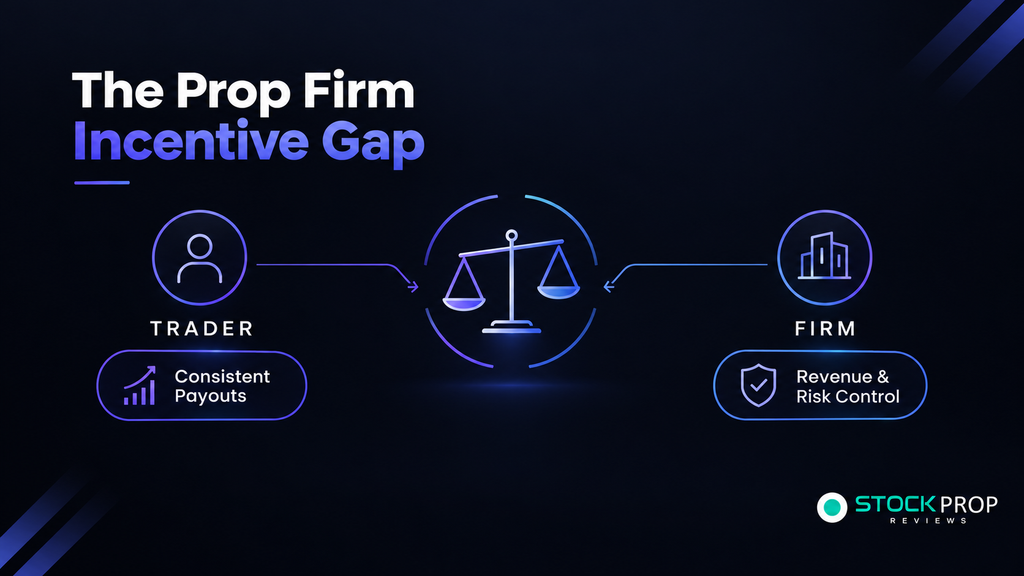
So what incentives does a prop firm have ? Incentives are the financial and operational elements that influence a trading firm’s approach to attracting clients , generating revenue , assessing traders , managing risk , and compensating eligible participants .
These incentives could affect challenge costs, account limits, drawdown calculations, consistency rules and payment rules. That does not mean misconduct automatically.
For example, one trader could have a high drawdown limit to allow for normal fluctuations in the market. A firm can impose a minimum to control risk. And that difference can be fair, if the rule is clearly disclosed and suitable to the stated terms of the account.
That’s a big difference. There is nothing inherently unfair about a restrictive rule, but a material restriction that is hard to detect, or applied inconsistently, deserves scrutiny.
How the Prop Firm Business Model Creates Conflicting Incentives
1. Challenge fees can encourage repeat purchases
A lot of retail prop firms charge evaluation fees. Traders may also be charged for resets, subscriptions, activation or extra attempts depending on the program.
This provides an easy commercial incentive. If a trader fails and buys another challenge, the firm gets more revenue. If the trader qualifies for a payout, the firm might have a contractual obligation to pay.
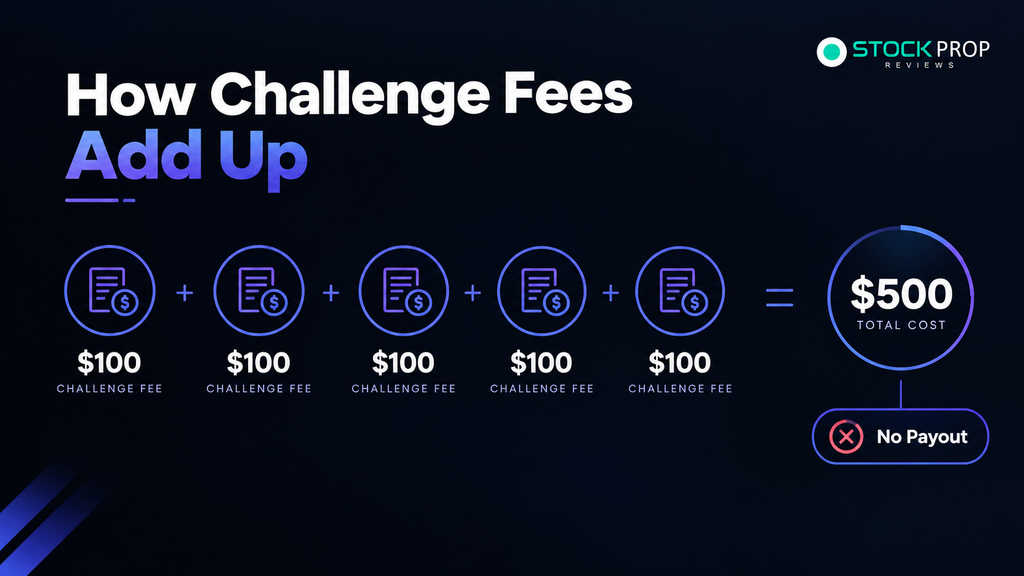
Pretend you are a trader who buys a challenge for $100 and loses. They spend $500 for 4 more attempts at the same price and do not receive a payout. And while the trader may believe that next time will compensate for the losses, the immediate financial result is clear.
The trader may be failing because of poor risk management, an unsuitable strategy, or difficulty following the rules. The firm’s revenue model may nevertheless benefit from another purchase.
Neither fact proves deliberate misconduct. The concern is that repeat spending can become commercially valuable even when it is not helping the trader improve.
A sensible approach is to establish a challenge budget in advance and stop buying evaluations when performance data shows the strategy is not ready.
2. High profit splits can distract from payout conditions
A large profit split is attractive, but it matters only if a trader meets the conditions for receiving a payout.
Some accounts may have minimum trading days, consistency requirements, payout schedules, maximum withdrawal amounts or trading style restrictions.
Suppose there are two firms and they split their profits differently. One has a better percentage but has clauses that often clash with a trader’s method. The other one has a lower percentage but is clearer on eligibility. The headline figure doesn’t tell us which arrangement is more cost effective.
Traders should consider challenge costs, the likelihood of passing, payout eligibility, additional fees, and the amount they can realistically withdraw.
No calculation can guarantee future earnings. Its purpose is to make the costs and conditions easier to compare.
3. Drawdown rules influence strategy viability
Limits on drawdowns are valid risk-management tools, but the way they are designed can influence whether a strategy is appropriate for an account.
A static drawdown typically has a fixed loss limit. As the account makes new highs in balance or equity trailing drawdowns may happen . Traders should also be aware of another restriction, the daily loss limits.
For example a futures trader makes a large profit early on, and then has a normal pullback. If the trailing threshold has been moved up, the margin for losses might be smaller than expected. A good strategy with static drawdown may not work as well with this structure.
The problem is not that trailing drawdown is necessarily unfair. It is whether the calculation is transparent and traders understand its practical effect before they pay.
Traders should backtest their strategy with the actual account rules, including the effect of unrealized profits, daily resets and open positions on the limits.
4. Passing does not always mean receiving a payout
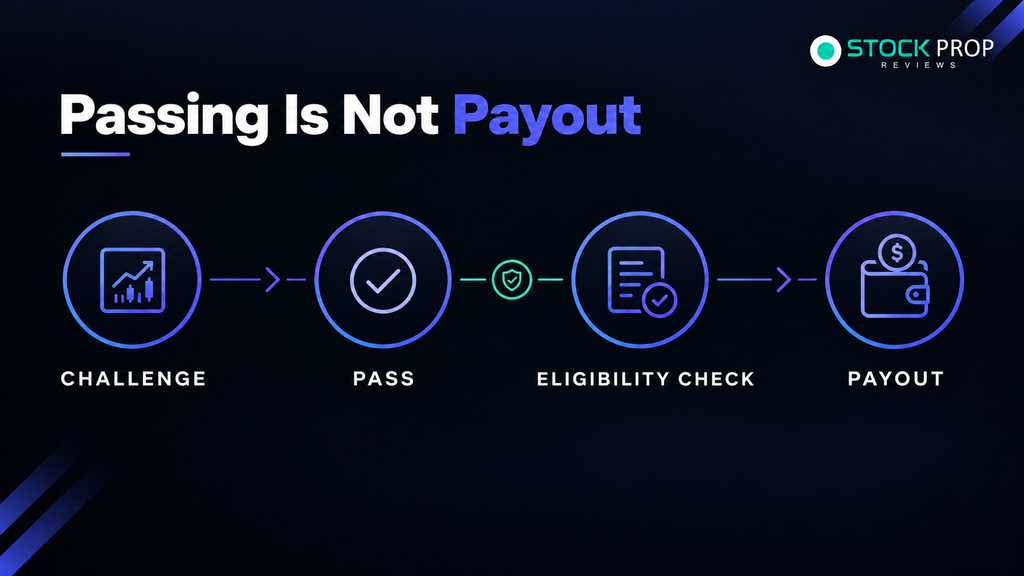
Passing an evaluation is not the same as qualifying for a payout. The funded stages may have some requirements like consistency rules, minimum days of trading, identity verification, prohibited trading practices or specific payout windows.
A trader might hit the profit target on one unusually large winning day, but find the account’s consistency requirement prevents them from withdrawing immediately. Another might have a position from a news event and be unaware of restrictions on opening or closing trades during that time.
These situations do not automatically indicate misconduct. They show why traders need to understand the full agreement before purchasing an evaluation.
A firm should make material restrictions easy to find. Traders, in turn, should verify the rules for their exact account type rather than relying on promotional summaries or another trader’s experience.
What Competitors Often Miss
Rules such as breaking drawdown, trading news, payout eligibility, etc. are often discussed as hidden prop firm rules. But the more basic question is how these rules relate to the firm’s business model.
A strict rule is not proof of bad incentives
Daily loss limits can help in managing risk. The need for consistency may make you less likely to rely on one large trade. Some strategies may be restricted due to operational or execution problems.
More useful questions are whether the rules are disclosed before purchase, are proportionate to the product and are applied consistently.
Passing rates do not tell the whole story
A firm’s advertised pass rate may be useful, but it doesn’t tell you how many different traders actually end up with payouts, how much successful traders spent on multiple attempts or how long it took them to qualify.
The reporting methods are also different. Some counts are for accounts, not people, and some are for a specific product or period of time. Comparisons are meaningless without consistent definitions and independent verification.
Payout reports and customer experiences are helpful contexts, but individual complaints and isolated success stories aren’t enough to determine a firm’s overall reliability.
Simulated funding changes the relationship
Many retail prop firm programs use simulated trading in the evaluation and funded stages. In these cases, the balance displayed is not necessarily money held in a brokerage account that the trader has control over. Rewards may be contractual terms and simulated performance instead.
Some firms might use trading data to inform live activity, others might work on different models. Traders should verify the details of each program rather than assuming their orders are being placed in live markets.
This distinction makes the firm’s contractual obligations, financial health and payout practices as important considerations as trading performance.
How Traders Actually Lose Money
The first common mistake is treating challenge fees as an investment that must eventually pay off. After several failed attempts, traders may purchase another evaluation to recover their spending. This is sunk-cost thinking: money already spent does not make the next attempt more likely to succeed.
The second mistake is to change a proven strategy in an effort to meet an evaluation target quickly. This pressure to meet a deadline means that traders may increase position size, trade lower quality setups, or continue after hitting their daily loss limit.
The third mistake is to underestimate the total cost. So 10 times a $50 challenge would cost $500 before data subscriptions commissions or any other applicable fees.
Finally, traders sometimes assume that any dispute about a payout is evidence of bad faith. Firms can be mistaken and some policies can be confusing but conclusions should be based on evidence. Keep copies of the rules, payment receipts, account metrics and support communications.
The job of the trader is to control risk and expense. It is the firm’s duty to communicate its terms accurately and to apply them consistently.
The Counterargument: Firms Need to Manage Risk
To say that the prop firm should only make money when the traders make money would be naive.
Companies have to deal with operating costs, fraud risk, platform costs and contractual obligations. They need protection against excessive losses. They may reasonably charge evaluation fees to cover the costs of administering their programs.
There’s also an important difference between a business making money from repeat business and a firm that deliberately changes its rules to avoid paying out. The first is a commercial question; the second a grave accusation, which must be proved.
A sustainable firm can provide adequate controls, reward eligible traders and generate revenue. It can also help to retain skilled participants and build a credible reputation, which can underpin long-term growth.
The problem is repeat sales seem to matter more than clear terms, fair enforcement and meaningful payout transparency.
How to Evaluate a Prop Firm Before Paying
Use these checks to assess the firm beyond its promotional claims.
| What to check | Why it matters |
| Complete fee structure | Reveals the cost of challenges, resets, subscriptions, and activation |
| Drawdown calculation | Shows how much room your strategy has to absorb losses |
| Payout requirements | Clarifies the conditions between passing and receiving money |
| Rule-change policy | Helps establish whether terms can change after purchase |
| Company identity | Identifies the entity responsible for contractual obligations |
| Payout evidence | Provides context on reported customer experiences and reliability |
Start by saving the agreement for your precise account type. Check that the summary on the website matches the terms of the contract and calculate what your total potential spend might be.
Next, test your strategy with drawdown and trading restrictions. Futures traders need to understand: Intraday vs. end of session calculations, Trailing thresholds, Session resets. Forex and CFD traders should review news restrictions, weekend holding rules and consistency requirements.
And finally, look for trends in documented customer experiences, not just testimonials. Positive reports of payouts boost confidence, but nothing is guaranteed. Clear terms can help.
Is TradeThePool Worth Considering?
TradeThePool is one of the stock-focused prop-trading programs to check out for stock and ETF traders. Check out its current account rules, costs, drawdown conditions and payout requirements before you decide if this fits your strategy.
Be specific about regulatory claims . A firm’s focus on stock trading does not mean the prop firm is regulated in and of itself. Check actual legal entity, contractual arrangement and regulatory status for the relevant service provider, not a generic marketing description.
Clear documentation is essential to help traders understand the risks involved, but no company can guarantee that a trader will pass an evaluation or get a payout in all situations.
Readers get up to 10% off when they buy via our TradeThePool link. Please check the current offer and eligibility terms before the purchase.
FAQs
Why do traders lose and prop firms win?
For unsuccessful attempts, the evaluation fee is a revenue with no payout liability if a firm retains evaluation fees for failed attempts. But firms have different business models so this does not explain all of the financial incentives of firms.
Are prop firms trying to make traders fail?
The presence of challenge fees is not evidence of intentional wrongdoing. Look at the documented rule changes , the payouts disputes , contracts , enforcement patterns . Before you jump to any conclusions .
Do high profit splits mean a good prop firm?
Not on their own. Drawdown limits, payout eligibility, extra fees, and withdrawal terms can outweigh the percentage listed.
How can traders get better aligned incentives?
This means transparent fees, clear risk limits, understandable payout rules, a verifiable company identity and constant communication. These are factors that help in evaluating a firm but do not guarantee future payouts.
Are prop firms a complete no-go for traders?
Not necessarily. A prop firm may be for you if you have a proven strategy, understand the rules and can afford to lose the evaluation fee. Less useful to someone who needs to make repeat purchases in an effort to recoup previous losses.
The Bottom Line
The hidden incentive problem in prop firms is the possibility of misalignment between a trader’s goal of earning payouts and a firm’s commercial interests of selling evaluations, controlling costs, and managing risk.
But that doesn’t make every firm a bad one. But it does mean that traders should examine the business model as closely as the rules of the trade.
Before payment, know the total cost, learn the limits on the drawdown, learn the payout conditions, know who is paying you. If you fail, review your trading data before buying another attempt.
A challenge is a paid opportunity, not a guarantee of income. Base your decision on documented rules, realistic performance and a clear understanding of the firm’s incentives.