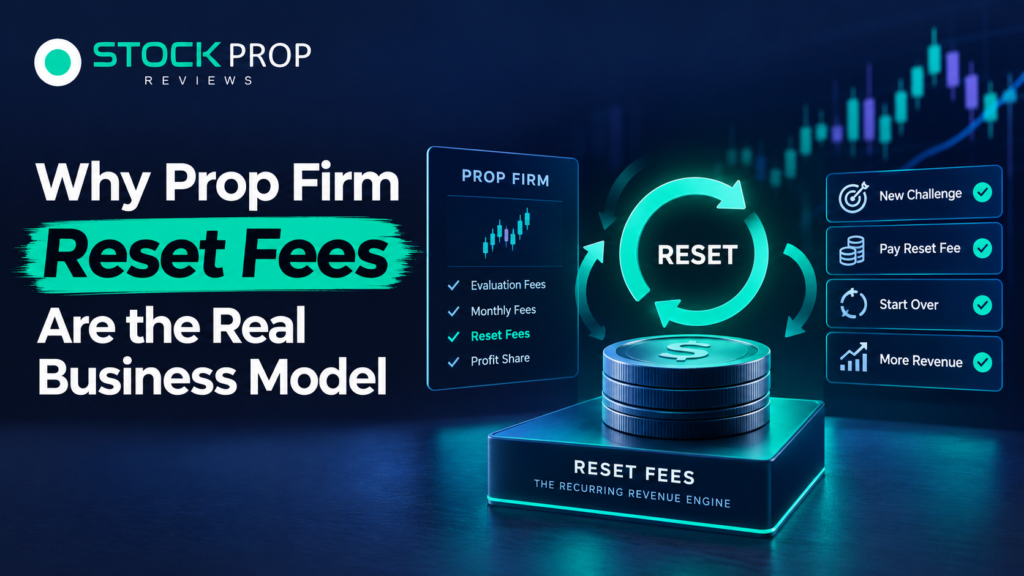
Prop firm reset fees transform a failed trading challenge into an additional revenue stream for a proprietary trading firm. When traders hit either a drawdown limit or a profit target, instead of buying a new account, some firms give them the option to restart the challenge for an additional fee. The option can be useful, but it is expensive to keep resetting again and again, especially when traders keep jumping into challenges without fixing the mistakes that caused their previous failures.
This deep dive is for future funded traders, beginners and experienced traders who buy evaluations regularly. It’s not an argument that all prop firms are dishonest or that all resets are a bad decision. The objective is to study the economics of reset fees, explain their impact on trader behavior and assist traders in making decisions on when another payment makes economic sense.
Quick Verdict: Are Prop Firm Reset Fees the Real Business Model?
Reset fees are a big potential source of income for some prop firms, but they don’t tell the whole story of the industry’s business model. Companies can also make money from initial challenge fees, repeat purchases, subscriptions, platform services and other allowable charges. The revenue structures are different and the exact contribution of resets is not published often.
The central problem is the incentive created when a firm receives another payment after a trader defaults. The firm can make more money from repeat attempts without that trader ever getting a payout. This does not prove misconduct per se, but it does mean that traders should consider the commercial incentives behind the product rather than just the advertised account size.
For traders the practical test is simple: is paying the reset fee a rational decision based on the quality of your trading or an emotional attempt to recover the money already lost?
The second payment is unlikely to solve the original problem if the strategy has not been changed.
What Are Prop Firm Reset Fees?
A prop firm reset fee is a payment that allows a trader to restart an evaluation or challenge after failing to meet its rules, usually without purchasing an entirely new challenge.
The reset could bring the account back to its starting balance, reset the evaluation period or return the account to its original conditions, depending on the firm’s terms. Some firms only allow resets at certain times, and some firms have different arrangements for different account models.
A reset is not a free retry, a funded-account restart or a new evaluation. This is important as eligibility, pricing, drawdown calculations and payout terms may all vary.
For example, say a trader pays $150 to buy a simulated $100,000 evaluation. The trader loses too much during a volatile session and goes over the maximum daily loss limit. The firm has a $75 reset.
The trader has now spent $225 across the original attempt and the reset. If the second attempt fails, another payment may follow.
The account’s advertised $100,000 size does not change the basic calculation. The trader is risking real money on evaluation fees, even when the trading balance itself is simulated.
How Reset Fees Generate Revenue for Prop Firms
The economics become clearer when we separate a firm’s revenue from its costs and obligations.
A challenge-based prop firm may receive payments from traders who pass and traders who fail. It may also have expenses associated with platform access, data, payment processing, marketing, customer support, technology, and payouts to eligible traders.
Reset fees add another possible source of income because they monetise a trader’s decision to continue after failure.
Consider a simplified example:
| Trader activity | Payment received by the firm |
| Initial challenge | $150 |
| First reset | $75 |
| Second reset | $75 |
| Total payments | $300 |
The trader has paid $300 before considering any further challenge purchases. The firm has received $300 in gross revenue from that trader, not $300 in profit. Its actual profit depends on operating costs, payout obligations, and other expenses.
Now consider 1,000 traders who each purchase an initial challenge for $150. Initial gross receipts would total $150,000. If 300 of those traders subsequently buy one $75 reset, that creates another $22,500 in gross receipts.
These figures are illustrative, not industry data. They demonstrate how repeat payments can increase revenue without requiring the firm to acquire an entirely new customer for each transaction.
The important limitation is that we cannot determine how dependent a particular firm is on reset fees without reliable financial disclosures. Claims that all prop firms primarily survive on failed traders go beyond what these calculations establish.
Why Failed Challenges Can Still Be Commercially Valuable
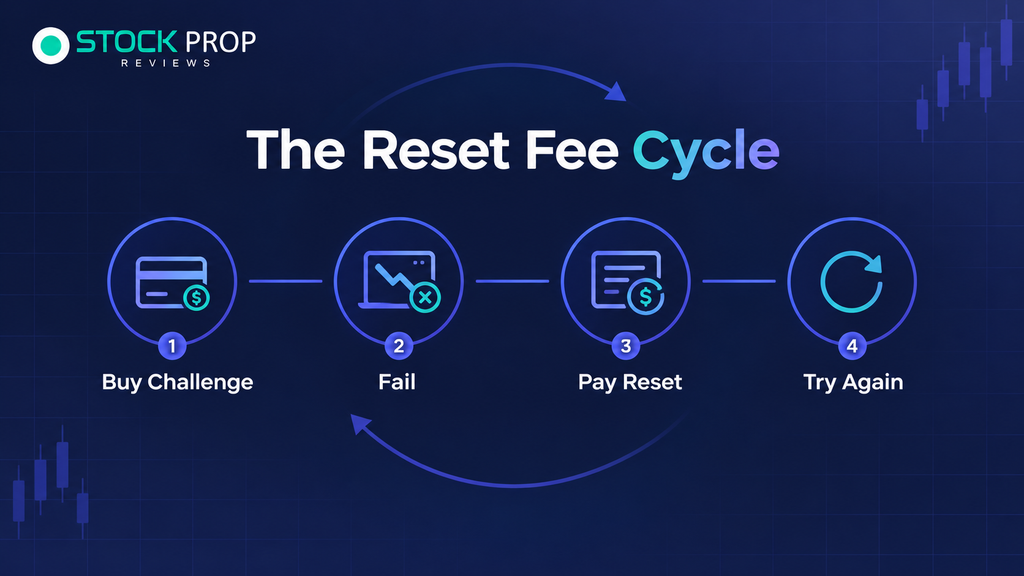
Failure on an evaluation isn’t the end of a customer relationship. The trader can buy another challenge, pay for a reset or return after a pause.
That gives a commercial incentive to make it easy to restart. A prominent reset button, a discounted restart, or a limited-time offer can reduce the friction of making another purchase.
None of these features are inherently unethical. A trader with a good system can really profit from a restart under the same rules. The problem is when the buying process is designed to encourage repetitive buying without helping traders assess the viability of their underlying approach.
A company can be selling a real product, but still have incentives that are not perfectly aligned with the long-term financial interests of a trader.
The Psychology Behind Repeat Reset Payments
Reset fees are not just a pricing issue. They also interact with common psychological biases that influence trading decisions.
1. The sunk-cost fallacy
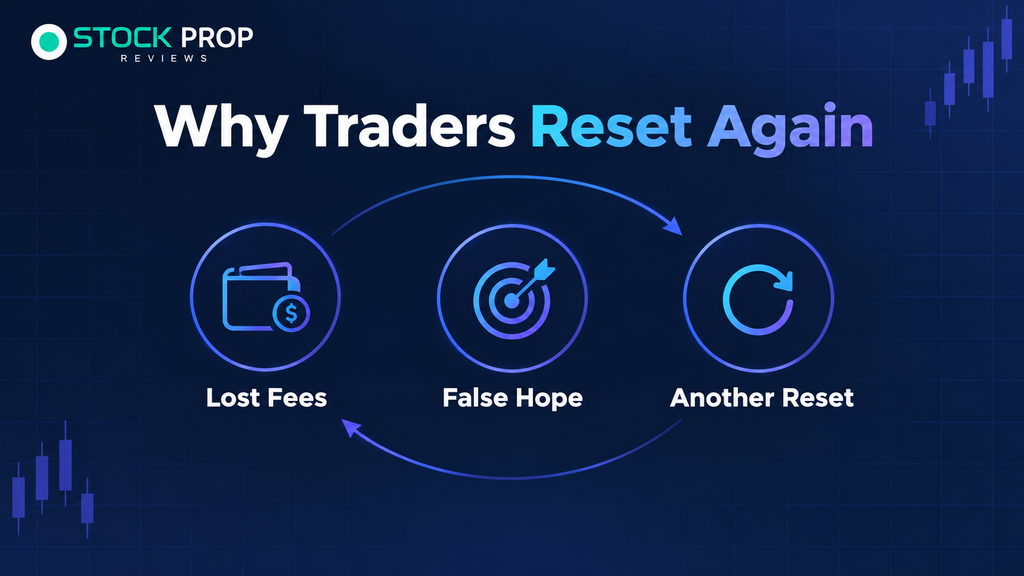
A trader who has already spent $150 may feel that quitting the challenge is like admitting defeat. Another $75 may seem like a way to get your original money back.
But the initial $150 is already spent. It should not determine whether the next $75 is worthwhile.
The question is whether the expected future benefit to the trader justifies the extra expenditure. If the strategy is not proven or the trader keeps on making repeated mistakes with risk-management, the reset may only increase the total loss.
2. Revenge trading
Imagine a trader who failed a challenge after 3 losing trades in a row. Instead of looking at position sizing and entry quality, the trader buys a reset and immediately increases risk, so as to hit the profit target faster.
The new account could begin with the original balance but the trader’s pattern has not been reset.
This often leads to a dangerous cycle of frustration leading to new buying, urgency to larger positions and excessive risk to another breach.
The reset has changed the conditions of the account, not the thinking of the trader.
3. The illusion of being close
A trader who makes 8% on a challenge with a 10% target may think passing is a sure thing. Then if the account violates its drawdown limit, restarting is more appealing because the trader remembers being within a hair’s breadth of success.
However, reaching 8% once does not establish that the strategy has a repeatable edge. A few favourable trades can produce a strong result even when long-term performance is inconsistent.
A trader should evaluate a sufficiently large sample of trades, drawdown behaviour, and rule compliance rather than relying on how close the previous attempt appeared to be.
The Real Cost of Prop Firm Reset Fees
The headline reset price can hide the cumulative cost of repeated attempts.
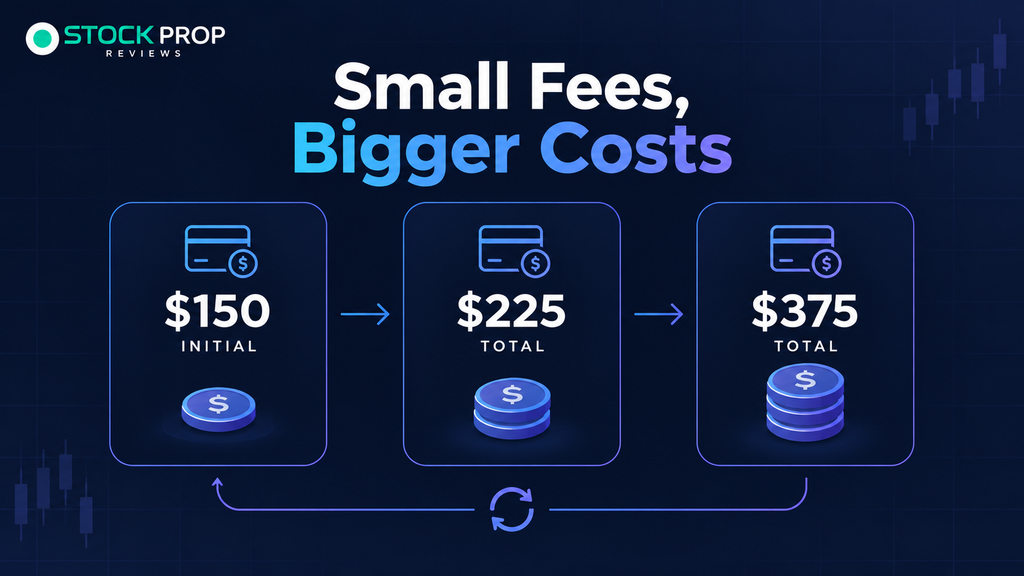
Consider three scenarios involving a $150 initial challenge and a $75 reset.
| Scenario | Total paid | Outcome |
| Initial challenge only | $150 | Challenge failed |
| Initial challenge + 1 reset | $225 | Second attempt failed |
| Initial challenge + 3 resets | $375 | Four attempts in total |
These examples exclude taxes, foreign-exchange conversion charges, and other possible fees. Actual pricing and reset conditions vary by firm.
The financial problem is not simply that the trader pays more. It is that repeated fees can encourage a trader to continue funding a process that has not demonstrated positive expected value.
A trader who spends $375 on repeated evaluations has not necessarily purchased a better chance of passing. That depends on the trader’s skill, strategy, execution, and the conditions of each attempt.
Calculate the Cost Before You Reset
Before purchasing a reset, write down four numbers:
- The first challenge charge.
- Reset all previously submitted challenges and repeat payments.
- The extra cost of the proposed reset.
- The dollar amount you can afford to lose without affecting the essentials.
Then assess your trading record separately from your spending history.
For example, a trader who repeatedly violates daily drawdown rules has a different problem from someone who follows a tested strategy but loses an evaluation during an unusually poor sequence of trades. Both have failed the challenge, but the reasons for failure may justify different decisions.
Neither scenario ensures a reset is worth it. The first generally needs risk management adjustments before another paid attempt. The second is a fair review of how the strategy performed and of the rules of the firm.
When Paying a Reset Fee Can Make Sense
Reset isn’t necessarily a bad idea financially . If the trader has evidence that another attempt is warranted, it may be warranted.
Picture a trader with a proven strategy, a significant sample of backtested and live or simulated trades, and a consistent adherence to risk limits. The trader is executing the strategy well, but succumbs to a challenge following a bizarre losing streak.
If the trader knows the firm’s drawdown policies, has reviewed the failed attempt, and can comfortably afford the reset then starting over may be a viable option.
And even then, a good historical record is no guarantee for the future. Market conditions change and a strategy that performs well in one period may not perform well in another.
A reset is more difficult to justify when the trader:
- No tested strategy, no reliable trading journal.
- Regularly breaks daily or total drawdown limits.
- Increases the chance of hitting a target before the deadline.
- Whether you borrow money or use money you need for living expenses.
- Resets are bought primarily for reasons of frustration or to recover fees paid in the past.
The last point deserves particular attention. A reset should be treated as a new financial decision, not as an obligation to rescue the money already spent.
What Competitors and Generic Pricing Analysis Miss
General business articles about pricing resets often focus on customer retention, price optimization, and improving revenue. Those concepts can help explain the commercial side of prop trading, but they do not fully address the risks faced by evaluation customers.
There are four important distinctions.
Reset revenue is not the same as net profit
A firm that collects substantial reset fees still has costs and financial obligations. Gross receipts alone cannot reveal profitability, financial stability, or whether the business is sustainable.
Traders should be cautious about claims that a firm earns a particular percentage of its revenue from failed challenges unless credible evidence supports the claim.
A reset does not necessarily improve the probability of passing
A new opening balance can restore the opportunity to complete an evaluation, but does not necessarily improve the quality or application of strategy. Passing depends on the trader’s performance and the conditions of the challenge.
Resetting the account does not solve the problem of regular losses greater than the allowed limit by a trader’s approach. It is a statistical/behavioural problem.
The rules can matter more than the reset price
A relatively inexpensive reset can still be poor value if the rules are incompatible with the trader’s strategy.
For example, a scalper who relies on rapid position adjustments should understand how the firm handles execution restrictions, daily drawdown, and any relevant trading limitations. A swing trader should understand whether holding positions overnight or over weekends is permitted.
Static drawdown and trailing drawdown also lead to different risk profiles. Trailing drawdown means that the allowable loss level can move if the account reaches new equity or balance highs (by the firm’s method).
These mechanics should be understood by a trader before paying for the first challenge and not afterward.
Repeat purchases can obscure the trader’s actual performance
A trader could celebrate finally passing after multiple resets, ignoring the total cost of getting there.
So, if the final account has identical headline terms then it is financially different to pass after spending $450 in cumulative evaluation fees than it is to pass after spending $150.
A useful performance record should include the total amount spent on evaluations, the number of attempts and resets, the time you put in, and any payouts you actually got. Passing a challenge is a milestone, but it is not the same as making a net profit from the entire process.
How to Evaluate a Prop Firm Before Paying Again
The firm’s rules and commercial terms should be assessed before buying a challenge to minimize reset related losses.
Start with the published price list. Check to see if resets are available, how much they cost, whether the original challenge period is restored, and if there are any limitations. Don’t assume that a reset keeps the same conditions for each account type.
Next look at the drawdown methodology. Find out if the daily loss limit is calculated on balance or equity, how floating losses are handled and if the total drawdown trails your account high water mark. Small differences can make a big difference in the amount of room that a strategy has to take losses.
Finally, check the firm’s payout conditions, limited trading practices, refund policy and account termination rules. A low entry fee doesn’t always mean good value if the conditions mean the challenge is wrong for your strategy.
For a broader view, also see our FTMO review, FundingPips review, and prop firm comparison of well established providers. Read our analysis of the reality behind the funded trader lifestyle to understand why passing an evaluation is not to be confused with making consistent income.
What About Alternatives to Repeated Resets?
There is no one best alternative for every trader. Which one is right depends on what instruments you trade, how much capital you have, your risk tolerance, and preferred evaluation structure.
1. Stop purchasing challenges temporarily.
When the trader has had repeated breaches this is often the most practical course of action. Take a look at your trading journal, determine the main reasons you failed and test changes in a simulated environment before risking more money.
2. Compare firms with different evaluation structures.
Some traders may prefer a model with different time limits, drawdown calculations or trading restrictions. Don’t just look for the advertised buying power or cheapest entry price , compare the full rules.
3. Consider a stock-focused evaluation.
Traders who primarily trade equities may prefer a programme built around stock trading rather than foreign exchange or futures. TradeThePool is one option to investigate because it publishes programme objectives and risk rules for its stock-trading evaluations. Its website also states that evaluation activity takes place in a simulated environment. Review its current terms and eligibility requirements before paying.
Readers can receive a discount of up to 10% if you purchase through our TradeThePool link. The discount is a price advantage, not a guarantee that a program is right for each trader. Also, don’t assume a proprietary trading firm is regulated just because it offers stock-trading evaluations. TradeThePool Disclaimer: The operator of TradeThePool is not subject to any financial regulatory authorities for the services provided. Traders should differentiate transparent rules from formal regulatory oversight.
Common Mistakes Traders Make With Reset Fees
The most expensive mistakes often occur when traders treat a reset as a solution rather than an opportunity to reassess their process.
Paying before reviewing the breach.
If a trader has no idea why the last attempt failed, then he has little reason to believe that the outcome will be different. Review of trade size, stop placement, daily exposure, quality of execution, adherence to firm rules
Ignoring cumulative spending.
Small payments can seem like they can be handled on their own. Together they may cost more than several alternative evaluations, or more than the trader can afford to lose.
Confusing a passing account with profitability.
Passing is only one stage of a prop firm’s process. Eligibility for a payout may depend on additional conditions, and payout approval is not guaranteed simply because a target has been reached.
Increasing risk after every failure.
Some traders react to a breach by trying to reach the profit target faster. This creates a cycle of bigger positions, higher emotional pressure and possibly faster losses.
Assuming a discount makes another attempt worthwhile.
A cheaper reset is still an expense. The decision should depend on the expected value of the next attempt, not the size of the discount.
Who Should Avoid Repeated Prop Firm Resets?
Multiple resets are not ideal for traders who have not yet proven their ability to consistently manage risk, have limited disposable income, or rely on purchasing challenges to recoup past losses.
They are also a poor fit for traders who cannot explain the cause of their last few failures. Without a clear diagnosis, restarting is likely to reproduce the same problems.
Even a more experienced trader needs to be careful. Even disciplined execution does not mean the evaluation will be passed. A tested strategy can have losing periods. The critical distinction is between an informed decision based on evidence and a hasty payment under duress.
One useful personal rule is to establish a maximum evaluation budget before buying the first challenge. Limit the number of attempts, log all payments and stop once the limit has been reached. Any decision to continue should be based on a fresh review, not an automatic commitment to spend more money.
FAQs
Are prop firm reset fees a firm’s main source of income?
While they can be a meaningful revenue source for some firms, there is no good basis for claiming they are the primary source for every provider. Initial challenge fees and other allowable payments may also be charged by companies. Without audited or otherwise credible financial disclosures it’s not clear what role reset fees play.
Is it worth it to pay a prop firm reset fee?
If the trader has a tested strategy, understands why it failed, can pay the fee, and has a reasonable basis to try a challenge again, this might be worth it. It is hard to justify when the trader repeatedly breaks risk limits or buys resets to recover previous spending.
Do reset fees improve your odds of winning a challenge?
A reset is another chance with the terms and conditions that apply but it doesn’t necessarily improve trading skill or the likelihood of success. That probability will depend on strategy performance and execution, market conditions and the rules of the challenge.”
Are prop firms incentivized when traders lose?
Companies that collect challenge and reset payments may have a commercial interest in customers buying more tries. But the strength of that incentive depends on the business model, costs, payout obligations and other revenue sources. A commercial incentive by itself does not constitute misconduct.
How many times can you reset a prop firm challenge?
There is no single right number. Look at each failure. Set yourself a spending limit before you start. If the same risk management issue keeps popping up, stop paying for resets until you’ve solved it and proven improvement in testing.