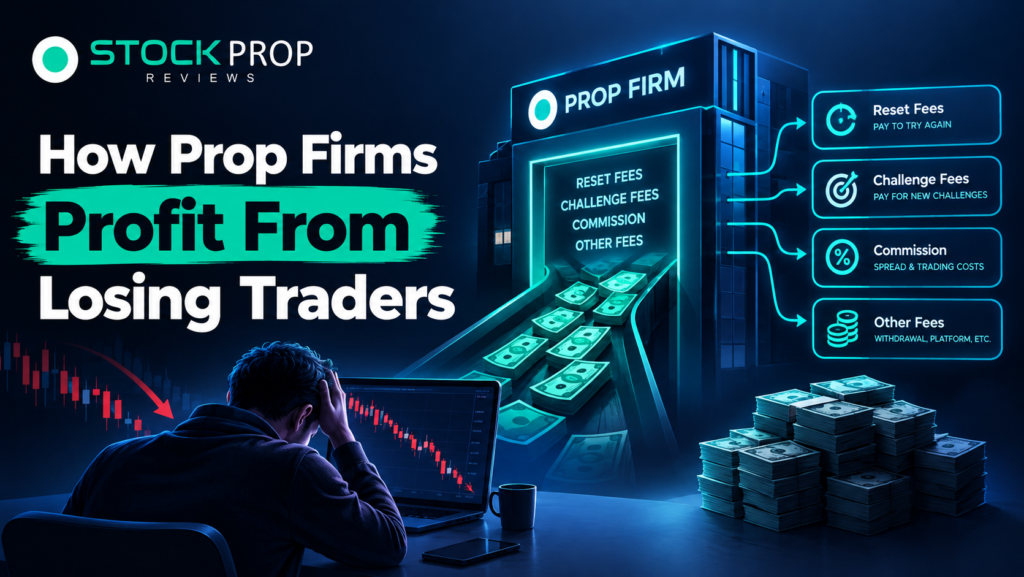
Prop firms make their money primarily from losing traders via challenge fees, account reset fees, and business models where they pay out less than they make in revenue. Depending on their business model, many firms also generate revenue from successful traders through subscription revenues, trading-related arrangements or other commercial activities. The precise model differs by firm.
The major difference is, if a trader loses money on a demo account, it doesn’t necessarily mean a direct gain for the prop firm. In many retail prop trading programs, traders are trading on simulated capital and the firm is making money from fees rather than being the counterparty on every trade. Some firms also copy certain traders into live markets, or employ other forms of risk management, but these practices should not be assumed without evidence.
This analysis is for new and experienced traders who want to see the economics of prop trading challenges before paying for an account. It’s not a guide to shortcuts, or a claim that all prop firms are dishonest. The goal is to explain how the business works, why failed challenges can be commercially valuable and what traders should look for before buying one.
How the Prop Firm Profit Model Works
Traditionally, a proprietary trading firm is a firm that trades its own capital to make money. Many retail prop firms have a different model where they sell access to evaluations, have trading rules, and distribute profits to qualifying traders on certain terms.
The difference is important because a company that is advertising a $100,000 funded account may not be putting that $100,000 into a live brokerage account for that trader. It may be that the account is simulated and the payout is dictated by the firm’s contractual terms.
A typical retail prop firm can generate revenue through several channels:
- Challenge fees: Traders pay to take a shot at an evaluation.
- Subscriptions and resets: Some companies charge recurring fees or sell attempts to reset an evaluation.
- Revenue from trading: this may be made up of commissions, spreads, arrangements relating to platforms or other commercial agreements, depending on the provider.
- Live trading profits: Depending on their operating model, some firms may assign selected traders to live accounts or copy their strategies.
Not every firm uses every revenue source. Challenge fees are particularly important to understand because they can generate revenue even when a trader never reaches the funded stage.
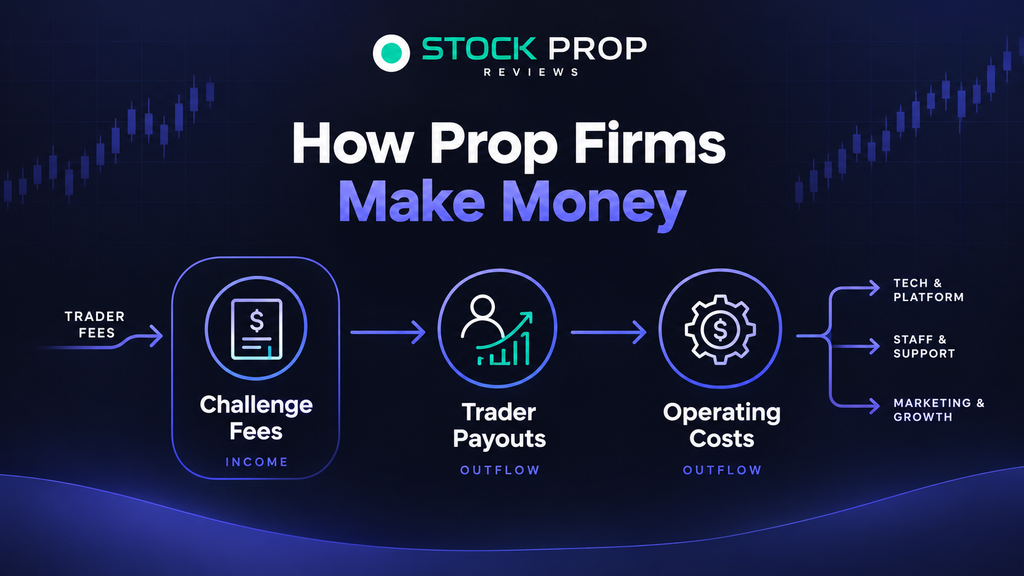
Why Losing Traders Can Be Profitable for Prop Firms
The economics are simple: a prop firm can collect an evaluation fee while not having to pay a funded-trader reward to every participant.
Let’s say we have a hypothetical firm that sells challenges for $100 each and sells 1,000 of them. It generates $100,000 in gross challenge revenue But if 100 traders qualify for funded accounts, the firm wouldn’t automatically owe those traders $100,000. Qualifying does not guarantee an eligible payout. Payouts are dependent on future performance and the terms of the program.
The other 900 traders could fail their tests. The firm still has to take out operating costs, payment processing, refunds where applicable, marketing, platform expenses, taxes and other liabilities but their fees still count as revenue.
This example illustrates the business model, not the performance of any particular firm. There are no independently verified figures available to enable the evaluation of sales, pass rates, payout rates and expenses so it is impossible to accurately calculate a particular company’s profit margin.
Challenge fees create predictable revenue
The evaluation fee is a revenue stream for firms that is not solely tied to market performance. The company has already received the entry fee, and the trader might lose the account in a few days.
Some providers offer discounted challenges, subscriptions or resets that recur. These options can make a second attempt cheap, but if the trader keeps buying them, the total cost can be quite high.
A trader who takes on a $100 challenge 4 times will spend $400 before getting a payout. Even if the fifth attempt is successful, the trader has to consider those earlier costs when assessing the total financial result.
Most participants do not necessarily reach the payout stage
The firm benefits when evaluation participants pay fees but do not progress to a payout. However, a challenge failure rate alone does not establish how profitable a firm is. The firm also has to pay its operating expenses and any rewards owed to eligible traders.
The key figures would include the percentage of participants who pass, the percentage who receive a first payout, average payouts, repeat-purchase rates, refunds, and customer acquisition costs. Many firms do not publish enough independently verifiable data to establish all these figures.
That information gap is important. A company can advertise a large simulated account size without disclosing the economics of its evaluation program.
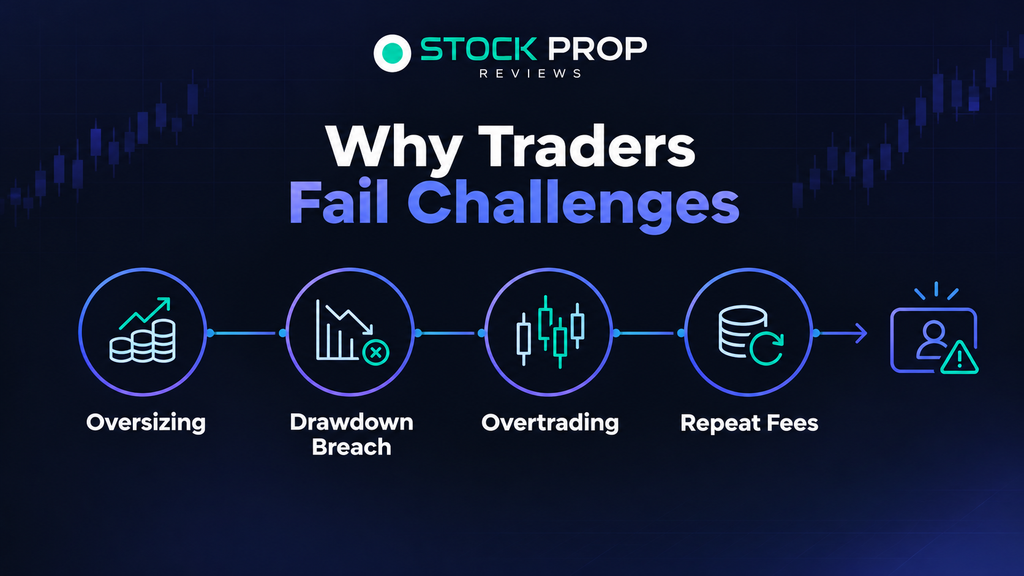
How Traders Actually Fail Prop Firm Challenges
Traders often assume that passing a challenge is mainly about finding profitable trades. In practice, they must also control drawdown, position sizing, daily losses, and any restrictions specific to their account.
A strategy can be profitable over time and still fail an evaluation because the trader violates a risk limit before the strategy has an opportunity to recover.
Oversizing positions after a loss
Imagine a trader with a $100,000 simulated account and a 5% maximum loss limit. The permitted loss under that rule would be $5,000, subject to how the firm calculates drawdown.
After losing $1,500, the trader tries to recover quickly by increasing position size. Two further losing trades of $1,800 each would bring the total loss to $5,100. The account would breach a $5,000 limit, even if the trader had previously been profitable.
The problem is not simply that the trader picked the wrong direction. The trader increased risk when the account had less room to absorb losses.
Misunderstanding daily and overall drawdown
Drawdown rules are not standardized across the industry. Some firms use static limits, while others calculate trailing drawdown based on account equity or a high-water mark. Daily loss limits may also use different reference points and include unrealized losses.
A trader who sees a balance above the initial account value may believe there is sufficient room to trade. However, an equity-based limit can be breached by an open position before the trader closes it.
This is one reason to read the exact rule definitions rather than relying on a firm’s headline account size or a short promotional summary.
Overtrading to meet a profit target
A challenge may require a particular profit target within a set of conditions. Traders who focus exclusively on reaching that target can take marginal setups, increase leverage, or trade during unfamiliar market conditions.
Suppose a trader is close to passing and opens several correlated positions before a major economic announcement. A sharp move in the wrong direction can cause a daily loss breach. Being close to the target offers no protection against a rule violation.
Paying for repeated attempts
There are also costs involved in repeated challenges. A trader may see each failure as a temporary setback and immediately buy another account without reviewing the underlying strategy.
Figure out how much was spent before you pay again . Figure out what went wrong last time and if the next time is going to have a meaningfully different risk plan . If this same mistake is repeated, then perhaps another challenge will just have the same result.
What Happens When a Trader Passes?
Passing an evaluation doesn’t mean you will be given a live trading account or entitled to a payout immediately. The next phase depends on the firm’s account structure, verification requirements, contractual terms and trading rules.
There are some programs that offer simulated funded accounts where the rewards are paid through a contract arrangement. Other traders may be using real money. A firm may also change its approach from product to product, so its general description of business may not cover every kind of account.
The profit split is the percentage of trading profits eligible to be paid to the trader. For example, an 80% reduction of an eligible reward of $2,000 would leave the trader with $1,600 before taxes or other deductions. This does not imply that the trader owns 80% of the account balance.
The firm also has to consider payout obligations. If a successful trader is consistently receiving rewards, those payments reduce the revenue available to cover other costs unless they are offset by other revenue or trading results.
So successful traders are not necessarily bad for a prop firm. If firms can identify good traders, control risk, retain customers and satisfy their obligations, there are advantages in having traders that continue to perform.
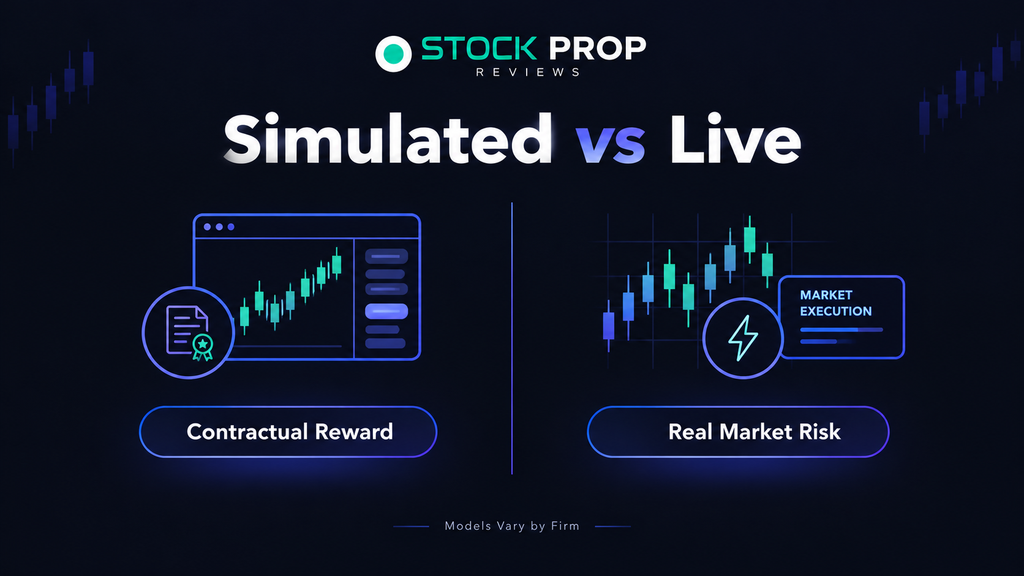
Simulated Accounts Versus Live Trading
The difference between simulated and live trading is one of the most important details that competing explanations of the prop firm business model can overlook.
A simulated account records hypothetical trading performance without necessarily placing equivalent orders in the live market. The firm’s financial exposure can therefore differ substantially from the notional account size shown on the dashboard.
A live account, by contrast, involves actual market execution and financial exposure, although the firm may still use risk limits and other controls to manage that exposure.
Some providers may use the performance data to select traders for live trading, to copy certain strategies or otherwise control exposure. These practices vary, and claims about a specific firm’s execution model should be supported by its documentation or other reliable disclosures.
The trader should not presume that each unsuccessful simulated trade will translate into a corresponding cash gain for the firm. They should not expect that a company will pay every successful simulated trade from a profit earned in live trading. That depends on the true operating model of the company and the contractual reward structure.
What Other Prop Firm Business Model Explanations Often Miss
Common ways prop firms make money are usually described as challenge fees, profit splits and trading revenue. Those are useful starting points, but do not fully explain the risks traders face.
First, revenue is not the same as profit. A company generating $1 million in evaluation fees cannot claim $1 million in net profit without accounting for payouts, advertising, staff, technology, refunds, and other expenses.
Second, a high failure rate does not prove misconduct. Evaluation rules can be commercially attractive to firms, but traders can also fail because their strategy has no edge, they manage risk poorly or have unrealistic expectations. Evidence must be provided before alleging deliberate manipulation or unfair treatment.
Third, payout rules affect the practical value of a funded account. A trader must understand eligibility criteria, minimum trading days if applicable, any consistency requirements, forbidden strategies, payout schedules, and rules for account termination.
Fourth, operational and counterparty risk matters. The potential reward of a trader depends on the ability and willingness of the firm to process eligible payouts as per the contract. Clear rules are helpful but do not eliminate the risk of a business getting into financial difficulties or disputes.
Finally, headline account sizes can obscure the most relevant numbers: the fee paid, the loss limits, the realistic probability of passing, and the conditions required to withdraw a reward.
How to Evaluate a Prop Firm Before Paying
The most useful question is not simply whether a firm profits when traders fail. It is whether the firm’s rules, pricing, and payout terms are clear enough for you to make an informed decision.
Review the following points before purchasing a challenge.
| What to check | Why it matters |
| Evaluation fee and reset cost | Shows the amount you can lose before any payout |
| Daily and maximum drawdown | Determines how much room your strategy has to absorb losses |
| Static or trailing limits | Changes how the loss threshold behaves as equity rises |
| Profit target and time limits | Determines the performance required to qualify |
| Payout eligibility | Explains when profits become payable and what conditions apply |
| Prohibited trading practices | Reduces the risk of unexpected account termination |
| Simulated or live account status | Clarifies how the program operates |
| Refund and termination policies | Helps establish your rights if a dispute occurs |
Read the rules for the specific product you intend to buy. A firm’s different account models may have different restrictions, even when they appear under the same brand.
Instead of assuming that a lower entry fee means better value, compare the firm’s pricing and conditions to those offered by other providers for a broader view. StockPropReviews readers looking at different business models can also check out our prop firm reviews, prop firm comparison.
Is a Prop Firm Challenge Worth the Cost?
If you have a tried and tested strategy, consistent risk limits and an understanding of the firm’s rules then a challenge may be worth considering. It’s much harder to justify if a trader is still learning basic position sizing or if they’re expecting a funded account to solve financial pressure.
Find out what your maximum potential cost could be before you buy. Add the first challenge, probable resets, subscriptions and other fees needed. Then look at the probability of getting an eligible payout, not only at the probability of clearing the first stage.
For example, a challenge of $100 bought five times is $500. The next eligible reward of $1,000 does not mean the trader has made $1,000 overall. The net result depends on all fees, the amount actually paid, any additional costs and relevant taxes.
Don’t get caught up in funding challenges with money that’s needed for rent, bills, debt payments or emergency savings. Think of the fee as money you are going to lose entirely.
For stock-focused traders, there’s also TradeThePool, a regulated stock prop firm that emphasizes transparency in rules and risk. Be sure to read the applicable account terms and eligibility requirements prior to purchasing. You can receive up to 10% off by purchasing through our TradeThePool link.
You can only get the discount once you check whether the program fits your trading approach. A lower fee doesn’t make a bad strategy profitable or guarantee a payout.
FAQs
Do prop firms make money off traders losing?
Many retail prop firms make money from fees paid by traders who don’t evaluate. But a failed simulated trade does not necessarily mean a direct trading profit for the firm. The overall business result is determined by fees, payouts, expenses and other revenue sources.
Are prop firms betting against their own traders?
Not really. Some retail programs utilize simulated accounts and contractually agreed upon reward arrangements. Some may trade live capital or employ the strategies of selected traders. The actual model varies between providers. Traders should check out the firm’s disclosures and not assume that every firm is on the other side of every trade.
Why do prop firms charge a challenge fee?
Challenge fees offset the cost of running evaluations and can provide a revenue source for participants who do not qualify for funded stages. The reasonableness of a particular fee depends on the product, the rules, the services offered and the likelihood of the trader meeting the requirements.
“Do prop firms lose money when traders get paid?”
These payouts are a cost or liability to the firm under the applicable program . That does not necessarily mean the firm is out of pocket overall . Payouts may be offset by revenue from fees, live trading or other business activities. The result is a function of the entire financial position of the firm.
How can traders keep from losing money on repeated challenges?
Use a proven strategy, set strict risk limits, understand how to calculate drawdown and review every losing trade before buying another. “Track all challenges and reset fees. If you’re repeatedly breaking the same rule, get your trading process improved before spending further on evaluations.