
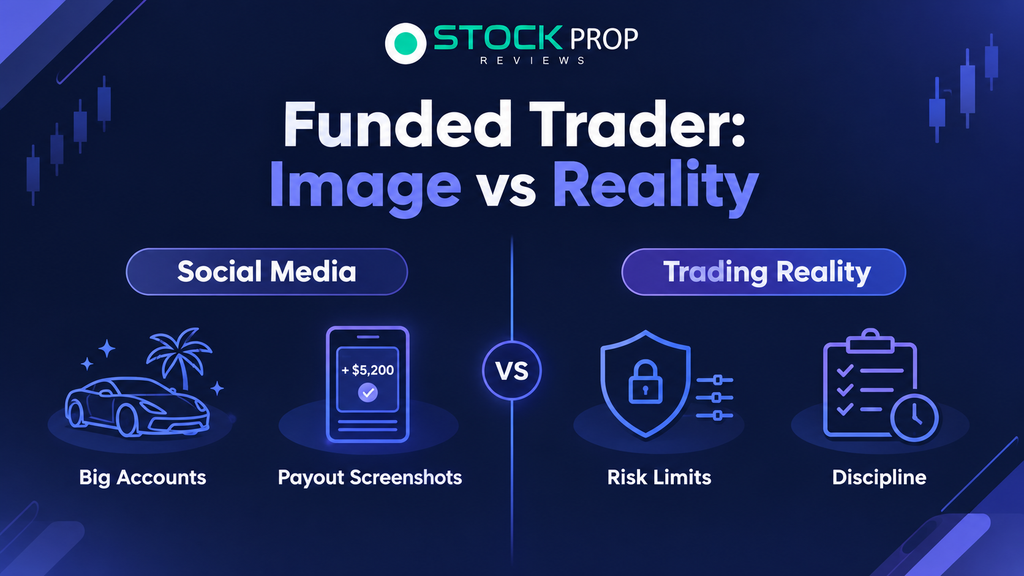
On social media, the funded trader lifestyle is often depicted as glamorous, with large trading accounts, luxury cars, flexible hours, and screenshots of impressive payouts. The truth is not so pretty. To be a funded trader, you usually have to abide by strict risk limits, deal with the psychological pressure, abide by the account rules, and accept that a funded account does not give a regular income.
This reality check is for prop firm traders aspiring, beginners thinking about taking a trading challenge and funded traders wanting a more realistic picture of the profession. It’s not for anyone who wants guaranteed income, financial freedom overnight, or a shortcut to wealth.
Proprietary trading firms provide traders with access to simulated or live trading environments subject to specific rules. Traders can receive a portion of the profits if they qualify, depending on the firm and program, once the minimum criteria are met. However, an advertised account size is not the same as the cash in the trader’s bank account.
Understanding the difference is the first step in figuring out if the funded trader lifestyle is right for you.
What Is the Funded Trader Lifestyle?
The funded trader lifestyle describes the working habits, financial arrangements, routines, and personal expectations associated with trading through a proprietary trading firm.
The real lifestyle is not the one displayed on social media. It is based on risk management, preparation, record keeping, emotional control and compliance with account rules. Some traders work from home, some trade around existing jobs and a smaller group of traders treat trading as a full-time occupation.
There is no single funded trader lifestyle. A trader who receives occasional payouts while maintaining another source of income has a very different experience from someone relying entirely on trading profits to pay rent and household expenses.
The main distinction is between the lifestyle being advertised and the trading process required to sustain it.
A funded account may provide access to a larger trading balance or buying power than a trader could personally finance. It does not remove market risk, guarantee a payout, or eliminate the possibility of losing access to the account.
The Social Media Image Versus Trading Reality
Social media is more about the results than the process.” A payout screenshot can prove you received a payment, but it usually doesn’t show the trader’s full history, total challenge fees, failed attempts, trading costs, or the time spent creating a strategy.
This is an incomplete picture of what it means to trade professionally.
| Social media image | Practical reality |
| Large funded account | Strict drawdown and loss limits |
| Regular payout screenshots | Payouts depend on performance and eligibility |
| Freedom to trade anytime | Trading hours may be limited by strategy, market conditions, or firm rules |
| Quick financial independence | Income can be inconsistent or absent |
| Trading from anywhere | Reliable internet, suitable equipment, and a workable routine still matter |
| One successful challenge | Long-term consistency remains unproven |
None of this means successful funded traders do not exist. Some traders develop repeatable strategies, follow their risk limits, and receive multiple payouts over time. The problem is treating selected success stories as representative of the average participant.
A trader should evaluate the business model and their own performance rather than using another person’s lifestyle as evidence that trading will work for them.
How Much Can a Funded Trader Actually Earn?
Funded trader income has no universal number you can rely on. Your earnings are based on the trading performance, the programme’s payout policy, the eligible profits, the trader’s share of the profit, any fees incurred and whether the account is still eligible for rewards.
A useful way to understand potential earnings is to work through a hypothetical example.
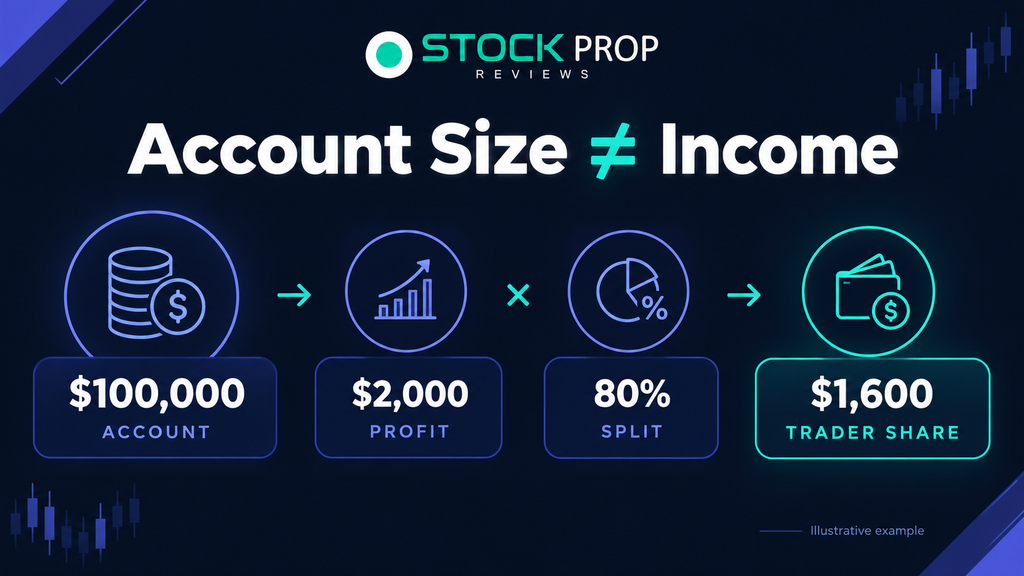
Suppose a trader generates $2,000 in eligible profit on an account and qualifies for an 80% profit split. The trader’s share would be $1,600 before any applicable taxes, currency conversion costs, or other personal expenses.
That calculation assumes the profit is eligible and the payout is approved. It is not a prediction of what the trader will earn.
Now consider a less favourable month. The trader might make little or no profit, incur a loss within the permitted limits, or fail to qualify for a payout under the programme’s conditions. Personal living expenses, however, continue regardless.
This is why an advertised account size should never be used as a salary estimate.
Account size is not personal capital
A funded account of $100,000 does not mean that a trader has $100,000 or can withdraw $100,000. Depending on the drawdown structure the usable risk allowance could be a small fraction of the headline balance.
For example, a simple fixed-limit illustration would show a loss threshold of $5,000 for a program with a maximum loss limit of 5% on a $100,000 nominal account. However the actual calculation may be different if the program uses trailing drawdown, equity based limits, daily loss limits or other conditions.
The trader must understand the precise rules when executing a trade. A large face value account can still leave room for error
Why payout screenshots do not tell the whole story
A payout is evidence of a payment, not proof of steady long-term income.
It doesn’t tell how many challenges the trader bought, how many accounts were lost, if the results are repeatable, or how much time and money were spent. It does not establish that the same results will happen.
If a trader is going to make claims you want to see more history, risk management, reasonable drawdowns and some proof the trader is consistent across market conditions.
A single profitable week is not a sustainable income model.
Why Funded Traders Fail Despite Having a Strategy
A trading strategy can be profitable in testing but not in a funded account. That is because performance in trading is only half the battle. Traders also have to operate within the risk framework of the firm, manage pressure and adjust to fluctuating market conditions.
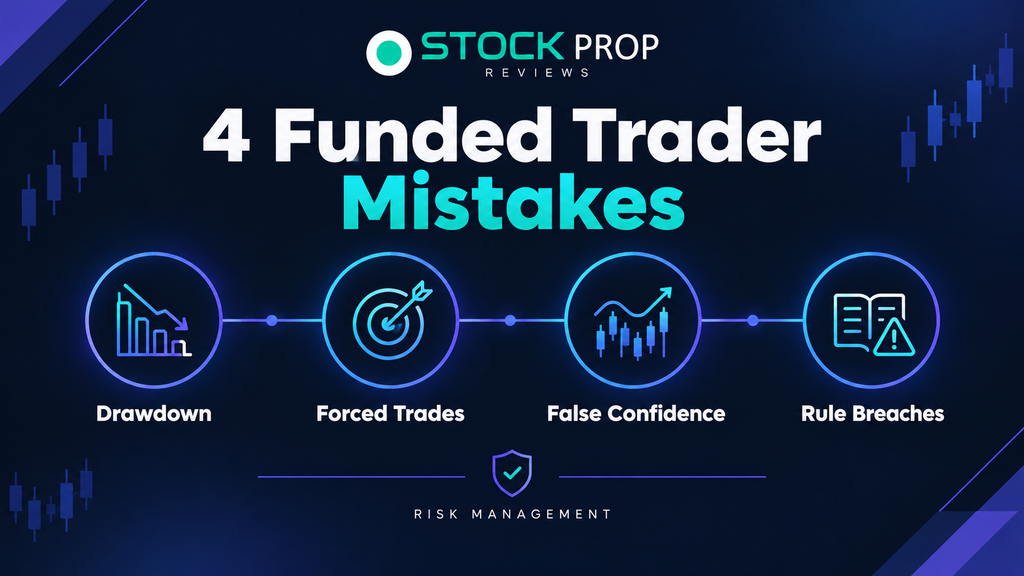
Some common reasons why traders lose funded accounts
1. Treating drawdown as a spending allowance
Drawdown is the amount an account can lose before reaching a pre-determined risk threshold. It is not something to be used up.
Now suppose a trader makes 1% bets on a strategy that wins 45% of the time. The trader may feel pressure to make up the losses after three losing trades in a row. A losing streak that can be handled can turn into a breach of the account by increasing position size or by abandoning the original setup.
A better approach is to define risk per trade, set a daily stop and reduce exposure when performance deteriorates. The exact limits should be consistent with the rules of the account and the historical drawdowns of the strategy.
2. Forcing trades to meet a target
Certain traders become anxious near the point of passing an assessment or qualifying for a payout. They might be trading unfamiliar sessions, using marginal setups or increasing leverage to get to a goal faster.
That is when discipline matters and that changes the strategy.
Don’t make a trade based on profit targets. Sometimes the best professional decision is to not take a position if the market does not offer a valid setup.
3. Confusing a good month with a repeatable edge
“Maybe you got lucky a few times, maybe the market was good. Not a sustainable advantage. A good trader in a strong trend might be a poor trader in a ranging or volatile market.
More meaningful evaluation would be to look at multiple market environments and look at average win, average loss, max drawdown, trade frequency and performance after trading costs.
Without that record, it is difficult to tell whether success is a function of a repeatable process, or a short run of good luck.
4. Ignoring account-specific rules
Two prop firms may have the same account size, but their drawdown calculations, payout conditions, holding limitations, and forbidden trading strategies may differ.
A trader may violate the terms of one firm without intending to take on too much risk if they believe the rules of one firm apply everywhere.
Read the rules for the exact program you purchase. Make sure you note if the drawdown is fixed or trailing, if it is calculated on equity or balance and if there are any special restrictions during news, overnight or payout periods.
The Psychological Cost of the Funded Trader Lifestyle
Trading out of the home provides flexibility; but flexibility does not necessarily create a healthy routine. Traders whose monthly bills are paid by payouts often feel more pressure than those with other sources of income.
That pressure can influence decision-making in many ways. A trader might be afraid to lose profits and will close profitable positions too soon. Another may hold on too long in a losing position because to admit the loss is to admit failure. Some may overtrade to make up for a missed opportunity or to make up for losses from the previous day.
These behaviors are not unique to prop trading. But tight account limits and evaluation goals can bring their effects more immediate.
The difference between trading for a living and trading to build a track record
A trader building a track record can focus on improving execution, gathering data and controlling losses. A trader who depends on making trades to pay the essential bills may feel the need to make income even when conditions are poor.
This is why it is important to separate finances.
Before you start trading funded trading as a full-time job, consider having an emergency fund, separating challenge fees from other expenses, and setting a realistic time period to evaluate your performance. There is no one right number of months, but a single payout is not enough proof of reliable income.
A useful question is not just “Can I make money trading?” ,”Can I stay with my process through profitable times, losing periods and quiet markets without jeopardizing my financial stability?”
What Competitors Often Miss About the Funded Trader Lifestyle
A lot of lifestyle articles are about flexibility, possible payouts and the advantages of trading without having to invest a large personal trading balance. Those points are relevant, but they miss a couple of key considerations.
First the challenge costs are accumulated. A trader might pay for several evaluations before they pass one. If you lose a challenge, you may not get your original fee returned. That money that was spent on repeat purchases could have been better spent on education, savings, or a proven strategy.
Second, passing an evaluation does not prove long term profitability. An evaluation is a measurement of performance in a given situation. Funding and the ability to withdraw provides further tests of consistency, risk management and adherence to rules.
Thirdly, the rules governing payout vary from one company to another. Some programs have minimum days of trading required, profit targets, consistency rules or waiting periods. A trader might be making paper money but at some point not be able to make a withdrawal.
Fourth, the commercial relationship matters. Traders need to know if activity is in a simulated environment or a live market, how rewards are calculated, what can cause termination and which legal entity is running the program. The nominal account balance should never be considered as an indication that the firm has kept that amount of cash for the individual trader.
These things aren’t as exciting as lifestyle content, but they’re more useful in deciding whether a prop firm is right for you.
How to Build a More Sustainable Funded Trading Routine
A realistic routine begins before purchasing an evaluation. Traders should have a documented strategy, a record of its historical performance, and a clear understanding of the rules they intend to follow.
- A practitioner to the session reviews the upcoming economic releases, the associated market conditions and remaining risk allowance for the account.
- In trading: ONLY take setups that match pre-defined criteria. Do not try to recover losses or reach a target by increasing risk.
- Post session: Record entries, exits, mistakes and whether each trade was on plan.
- At the end of the week: Review expectancy, drawdown, execution quality and rule compliance, not just profit
- Before you request a payout: Review the current eligibility requirements and how a withdrawal could impact the risk buffer or scaling conditions of the account.
The goal is to make decisions based on a process rather than daily financial pressure.
It’s also worth setting limits on screen time. Watching charts all the time can cause unnecessary trading, especially when there are few high quality opportunities in the markets. Rest, exercise and time away from the trading platform can help to stay focused on.
Choosing a prop firm that fits your trading style
It’s all about what you trade and how you trade it. A stock trader who holds positions for longer periods may need different conditions than a forex scalper or futures day trader.
You should compare the loss limits, payout structure, news restrictions, holding rules, platform and trading methods allowed by the firm before you invest your money. Get hold of the official rulebook but use independent reviews to help identify areas that might require additional verification.
To give traders some context, you can see how the evaluation structure is presented in an FTMO review and the account conditions discussed in a The5ers review. Studying prop firm comparison can help to understand the differences in costs and rule structures, and an analysis of prop trading risks can provide a more balanced perspective of the trade-offs of the industry.
These references should support your own assessment, not replace checking the firm’s current terms.
For stock traders who prefer a programme centred on equities, TradeThePool is another option to research. It publishes programme rules covering risk limits, trading conditions, and payout eligibility. Readers can get up to 10% discount when purchasing through our TradeThePool link. This is a commercial offer, not a guarantee of suitability or profitability.
One important clarification: TradeThePool describes itself as a stock prop trading provider, but its published terms state that it is not a financial institution operating under the purview of financial regulatory authorities. It should therefore not be described as a regulated financial institution without a specific, verifiable regulatory basis.
FAQs
Is the lifestyle of a funded trader achievable?
Yes, it can be realistic for traders who have a repeatable strategy, control risk and have realistic financial expectations. Flexibility and steady payouts, however, are not guaranteed. Many participants lose their evaluation fees or can’t maintain their accounts.
Is it possible to make a full-time income from prop trading?
It can be, but it should not be taken for granted. Your income will be determined by your trading performance, your eligibility for a payout, the rules of the firm and the consistency of your results over time. Traders should not count on projected payouts for essential expenses until they have a long and documented track record.
Do funded traders receive the entire account balance?
Nope. The account size advertised is usually the nominal trading balance or buying power of the program, not the money owned by the trader. Withdrawals are generally made on the basis of eligible earnings and the payout arrangement.
What’s the biggest risk of being a funded trader?
The big risk is spending, spending on evaluations without building a profitable, rule-compliant trading process. Other risks are: losing access to an account because of drawdown violations, misunderstanding payout conditions, and counting on uncertain trading income to pay living costs.
Can Beginners Do a Prop Firm Challenge?
As a rule, beginners should learn, practice and test a strategy before paying for a challenge. A prop firm eval can add financial costs and rule constraints that make learning more difficult. Anyone who’s considering one should be able to do without the fee without impacting essential spending.
The Bottom Line
The funded trader lifestyle is less about financial freedom and more about dealing with uncertainty. To participate profitably you need a sound trading process, realistic expectations, disciplined risk management and a clear understanding of the terms of the program.
A Funded Account can be an opportunity to prove your trading ability but it is not a salary, financial independence or long term success. The only way a trader should be measuring their progress is in repeatable execution and controlled drawdowns, not against a screenshot of a payout on the internet.
“Before you buy a challenge, ask yourself if your strategy has been tested, if you understand the rules, and if you can afford the fee if it fails,” he said. If the answer to any of these questions is no, then it may be the more sensible trading decision to delay the purchase.