
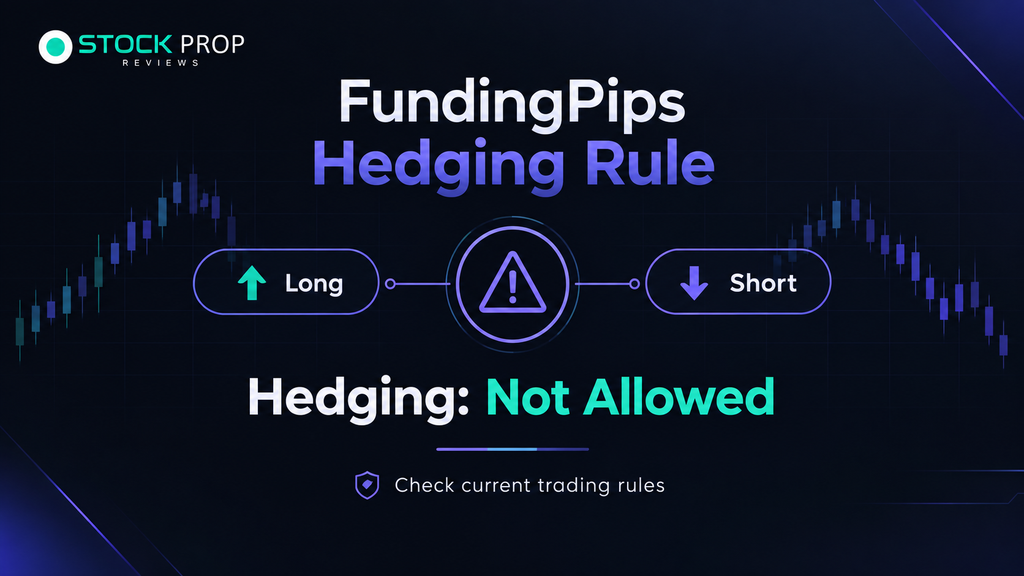
Yes, hedging at Funding Pips is prohibited. FundingPips explicitly lists hedging among its forbidden trading strategies, alongside long-short arbitrage, reverse arbitrage, opposite account trading, latency arbitrage and several other strategies. The current trading conduct rules state that forbidden strategies can result in account termination.
This guide is mainly for beginner and funded forex traders who want to understand whether opening opposing positions can be used to protect or manage a FundingPips account. It is not aimed at traders looking for a loophole around the firm’s risk rules. If your normal strategy depends on simultaneously holding long and short exposure to the same market, FundingPips’ published rules are directly relevant to you.
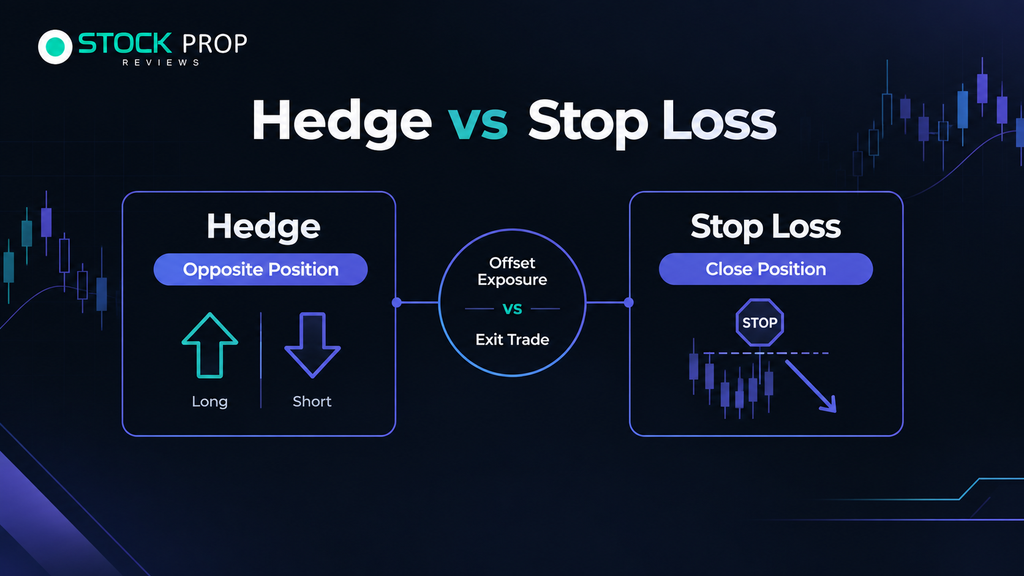
There is also an important distinction between ordinary risk management and hedging. Using a stop loss, reducing position size or closing a trade is not the same as opening an opposing position to offset exposure. That distinction matters because a trader can think they are simply “protecting” a trade while actually using a strategy that falls within FundingPips’ prohibited hedging rules.
Quick answer: Is hedging allowed at Funding Pips?
No. FundingPips currently lists hedging as a forbidden strategy.
Its Trading Conduct and Security Standards specifically name hedging, long-short arbitrage, reverse arbitrage and opposite account trading as prohibited. The firm’s terms also state that prohibited trading methods can result in account termination.
The rule is particularly important because hedging can take several forms. It does not necessarily mean buying and selling the exact same instrument at exactly the same time.
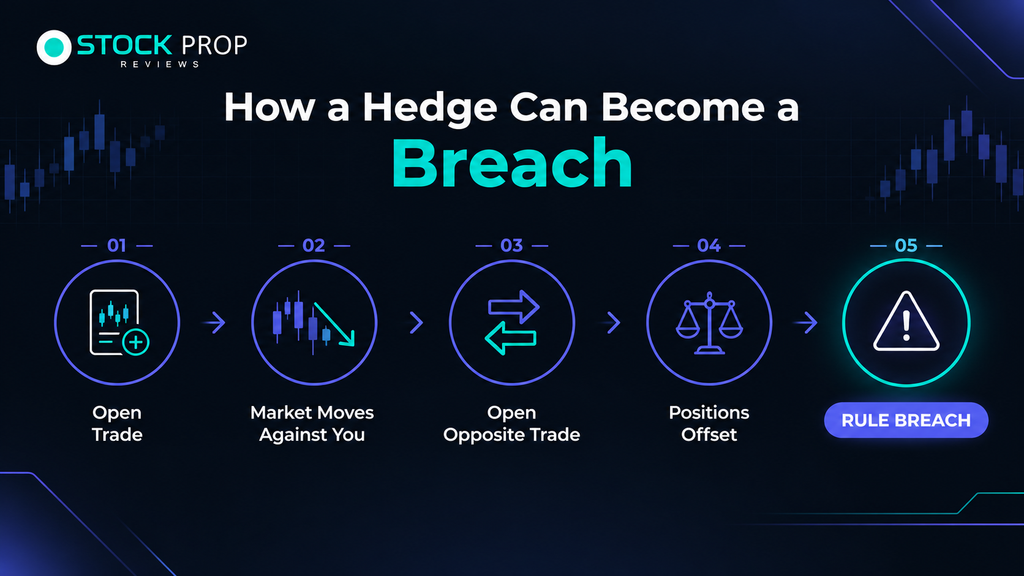
For example, a trader might open a long EUR/USD position and then open a short EUR/USD position when the first trade starts moving against them. That is straightforward opposing-position hedging.
A more complicated example would involve taking opposite positions across different accounts in an attempt to guarantee that one account benefits from a market move. FundingPips separately prohibits opposite account trading and coordinated hedging designed to guarantee an outcome.
What does hedging mean in trading?
Hedging is a risk-management technique in which a trader takes an additional position intended to offset some or all of the risk of an existing position.
In a normal trading environment, a trader might use a hedge because they expect temporary uncertainty and do not want to immediately close the original position.
Suppose a trader is long EUR/USD:
- Long EUR/USD: 1.1000
- Price begins falling
- Trader opens a short EUR/USD position
- The short position offsets some of the long exposure
The trader has not necessarily reduced the underlying market exposure by closing the original position. Instead, they have created opposing exposure.
That can be a legitimate strategy in some trading environments. The problem is that FundingPips does not permit hedging as part of its trading conduct rules.
Researchers have developed a deep reinforcement learning framework that optimizes algorithmic market-making and hedging under real-world market frictions, solving complex scenarios traditional mathematical models cannot handle.
Why FundingPips prohibits hedging
FundingPips groups hedging with strategies that it considers prohibited trading practices, including arbitrage and techniques intended to exploit trading-platform inefficiencies. The firm’s current conduct rules say these strategies are not allowed and may lead to account termination.
This is where some trader discussions become confusing.
A trader may think:
“I am not trying to exploit the platform. I am only reducing my risk.”
The intention may be different, but the firm’s published rule is based on the trading method. If the method involves hedging, the fact that the trader describes it as risk management does not make it permitted.
This is one reason it is safer to build the trading plan around the firm’s actual rules rather than relying on the normal definition of what constitutes sensible risk management.
Hedging vs stop loss at Funding Pips
A stop loss and a hedge can both be used after a trade moves against you, but they work differently.
| Method | What happens | FundingPips position |
| Stop loss | Original position is closed at a predefined loss | Normal risk-management method |
| Position reduction | Part of the original position is closed | Generally different from opening an opposite hedge |
| Manual exit | Trader closes the losing position | Normal trading action |
| Opposite position | A new position is opened in the opposite direction | Hedging is prohibited |
| Opposing accounts | Different accounts take opposite positions to offset outcomes | Prohibited when used as opposite-account trading or coordinated hedging |
The important point is that closing risk and creating opposing exposure are not the same thing.
A trader who is long gold and closes the trade after a technical invalidation has simply accepted the loss.
A trader who keeps the long position open and opens a short gold position has created offsetting exposure. Under FundingPips’ published rules, that falls into prohibited hedging territory.
What happens if you hedge at Funding Pips?
FundingPips states that forbidden strategies can result in immediate account termination. Its terms also state that prohibited trading methods can result in account termination.
That means traders should not approach hedging as a minor technical rule violation.
A common mistake is assuming that an account can be hedged occasionally without consequence if the overall profit and loss remains within the drawdown limits.
That assumption is risky.
Drawdown rules and prohibited-strategy rules are separate. Staying below the maximum loss limit does not automatically make a prohibited trading method acceptable.
For example, a $100,000 account could remain comfortably inside its loss limit while a trader opens simultaneous long and short positions. The fact that the account has not lost too much money does not remove the separate restriction against hedging.
The drawdown rule does not make hedging acceptable
FundingPips’ current account structures have separate risk limits, and these vary by model. For example, the current 2 Step Standard information lists a 10% maximum loss and a 5% daily loss limit for the applicable Master Account structure, while other models have different limits.
That creates an important practical distinction:
Risk limit: How much the account can lose.
Trading conduct rule: Which methods the trader is allowed to use.
A trader has to satisfy both.
This is something many simplified explanations of hedging fail to explain. Passing the drawdown test does not override a prohibited-strategy rule.
A practical example of how traders get into trouble
Consider a trader who buys XAU/USD after a breakout.
The trade initially moves in the expected direction. Instead of closing the position when momentum fades, the trader opens a short position against the original long.
Gold then moves sideways.
The trader now has:
- An existing long position
- A new short position
- Two positions reacting differently to costs and execution
- No clear exit plan
- A strategy that conflicts with FundingPips’ prohibition on hedging
The trader may feel safer because the two positions offset each other.
But the underlying problem has not necessarily disappeared. Spread, commission, swap where applicable, execution differences and market movement can still affect the account.
More importantly, the trading method itself is not permitted under FundingPips’ published rules.
The cleaner response would have been to define the original trade’s invalidation point before entering and close the position when that condition occurs.
What competitors often miss about FundingPips hedging
Many articles answer the question with a simple “hedging is prohibited” statement. That is useful, but it leaves out the practical part.
The bigger issue is how traders interpret the word hedging.
A trader does not necessarily have to use a formal “hedging strategy” with a complicated system. Opening an opposite position to offset an existing position can create the same problem.
There is another distinction worth understanding: FundingPips also separately addresses opposite account trading. Its current conduct policy allows copying trades between your own FundingPips accounts in the same direction, but prohibits coordinated opposing positions designed to guarantee an outcome.
So traders should not assume that “different accounts” makes an opposing-position strategy acceptable.
Can you use a hedge on another FundingPips account?
You should not use another account to create an opposing hedge.
FundingPips’ current rules distinguish between permitted copying across your own accounts and prohibited opposite-account trading. The company says copying trades between your own FundingPips accounts is permitted when they are registered to the same individual and traded in the same direction. It also specifically says coordinated hedging across accounts to guarantee a win on one side is not permitted.
That means this setup is problematic:
Account A: Buy EUR/USD
Account B: Sell EUR/USD
The intention may be to let one account benefit regardless of market direction. That is materially different from simply trading the same strategy across your own accounts.
What should you do instead of hedging?
For most traders, the simpler solution is to manage risk before entering the trade.
A practical FundingPips-compatible approach is:
- Define the invalidation level before entering.
- Calculate the position size from the stop distance.
- Accept the predefined loss if the setup fails.
- Avoid opening an opposite position simply to neutralize the first trade.
- Reassess the market only after the original position has been closed.
This approach has an important psychological benefit.
Hedging can sometimes turn a single losing decision into two unresolved positions. Instead of accepting that the setup failed, the trader keeps both sides open while waiting for the market to make the decision.
That can lead to hesitation, overtrading and larger cumulative costs.
Common mistakes traders make with FundingPips hedging
Mistake 1: Calling every risk-management action hedging
Closing a losing position is not the same as hedging it.
A stop loss closes out your initial position. Hedge creates opposite exposure.
Mistake 2: Assuming drawdown rules are the only rules
A trader can stay within his daily loss limit and maximum loss limit, but still break a separate rule against a certain trading strategy.
Mistake 3: Hedging across accounts
This limitation does not go away just because you have separate accounts. FundingPips is a specialist in opposite accounts trading and coordinated hedging.
Mistake 4: Believing a small hedge is safe
The size of the hedge does not change the fact that FundingPips explicitly lists hedging as prohibited.
Mistake 5: Following old FundingPips rule summaries
This is especially important right now.
FundingPips states that its legacy rules apply to purchases made before September 28, 2026, while new purchases and account resets after that date fall under the newer rules. Traders should therefore check the current rules applicable to their specific account instead of relying on an old review or forum post.
Our FundingPips review also looks at how the firm’s rule structure affects actual trading behaviour rather than focusing only on headline profit splits.
Who should avoid FundingPips if they rely on hedging?
A trader should think carefully before choosing FundingPips if hedging is an essential part of their strategy.
This includes traders who routinely:
- Keep long and short positions open simultaneously
- Use opposing trades to delay taking a loss
- Hedge positions between accounts
- Depend on arbitrage-style exposure
- Treat hedging as a core part of their entry and exit system
The issue is not whether hedging can be useful in conventional trading. It can be. The issue is that it conflicts with FundingPips’ current trading conduct rules.
A trader whose strategy works perfectly well without hedging has a different situation. They may simply need to adjust their risk-management process around stops, position sizing and trade exits.
FundingPips and strategy fit
The more useful question is not whether FundingPips has “good” or “bad” rules. It is whether the rules fit the way you already trade.
| Trading style | Potential issue at FundingPips |
| Standard directional trading | Hedging restriction still needs to be observed |
| Stop-loss based trading | Compatible with a non-hedging approach |
| Long/short hedging | Direct conflict with published rules |
| Opposite-account strategy | Conflict with prohibited opposite-account trading |
| Arbitrage | Several arbitrage methods are prohibited |
| Rapid execution strategies | Certain HFT, tick-scalping and execution-exploit strategies are prohibited |
| Risk-managed swing trading | Must still follow the current model’s holding and account rules |
Our FundingPips rules guide goes deeper into how the firm’s risk architecture can affect strategy selection.
For a broader comparison, a prop firm comparison is more useful than focusing on profit split alone. Traders should compare the actual restrictions around drawdown, execution, news, holding periods and strategy freedom.
What about TradeThePool?
TradeThePool is a different type of prop trading program because it focuses on stocks and ETFs rather than the forex-focused model associated with FundingPips.
However, there is an important accuracy point for traders researching alternatives. TradeThePool’s current terms explicitly state that Five Percent Online Ltd. is a technology company operating proprietary trading services and is not a custodian, exchange, financial institution, trading platform, fiduciary or insurance business outside the purview of financial regulatory authorities. Its own website also describes its online prop trading environment as unregulated and simulated.
For that reason, it would be inaccurate to describe TradeThePool as a regulated stock prop firm.
It can still be relevant to traders who want stock-focused trading, clearly published risk parameters and a different rule structure. Its current program terms explain the evaluation and funded-account framework in detail.
Readers can get up to 10% discount when purchasing through our TradeThePool link.
Our TradeThePool review covers the firm’s stock-focused structure, rules and practical considerations in more detail.
Final takeaway
Hedging at Funding Pips is not allowed under the firm’s current published trading conduct rules.
The important part is not simply remembering the word “hedging.” Traders need to understand the difference between closing an existing position and opening an opposite position to offset it.
If your strategy requires simultaneous long and short exposure, FundingPips’ rules create a direct strategy-fit issue. If you normally use stop losses, position sizing and predefined exits, the hedging restriction is much less likely to affect your day-to-day trading.
Most important, check the rules on your actual account. FundingPips transitioned from legacy rules to newer rules for purchases and resets after September 28, 2026, so older articles could rapidly become misleading.
The safest approach is simple: do not assume that a strategy is allowed because it is common in conventional trading. At a prop firm, the firm’s current trading rules determine what you can actually do with the account.
FAQs
Is hedging allowed at Funding Pips?
No, Hedging is currently listed as a prohibited trading strategy on Pips. Traders should not hedge an existing position by opening opposite positions.
Can I hedge a Funding Pips trade using another account?
No. Funding Pips also prohibits opposite-account trading that involves coordinated positions intended to offset risk or guarantee an outcome. Traders should check the current rules applicable to their specific account.
Does funding pips consider stop loss as hedging?
No. A stop loss is used to close an existing position when a particular price level is reached. Hedging is the process of taking an opposite position to your original open position. These are different risk management types.
Can I hedge and stay within the drawdown limit?
Even if it stays within the daily or maximum drawdown limit, prohibited strategy is not acceptable. Funding Pips has distinct rules for trading conduct and account loss limits, meaning a trader can violate a strategy restriction without breaching the drawdown threshold.
What else can I do other than hedging at Funding Pips?
Traders can manage risk through position sizing, pre-defined Stop Losses and well defined levels where trades are invalidated. The key is to decide what risk is acceptable BEFORE you enter the trade rather than opening an opposing position so you don’t have to close a losing trade.