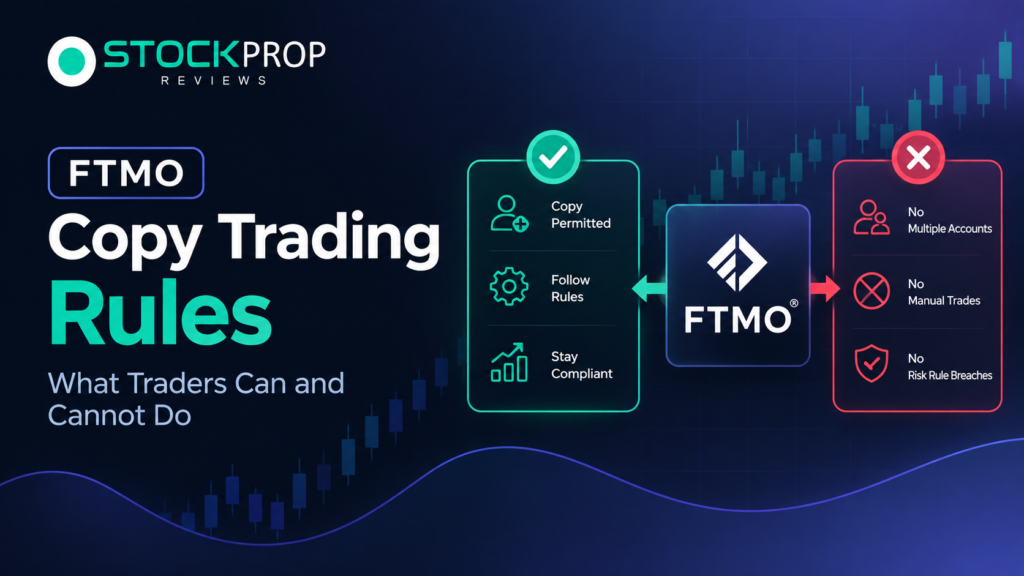
There are two very different situations to consider when considering Copy Trading at FTMO. One is copying your own trades between accounts and the other is copying trades from another trader or signal provider.
FTMO Futures has explicit current rules. Copying another trader’s decisions is not allowed. However copy trading on your own accounts is allowed as long as every account respects the applicable rules individually.
More careful reading is needed on the CFD side as the current public forbidden-practices page for the CFD side does not have the same explicit “copy trading” wording that is used in the Futures rulebook. But FTMO’s CFD rules are geared toward personal use, account ownership, legitimate trading and strategies that reflect real-market behavior.
This article is mostly for traders who are thinking about using a copier to manage multiple FTMO accounts. It is not for traders looking for a way to follow someone else’s signals without developing or controlling their own trading decisions.
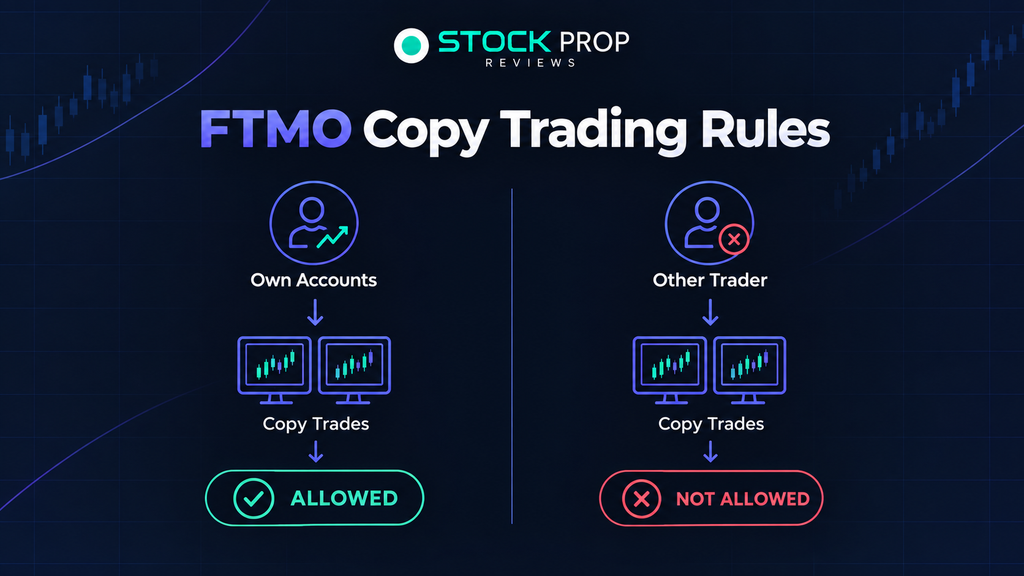
Quick answer: Can you copy trade at FTMO?
The answer depends on the setup.
| Copy trading setup | FTMO position | Main concern |
| Your own account → another account you own | Permitted for FTMO Futures, subject to each account’s rules | Each account remains independently responsible |
| Another trader → your FTMO account | Prohibited for FTMO Futures | Trading decisions originate from a third party |
| Paid signal service → FTMO account | Prohibited for FTMO Futures | The strategy is not your own |
| Master account → several accounts you own | Possible within the applicable rules | Capital allocation and risk still matter |
| Third party operates your FTMO account | Not permitted | FTMO accounts are for personal use |
| Opposite positions used to offset accounts | Restricted/prohibited | Can be treated as hedging or risk manipulation |
The important point is that a trade copier itself is not automatically the problem. The source of the trading decisions and the way the accounts are managed matter more.
FTMO’s Futures rules specifically say that copying your own accounts is permitted when each account independently complies with the rules.
What does copy trading mean at FTMO?
Copy trading means automatically or manually reproducing trades from one account into another.
For example, suppose you personally trade a $100,000 FTMO account. You buy EUR/USD with a defined stop loss. A trade copier then sends the same trade to another FTMO account that you also own.
That is different from subscribing to a trader who sends EUR/USD buy and sell signals and automatically executing those signals on your FTMO account.
The first setup originates from your trading decisions. The second originates from someone else’s decisions.
That distinction becomes particularly important under FTMO Futures, where the forbidden-practices rules explicitly prohibit replicating or incorporating another person’s trading decisions through signal services, master accounts, trade copiers, or manual arrangements.
FTMO CFD vs FTMO Futures: the distinction traders miss
Here is where a lot of copy trading articles make it easy.
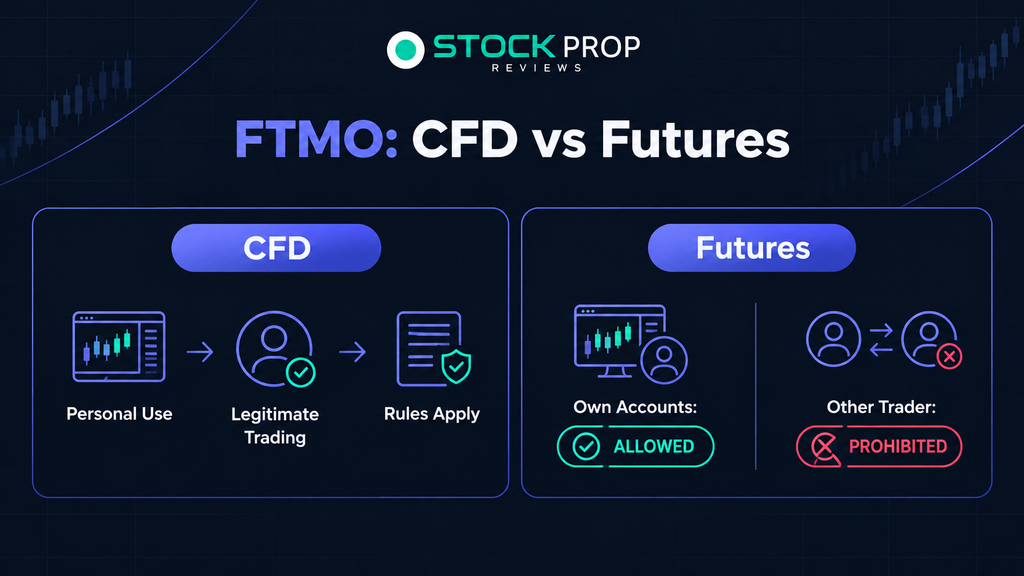
FTMO currently has separate CFD and Futures programs and wording is different in their rules.
FTMO has a specific rule for Futures that copying another trader is not allowed. That same page explicitly permits copying between your own accounts, with the caveat that each account separately adheres to the applicable rules.
For the CFD programme, FTMO’s public forbidden-practices page focuses on personal use and prohibits allowing another person to access or operate your account. It also prohibits trading practices that conflict with FTMO’s terms or exploit the simulated environment.
FTMO’s CFD FAQ also states that traders can use discretionary or algorithmic strategies, including EAs, provided the strategy is legitimate, follows the rules and is consistent with real-market conditions.
That means traders should not automatically take a Futures-specific sentence and assume it applies word-for-word to every FTMO CFD account.
If your setup involves a third-party signal provider, another trader’s account, or a copier connecting accounts held under different ownership, the safest approach is to obtain written clarification from FTMO before placing trades.
Why copying your own accounts can still be risky
Being allowed to copy trades does not mean that the risk disappears.
Imagine you have three $100,000 accounts and risk 1% on each trade.
A single losing trade could produce approximately:
Account 1: $1,000 loss
Account 2: $1,000 loss
Account 3: $1,000 loss
The copier has made execution easier, but it has also multiplied the financial impact of your decision across accounts.
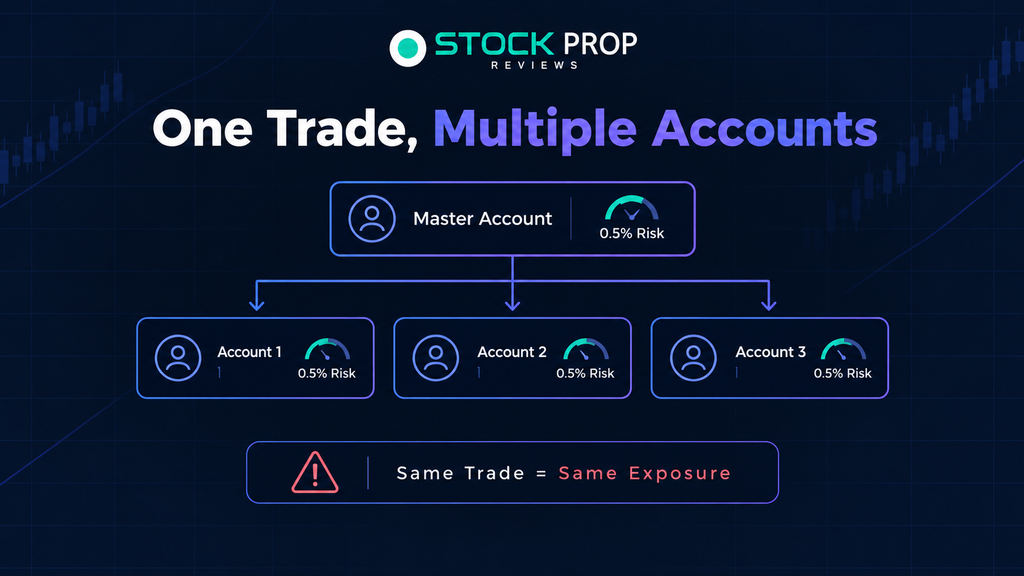
This is one of the biggest misunderstandings around copy trading. Traders sometimes see several accounts as separate opportunities when, from a risk perspective, they may simply be multiple exposures to the same strategy.
FTMO’s CFD account rules currently place a maximum capital allocation of $400,000 per trader or strategy before scaling. FTMO also says that identically traded strategies across accounts can be relevant when assessing the allocation limit.
So copying the same strategy across accounts should not be treated as unlimited scaling.
A practical example
Consider a trader running a master account with a 0.5% risk per trade.
The trader copies each position to three accounts.
A normal sequence might look like this:
Trade 1: -0.5%
Trade 2: -0.5%
Trade 3: +1%
Trade 4: -0.5%
Trade 5: -0.5%
The strategy has experienced four losses and one winner.
On the master account, this may be manageable.
But the psychological problem appears when the trader starts thinking about the combined dollar result across multiple accounts. Instead of accepting the normal statistical variation of the strategy, they may increase the master-account position size to recover the loss faster.
Now the copier spreads that larger position across every follower account.
The technology has not caused the problem. The change in risk behaviour has.
This is one reason I would treat copy trading as an execution tool rather than a risk-management system.
What competitors often don’t explain
Many articles about FTMO copy trading concentrate on whether a copier technically works with MT4, MT5 or another platform.
That answers the wrong question.
The more important questions are:
- Who owns the source account?
- Who makes the trading decisions?
- Who controls the target accounts?
- Does the setup create prohibited hedging or correlated exposure?
- Does every account independently remain inside its drawdown and other rules?
- Does the total strategy exposure remain within FTMO’s allocation requirements?
A copier can successfully transmit an order and still leave the trader with a compliance problem.
FTMO also states that its CFD trading environment is simulated. FTMO monitors trading activity and may use trading data separately for its own live trading activities, but the client’s FTMO Account itself uses fictitious capital.
That matters because traders should not assume that successful technical execution automatically means a strategy is acceptable under the firm’s programme rules.
The biggest copy trading mistakes
Copying someone else’s signals
This is the clearest problem under the current FTMO Futures rules.
A trader may find a profitable-looking Telegram, Discord or signal service and connect it to an FTMO account. The trader is technically controlling the account, but the underlying trading decisions originate elsewhere.
FTMO explicitly prohibits this on its Futures Evaluation and Sim-Funded Accounts.
Treating several accounts as one giant account
If five accounts follow exactly the same trades, a losing sequence affects all five simultaneously.
The account dashboards may be separate, but the strategy risk is connected.
Using the same position size everywhere
A 1-lot position may have completely different consequences depending on account size, instrument volatility, stop distance and drawdown room.
A copier should therefore not be viewed as a reason to blindly duplicate lot sizes.
Forgetting execution differences
Copied orders are not guaranteed to have identical fills.
FTMO notes that execution delays can occur and says its infrastructure can introduce delays of up to 200 milliseconds. Slippage can also be positive or negative.
For a swing trader, a small difference in entry price may be insignificant. For a very short-term strategy, it can materially change the trade.
Assuming a copier protects you from drawdown
It does the opposite if used carelessly.
A copier makes it easier to distribute the same mistake across multiple accounts.
Does FTMO allow EAs and automated trading?
FTMO does allow algorithmic trading under its CFD rules as long as the strategy remains legitimate and complies with the firm’s restrictions.
However, automation does not remove responsibility from the trader.
An EA can open trades faster than a human, but it can also repeat an error faster.
The same principle applies to copy trading. If the master strategy suddenly increases position size, opens several correlated positions or behaves differently from its normal risk profile, the follower accounts can reproduce the problem almost instantly.
For that reason, traders should monitor the actual positions rather than assuming that the copier is simply a passive technical tool.
When copy trading makes sense
Copy trading can have a practical use when you are the person generating the strategy and you need consistent execution across accounts that you legitimately control.
For example, a trader might manually analyse the market on one account and then use a copier to reproduce the same trade on additional accounts.
The benefit is operational efficiency.
You do not have to manually enter the same order several times, which can reduce inconsistent entries caused by hesitation or simple execution mistakes.
But the strategy should still be designed around the rules of the individual account.
A 0.5% risk trade on one account does not automatically mean the same numerical position is appropriate on another account.
When you should avoid copy trading
Copy trading is probably the wrong approach if your main reason for using it is that you do not have a trading strategy of your own.
It is also unsuitable if you are relying on another trader’s results without understanding their risk model.
A signal provider might use averaging, aggressive recovery trades or a high percentage of account equity on individual positions. A short period of good performance does not tell you how the strategy behaves during a sustained losing sequence.
FTMO itself has warned traders about the risks of blindly following signal providers and account managers, including overtrading and aggressive position sizing.
If you cannot explain why a trade is being taken, you should be especially careful about allowing that trade to reach a funded account.
FTMO copy trading and account limits
For the CFD programme, FTMO currently states that there is no numerical limit on the number of accounts, but there is a $400,000 maximum capital allocation per trader or strategy before scaling.
This is important for traders who want to build a large multi-account setup.
For example, buying numerous challenges does not necessarily mean you can eventually operate unlimited funded capital using one identical strategy.
FTMO also says that multiple registrations are not permitted and that identically traded strategies can be relevant when determining whether the allocation limit has been exceeded.
The practical lesson is simple: count your total strategy exposure, not just the number shown on each dashboard.
Who should use FTMO copy trading?
Copying your own trades can be useful for an experienced trader who already has a tested strategy, understands FTMO’s current rules and wants to reduce repetitive manual execution.
It is less appropriate for a beginner who is using a copier because they have not yet developed a trading process.
It should also be avoided when the source of the trades is another trader, particularly where the arrangement conflicts with FTMO’s personal-use or strategy requirements.
If your strategy depends heavily on ultra-fast execution, you should also test how the copier behaves under realistic market conditions before risking an evaluation account.
Alternatives for traders who do not want copy trading
If the objective is simply to find a prop firm that better fits your trading style, compare the rules rather than choosing based on copy-trading features alone.
Our FTMO review covers the broader account structure, trading restrictions and risk framework.
For another forex-focused option, our FundingPips review looks at its rules and operating structure.
You can also use our prop firm comparison to compare account models and restrictions across firms instead of focusing on one feature in isolation.
For traders interested in the behavioural side of prop trading, our article on consistency rules explains why increasing risk after losses can become more damaging than the original losing trade.
A note about TradeThePool
If your focus is stocks rather than forex or CFDs, TradeThePool is another type of prop trading programme worth researching. Its current programme terms describe stock trading, risk controls, evaluation requirements and a simulated trading environment.
One correction is important here: TradeThePool should not currently be described as a regulated stock prop firm. Its own website says that the online prop trading arena is not yet regulated and its terms state that the company is not a broker-dealer or financial institution.
What traders can evaluate instead is its published rule structure and risk transparency. The current programme terms contain detailed requirements around position volume, risk management, trading scope and copy/wash trading.
Readers can get up to 10% discount when purchasing through our TradeThePool link.
Final takeaway
The important question is not simply “Does FTMO allow copy trading?”
The better question is whose trades are being copied and how are the accounts connected?
For FTMO Futures, the current rule is clear: copying another trader is prohibited, while copying between your own accounts is permitted when each account independently follows the rules.
For FTMO’s CFD programme, the public rules use different wording, so traders should not automatically apply the Futures rulebook to MT4 or MT5 accounts. The CFD rules still require personal use, legitimate trading and compliance with FTMO’s forbidden-practice requirements.
The safest way to think of a copier is as a tool for execution and not a shortcut to someone else’s strategy. If someone else is doing your trades, get clear clarification from FTMO before using that setup. If you are copying your own trades, be respectful of the risk of each account individually and watch out for your total strategy exposure.
That distinction can prevent a trader from confusing “the software works” with “the trading arrangement is permissible.”
FAQs
Is copy trading allowed at FTMO?
Copy trading between your own accounts is expressly allowed by FTMO Futures, as long as each account separately follows the applicable rules. It is forbidden to copy the decisions of another trader..
Can I copy trades from another FTMO trader?
For FTMO Futures, no. The current forbidden-practices rules prohibit replicating or following another person’s trading decisions through signals, master accounts, trade copiers or other arrangements.
Can I copy my own trades between FTMO accounts?
FTMO Futures explicitly says that it’s okay to copy trades between your own accounts as long as each one individually adheres to the relevant rules.
Does FTMO allow EAs?
Yes, FTMO’s CFD FAQ says algorithmic trading and EAs can be used when the trading remains legitimate, follows the rules and is consistent with real-market conditions.
Does copy trading guarantee that all accounts will have the same result?
No. Execution delays, slippage, different account conditions and different risk settings can produce different outcomes. FTMO states that execution delays can occur and that slippage may be positive or negative.