SurgeTrader is no longer an active proprietary trading firm. Any website now offering a “SurgeTrader instant funding” account should be treated with extreme caution as the company ceased trading in May 2024. Historical SurgeTrader programs did provide a relatively simple path to funding, but the real risk was more than just the advertised profit target. It was the combination of daily loss limits, drawdown, position sizing, stop-loss rules, and the trader’s tendency to increase risk after losses.
Therefore, this SurgeTrader review is only useful as a historical risk analysis and a warning about the danger of instant-funding structures. This is useful for traders who are researching older SurgeTrader rules or comparing them to the prop firms of today. This is not for traders who want to buy a current SurgeTrader account, as the original company is out of business.
Quick verdict
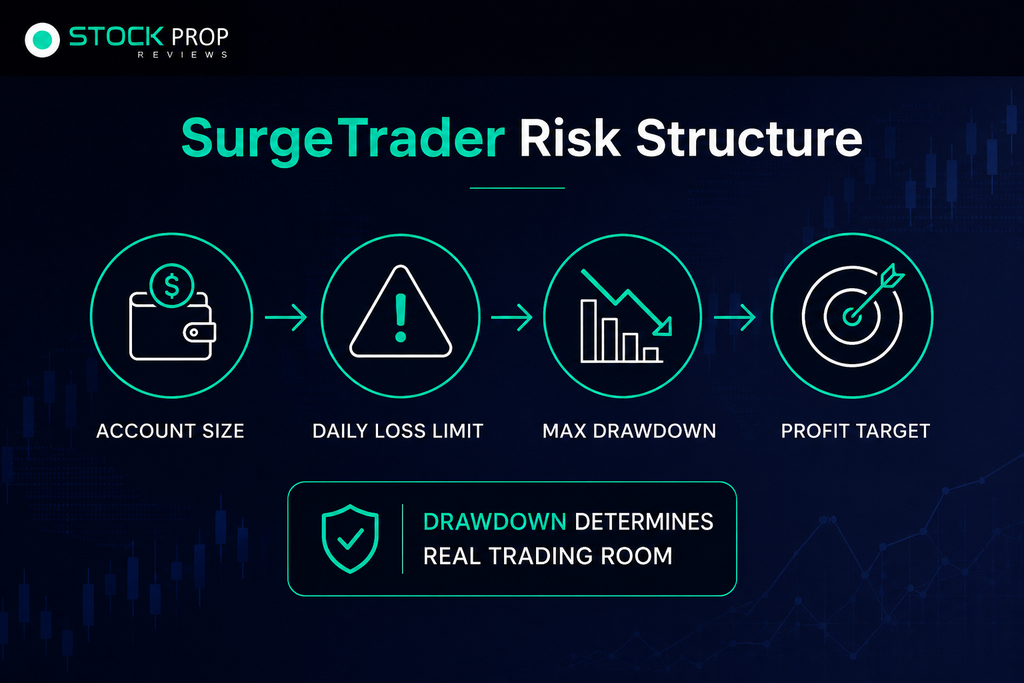
In the past, SurgeTrader was an attractive proposition because traders could get through one evaluation rather than a multi-stage challenge that requires a long time. It advertised a 10% profit target, daily loss limits of around 4% to 5%, and maximum drawdown rules that could be significantly tighter than the headline account size implied, depending on the account and version of the rules. Historical sources also report profit splits of 75%, with the possibility of raising the split to 90%.
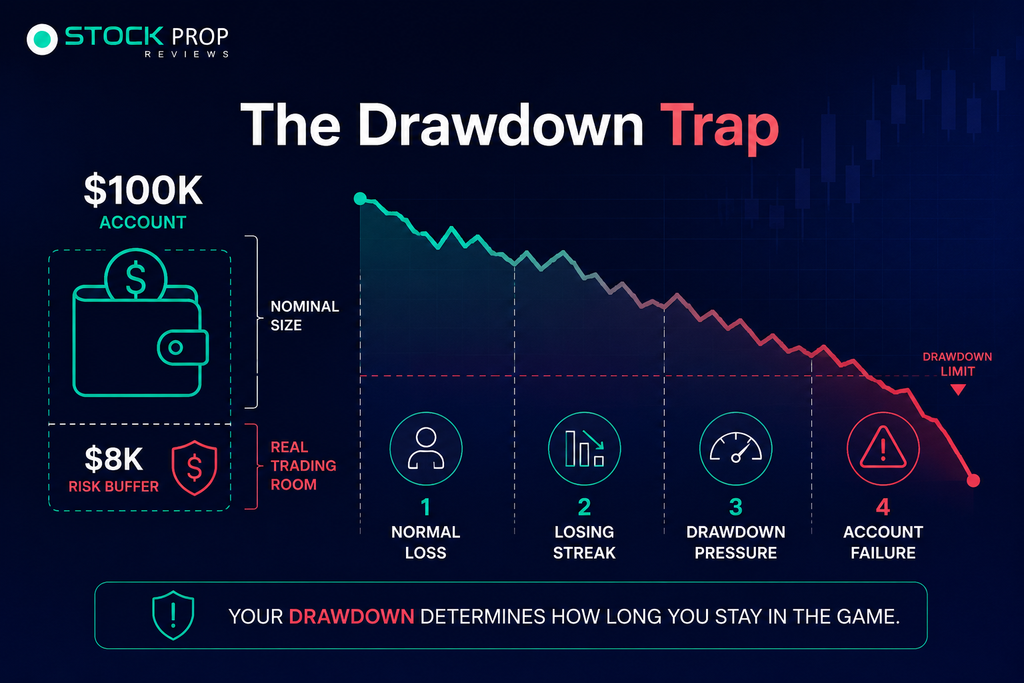
The important thing to understand is that a $100,000 account did not mean a trader could comfortably risk $100,000. The loss and drawdown limits defined the actual trading room.
That distinction is where many prop traders get into trouble.
A trader who thinks, “I have $100,000, so I can take larger positions,” can reach the firm’s risk limit surprisingly quickly. The nominal account size is marketing capital. The drawdown allowance is the number that matters when designing a strategy.
And because SurgeTrader has closed, the most important present-day risk is even simpler: do not send money to a website claiming to be the current SurgeTrader.
What SurgeTrader’s historical risk structure looked like
SurgeTrader changed parts of its program over time, which explains why older reviews often show different numbers. Historical sources describe different combinations of daily loss limits, trailing or static drawdown, profit targets and account sizes. For example, one contemporary review recorded a 10% profit target, 4% daily loss limit and 5% maximum trailing drawdown, while later historical summaries cite a 5% daily loss limit and 8% maximum drawdown.
That makes copying a rule table from an old review particularly risky.
| Risk factor | Historical SurgeTrader structure | Why it mattered |
| Evaluation target | Around 10% on one-step programs | Encouraged traders to focus on reaching a relatively large return |
| Daily loss limit | Around 4% to 5%, depending on program/version | A few oversized trades could consume a large part of the daily allowance |
| Maximum drawdown | Varied by program and rule version | This was the real account survival limit |
| Profit split | Generally 75%, with higher split options | Higher split could involve an additional fee |
| Trading period | No fixed time limit on major historical programs | Reduced time pressure |
| Scaling | Available after additional profit milestones | Created an incentive to continue trading after reaching an initial target |
| Stop-loss requirement | Applied under some historical rule sets | Affected discretionary and news-based strategies |
| Maximum position/lot exposure | Restricted | Prevented traders from treating the nominal balance as unrestricted capital |
The variation between historical versions is itself something competitors often gloss over. A review written in 2023 should not automatically be treated as a description of the program in early 2024.
The real risk was the drawdown, not the account size
What if a trader had a previous SurgeTrader account of $100,000.
Taking an 8% maximum drawdown for us, the trader’s real-world loss budget would be about:
$100,000 × 8% = $8,000
This means that the trader was essentially controlling a $8,000 risk buffer, not $100,000 of disposable loss capacity.
This is a critical distinction in every prop-firm review.
A trader risking 1% of the nominal account per trade would be risking $1,000. Eight consecutive losses at that level could theoretically consume the entire $8,000 drawdown allowance before considering slippage, spreads, commissions or other rule interactions.
It would have been more sustainable to have first calculated position size from the drawdown allowance and then worked backward to the nominal account size.
For example:
Maximum planned loss per trade = $8,000 drawdown x 10% risk allocation = $800.
That does not mean $800 was an official SurgeTrader limit. It is simply an example of how a trader could translate the firm’s risk boundary into a personal risk framework.
This is one of the biggest gaps in generic SurgeTrader reviews. They tend to describe the account as “$100K funded” without explaining that the trader’s survival depended on a much smaller loss budget.
How traders actually failed
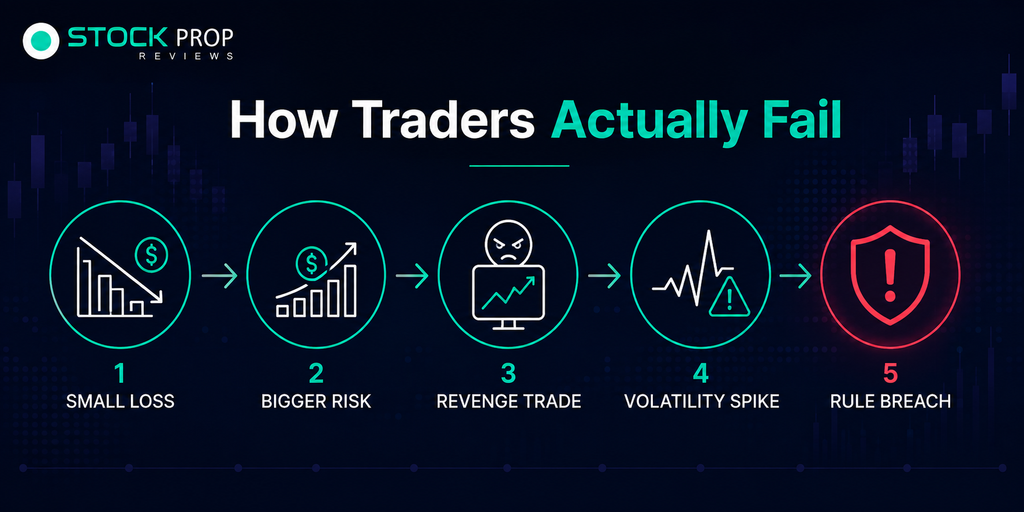
The most realistic failure scenario was not usually one enormous mistake.
It was a sequence.
A trader starts with a normal strategy and takes a small loss. Nothing unusual happens.
The next setup appears. The trader increases position size slightly because they want to recover the previous loss.
Another loss follows.
Now the trader is under psychological pressure. Instead of waiting for the next valid setup, they begin looking for a trade that can repair the account.
This is where a prop-firm drawdown structure becomes dangerous.
Normal trade
The trader risks $400 and loses.
Recovery trade
They increase risk to $700.
Revenge trade
They increase exposure again because the account is now further from the profit target.
Volatility spike
A position moves against them quickly.
Rule breach
The drawdown or daily loss limit is reached.
The strategy did not necessarily stop working. The risk model changed.
That is an important distinction.
A trader can have a profitable strategy and still fail a prop account because the strategy’s normal losing streak is incompatible with the firm’s drawdown structure.
Why instant funding can create a psychological trap
Instant or accelerated funding sounds attractive because it reduces the number of steps between paying for an account and trading it.
But removing evaluation stages does not remove risk.
It can actually change trader psychology.
With a traditional two-step challenge, the trader expects to prove consistency before receiving the funded account. With a fast funding model, the trader can become psychologically attached to the idea that they already have substantial capital.
That can produce three dangerous behaviors.
First, oversizing.
The trader sees the account balance rather than the drawdown allowance.
Second, target chasing.
If the required return is 10%, the trader may begin treating that percentage as a deadline even when the market is not offering suitable opportunities.
Third, loss recovery trading.
After falling behind, the trader tries to make the account recover faster by increasing risk.
This is particularly dangerous when a trailing drawdown is involved because profitable trades can change the account’s risk boundary.
Trailing drawdown deserves special attention
The trailing drawdown doesn’t stay flat, it moves with the account performance.
Consider a simple account with an initial balance of $100,000 and a $8,000 trailing drawdown.
If the account rises to $105,000, the relevant drawdown reference can move upward depending on the exact rule.
Now consider what happens after the trader gives back part of those gains.
A trader may think:
“I am still $3,000 above my original balance, so I am safe.”
That may be the wrong calculation.
The relevant question is:
Where is the current drawdown threshold?
This is why traders should never manage a trailing-drawdown account using starting balance alone.
The firm’s exact calculation method matters.
What competitors often miss
Many SurgeTrader reviews focused on account sizes, profit splits and the simplicity of the audition.
Those are useful, but they don’t answer the question a serious trader should ask:
How does my strategy behave around the firm’s risk boundary?
A trader should examine at least four things before choosing an instant or accelerated funding model:
- Average risk per trade
- Normal losing streak
- Maximum correlated exposure
- Worst historical drawdown
Suppose a strategy has a historical maximum losing streak of seven trades.
If the trader risks 1% per trade, that losing streak represents approximately 7% before execution costs.
A prop firm’s 8% drawdown may therefore look generous on paper but be extremely uncomfortable for that strategy.
The strategy might be profitable over 1,000 trades and still be a poor fit for the funding model.
The position-sizing problem
Another area traders often underestimate is position limits.
SurgeTrader Rules History SurgeTrader rules historically included limits on the exposure levels that traders could maintain. Older reviews mentioned maximum lot requirements depending on the account size.
This matters because a trader can violate risk expectations without necessarily having a poor directional view.
For example, a trader might open several correlated positions:
- EUR/USD long
- GBP/USD long
- GBP/JPY long
Individually, each position may appear reasonable.
Together, however, they can represent a much larger bet on USD weakness and risk sentiment.
The account does not care that the positions have different symbols. A sharp market move can hit all of them simultaneously.
That is why portfolio-level exposure matters more than looking at each trade in isolation.
Common mistakes traders made
The most common mistakes were behavioral rather than technical.
Treating the account size as personal capital
A $200,000 account did not mean the trader could comfortably lose $20,000.
The drawdown rule determined the actual operating room.
Increasing risk after losses
This is probably the most damaging mistake because it turns an ordinary losing streak into an account-level event.
Trading every day because there is no time limit
No time limit is a benefit only if the trader uses it to wait.
It becomes a problem when the trader interprets unlimited time as a reason to keep searching for trades.
Ignoring correlated positions
Three trades that all depend on the same macro outcome are not necessarily three independent trades.
Scaling too aggressively
Reaching another profit milestone can tempt traders to increase position size before their strategy has demonstrated that it can handle the new account parameters.
Who should avoid an instant-funding structure?
Even when SurgeTrader was operating, this type of structure was not suitable for everyone.
It was a poor fit for traders who were still experimenting with their strategy, frequently changed position size, relied on averaging down, or needed a large drawdown buffer to survive ordinary losing streaks.
It was also unsuitable for anyone who expected the account size itself to provide a safety cushion.
Beginners should be particularly careful. A funded account does not solve the underlying problem of an untested strategy.
If your strategy has not survived a meaningful sample of historical and forward-tested trades, adding prop-firm rules usually makes the situation harder rather than easier.
SurgeTrader’s closure is part of the risk analysis
This is the point that older SurgeTrader reviews cannot address.
SurgeTrader ceased operations on May 24, 2024. Reports on the closure connect the shutdown to problems surrounding trading-platform licensing and migration.
The platform migration period in March 2024 also drew complaints from traders who said they were unable to trade while the platform transition was taking place. Trustpilot reviews from that time include complaints about account access and SurgeTrader’s responses about the migration.
That creates an important lesson for anyone evaluating prop firms today:
Rule risk is only one part of prop-firm risk.
There is also:
- platform risk
- counterparty risk
- payout risk
- operational risk
- rule-change risk
- business-continuity risk
A trader can follow every trading rule correctly and still be exposed to problems outside the trading strategy.
That is why a serious [prop firm review] should examine the company as well as its drawdown model.
SurgeTrader alternatives
Because the original SurgeTrader business is closed, traders should compare active firms rather than looking for a replacement SurgeTrader website.
For stock traders, TradeThe Pool is one option worth researching because its current program is specifically focused on stocks and ETFs, with published risk rules covering drawdown, position volume, trade duration and other execution requirements.
One important correction to promotional descriptions is necessary here: Trade The Pool itself states that its online prop-trading industry is not regulated, and its current website says the company is not a financial institution or other regulated financial-services entity.
So I would not describe TradeThe Pool as a regulated stock prop firm. Its attraction is instead its focus on stock trading, published rules and relatively detailed risk framework.
Readers can get up to 10% discount when purchasing through our TradeThePool link.
For traders considering other firms, the better comparison is not simply “Which company gives the biggest account?” A better question is “Which firm’s risk model fits my strategy?”
That is also where our [prop firm comparison] content can be more useful than headline funding figures.
How to evaluate an instant funding model yourself
Before buying any prop account, calculate your strategy against the firm’s rules.
Take your average stop-loss distance and normal position size.
Then calculate the dollar loss.
Next, compare that loss with:
Daily loss allowance
and
Maximum account drawdown
Then test your worst historical losing streak.
If your backtest shows eight consecutive losses and the firm’s drawdown allows only six normal losses, the problem is not the firm or the strategy individually.
The problem is the fit between them.
This approach is much more useful than choosing a firm because it advertises a large account or a high profit split.
A high profit split is irrelevant if the risk structure causes the account to fail before the trader can generate a meaningful payout.
SurgeTrader review: final assessment
SurgeTrader’s historical model was attractive because it made funding easier to obtain and offered traders a lot of flexibility versus some multi-stage evaluations. But the headline account size and profit split were never the most important figures.
The real question was how much risk the trader could take before reaching the daily or maximum drawdown boundary.
That is true for instant funding generally.
The closure of SurgeTrader adds another lesson. A prop firm should be evaluated not only on its trading rules, but also on its operational stability and the clarity of its current legal and business status.
For traders researching SurgeTrader today, the decision is straightforward: do not treat old SurgeTrader reviews as evidence that the firm is currently available. The original firm is closed.
For active traders choosing a current prop firm, focus on the risk model first, then the payout structure, then the account size.
If you are comparing this with another firm’s risk model, our risk-focused prop firm review and truth about prop trading articles are useful next reads.
FAQs
Is SurgeTrader still operating?
No. SurgeTrader ceased operations in May 2024. Current websites claiming to offer the original SurgeTrader service should therefore be treated cautiously.
Did SurgeTrader offer instant funding?
Historical sources report that SurgeTrader provides expedited funding and one-step evaluation programs. The specific rules did change over the years though, so older reviews might have different drawdown and loss limit numbers.
What was the biggest SurgeTrader risk?
The biggest trading risk was the relationship between position sizing, daily loss limits and maximum drawdown. Traders could have a profitable strategy but still fail if their normal losing streak was too large for the account’s permitted drawdown.
Why are instant funding accounts risky?
Instant funding can reduce the psychological distance between paying for an account and trading it. Traders may oversize positions, chase a profit target or increase risk after losses. The absence of a traditional evaluation does not remove the underlying risk.
Is TradeThe Pool regulated?
TradeThe Pool currently describes itself as a proprietary trading firm and explicitly states that the online prop-trading industry is not regulated. It should therefore not be presented as a regulated broker or regulated prop firm.
If you are considering TradeThe Pool, its current rules are worth reviewing carefully because its program includes specific limits around position volume, trade duration, drawdown and consistency.