The5%ers scaling can take a small funded account to a much bigger allocation but the headline numbers don’t tell the whole story. The real question is whether a trader can hit the required profit milestones again and again without changing risk behavior or getting caught by the firm’s drawdown rules.
This article is for traders with a proven strategy who are considering The5%ers as a long term funding path. Not the best for traders who want to get big capital fast, aggressive compounding or a model where they can increase position size freely after each profitable period.
The5%ers now have a number of different scaling structures. High Stakes scales after 10% profit milestones, whereas Bootcamp uses smaller 5% milestones. Its futures program also has a different scaling mechanism. The significance of this difference is that “The5%ers scaling” is not one system.
Quick verdict
The5%ers offers one of the most clearly defined structures for long term growth in prop trading. It’s a simple appeal – traders can grind their way through set milestones as opposed to continually buying bigger challenges.
The problem is that scaling is not the same thing as earning more money.
A trader who doubles or substantially increases account size still has to operate within the same basic risk framework. If the trader responds to a larger nominal balance by increasing risk too aggressively, the scaling advantage can disappear very quickly.
The High Stakes program currently scales at 10% profit milestones and can reach $500,000. The program uses a 5% daily loss limit and 10% maximum loss, with 80% to 100% profit sharing depending on the account level.
Bootcamp takes a different approach. Its funded account scales at 5% milestones and the published structure can ultimately reach much larger nominal balances, with profit sharing rising toward 100%.
That sounds impressive. The reality is more demanding.
How The5%ers scaling actually works
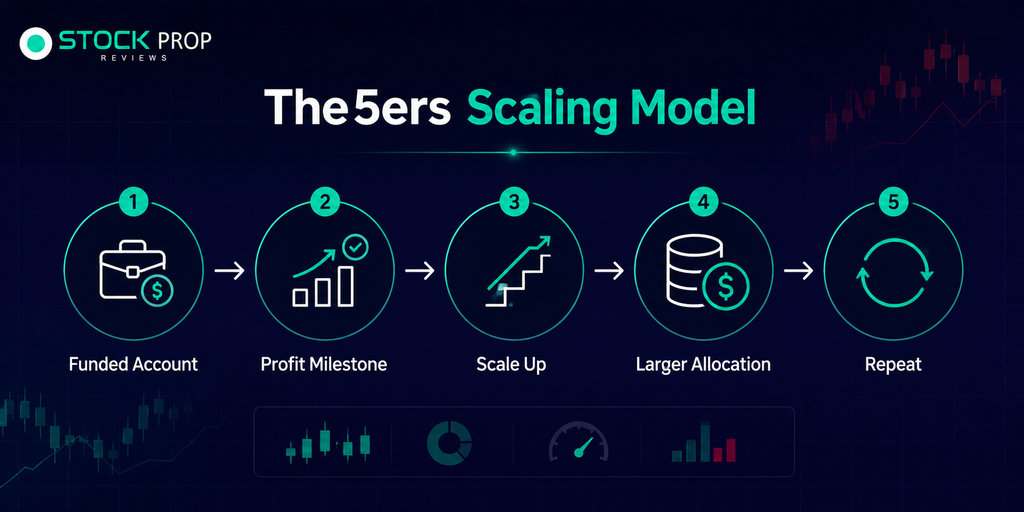
Scaling means your account allocation increases after you reach a predefined profit target.
It does not mean the firm simply gives you a large cash account after one good month.
For example, under the current High Stakes structure, a $50,000 account reaches its next milestone after making 10%, or $5,000. The account then moves to the next scaling level. Similar milestones continue as the account grows.
At higher levels, the payout ratio also improves. The published High Stakes table shows 80%/20% at lower levels, moving to 85%/15%, then 90%/10%, and eventually 100%/0% plus fixed payout eligibility at the highest levels.
This creates an important distinction:
The5%ers scaling rewards consistency, not simply account growth.
You have to repeatedly produce the required return while staying inside the risk limits.
The current High Stakes structure
| Factor | Current High Stakes structure |
| Evaluation | 2 steps |
| Phase 1 target | 10% on New High Stakes |
| Phase 2 target | 5% |
| Funded scaling target | 10% |
| Daily loss | 5% |
| Maximum loss | 10% |
| Time limit | Unlimited |
| Profit split | 80% to 100%, depending on level |
| Maximum scaling | Up to $500,000 |
| Overnight holding | Allowed |
| Weekend holding | Allowed |
| News | Holding allowed, but certain order execution around high-impact news is restricted |
The5%ers also states that funded withdrawals can be requested every 14 days, with a $150 minimum after the applicable profit split. The 14-day withdrawal timer resets when the account is scaled.
That last detail is easy to overlook.
A trader may reach a scaling milestone and assume that scaling immediately means another payout opportunity. In reality, the payout schedule changes because the timer resets from the scaling date.
The real cost of chasing scaling milestones
A 10% target sounds do-able when you look at it as a percentage.
When it is converted into dollars it looks very different.
Say a trader has a $100,000 High Stakes account and requires a 10% milestone. What that means is to make a profit of $10,000 while keeping the risk parameters of the account.
A 1% risk trader may need a significant string of trades to hit that target. A trader risking 2% might get there faster but so does the chance of a damaging losing streak.
This is where scaling models can create psychological pressure.
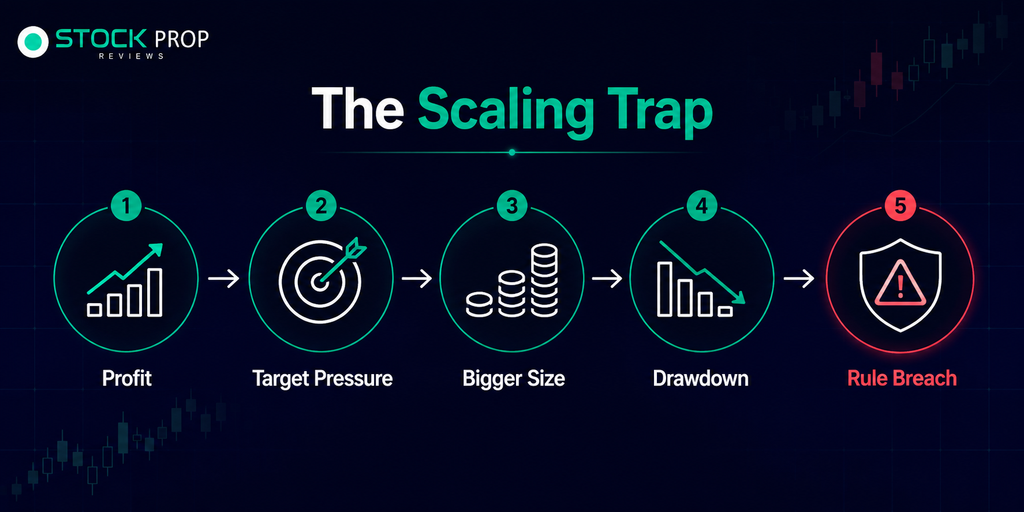
The trader knows another milestone is available. That can encourage behaviour such as:
- increasing position size after several winning trades
- taking marginal setups because the target feels close
- trading during conditions outside the normal strategy
- holding a position longer because closing it would reduce progress toward the target
The irony is that the closer a trader gets to scaling, the more dangerous emotional decision-making can become.
A trader who makes 8% and then takes excessive risk to make the final 2% has not really benefited from the scaling structure.
What competitors don’t explain about The5%ers scaling
Most scaling explanations focus on the final account size.
That is the least useful number for many traders.
The more important question is:
How much risk can your strategy tolerate while repeatedly reaching the milestone?
Now, a $500,000 account sounds a lot different than a $100,000 account. However, if the trader’s strategy cannot reliably deliver the required return without risking the drawdown limit, the larger allocation has little practical value.
There is another issue. Scaling can change the psychological perception of risk.
Losing $500 on a small account feels different from losing $5,000 on a larger one, even if both represent the same percentage of capital.
This matters because traders often increase their nominal risk faster than their emotional tolerance.
A strategy that feels comfortable at $10,000 can become difficult to execute consistently when every normal losing trade is worth several thousand dollars.
That is why scaling should be treated as a risk-management test, not a reward ladder.
How traders actually fail The5%ers scaling
The most common failure pattern is not necessarily a terrible strategy.
It is a strategy that gets modified under pressure.
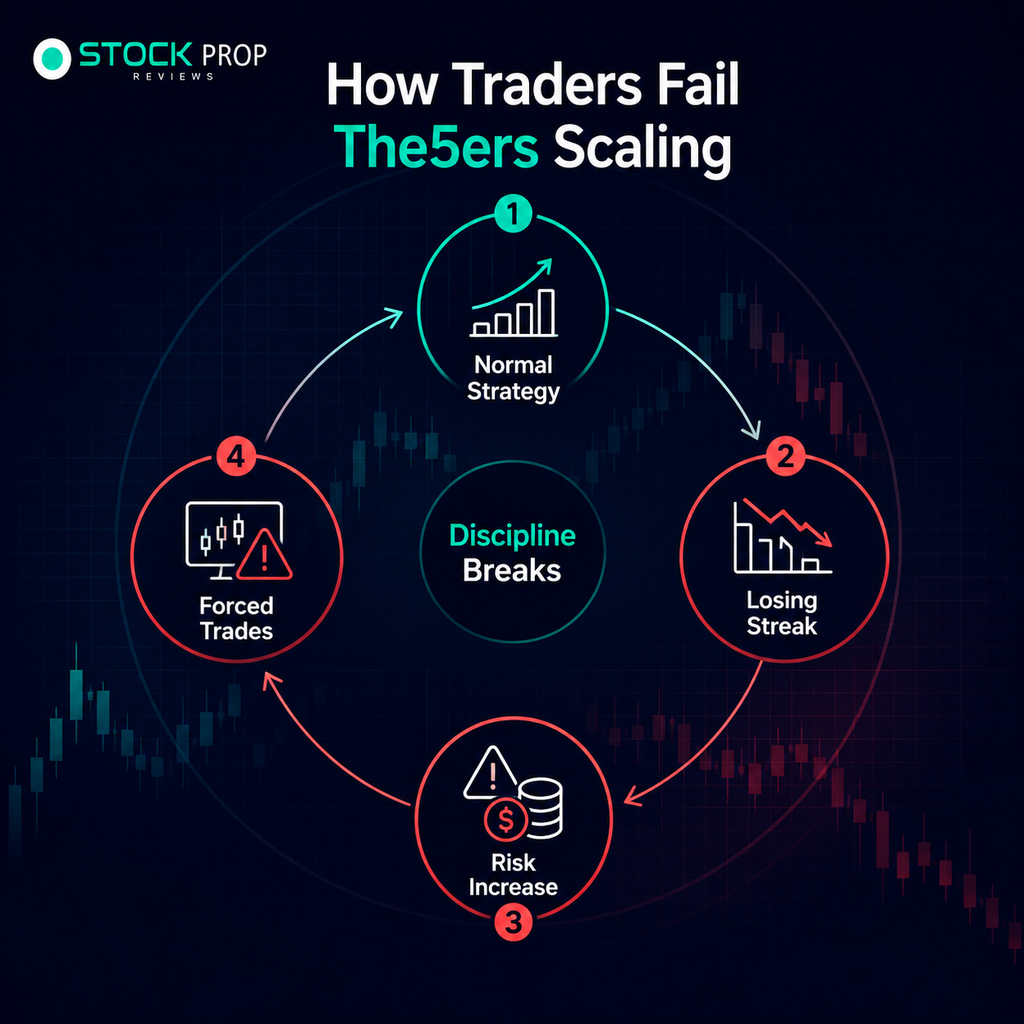
Consider a trader with a 45% win rate and a 2:1 average reward-to-risk ratio. The strategy can have positive expectancy even though losing trades occur frequently.
The trader reaches 6% profit.
Then comes a three-trade losing streak.
Instead of accepting the drawdown as normal variance, the trader doubles the next position.
One winning trade recovers some losses.
The trader becomes more confident and keeps the larger size.
A second losing trade arrives.
Now the account is close enough to its risk limit that the trader starts forcing trades.
The original strategy has disappeared.
The account eventually fails because the trader was no longer trading the system that generated the earlier profits.
This is the real scaling trap.
The account gets larger, but the trader’s risk discipline does not scale with it.
Drawdown matters more than the headline account size
For High Stakes, the current published rules specify a 10% maximum loss and a 5% daily loss. The maximum loss is calculated from the initial balance, while the daily limit is based on the previous day’s closing equity or balance.
That structure is relatively straightforward, but traders still need to understand how it behaves around volatile positions.
For example, a swing trader might be profitable over several weeks but experience a temporary floating loss during a normal market retracement. Overnight and weekend holding is allowed under High Stakes, but the position can still move substantially against the trader.
The rule may allow the trade.
The market does not care whether the rule allows it.
That distinction is important.
A strategy that needs very wide stops or routinely experiences large temporary drawdowns may still be a poor fit even when overnight holding is permitted.
News trading is another area traders misunderstand
The5%ers currently allows traders to hold positions through news on High Stakes, but there are restrictions on executing orders around high-impact news. The firm states that new orders cannot be executed from two minutes before until two minutes after high-impact news under the applicable High Stakes rule.
This is different from saying “news trading is unrestricted.”
A trader using a strategy based on entering immediately around CPI, NFP or other major releases needs to pay attention to the exact execution restrictions.
Bootcamp has a different news framework. News trading is allowed except for bracket strategies around news.
That is another reason traders should not assume that one The5%ers program has exactly the same rules as another.
Bootcamp scaling is fundamentally different
Bootcamp uses smaller scaling milestones.
The published program describes scaling after every 5% target, with a funded structure that can progress through several account levels.
That can be attractive to traders who prefer smaller, more frequent progression steps.
But there is a trade-off.
Smaller milestones can create more frequent opportunities to scale, while also giving traders more opportunities to make the mistake of treating every milestone as a reason to increase risk.
Bootcamp also has its own funded-account restrictions, including a 3% daily pause and a 14-day payout cycle. The payout cycle resets whenever the account scales.
So the program should be evaluated independently rather than simply described as a cheaper version of High Stakes.
The5%ers futures scaling deserves separate attention
The5%ers’ futures program operates differently again.
The current futures offering has a $25,000 account option with a 6% evaluation target, 4% maximum end-of-day loss and 4% funded-stage maximum loss. The funded account can scale toward $500,000.
The scaling milestone is 10%, but buying power increases by 5% and the maximum contract allowance increases as the account scales.
For example, The5%ers gives the example of a $50,000 account reaching a $5,000 profit milestone. After scaling, the new balance becomes $52,500, with the trader’s profit share handled separately.
That is an important reality check.
A 10% profit milestone does not necessarily mean your usable trading capacity increases by 10%.
The account balance, buying power and contract allowance can move differently.
Common trader mistakes
The first mistake is treating the maximum funding figure as expected income.
A trader should never build a personal financial plan around eventually reaching $500,000 simply because the scaling table permits it.
The second mistake is increasing risk after scaling.
If your normal risk is 0.5% per trade, moving immediately to 1.5% because the account is larger can fundamentally change the probability distribution of your results.
The third mistake is confusing a high profit split with high take-home income.
An 80% split on a consistent $2,000 month is more useful than a theoretical 100% split on an account that repeatedly fails before reaching a payout.
The fourth mistake is ignoring payout timing.
The5%ers states that scaling resets the payout timer.
The fifth mistake is choosing a program based on the scaling table before checking whether its trading rules match the strategy.
That is backwards.
The strategy should determine the suitable rule structure.
Who should avoid The5%ers scaling?
The5%ers is probably not the right choice for traders who need very aggressive growth from a small account.
It may also be a poor fit for traders whose edge depends on extremely high-frequency execution, aggressive news entries or position sizing that regularly approaches the drawdown limits.
Traders who dislike milestone-based progression may also find the model frustrating.
The firm makes more sense for someone who already has a repeatable system, accepts periods of low activity and wants a defined route toward larger nominal capital.
For a deeper look at how different firms fit different trading styles, our guide to prop firm comparisons is useful because account size alone does not tell you how a strategy will behave under the rules.
Our FTMO review is another useful reference for traders comparing established firms with different risk structures.
And if you are specifically considering longer holding periods, our analysis of swing trading prop firms looks at why drawdown design can matter more than the advertised profit split.
The5%ers vs alternatives
| Firm | Best suited to | Main attraction | Main limitation |
| The5%ers | Traders seeking structured long-term scaling | Multiple scaling paths | Milestones require consistent returns |
| FTMO | Structured forex and multi-asset traders | Established evaluation model | Strategy must fit its specific risk rules |
| TradeThePool | Stock traders | Equity-focused environment | Not designed for forex or futures |
| Topstep | Futures traders | Futures-specific infrastructure | Different drawdown and scaling mechanics |
The5%ers makes the most sense when scaling itself is part of the trader’s long-term objective.
FTMO may be preferable for traders who want a more conventional evaluation structure. Our FTMO review covers the practical implications of its rules rather than just its reputation.
Topstep is the more natural comparison for futures traders because the product is specifically built around futures.
TradeThePool is a different story as it deals with stocks instead of forex or futures.
For traders looking for a stock-focused alternative, TradeThePool is worth considering for its documented trading rules and risk framework. But it shouldn’t be presented as a regulated financial institution. The online prop trading environment is unregulated, according to its own disclosures, so traders should differentiate clear risk rules from regulatory status.
Readers can receive up to 10% discount when buying through our TradeThePool link.
Is The5%ers scaling actually worth it?
For the right trader, yes.
But the value is not the maximum account number displayed on the website.
The real value is having a structured path where profitable performance can gradually translate into greater nominal trading capacity.
The system works best when a trader keeps risk proportional as the account grows.
Now imagine two traders both hitting a $100,000 allocation.
Trader A takes the risk of 0.5% per trade, accepts the normal losing streaks and continues trading the same system.
Trader B is now risking 2%, as his account has grown and he is eager to hit the next milestone.
Trader A is using scaling as a way to increase opportunity while protecting the process.
Trader B is using scaling as permission to increase risk.
Those two traders may have exactly the same account size, but their probability of reaching the next milestone is completely different.
That is the part of The5%ers scaling that gets missed in most promotional explanations.
The bottom line
The5%ers scaling is legitimate as a growth mechanism, but it should not be confused with guaranteed capital growth.
The strongest part of the model is the defined progression. High Stakes currently provides 10% scaling milestones, while Bootcamp uses 5% milestones, and the futures program has its own 10% scaling framework.
The weakness is in the head.
Every milestone can put pressure on you to get to the next one quicker. Traders reacting with higher risk can transform a reasonable scaling plan into an account survival issue.
The best way to do this is to treat each new level as a test of whether your existing strategy can continue to work on a larger nominal scale.
If it can, scaling really has value.
If it can’t, then the $500,000 top line allocation doesn’t matter.
TradeThePool also provides a separate stock-focused alternative for traders seeking alternatives to stocks, with documented risk rules. Don’t buy into the promotional descriptions, check its present terms and regulatory disclosures before you buy.
FAQs
What is The5%ers scaling?
The5%ers scaling is a systematic procedure that allows a funded trader to reach particular profit objectives and to receive a higher account allocation or increased trading capacity.
How often does The5%ers scale accounts?
It depends on the program. Current High Stakes scaling uses 10% profit milestones, while Bootcamp uses 5% milestones. The futures program also uses 10% profit milestones.
Can The5%ers accounts scale to $500,000?
Yes. The current High Stakes and futures programs both publish scaling paths reaching up to $500,000. Other The5%ers programs have different maximum scaling levels.
Does scaling increase the payout percentage?
It can. In the High Stakes structure today, the payout ratio increases at higher account levels and is 100% at the highest published levels, subject to the program’s terms.
Is The5%ers scaling good for beginners?
It can be, but the scaling model is more useful for traders who already have a tested strategy and understand position sizing. Beginners who are still changing strategies or frequently increasing risk are more likely to misuse the progression structure.