Martingale trading and proprietary trading don’t often go hand-in-hand. Some prop firms that allow martingale strategies may not have an explicit ban on the strategy itself but their drawdown rules, consistency requirements and risk controls can make it difficult to use successfully over time.
If you’re a trader considering trying martingale in a prop firm environment and want a brutally honest assessment before risking challenge fees or funded accounts, this guide is for you. It is not for traders who want to take a shortcut to pass evaluations or make up losses quickly.
The biggest question is whether a firm allows martingales. A more relevant question is whether the firm’s risk model renders the strategy mathematically possible.
What Is a Martingale Strategy?
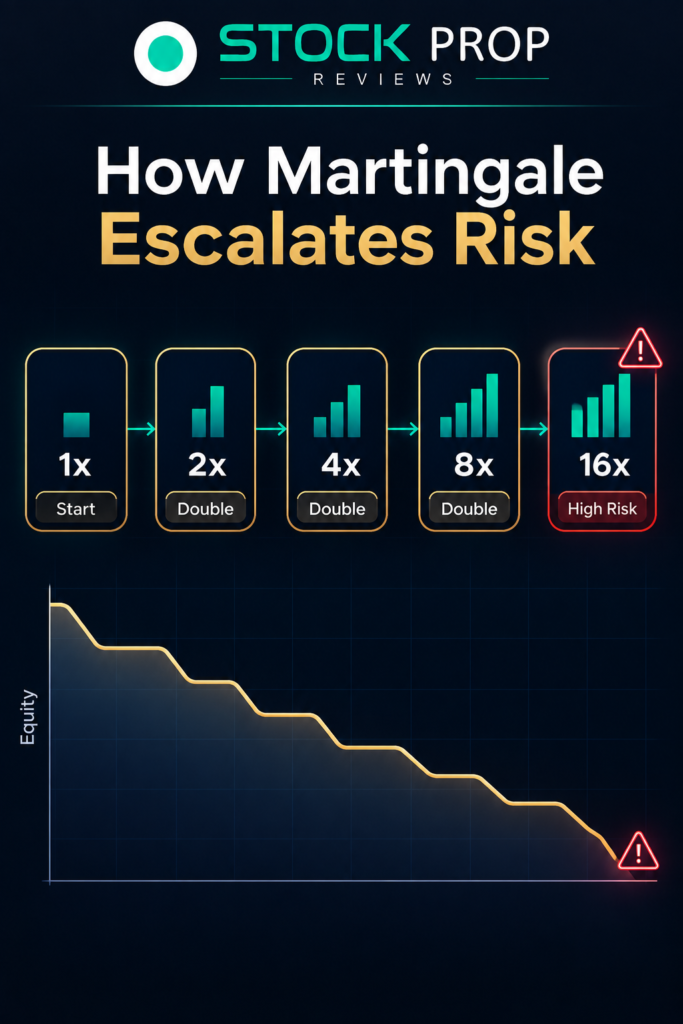
A martingale strategy increases position size after each losing trade with the goal of recovering previous losses when the next winning trade arrives.
A simplified example:
| Trade | Position Size | Result |
| 1 | 1 lot | Loss |
| 2 | 2 lots | Loss |
| 3 | 4 lots | Loss |
| 4 | 8 lots | Win |
If the fourth trade wins, previous losses may be recovered along with a small profit.
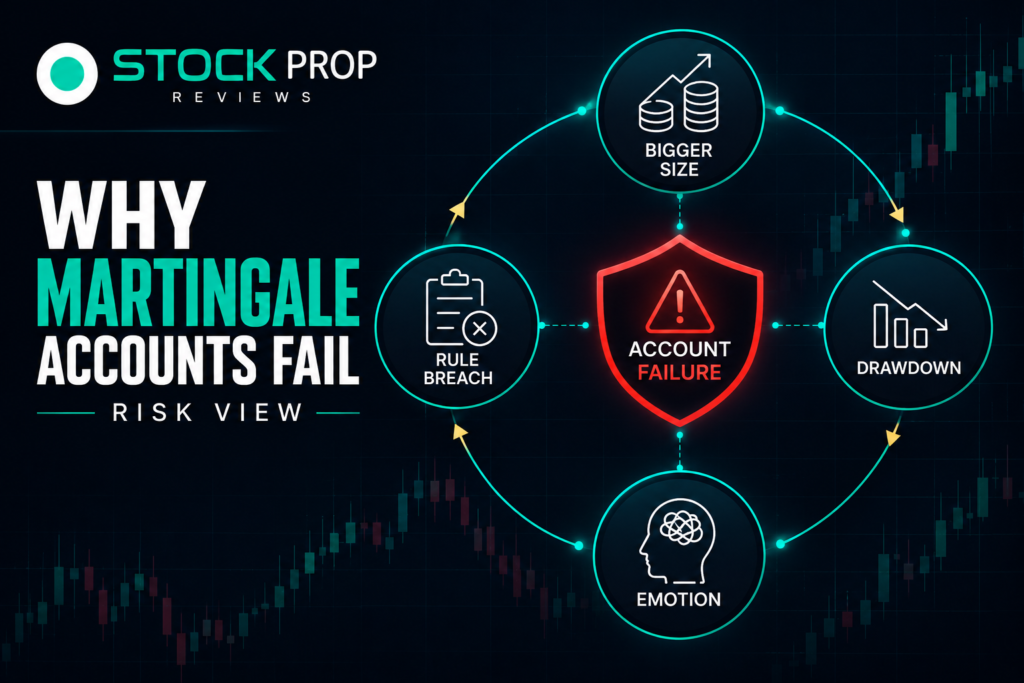
The problem is that losing streaks happen far more often than many traders expect. In a prop firm account, increasing exposure during a drawdown is exactly what most risk departments try to prevent.
Why Most Prop Firms Dislike Martingale
Many traders think a company just wants to make money. In reality, risk managers are very aware of how profits are generated.
Martingale raises a number of concerns:
- Fast draw down acceleration
- Big movements in account equity
- Increased chance to exceed daily loss limits
- Discipline in not sizing positions
- More risk in volatile market conditions
Even firms without an explicit “No Martingale” rule often monitor risk behavior manually.
Passing an evaluation does not necessarily mean the strategy will remain acceptable after funding.
Can You Actually Find Martingale Prop Firms?
The answer is yes, but with important limitations.
Some firms do not specifically prohibit martingale in their rulebooks. Others simply prohibit “excessive risk” or “gambling-style trading,” leaving room for interpretation.
That’s a very important distinction.
Not always allowed is approved.
Risk teams can review accounts with:
- Quick lot progression
- Losses drive growth for Large Exposure
- Abnormal patterns of recovery
- highly volatile equity curves
Several firms reserve the right to terminate accounts that display behavior considered excessively risky, even if no single written rule mentions martingale.
Quick Verdict
| Category | Assessment |
| Suitable for beginners | No |
| Suitable for experienced discretionary traders | Rarely |
| Compatible with strict drawdown models | Poor |
| Works better with static drawdown | Slightly |
| Long-term funded sustainability | Low |
For most traders, reducing risk after losses produces better long-term survival than increasing it.
What Really Matters More Than “Martingale Allowed”
Many comparison articles simply list firms that allegedly permit martingale.
That misses the more important discussion.
Before considering any prop firm, examine these risk rules.
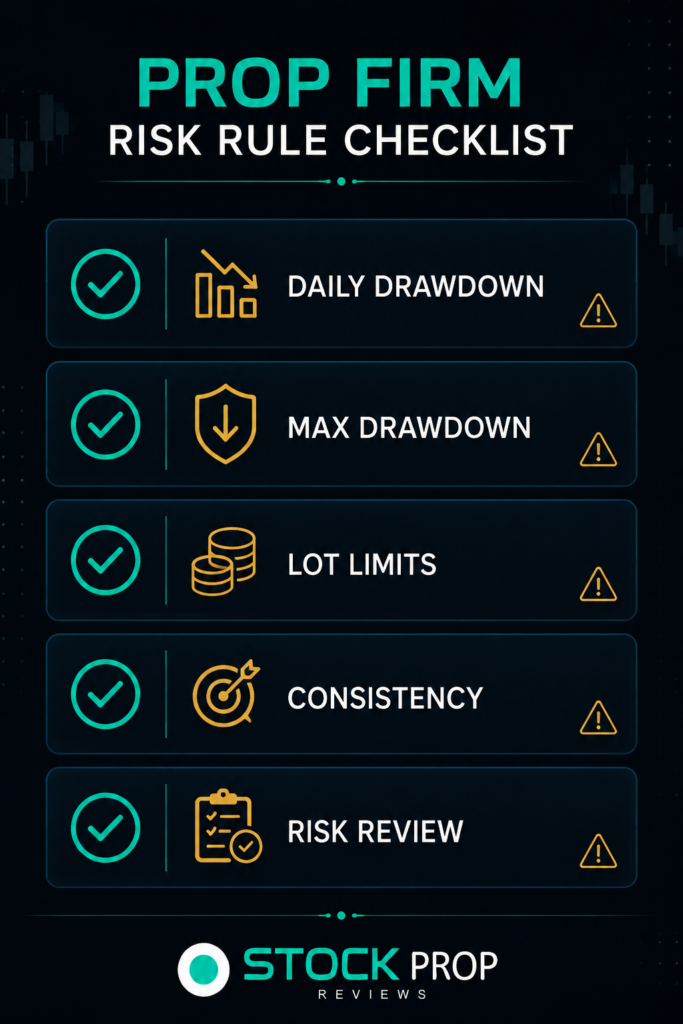
| Rule | Why It Matters |
| Daily drawdown | Multiple losing trades quickly breach limits |
| Maximum overall drawdown | Martingale compounds losses rapidly |
| Maximum lot size | Can restrict recovery progression |
| Consistency requirements | Large recovery trades may violate consistency metrics |
| News restrictions | Volatility increases risk dramatically |
| Manual risk review | Aggressive scaling may trigger investigation |
A firm can technically allow martingale while making it practically impossible to execute safely.
Strategy Fit Analysis
Static Drawdown Models
Static drawdown is usually less restrictive than trailing drawdown.
And there is a cap on the maximum loss so traders have a little more wiggle room during temporary drawdowns.
Even then, martingale sequences can consume available risk faster than expected.
Fit: Moderate to Poor
Trailing Drawdown Models
Trailing drawdown creates one of the biggest problems for martingale traders.
As account equity increases, the drawdown threshold often moves higher.
One failed recovery sequence can erase weeks of steady gains.
Fit: Very Poor
Consistency-Based Evaluations
Several firms now measure consistency alongside profitability.
A trader making 80% of total profits from one oversized recovery trade may attract unwanted attention.
Fit: Poor
Real Trading Scenario
Imagine a funded forex trader risking 0.5% per trade.
After four losses, they switch to martingale.
Position sizes become:
- 0.5%
- 1%
- 2%
- 4%
- 8%
A normal five-trade losing streak suddenly becomes a drawdown beyond the daily limits of many firms.
The strategy was wrong before the market direction changed.
Professional traders tend to survive because they reduce exposure during uncertainty, not increase exposure.
What Competitors Don’t Explain
Many online articles focus only on whether martingale is technically permitted.
They often ignore several practical realities.
Passing a Challenge Is Different From Keeping Funding
Some traders survive an evaluation using aggressive recovery techniques.
Maintaining funding for months is much harder.
Prop firms evaluate long-term behavior, not only short-term profits.
Winning Streaks Hide Risk
Martingale often appears successful until one extended losing streak arrives.
That creates survivorship bias.
Successful examples are highly visible.
Failed funded accounts disappear quietly.
Psychological Pressure Increases
Every larger recovery trade creates emotional stress.
Instead of analysing the market objectively, traders begin hoping for a reversal simply because position size has grown.
That mindset often produces poor execution.
Common Trader Mistakes
We see the same patterns over and over again with traders trying martingale inside funded accounts.
Ignoring Daily Loss Limits
Many traders are computing total drawdown, but forgetting daily limits.
The account blows up before maximum overall loss.
Increasing Size Too Quickly
Double up with every loss creates exponential exposure.
If you lose 5 trades in a row, your position size will be 16x bigger.
Trading During High Volatility
Martingale along with news events lead to erratic price action and slippage.
The recovery assumptions quickly fall apart.
Assuming Previous Wins Guarantee Recovery
Markets do not have a memory.
What worked yesterday may fail time and time again today.
Truth vs Opinion
Facts
- Most prop firms have tight drawdown controls.
- Large positions increase risk.
- Any trading strategy will have longer losing streaks.
- Professional risk managers prioritize capital preservation.
Opinion
Some more experienced traders have been successful with limited versions of anti-martingale or controlled recovery systems.
That is very different from classic unlimited martingale progression.
There’s a meaningful difference between adjusting position size based on probability and doubling down after every loss, no matter what the market conditions are.
Best For
Martingale might be better suited for traders who:
- Trade with small initial risk.
- Limit maximum progression severely.
- Know statistical drawdown
- Agree to cease after predetermined losses.
At that point you still need position sizing discipline.
Worst For
Martingale is particularly unsuitable for:
- Beginners’
- Participants in the challenge
- Traders using trailing drawdown companies
- Very highly leveraged CFD traders.
- Emotional Revenge Seekers
- Anyone without tested risk stats
If your strategy relies on eventually getting a winning trade before reaching account limits, the risk profile is already concerning.
Better Alternatives to Martingale
Instead of looking for martingale prop firms, consider approaches centered on sustainable risk.
Fixed Fractional Position Sizing
The risk is uniform across all trades.
Drawdowns are still foreseeable.
This is the approach most professional traders favour.
Anti-Martingale
Instead of increasing after losses, exposure increases after successful trades.
Profits compound while losses remain controlled.
Volatility-Based Position Sizing
Lot size changes according to market volatility rather than previous wins or losses.
This often aligns better with institutional risk management.
Comparison
| Strategy | Drawdown Risk | Prop Firm Compatibility | Long-Term Sustainability |
| Martingale | Very High | Poor | Low |
| Fixed Risk | Low | Excellent | High |
| Anti-Martingale | Moderate | Good | High |
| Volatility Position Sizing | Moderate | Very Good | High |
Should You Choose a Firm Because It Allows Martingale?
Probably not.
Choosing a prop firm based solely on martingale compatibility ignores more important factors:
- Simple calculations of drawdown;
- Fair conditions of execution
- Regular payments
- Steady trading platforms
- Enforce rules strictly
These factors influence long-term profitability far more than whether aggressive recovery methods are tolerated.
If you are comparing firms, our review of TradeThePool explains how a regulated stock prop firm approaches risk transparency and account management. You can also compare it alongside other firms in our broader prop firm comparison guide and read our analysis on whether funded trading is really sustainable for long-term traders.
TradeThePool is positioned differently from many CFD-focused firms because it operates as a regulated stock prop firm with clearly documented risk rules. Readers can get up to 10% discount when purchasing through ourTradeThePool link. That should be viewed as a cost saving rather than a reason to choose the firm, since strategy fit and transparent rules matter far more than discounts.
Final Risk Assessment
After seeing traders make up losses with aggressive position size, it’s understandable to look for martingale prop firms.
Usually, the most supportive firms for long-term traders are those with clear rules, predictable drawdown models, and consistent risk expectations. These are features not often associated with free martingale progression.
Instead of asking if a prop firm permits martingale, ask if your strategy can survive twenty losing trades in a row and still be within the prop firm’s rules. That question often reveals much more about long-term success.
FAQs
Do prop firms actually allow martingales?
While some firms explicitly prohibit martingale, most still have drawdown rules and reserve the right to look at abnormal risky trading behavior.
Is martingale a good strategy for funded accounts?
In general no. Daily and maximum drawdown limits make it hard to keep a classic martingale going over time.
Can you pass a prop firm challenge with martingale?
Some traders have been successful in the evaluations using aggressive recovery techniques but trading a funded account is much more difficult as it’s long-term risk management that takes precedence.
Which drawdown model is least restrictive for martingale?
Static drawdown models are usually less restrictive than trailing drawdown, but both still put a big damper on growing position sizes.
What is a safer alternative to martingale?
More in line with proprietary trading risk rules are fixed fractional risk management, anti-martingale position sizing, and volatility based sizing.