Algorithmic trading is a standard approach for many forex and futures traders, but not every prop firm is a fan. Some firms are more accommodating of Expert Advisors (EAs), APIs and automated execution, while others limit certain strategies or reject accounts they think are exploiting pricing inefficiencies.
This guide is for traders who build or use automated systems and want to avoid expensive rule violations if you are looking for the best algo trading prop firms. It is not for traders looking for a “set and forget” robot that guarantees profits. Even the best algorithm can fail if used with bad risk management or with a banned strategy list of a prop firm.
Instead of ranking firms on marketing claims, we’ll compare them on what matters in live trading: execution quality, automation support, drawdown rules, consistency requirements and transparency.
Quick Comparison of the Best Algo Trading Prop Firms
| Prop Firm | Best For | Algo Trading | Profit Split | Key Limitation |
| FTMO | Experienced EA traders | Yes | Up to 90% | Strict risk rules |
| 5%ers | Long-term systematic traders | Yes | Up to 100% (scaling) | Slower account growth |
| FundedNext | Flexible challenge options | Yes | Up to 95% | Rules vary by program |
| TradeDay | Futures algorithms | Yes | Up to 90% | Futures only |
| TradeThePool | Stock trading algorithms | Yes | Performance-based | Stock market focus |
The right choice depends less on profit split and more on whether your strategy fits the firm’s trading rules.
What Makes a Prop Firm Good for Algorithmic Trading?
Many traders assume that “EA allowed” means complete freedom. That is rarely true.
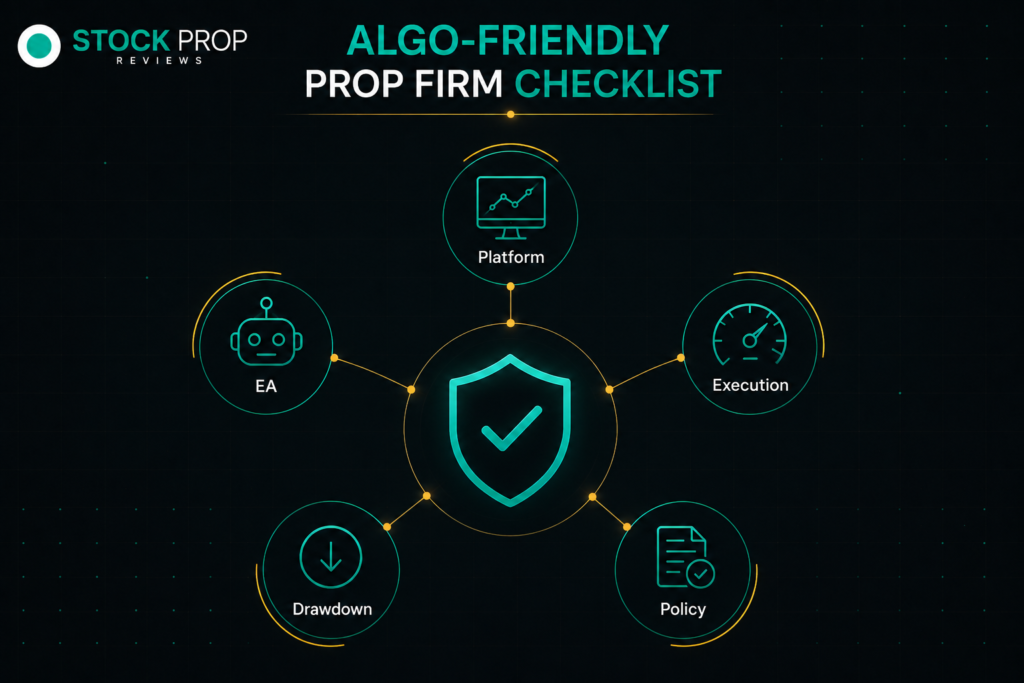
A prop firm suitable for automated trading should offer:
- Application Programming Interfaces or Expert Advisors
- Minimal slippage, consistent execution
- Transparent latency & arbitrage rules
- Transparent and easy drawdown calculations
- No secret limits on auto order handling.
Importantly, the firm must also spell out which strategies are prohibited. Some firms permit automation but prohibit latency arbitrage, tick scalping, quote manipulation or taking advantage of server delays.
This is where a lot of traders lose funded accounts.
Best Algo Trading Prop Firms Reviewed
FTMO
Best for: Professional forex algorithm developers
FTMO remains one of the strongest choices for traders using well-tested Expert Advisors. The company has supported automated trading for years, provided the strategy follows its trading objectives.
Quick Verdict
FTMO suits traders with stable systems that prioritize consistency over aggressive returns.
Strengths
- Expert Advisors enabled
- Robust platform stability
- Clear documentation.
- Well-respected in the industry
- Big account sizes
Limitations
The Maximum Daily Loss and Maximum Loss rules can quickly filter out aggressive algorithms.
Often grid systems or Martingale variations or high risk recovery systems have trouble as they will hit the limits of drawdown with several losing trades before the system has a chance to recover.
Something that many new algorithm developers underestimate is this.
The 5%ers
Best for: Low-risk systematic traders
The 5%ers appeal to traders who focus on long-term consistency instead of short-term gains.
Their scaling model rewards disciplined performance rather than explosive monthly returns.
Quick Verdict
Excellent for swing-based algorithms with controlled position sizing.
Strengths
- Supported automated trading
- Conservative risk culture
- “Long term scale potential
- Flexible periods of holding
Limitations
Traders looking for rapid account growth can be frustrated.
If you are trading many times a day then perhaps another prop firm is better suited.
FundedNext
Best for: Traders looking for multiple challenge models
FundedNext has a range of evaluation programs to suit all trading styles.
Such flexibility is attractive to developers of algorithms that test different approaches.
Quick Verdict
A good option if you carefully understand the rules of each challenge before purchasing.
Strengths
- EA support
- Multiple funding models
- Competitive profit split
- Growing reputation
Limitations
Different rules for different types of accounts.
An algorithm that works perfectly on one challenge may violate conditions on another if you disregard consistency or drawdown requirements.
Understanding the rulebook is more important than comparing profit splits.
TradeDay
Best for: Futures algorithm traders
TradeDay focuses on futures rather than forex.
For traders running systematic futures strategies, this specialization can be an advantage because the firm’s rules are designed around futures markets instead of adapting forex policies.
Quick Verdict
A strong choice for disciplined futures traders who already have a tested algorithm.
Strengths
- Conditions of the future
- Rules of trading are clear
- good teaching resources
- Easy to review
Limitations
Not suitable for forex-only traders.
Your strategy must also account for futures contract specifications and exchange trading hours.
TradeThePool
Best for: Robots that trade stocks.
TradeThePool is different from traditional forex prop firms in that it trades equities.
This gives traders building stock based algorithms exposure to regulated equity markets, not CFD pricing.
Quick Verdict
If the strategy is tailored for stocks, not currencies, it’s worth considering.
The advantage is that the trading rules are transparent and that the focus is on risk management and not on unrealistic marketing promises.
Readers can get a discount of up to 10% when buying through our TradeThePool link.
It is still important to check that your automation setup meets the firm’s current policy before trading live.
Which Firm Fits Your Trading Strategy?
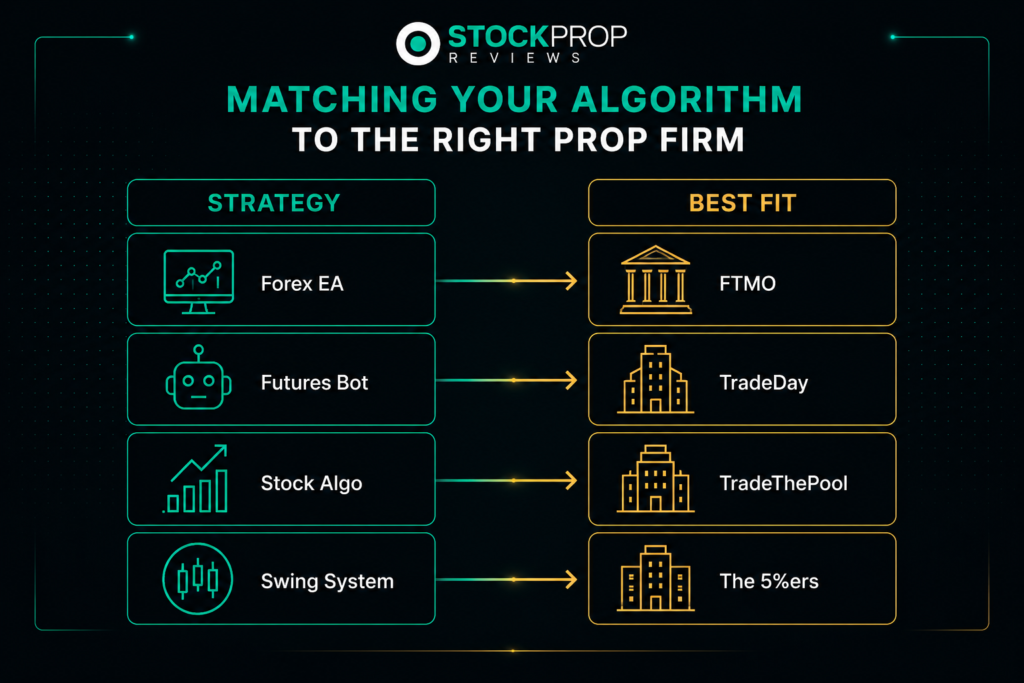
Choosing a prop firm should begin with your strategy rather than the firm’s headline profit split.
| Trading Style | Better Choice |
| MT4 Expert Advisors | FTMO |
| Conservative swing algorithms | The 5%ers |
| Flexible evaluation models | FundedNext |
| Futures automation | TradeDay |
| Stock algorithms | TradeThePool |
An algorithm designed for swing trading often performs poorly under firms that encourage high activity. Likewise, a scalping robot may struggle under firms with tighter execution restrictions.
Many traders switch firms without changing their strategy, then blame the prop firm when performance declines.
In reality, the environment changed while the algorithm remained the same.
What Most Competitors Don’t Explain
Many comparison articles simply list firms that “allow EAs.”
That leaves out the most important question:
What kind of automation is actually acceptable?
There is a major difference between:
- Automated Trading Execution
- Copy trading services
- Statistical arbitrage
- Latency arbitrage
- High-Frequency Trading
- Grid restoration systems
Only the first category is allowed by some firms.
Some others prohibit strategies that rely on delays in execution, price feed discrepancies or too high frequency of orders.
If a profitable robot uses techniques the prop firm considers abusive, it can become a rule violation overnight.
Before buying any challenge, read the firm’s prohibited strategy policy and not a marketing page.
Another factor that is overlooked is execution quality.
An algorithm backtested on historical data can produce very different results when live spreads widen during news events or during rollover periods. A little extra slippage can make a money-making system a money-losing one.
And finally, don’t think that passing an evaluation means you will succeed with a funded account. Many automated systems are designed for short term profit targets, but are unstable under stricter ongoing drawdown rules. A strategy that works for months is typically worth more than a strategy that passes a test and cannot maintain its performance.
Common Mistakes Algorithmic Traders Make with Prop Firms
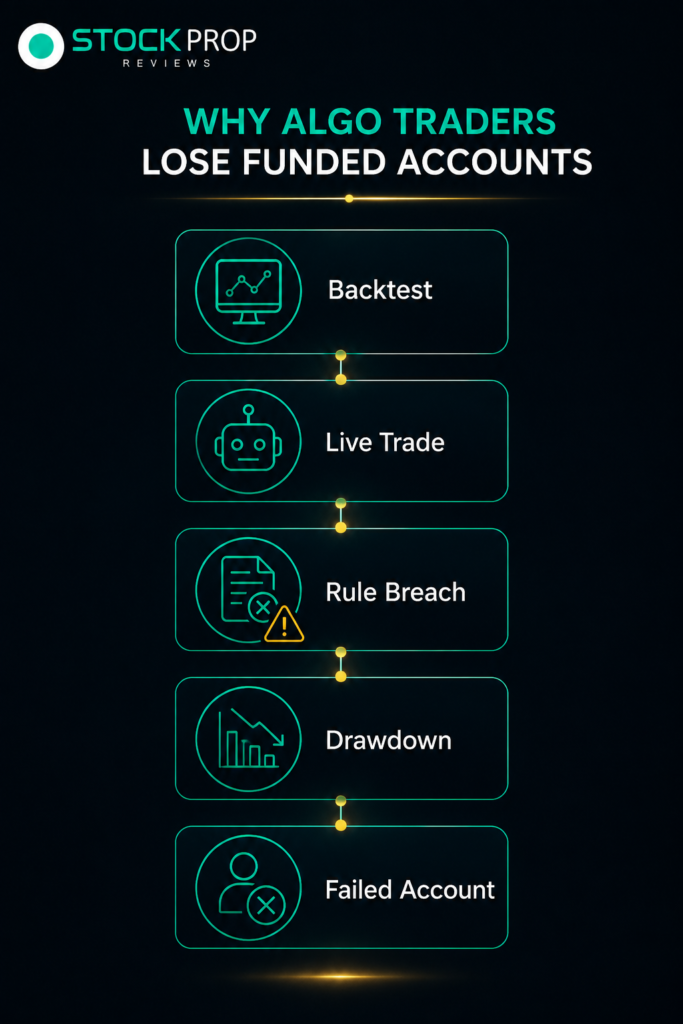
“A profitable algorithm is just part of the equation. There are many funded accounts lost by traders who only concentrate on the performance of the strategy and ignore the rules of operation set by the firm.
Optimising for the Challenge Instead of Long-Term Trading
One of the biggest mistakes is designing an algorithm solely to pass an evaluation.
For example, a trader might increase position size or loosen risk filters to hit a 10% profit target quickly. The strategy passes the challenge but becomes unstable once the funded account has stricter capital preservation requirements.
A system should be able to survive months of trading, not just a few winning days.
Ignoring Drawdown Calculations
Each individual company has their own drawdown rules.
Some calculate daily drawdown based on balance, others include floating equity. That difference can be a big difference to automated systems with multiple open positions.”
Backtesting a strategy that looks safe can unexpectedly break a daily loss limit just because unrealised losses are counted.
Always tailor your risk model to the firm’s specific drawdown method; don’t assume that every prop firm uses the same calculation.
Assuming Every EA Is Allowed
Many traders read “Expert Advisors permitted” and stop there.
In reality, firms often prohibit:
- Latency Arbitrage (LA)
- Tick arbitrage
- Quote Stuffing Account Cloning
- Few copy trading strategies
- Taking advantage of price errors
Breaking these rules can result in account termination even if the strategy is profitable.
Using Poor Quality Historical Data
Backtests are only as reliable as the data behind them.
If your historical data does not accurately reflect spreads, commissions, swaps, or execution delays, your algorithm may look profitable on paper but struggle in live conditions.
Professional algorithmic traders spend almost as much time validating data quality as they do building trading systems.
Overfitting the Strategy
An algorithm that performs perfectly across every historical market condition is often a warning sign rather than proof of quality.
Overfitted systems learn historical noise instead of market behaviour.
A more robust strategy usually accepts occasional losing periods while maintaining consistent long-term performance.
Who Should Avoid Algo Trading Prop Firms?
Algorithmic trading is not suitable for every trader.
You may want to avoid an algo-focused prop firm if:
- You have never traded your strategy on a demo account.
- Your robot has not been forward-tested for several months.
- You rely entirely on purchased EAs without understanding their logic.
- You frequently modify strategy settings after every losing trade.
- You are looking for guaranteed passive income.
Buying a challenge before validating your system often becomes an expensive lesson.
Manual trading may actually be a better starting point if you are still learning risk management or market structure.
Best Alternatives If These Firms Don’t Fit
Not every trader is looking for a traditional forex prop firm. These alternatives may be a better fit depending on your strategy.
E8 Markets
E8 Markets offers automated trading, multiple account sizes and modern evaluation models. It can be a good choice for traders who want flexible challenge structures, provided they read the firm’s list of prohibited strategies carefully.
Funding Pips
Funding Pips has been gaining popularity among algorithmic traders due to its competitive account options and support for automated execution. Like any prop firm, you want to make sure that your strategy is compatible before you buy a challenge.
Topstep
Topstep remains one of the most recognized evaluation firms for futures traders. If your algorithms are written for CME futures, rather than forex pairs, it may be a more natural fit than a multi asset prop firm.
Best For and Worst For
| Trader Type | Recommendation |
| MT4 or MT5 EA users | FTMO |
| Conservative systematic traders | The 5%ers |
| Multi-strategy developers | FundedNext |
| Futures algorithm traders | TradeDay |
| Stock algorithm traders | TradeThePool |
| High-frequency arbitrage traders | Avoid most retail prop firms |
| Grid and martingale users | Usually not recommended |
The last two categories deserve special attention. While some strategies can produce impressive short-term returns, they often conflict with the risk controls that prop firms use to protect capital.
Truth vs Opinion
It’s a common misconception that whoever is offering the biggest profit split is automatically the best prop firm for algo traders.
That’s your opinion and not fact.
The truth is that an 80% split of the profits of a firm that consistently executes and has clear rules is often worth more than a 95% split from a firm whose restrictions are constantly getting in the way of your strategy.
Likewise, unlimited automation does not guarantee profitability. Market conditions change, spreads widen, and the quality of execution varies. Even the best of algorithms have losing periods.
Good systematic traders spend less time searching for the “perfect” prop firm and more time making sure their strategy is robust across different environments.
How to Choose the Right Algo Trading Prop Firm
Before purchasing any evaluation, ask yourself these questions:
- Is my strategy in line with the firm’s rules on banned trading?
- Can I comfortably stay within the max drawdown of the firm?
- Have I performed backtests of this algorithm in realistic market conditions?
- Is it possible to use my favorite trading software on the platform?
- Am I selecting the firm to fit my plan or marketing claims?
Answering these honestly will generally whittle down your shortlist better than profit splits alone.
Should You Consider TradeThePool?
If your algorithms are designed for stocks rather than forex or futures, TradeThePool is definitely worth checking out.
It differentiates itself from many CFD-based prop firms through its focus on regulated equity markets and transparent risk framework. That said, all traders should review the latest trading rules and automation policies prior to purchasing an evaluation.
Readers can get up to 10% discount on purchases through our TradeThePool link.
Never let a discount be a determining factor. It’s not worth the risk of getting stuck with a firm that doesn’t mesh with your style just to save a couple of dollars on the evaluation fee.
FAQs
Which is the best prop firm for algo trading?
There is no universal solution. FTMO is well-liked by forex EA traders, TradeDay is good for many futures traders and TradeThePool is a good option for stock-based algo strategies. The best firm depends on your trading system and risk profile.
Can I run an Expert Advisor on the funded account?
Most prop trading firms permit the use of Expert Advisors but may disallow certain strategies such as latency arbitrage, quote manipulation, or certain types of copy trading. Always review the firm’s trading policies before going live.
Do algorithmic traders have an easier time passing prop firm challenges?
Not really. Automation takes the emotion out of decision making, but bad risk settings, overfitted strategies, and not understanding the rules of the firm still means many algorithmic traders fail evaluations.
Do prop firms accept AI or machine learning trading systems?
Some do, provided the strategy adheres to their trading rules and does not employ prohibited execution methods. Usually it is more important how a system executes trades than if it uses machine learning.
Should beginners start with algorithmic prop trading?
Not typically. The majority of new traders would be better off learning market structure, position sizing and risk management manually before they turn to automated systems. Understanding why an algorithm enters and exits trades makes it so much easier to manage funded accounts with success.
Final Verdict
Best algo trading prop firms are not always the ones that advertise automation support. They’re the firms that really align with how your strategy trades, in terms of rules, quality of execution and risk framework.
FTMO remains a benchmark for transparency and consistency among many forex traders. The 5%ers also attracts traders who are looking to grow their capital over the long term. FundedNext offers flexibility with its multiple evaluation models. Futures traders will probably be more interested in TradeDay, while stock algorithm developers should take a look at TradeThePool, since it focuses on regulated markets.
Read the rulebook more than you compare profit splits before buying any evaluations. A strategy that is appropriate to the risk appetite of the firm has a much better chance of long term success than one that just looks great in a backtest.