High frequency trading prop firms sometimes get a bad rap. Many firms tout fast execution, but few actually offer the automated, latency-sensitive trading that sophisticated HFT strategies demand.
If you’re looking for high frequency trading prop firms, this guide is for experienced algorithmic traders, quantitative developers and traders running ultra-fast execution systems. Not for beginners who manually scalp a handful of trades a day. Most retail prop firms differentiate between real HFT and normal scalping and you can get your account shut down for breaking their execution rules even if your strategy is profitable.
More than marketing claims, this comparison. We’ll cover the actual restrictions, why traders get rejected, and what a lot of competing articles don’t mention.
What Are High Frequency Trading Prop Firms?
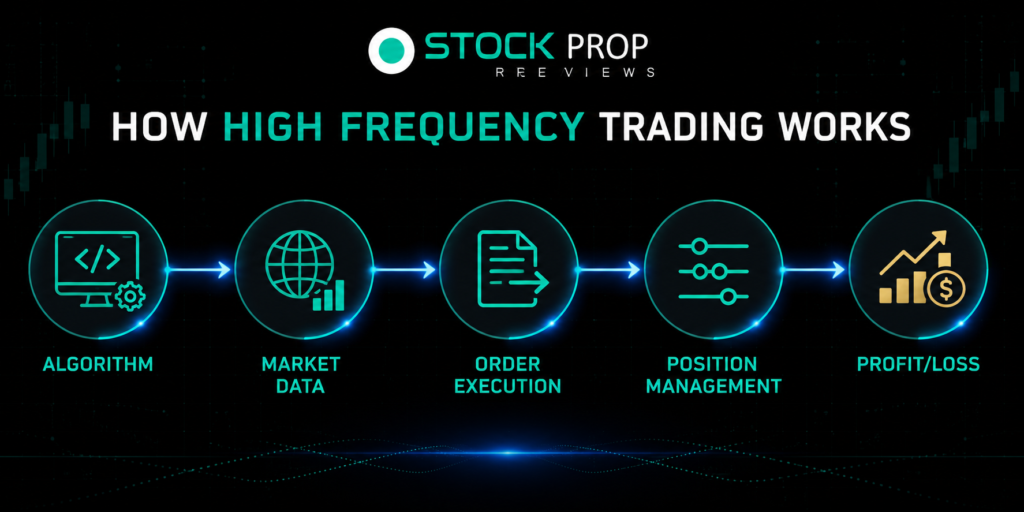
A high frequency trading prop firm provides trading capital while allowing strategies that execute a very large number of orders using algorithms, extremely low latency infrastructure, or automated systems.
Unlike standard scalping, true HFT typically involves:
- Hundreds and thousands of orders a day
- Execution in milliseconds
- Colocated servers or Automated decision making VPS
- Statistical or market making strategy
Many retail-funded accounts are not designed for this type of trading.
That distinction matters because many traders assume “scalping allowed” automatically means HFT is allowed. It usually does not.
Why Most Retail Prop Firms Restrict HFT
There are practical reasons behind these restrictions.
Retail prop firms copy trades to liquidity providers or hedge their exposure differently than institutional firms. Extremely fast execution can create problems such as:
- Arbitrage on outdated price feeds
- News lag exploitation
- Server is too busy!
- Liquiditeitsproblemen
- Disputes Regarding Broker Execution
Even profitable traders may have payouts denied if their strategy violates execution policies.
This is one of the biggest gaps in competitor articles. Many simply list firms without explaining why these restrictions exist.
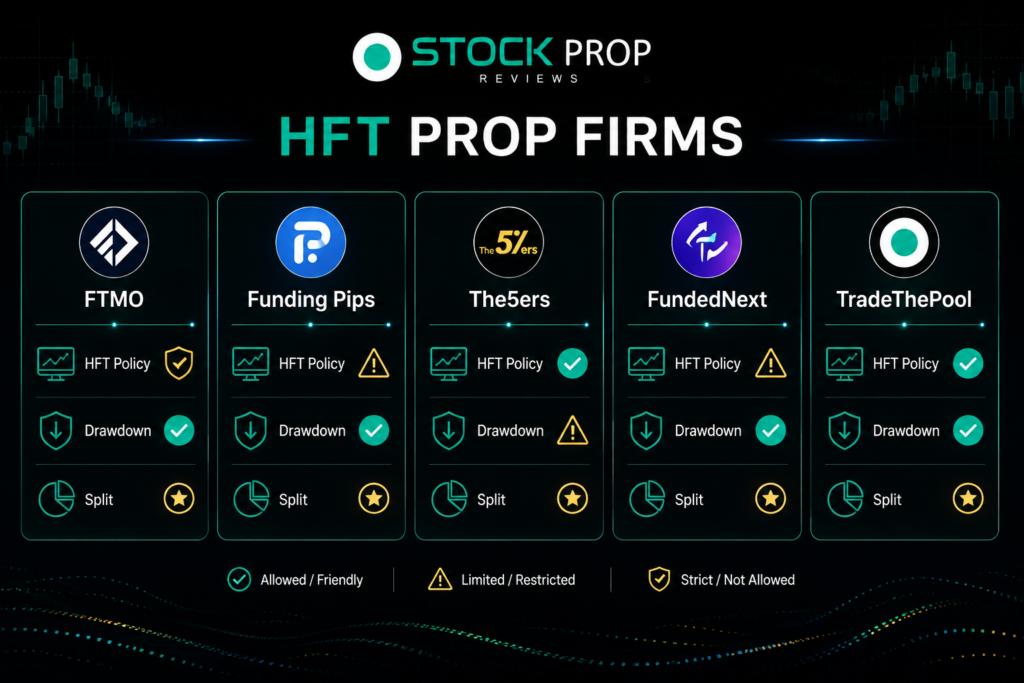
Best High Frequency Trading Prop Firms Compared
| Prop Firm | HFT Policy | Best For | Drawdown | Profit Split | Overall Verdict |
| FTMO | Limited, subject to execution rules | Professional algorithmic traders | Static | Up to 90% | Reliable but strict |
| Funding Pips | Certain automated strategies permitted with restrictions | EA users | Static | Up to 90% | Read policy carefully |
| The5ers | Algorithm-friendly within limits | Swing and algorithmic traders | Flexible | Up to 100% scaling | Better for lower frequency automation |
| FundedNext | Some EA strategies allowed | Hybrid automated traders | Depends on account | Up to 90% | Suitable for moderate automation |
| TradeThePool | Stock algorithmic traders | Professional equity traders | Clear risk model | Performance based | Transparent rules for stock traders |
Policies change regularly, so traders should always verify current rulebooks before purchasing a challenge.
Quick Verdict
| Firm | Best For | Worst For |
| FTMO | Experienced quantitative traders | Latency arbitrage |
| Funding Pips | EA traders | Tick-level HFT |
| The5ers | Longer-term automated systems | Ultra-fast execution |
| FundedNext | Mixed manual and EA trading | Institutional HFT models |
| TradeThePool | Professional stock traders | Forex latency arbitrage |
Strategy Fit Analysis
FTMO
FTMO remains one of the industry’s most respected firms because of consistent rule enforcement.
Realistically, FTMO is better suited for traders running disciplined automated systems rather than true high frequency trading.
Best for
- Professional EAs
- Quantitative strategies
- Controlled automation
Avoid if
- Your strategy is based on latency arbitrage.
- Hundreds of orders every minute you put in.
- You take advantage of broker pricing delays.
A common mistake is assuming a profitable EA automatically qualifies. FTMO reviews execution quality, trading behavior, and strategy characteristics.
Funding Pips
Funding Pips is popular with algorithmic traders because it supports a variety of automated systems.
But traders should not confuse HFT with algorithmic trading.
An EA that does 20 trades a day is a whole different animal to an algorithm that does thousands of executions a microsecond.
Please read the definitions of prohibited strategies before you buy a challenge.
Best for
- Medium frequency algorithmic trading
- Automated trend strategies
Who should avoid it
Traders relying on execution speed as their primary edge.
The5ers
The5ers has always been a destination for traders who prefer consistency to aggressive short-term execution.
The scaling model is attractive to systematic traders seeking stable returns.
Many HFT developers will find that their strategies are better suited for institutional environments than for retail-funded accounts like The5ers.
FundedNext
FundedNext supports various trading styles. And most of them are automated.
It is an attraction for experienced EA traders owing to its flexibility.
But traders should not have all the freedom in algorithms. “Every firm is going to watch trading behavior differently.
Execution patterns are equally important as profitability.
TradeThePool
The difference with TradeThePool is, this is stocks, not Forex.
Its transparent risk model and regulated environment can provide systematic equity traders with more predictable expectations than many retail funded Forex firms.
Our TradeThePool link gives readers up to 10% discount when they buy.
We don’t need endless automation. What we need are clear rules and transparent risk management.
Rules Comparison
| Firm | Daily Drawdown | Maximum Drawdown | Profit Split | Time Limits | EA Allowed |
| FTMO | Yes | Yes | Up to 90% | Depends on program | Yes with restrictions |
| Funding Pips | Yes | Yes | Up to 90% | Varies | Yes |
| The5ers | Depends on account | Yes | Scaling model | Flexible | Yes |
| FundedNext | Yes | Yes | Up to 90% | Account dependent | Yes |
| TradeThePool | Risk based | Program specific | Performance model | Program dependent | Stock automation allowed within rules |
Always verify current rules before opening an evaluation because firms regularly update execution policies.
What Most Competitors Don’t Explain
In many comparison articles, firms are just tagged as “HFT allowed”.
That, in itself, is of little value.
Professional traders should instead ask:
- Is Latency arbitrage illegal?
- Yes, you can use copy trading systems.
- Are tick scalping strategies tested?
- Are execution logs analyzed by the firm?
- Are EAs that use VPS allowed?
- How do you deal with news spikes?
Those questions determine whether a strategy survives beyond the evaluation stage.
A strategy can pass an evaluation and still become ineligible for payouts if it violates prohibited execution practices.
Why High Frequency Traders Usually Fail Prop Firm Evaluations
The biggest reason is not poor profitability.
It is misunderstanding the firm’s business model.
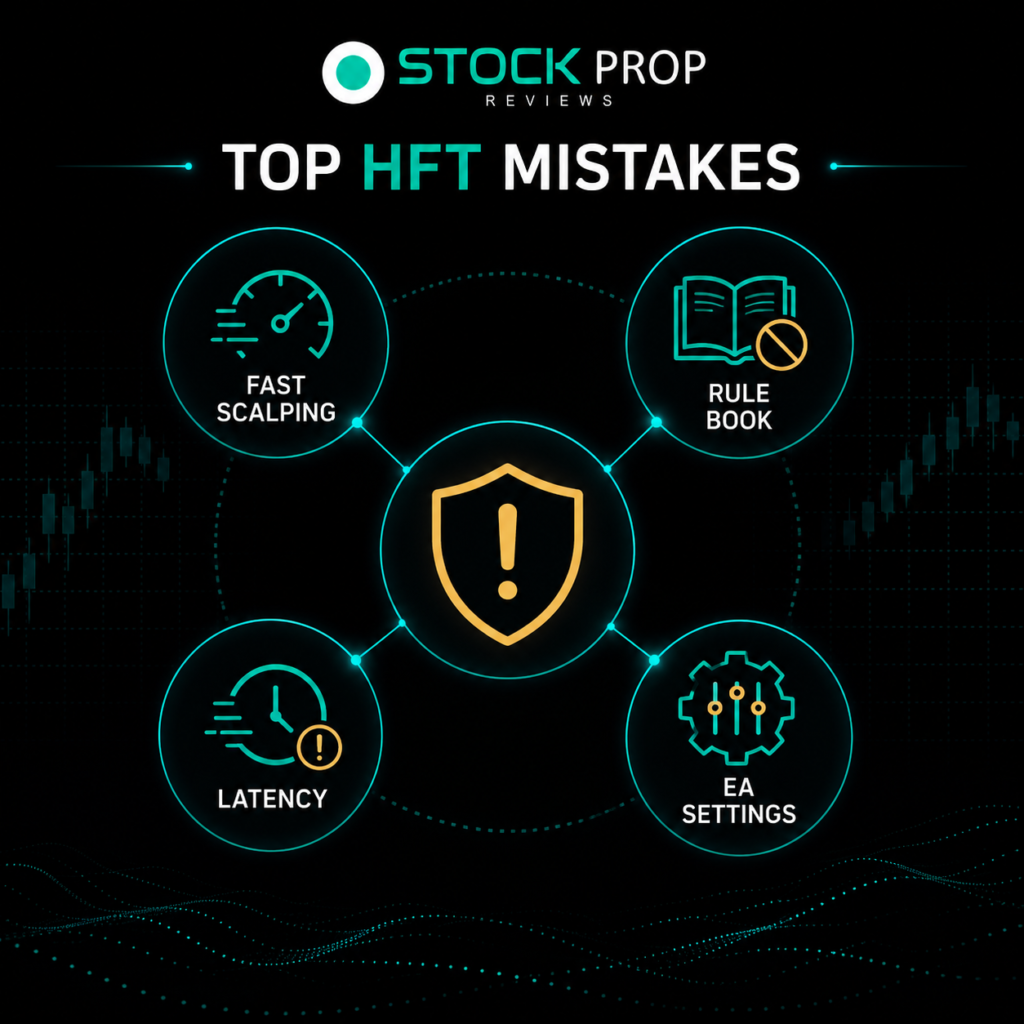
Common real-world failures include:
Confusing Scalping With HFT
Opening several fast trades manually is very different from institutional high frequency trading.
Retail firms often welcome one while restricting the other.
Ignoring Execution Policies
Most traders only read the drawdown rules.
Often the rules of execution matter more.
Over-Optimized Algorithms
Sometimes the strategies you develop will fail due to the large discrepancy between live execution and the historical tick data.
Small delays can destroy the statistical advantage.
VPS Does Not Equal HFT
A VPS just makes it more stable in execution.
It is not a high frequency strategy.
Assuming Every EA Is Allowed
Many firms permit Expert Advisors but prohibit some of the behaviors that those EAs perform.
That changes things.
Data Versus Psychology
Many traders believe that faster trading automatically means higher profits.
Real trading experience is a different story.
Higher trade frequency also means:
- Higher transaction costs
- More Slipage
- More infrastructure investment
- More tech failures
- Prop firms are monitoring more
Professional quantitative firms invest millions in infrastructure because milliseconds matter.
Retail traders rarely have access to similar technology.
That reality explains why many HFT systems lose their advantage when moved into retail-funded environments.
Truth vs Opinion
Fact
Most retail prop firms allow automated trading.
Fact
Most retail prop firms prohibit at least some forms of high frequency or latency-based execution.
Opinion
For the vast majority of retail traders, strong medium frequency automation is likely to produce more sustainable long term results than trying to implement institutional style HFT.
The evidence bears this out, with infrastructure, liquidity and execution quality hurdles not easily overcome by retail environments.
Alternatives to High Frequency Trading
If your strategy struggles under HFT restrictions, consider these alternatives.
Medium-Frequency Algorithmic Trading
Many systematic strategies execute fewer trades while maintaining statistical consistency.
These often comply more easily with prop firm rules.
Swing Automation
Longer holding periods reduce execution sensitivity and often experience lower transaction costs.
Quantitative Stock Trading
Firms such as TradeThePool provide opportunities for systematic stock traders under clearly defined risk frameworks.
Readers can receive up to 10% discount through our TradeThePool link if they decide the platform matches their trading style.
Which Traders Should Avoid High Frequency Trading Prop Firms?
These firms are generally unsuitable for:
- Novice traders
- Discretionary Traders Manual
- Traders who have never used a VPS
- Traders Who Don’t Understand Execution Latency
- Anyone who takes the time to copy online EA strategies
Professional HFT requires technical expertise beyond simply buying an Expert Advisor.
Related Reading
You may also find value in our detailed FTMO review and TradeThePool review, where we break down rule enforcement, payouts, and trader experience.
For a broader perspective, see our analysis on whether prop firm scaling plans are really worth it, which explains how growth opportunities compare with marketing claims.
FAQs
What prop firms allow high frequency trading?
There are very few retail prop firms that allow true high frequency trading without restrictions. Most allow automated trading but do not allow latency arbitrage, quote manipulation or excess order frequency.
Is scalping the same as HFT?
No. Scalping is a short term trading technique, usually traded manually. High frequency trading is algorithm based, ultra fast execution and very high order volume.
Can I use an EA on prop firm accounts?
Many brokers allow Expert Advisors, but usually with some restrictions on trading behaviors. Always read the firm’s automation policy before purchasing an evaluation.
Why do profitable HFT traders sometimes lose their funded accounts?
The money is not the problem, it’s usually breaking the rules. Payouts may not be available for strategies that exploit latency, pricing errors or prohibited execution methods.
Are Stock Prop Firms Better For Algo Traders?
For some traders, yes. TradeStock-based firms likeThePool is regulated under transparent risk frameworks which may be more appropriate for systematic equity strategies than for retail Forex funded accounts.