Passing a prop firm challenge is usually the hardest part of the journey. In reality, funding is only the beginning. Many traders discover that their real earning is far less than they had expected, not because they are bad traders, but because many unseen costs eat away at every payout. These are the untold costs of prop trading that don’t often make it onto a firm’s pricing page.
This article is for traders considering getting into a prop firm, for those already in an evaluation, and for funded traders that want a clearer picture of their actual profitability. If you’re just after the cheapest challenge fee, this is not the guide. The lowest upfront cost doesn’t always translate to the highest long-term return.
Having spoken with funded traders and examined dozens of prop firm models over the past few years, there’s one pattern that continues to emerge. A challenge fee is usually one of the cheapest costs you’ll face. Everything that comes after is really what determines your profitability.
The Short Answer
In most cases, prop firms clearly display the fees they advertise. Traders spend money on indirect costs they don’t budget for. Repeated challenge attempts, slippage, platform subscriptions, taxes, currency conversion and even the pressure created by strict trading rules can eat away at profits month after month, without you even noticing.
These costs don’t make prop trading a bad opportunity. They just mean you need to do more than look at a profit split and evaluation price to figure potential income..
The Difference Between Price and Cost
One of the mistakes new traders make is to consider the fee for evaluation as the total investment.
Picture two traders.
The first pays $89 for a challenge, passes the first attempt, follows the rules, gets regular payouts and keeps trading for a year.
The second also starts with a $89 challenge. They fail three evaluations, pay two reset fees, subscribe to a premium charting platform, rent a VPS for automated trading and miss several profitable setups due to strict restrictions. By the end of the year they had spent several hundred dollars before the normal trading losses.
Both traders bought the same challenge, but the real cost of getting funded was completely different.
Many comparison articles fail to explain this difference.
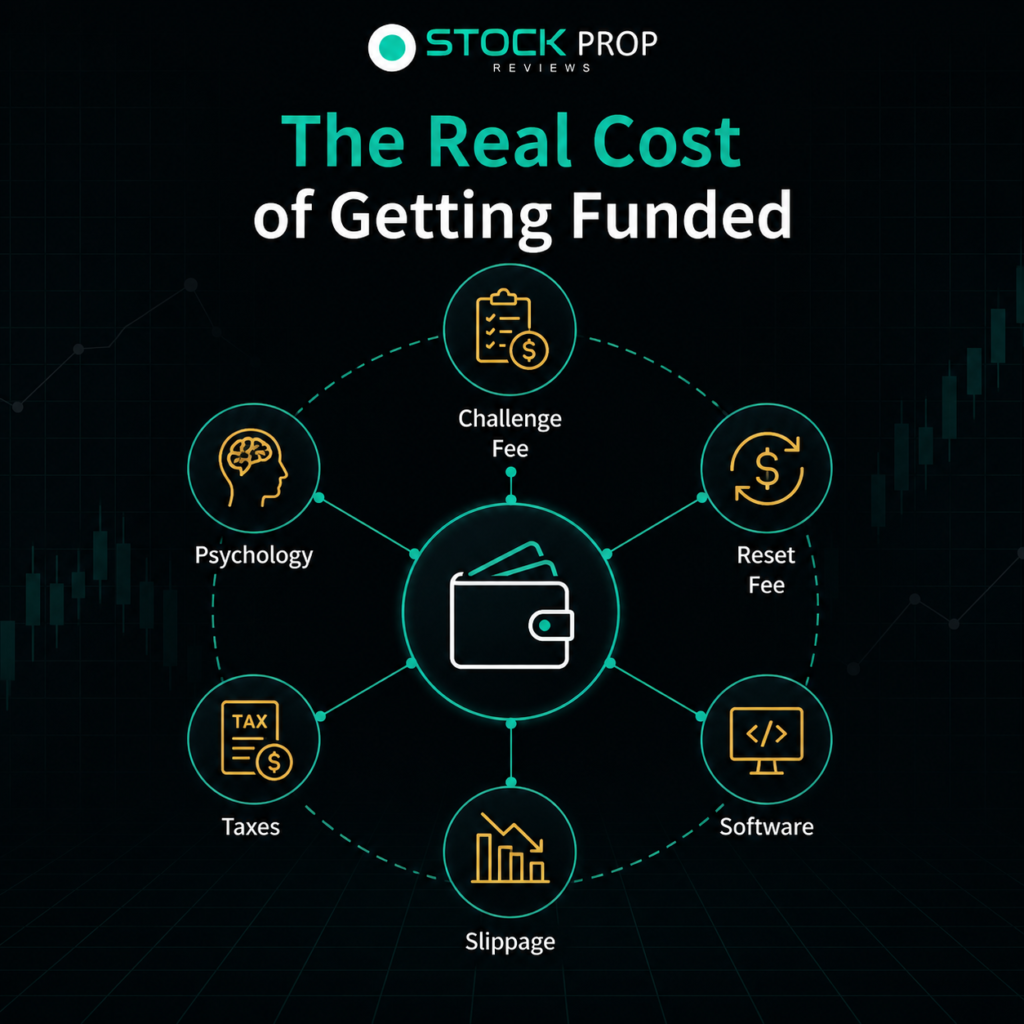
The Hidden Costs That Matter Most
Failing More Than One Evaluation
The evaluation fee is obvious. Multiple evaluation fees are not.
Very few traders pass their first challenge, especially those with limited experience. Most fail because of risk management rather than poor market analysis. A trader may correctly identify the direction of the market but still lose the account after increasing position size to recover previous losses.
This creates a cycle that becomes surprisingly expensive.
Instead of spending time reviewing what went wrong, many traders immediately buy another account. It feels productive because they’re still trading, but they’re often repeating exactly the same mistakes.
Over several months, challenge fees can easily exceed the cost of professional trading software or market education.
The better approach is to treat every failed evaluation like a performance review. If you don’t understand why the account failed, buying another one rarely changes the outcome.
Reset Fees Look Small Until They Add Up
Many firms do let traders reset an account rather than starting over. Sounds like a good deal on paper.
Often a trader begins to view frequent resets as a routine, not an emergency option.
There is nothing wrong with using a reset when abnormal market conditions lead to a failure. The problem starts when traders use the reset option. They expect that they will break the rules at some point.
Those small payments eventually add up to yet another monthly expense that wasn’t in the original plan.
Trading Costs Don’t Stop After You’re Funded
Funding does not mean free of cost. It just changes them.
Some firms provide all you need, others require traders to foot extra operational costs themselves.
Depending on your trading style, you might find yourself paying for charting software, market data, journaling platforms, trade analytics, or a virtual private server if you use automated systems.
None of these services are necessarily marginal. Many professionals happily pay for tools that make things more consistent.
The key is to take these expenses into account when calculating profitability.
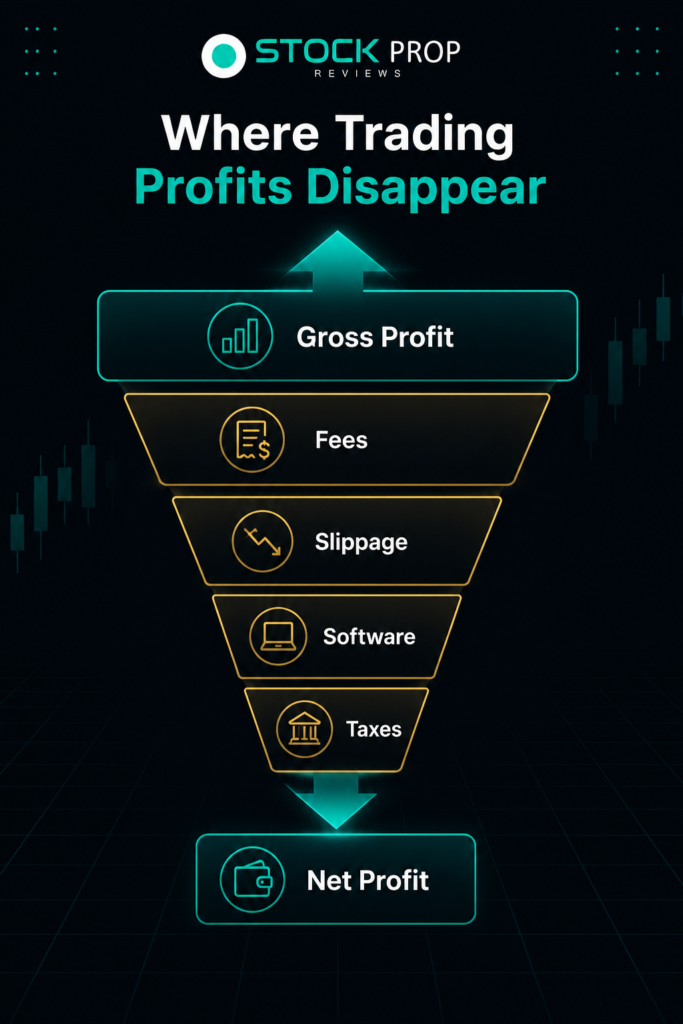
If a trader makes $800 a month but spends $150 on software, he’s not making $800.
Small Execution Differences Can Have a Big Impact
Execution quality is an area that is often underestimated by novices.
Backtesting typically assumes perfect entries and exits. In real life, markets rarely act like that.
If you are swing trading one pip probably does not matter that much. On a scalping strategy of 5 or 6 pips it can totally change the expected result.
You get wider spreads, slippage during volatile periods, delays in execution etc. All of those reduce profitability and are not shown as a separate fee.
This is particularly the case around key economic releases.
Some traders blame themselves after a losing trade, when the bigger issue was entering a fast moving market where execution became unpredictable.
Part of becoming a consistently profitable trader is knowing the difference between strategy failure and execution costs.
Opportunity Costs Are Real Costs
Not all of the hidden costs show up on a statement.
Sometimes the biggest loss is the trade you weren’t allowed to make.
Many prop firms have rules in place to protect the capital. These could be news trading restrictions, overnight holding policies, consistency rules or max position sizes.
From the firm’s point of view, these rules are quite reasonable.
But from the trader’s point of view they can limit flexibility.
Imagine spotting a good swing setup on Friday afternoon.
Your analysis is right on. By Monday morning, the market has reached your target.
If your firm’s rules say you can’t hold over a weekend, then you never had that profit.
Nothing that appears as a deduction on your account but you still had earning potential reduced.
That is why a comparison of firms is so much more than a comparison of challenge prices.
Taxes Are the Hidden Cost Nobody Likes Talking About
Many funded traders celebrate their first payout without thinking about what happens next.
Eventually, taxes become part of the conversation.
The amount you’ll owe depends on where you live and how your payouts are classified, but one thing remains consistent almost everywhere. Money withdrawn from a prop firm isn’t always money you get to keep.
Some traders spend their first few withdrawals only to discover months later that they should have reserved part of that income for taxes.
Planning for tax obligations from the beginning avoids unnecessary financial stress later.
Professional traders think about after-tax income, not just gross payouts.
Currency Conversion Quietly Reduces Withdrawals
Another hidden cost that international traders often face.
A payout can be made in US dollars but personal expenses are paid in another currency.
Banks, payment providers and changes in exchange rate can take a small percentage of every withdrawal.
One transaction may not seem like much.
If you have twelve withdrawals in a year then that’s a different story.
These are easy costs to miss because they rarely get the same attention as profit splits or evaluation fees.
The Cost That Doesn’t Show Up Anywhere
The biggest hidden expense in prop trading isn’t financial.
It’s psychological.
Many traders become more emotional after joining a prop firm than they ever were trading a personal account.
The reason is simple.
Rules introduce pressure.
The trader hits a daily drawdown limit, and he begins to make different decisions. They get stuck in good setups, they exit trades too early, or they force trades to make up losses before the trading day is over.”
The market is identical.
Their deeds have.
Experienced traders understand that emotional mistakes nearly always equal financial mistakes.
That’s why consistency beats chasing big returns.
What Most Competitors Don’t Explain
Many articles on prop firm costs end at challenge fees, reset fees, and profit splits. Those are easy numbers to compare because they are published on every firm’s website. The harder conversation is about the costs not on the pricing page.
The first is time itself.
A trader that has failed evaluations for 6 months has not only lost some challenge fees. They have also burnt hundreds of hours that could have been spent working on a strategy in a demo account or trading a small personal account. Time is valuable, even if it does not show up on a bank statement.
The second is strategic compatibility.
A winning strategy isn’t necessarily a winning strategy in every prop firm. The trader who normally takes positions on major news events or overnight may have to completely change their trading style to adhere to the firm’s rules. That adjustment process often results in a drop in performance, even when the strategy itself is sound.
Another often overlooked metric is consistency of payout. Traders often look at the size of the first withdrawal without asking how realistic it is to repeat that performance month after month. Usually one big payout doesn’t mean as much as consistent income.
Common Mistakes That Increase Hidden Costs
Most of the hidden costs can be avoided. They grow because traders decide without seeing the big picture.
One of the most frequent mistakes is to select a firm simply because it has the cheapest evaluation. If the rules are so strict that passing is much more difficult, the $30 saved on the initial fee is irrelevant.
Another mistake is to add to the position after a losing streak. This often leads to blowing the daily drawdown limits and thus forces the traders to buy another evaluation instead of working on the root cause.
Some traders also underestimate the cost of doing business. Software subscriptions, market data, internet upgrades, payment processing fees and tax obligations may not seem like much individually, but together they can take a noticeable bite out of annual profits.
You could make the biggest mistake in calculating your expected income without taking these deductions into account. People get excited about the 80% or 90% profit split, but that is before you start paying for all the expenses discussed in this article.
Comparing Advertised Costs With Real Costs
| What Firms Advertise | What Traders Actually Pay |
| Challenge fee | Multiple evaluation attempts |
| Profit split | Taxes reduce take-home income |
| Low commissions | Slippage and execution costs |
| Reset option | Frequent reset purchases |
| Fast payouts | Currency conversion and transfer fees |
| Trading account | Software and operational expenses |
Looking beyond marketing numbers provides a far more realistic picture of long-term profitability.
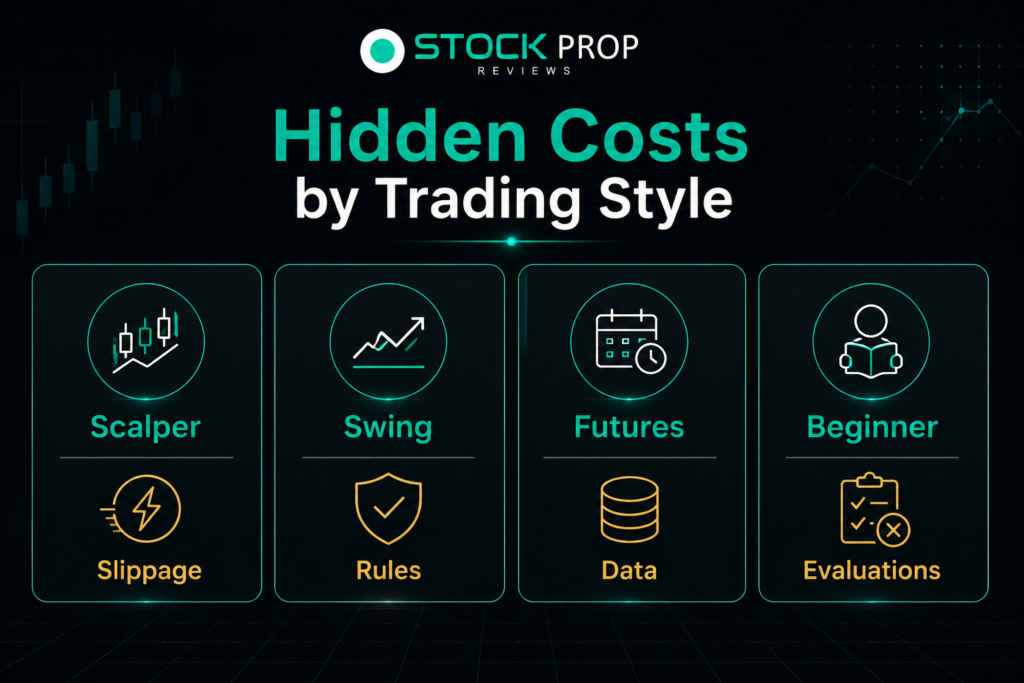
Which Traders Feel These Costs the Most?
Not every trader experiences the same hidden costs.
Beginners usually spend more on repeated evaluations because they are still developing consistency. The market isn’t necessarily the problem. Risk management often is.
Scalpers are heavily affected by spreads, commissions, and execution speed. A small increase in trading costs can turn a profitable strategy into a breakeven one.
Swing traders generally care less about execution quality but are more likely to feel restricted by rules around overnight positions or weekend holding.
Futures traders often face additional market data costs that forex traders may never encounter.
International traders should pay particular attention to withdrawal methods, exchange rates, and local tax obligations, as these can noticeably reduce net income.
Best For and Worst For
| Best For | Why |
| Experienced traders | Better at managing risk and avoiding repeated evaluations |
| Patient swing traders | Lower trading frequency reduces commission costs |
| Traders with written plans | Less likely to make emotional decisions |
| Worst For | Why |
| Complete beginners | Often underestimate evaluation costs |
| Revenge traders | Higher risk of repeated failures |
| Traders chasing quick income | Hidden costs usually appear before consistent profits |
Are Higher Fees Ever Worth Paying?
Sometimes they are.
A more expensive prop firm with simple rules, reliable execution and consistent payouts, can be better for long term results than a cheaper one with complicated restrictions.
That is why experienced traders don’t often compare companies on price alone. They look at the whole trading environment.
Even if they don’t seem like direct financial benefits, things like clear drawdown rules, transparent payout policies, responsive support and stable execution all add to profitability.
It should feel like you are selecting a broker. The cheapest option is not always the best one.
Before You Buy Another Challenge
If you’ve already failed several evaluations, resist the temptation to immediately purchase another one.
Instead, ask yourself a few questions.
Did you break your trading plan?
Were your losses caused by poor analysis or poor discipline?
Did you exceed your normal position size?
Did you trade because you saw an opportunity, or because you felt pressure to recover losses?
Honest answers to those questions are often worth more than another funded account.
Many successful funded traders didn’t become profitable because they found a better prop firm. They became profitable because they stopped repeating the same mistakes.
Related Reading
If you’re still comparing firms, our FTMO Review explains where its pricing and trading conditions are a good fit for different trading styles.
If you are looking to get into stock focused proprietary trading then our TradeThePool Review dives deep into its rules, evaluation process and risk model for traders.
If you’re trying to decide between providers, our FTMO vs FundedNext comparison breaks down how differences in drawdown rules, payouts and trading restrictions can impact your profitability.
If you’re trying to decide if funded trading is a good fit for your long-term goals, you may also find our article on whether prop trading is really worth it helpful.
A Note on TradeThePool
If you trade stocks more than forex or futures, TradeThePool is a good choice as it is a regulated stock prop firm with well-defined risk rules and transparent account structures. And that transparency may help you better estimate your real trading costs before you start.
Readers of StockPropReviews get up to 10% savings when they buy through our TradeThePool link. The discount shouldn’t be the deciding factor, but it can reduce your initial outlay if the firm’s setup already suits your trading style.
Final Thoughts
The biggest lesson from funded trading is that profitability is not one number.
Challenge fees are the entry fee only but they are great. The key to long-term success is controlling all of the downstream costs: the cost of repeated evaluations, the cost of execution, the cost of taxes, the cost of emotional decisions.
Prop firm traders who know about these hidden costs will probably make better choices when picking a prop firm. More importantly, they set realistic expectations about what they will actually take home after all deductions.
One of the easiest ways to become a more disciplined trader is to look at net profit, not advertised profit.
FAQs
What are the biggest prop trading hidden costs?
Few traders will consider the initial challenge fee as a big deal when compared to the effect of the multiple evaluation fees, slippages, software subscription, taxes, and emotional trading errors on their profits.
Are all prop firms charging hidden fees?
Yes . Even at firms where pricing is transparent, there are indirect costs, such as quality of execution, opportunity costs of any trading rules and operational costs. It’s just that those costs are communicated more clearly.
How do we minimize hidden costs?
They are not completely gotten rid of, but they can be managed. Picking a firm that fits your trading style, managing your operating costs and disciplined risk management all contribute to keeping more of your profits.
Why do so many funded traders make less than they expected?
Most traders will calculate potential earnings based on profit splits, not including taxes, trading costs, software costs, and the need to make multiple testing attempts. Those deductions cut actual take-home earnings.
Should challenge fees be the main factor in choosing a prop firm?
No. The total cost of trading, which includes rules, execution quality, payout structure and ongoing costs, usually has a far greater impact on long-term profitability than the initial challenge fee alone.