Many traders assume prop firms want aggressive traders who generate large profits quickly. In reality, most firms actively look for the opposite.
Low volatility prop trading is often more attractive to risk managers than high-return, high-risk trading. A trader producing steady gains with controlled drawdowns is usually viewed as a better long-term asset than someone who doubles an account one month and blows it the next.
This article explains why prop firms prefer low volatility traders, how risk teams evaluate performance, and what many competitors fail to explain about funded account success.
This guide is for aspiring funded traders, challenge participants and experienced traders looking to improve account longevity.
This is not for the traders who want to have a high-risk strategy, a gambling style or want to grow their account fast by taking too much size.
Quick Verdict
Prop firms like low volatility traders because their performance is more consistent and therefore easier to scale, easier to risk-manage and more likely to survive changing market conditions.
A trader making 3% to 5% a month with very little drawdown is usually worth more than a trader making 20% while flirting with the risk limits.
Most prop firms are not looking for the most profitable trader right now. The goal is to find traders who can make money for years to come.
What Is Low Volatility Prop Trading?
Low volatility prop trading is a trading strategy that provides relatively consistent returns with controlled risk exposure.
Characteristics typically include:
- Small and consistent position sizing
- Limited drawdowns
- Controlled daily losses
- Few emotional trading decisions
- High adherence to trading plans
The term does not necessarily mean trading low-volatility markets.
A trader may be invested in volatile instruments and at the same time keep the volatility of the account performance low with disciplined risk management.
For instance:
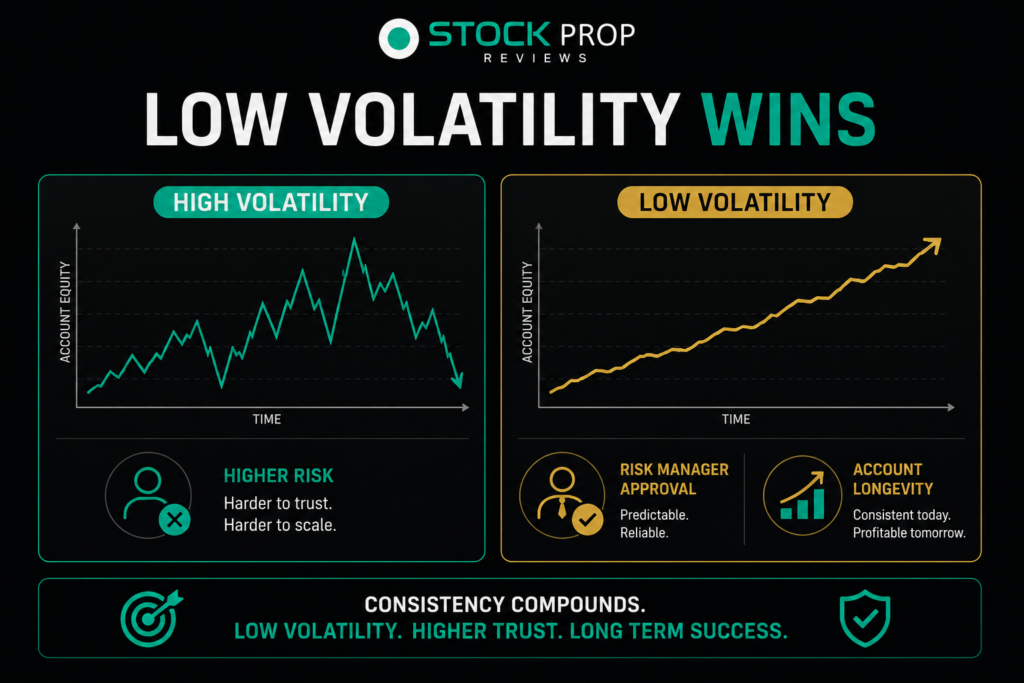
Trader A makes 10%, loses 12%, makes 15%, and loses 8%.
Trader B earns 3%, then gains 4%, then earns 2%, then gains 3%.
Trader A would create larger swings but most prop firm risk departments would prefer Trader B.
Why Prop Firms Care More About Risk Than Returns
One of the biggest misconceptions among challenge participants is believing profits are the primary evaluation metric.
Risk consistency is usually more important.
A trader generating strong returns while repeatedly approaching maximum drawdown limits creates uncertainty for the firm.
A trader producing moderate returns with predictable risk creates confidence.
From a firm’s perspective, predictable traders are easier to allocate capital to because future performance becomes easier to estimate.
This becomes particularly important once traders move into scaling programs.
The Real Cost of High Volatility Trading
Competitor articles often focus heavily on passing challenges.
What they rarely discuss is the operational risk created by volatile traders.
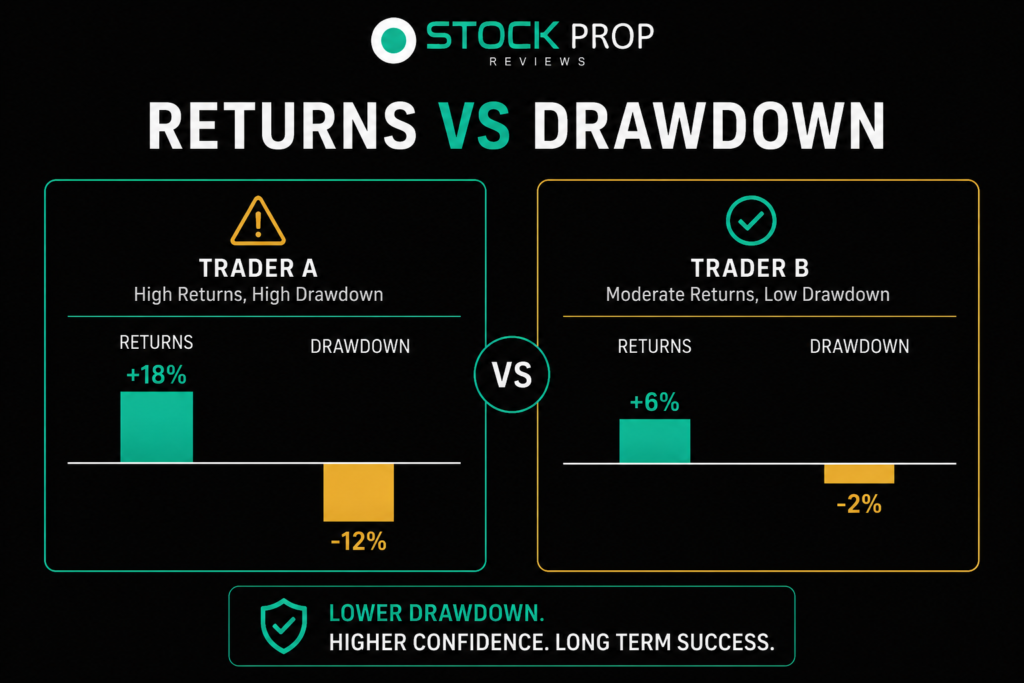
Consider two funded traders:
| Metric | Trader A | Trader B |
| Monthly Return | 15% | 5% |
| Max Drawdown | 12% | 3% |
| Daily Loss Violations | Frequent | Rare |
| Consistency | Low | High |
| Scalability | Limited | Strong |
Many traders naturally focus on the return column.
Risk managers focus on the drawdown column.
Large drawdowns create several problems:
- Increased chance of account failures
- Emotional lability
- Inconsistent sizing of positions
- Higher probability of rule breaches
These factors make long-term profitability less predictable.
How Prop Firm Risk Teams Actually Evaluate Traders
Most traders only see challenge rules.
Risk teams see much more.
Evaluation often includes:
Drawdown Behavior
Risk managers observe how traders behave during losing periods.
A trader who respects risk after losses is seen differently than a trader who immediately ups size to get back.
Consistency of Returns
Many companies would prefer a constant flow of weekly winnings rather than the occasional big win.
Consistency means that the trader has a repeatable edge, not random market conditions.
Position Size Stability
A sudden increase in lot size can indicate emotional decision-making.
Stable position sizing is often a sign of professional risk management.
Recovery Patterns
The way traders recover from losses matters.
Slow, disciplined recovery is usually preferred over aggressive revenge trading.
What Competitors Don’t Explain About Funded Success
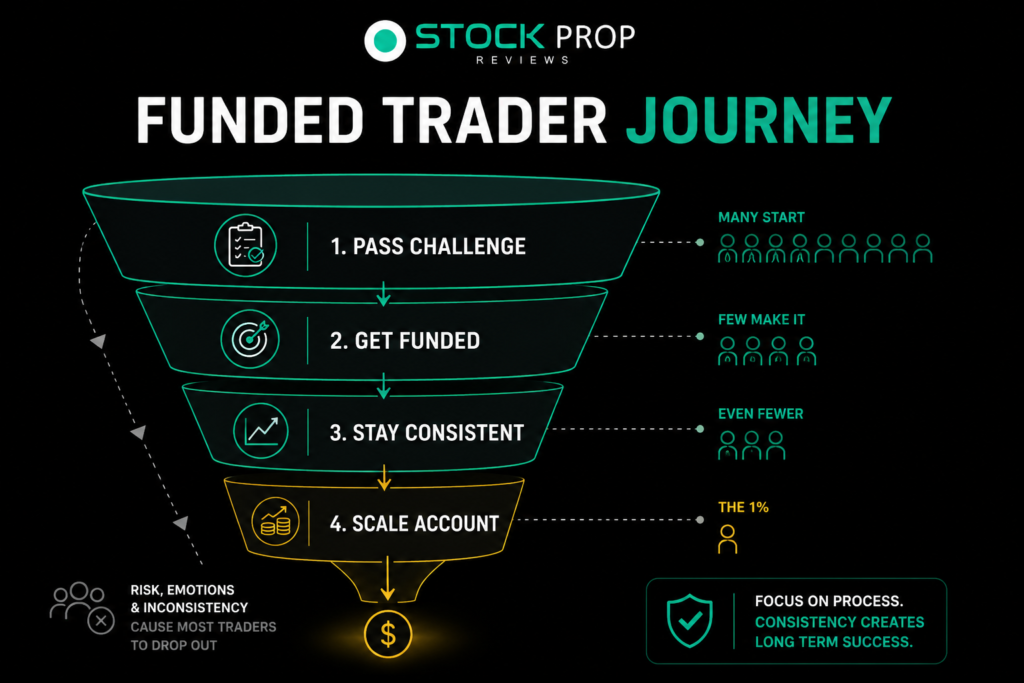
Many challenge-focused articles create the impression that passing is the finish line.
Experienced traders know the opposite is true.
Passing the evaluation is often the easiest stage.
Remaining funded is where most traders struggle.
Many traders pass through:
- Aggressive risk-taking
- Favorable market conditions
- Oversized winning trades
Once funded, these same habits often lead to violations.
This is why firms increasingly reward consistency rather than raw performance.
A trader who survives twelve months can generate more value than a trader who produces one exceptional month before failing.
Common Trader Mistakes That Increase Account Volatility
Oversizing After Winning Streaks
Confidence often becomes dangerous after several successful trades.
Many traders increase position sizes because they feel invincible.
This frequently leads to larger losses when market conditions change.
Chasing Daily Profit Targets
Some traders force trades simply because they want to hit specific numbers.
This behavior often increases unnecessary risk exposure.
Ignoring Market Conditions
Not every market environment suits every strategy.
Professional traders reduce activity when conditions become unfavorable.
Focusing Only on Passing Challenges
Short-term challenge objectives can encourage poor habits.
Many traders develop challenge-passing strategies rather than sustainable trading strategies.
Why Low Volatility Traders Are Easier to Scale
Scaling is where prop firms earn the greatest value from successful traders.
A trader managing risk effectively at $50,000 often has a higher probability of succeeding at $250,000 or $500,000.
The same cannot always be said for highly volatile traders.
Imagine two traders:
Trader A averages a 2% drawdown.
Trader B averages a 10% drawdown.
When account size increases, Trader B’s risk becomes significantly harder to manage.
Trader A remains predictable.
This predictability is what scaling programs are designed around.
The Psychology Behind Low Volatility Performance
Most profitable funded traders eventually discover a surprising truth.
Trading becomes easier when they stop trying to make money quickly.
Low volatility trading often reflects stronger psychological discipline.
These traders typically:
- Accept losses more readily
- Be consistent with rules
- 11. Avoid emotional decision making
- Focus on the process not the outcome
Ironically, many traders become more profitable after reducing risk.
Lower emotional pressure often leads to better execution quality.
Counter-Argument: Can High Volatility Traders Still Succeed?
Yes.
Some trading styles naturally produce higher performance swings.
News traders, breakout traders, and certain scalpers may experience greater volatility.
The key distinction is whether volatility remains controlled.
A trader producing strong returns with acceptable risk metrics can still be valuable.
The issue is not volatility itself.
The issue is unmanaged volatility.
Risk managers understand that different strategies create different equity curves.
What they want to avoid is behavior suggesting poor discipline.
Best Trading Styles for Low Volatility Prop Trading
Several approaches naturally align with prop firm objectives.
Structured Intraday Trading
Traders focus on predefined setups with fixed risk parameters.
Trend Following
Trend-following systems often generate smoother performance over time.
Rule-Based Futures Trading
Systematic futures traders tend to be well disciplined as decisions tend to be less emotional.
Selective Scalping
Keep position sizing in check and scalping can meet low volatility objectives.
Who Benefits Most From This Approach?
Best For
- New funded traders
- Traders pursuing scaling plans
- Futures traders
- Swing traders
- Long-term funded account holders
Worst For
- Traders seeking rapid account growth
- High-risk challenge gamblers
- Revenge traders
- Traders unwilling to follow strict risk limits
How TradeThePool Fits This Philosophy
The principles behind low volatility prop trading align closely with firms that emphasize transparent risk management.
One example is TradeThePool, a regulated stock prop firm that provides clearly defined risk parameters and account rules.
For traders focused on consistency rather than aggressive growth, transparent risk structures can make performance evaluation easier.
Readers can get up to 10% discount when purchasing through our TradeThePool link.
As always, traders should review all rules carefully and determine whether the firm’s structure matches their strategy.
Related Reading
If you’re researching funded account sustainability, it may also help to explore our analysis of payout reliability through various prop firm reviews.
Traders comparing challenge models should also read our prop firm comparison guide to understand how different risk frameworks affect trader outcomes.
For a deeper discussion on account longevity, our article examining whether prop firm scaling plans are worth pursuing provides additional perspective.
Final Thoughts
The traders most prop firms want are rarely the traders posting extraordinary gains on social media.
They are usually the traders nobody notices.
Their equity curves are steady.
Their drawdowns remain controlled.
Their risk management stays consistent.
Low volatility prop trading may appear less exciting, but it aligns closely with how professional risk departments evaluate trader quality.
In the long run, consistency often receives more capital than aggression.
FAQs
Why do prop firms prefer low volatility traders?
Low volatility traders build predictable risk profiles, have fewer rule violations, and are easier to scale into larger accounts.
Does low volatility trading mean lower profits?
Not necessarily. Many traders achieve strong annual returns through steady monthly gains while maintaining low drawdowns.
Can high volatility traders get funded?
Yes. However, they typically face greater challenges maintaining funded status over the long term because of increased drawdown risk.
What drawdown level do prop firms generally prefer?
There is no universal number, but traders who consistently maintain low drawdowns are usually viewed more favorably by risk managers.
Is low volatility trading better for beginners?
In most cases, yes. New traders often benefit from smaller position sizes and more controlled risk while developing consistency.