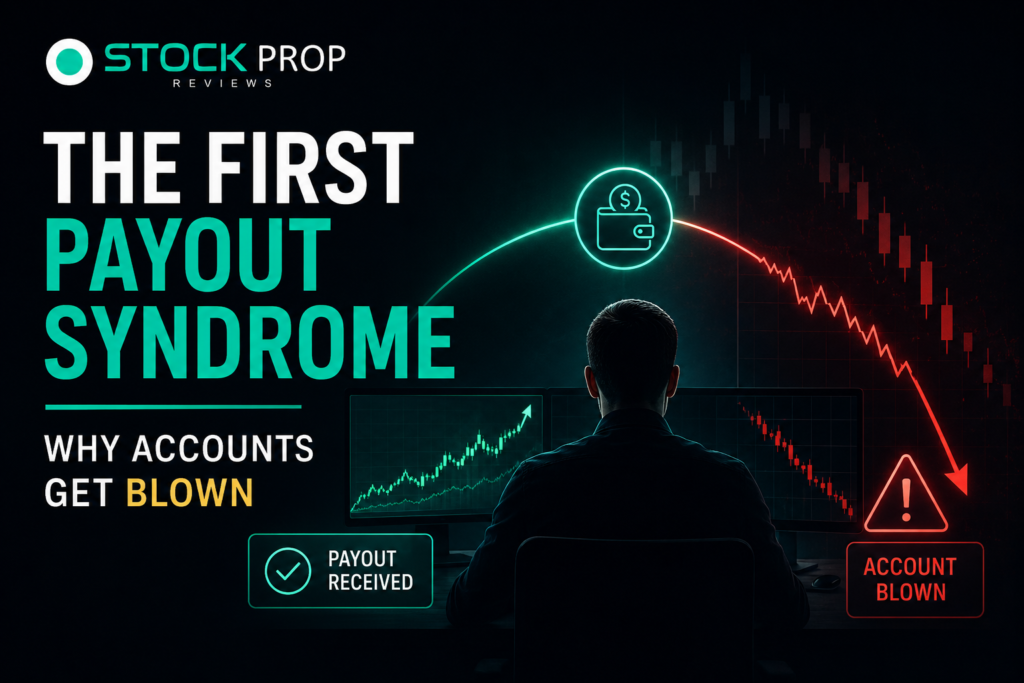
The hard part is passing a prop firm challenge. Yes, it is for many traders. But there’s a stage that gets a whole lot less attention, and causes more account failures, what happens after the first payout arrives.
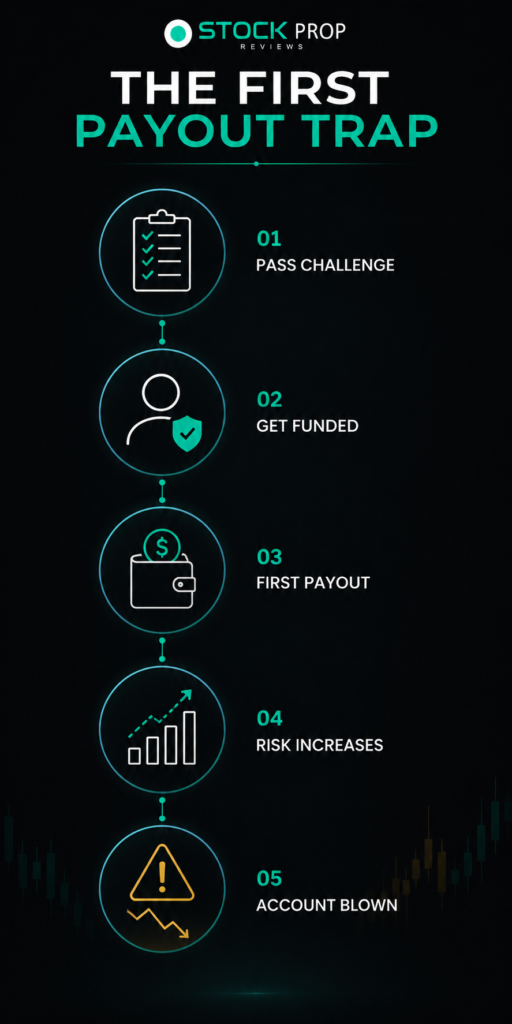
The first payout syndrome is a pattern seen all throughout the prop trading industry. The trader follows the plan, manages risk well, earns funding, makes a withdrawal and then starts making decisions that would never happen in the evaluation phase.
This article is for funded traders, challenge passers, and anyone who is preparing to manage a prop account on a long term basis. This is not for traders looking for quick payout strategies or shortcuts around risk management.
The sobering truth is that a lot of accounts are not lost because the strategy stopped working. They get lost because the behaviour of a trader changes after the first taste of success.
What Is First Payout Syndrome?
First Payout Syndrome is when traders become less disciplined after receiving their first payout from a funded account.
The payout itself is not the issue. The problem is what it tends to set off psychologically.
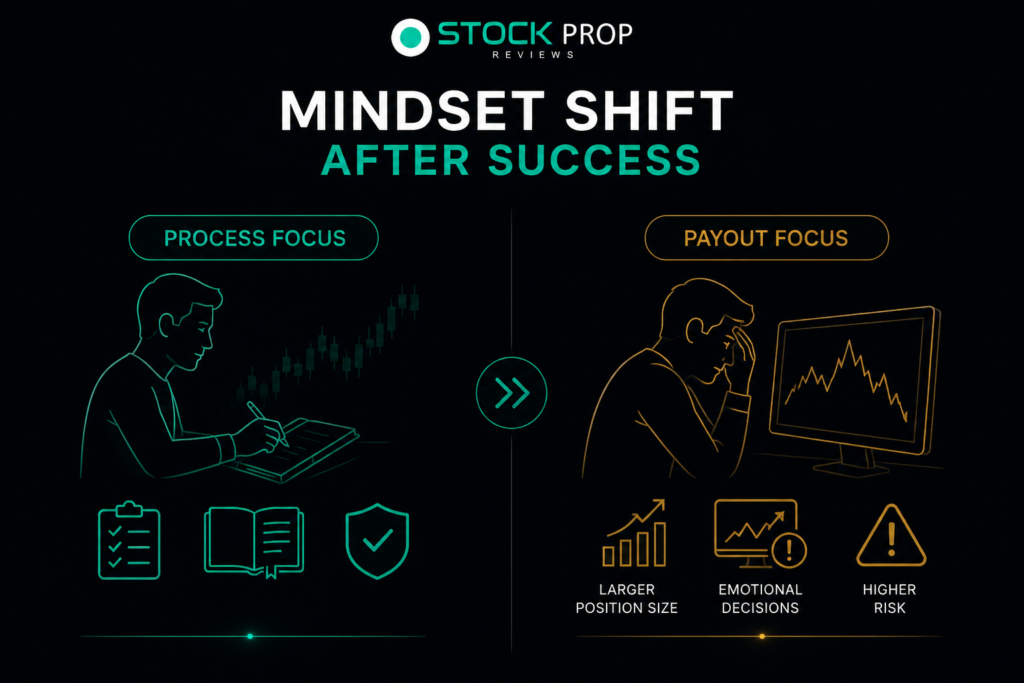
Before funding the focus is usually relatively straightforward. Follow the rules, secure the account and make the profit target. After a payout, the goal can quietly change to making more money, to earning larger withdrawals, or to replacing income faster than the trading process realistically allows.
That shift may seem innocuous, but it often alters decision-making.
A trader who respected every rule during the evaluation suddenly starts breaking them. Risk is slightly higher. More trades. It’s more difficult to accept losing trades. Small changes start to add up.
Weeks later, the account is dead.
Why the First Withdrawal Changes Everything
One thing many prop firm reviews fail to explain is how success changes trader psychology.
Most traders enter an evaluation with a defensive mindset. They know the account can be lost quickly, so they are selective. Every trade is considered carefully because the challenge still needs to be passed.
Receiving a payout creates a different emotional environment.
The account now feels proven. Confidence grows, which is normally a positive thing. The issue is that confidence can easily become overconfidence.
Instead of asking whether a trade fits the plan, traders begin asking how much money a setup could make.
That difference sounds minor, but it changes behaviour dramatically.
The traders who last longest in funded programs are often the ones who treat the first payout as confirmation that their process works. Traders who view it as a green light to become more aggressive tend to run into problems much faster.
A Scenario Seen Across the Industry
Let’s say you are a trader who accepts a challenge risking 0.5% per trade.
They gain consistently for more than 2 months and make their first withdrawal. Feels rewarding payout. It also sets up expectations.
The next month they decide to up the ante a little. After all, the account has made money already.
The first few trades work.
Confidence rises even further.
Then a losing streak arrives. Instead of accepting it as part of normal trading variance, the trader starts looking for ways to recover faster. Position size increases again. A few impulsive trades follow. The account approaches its drawdown limit.
Within days, the account breaches the firm’s rules.
Nothing changed about the market.
Nothing changed about the strategy.
What changed was the trader’s response to success.
What Competitors Often Miss
Most articles discussing funded account failures focus on obvious mistakes such as revenge trading, gambling, or ignoring drawdown limits.
Those mistakes matter, but they are usually the final stage of the problem rather than the starting point.
The deeper issue is often a change in motivation.
Before funding, traders focus on execution.
After funding, many become focused on outcomes.
That shift creates pressure.
A trader who wants another payout by the end of the month is more likely to force trades than a trader focused solely on following their plan.
The market rarely rewards urgency.
Yet urgency is exactly what many traders develop after their first withdrawal.
The Most Common Mistakes After a First Payout
One of the biggest mistakes is not usually one catastrophic trade. More often it is a series of small decisions that gradually take a trader away from the approach that worked for them originally.
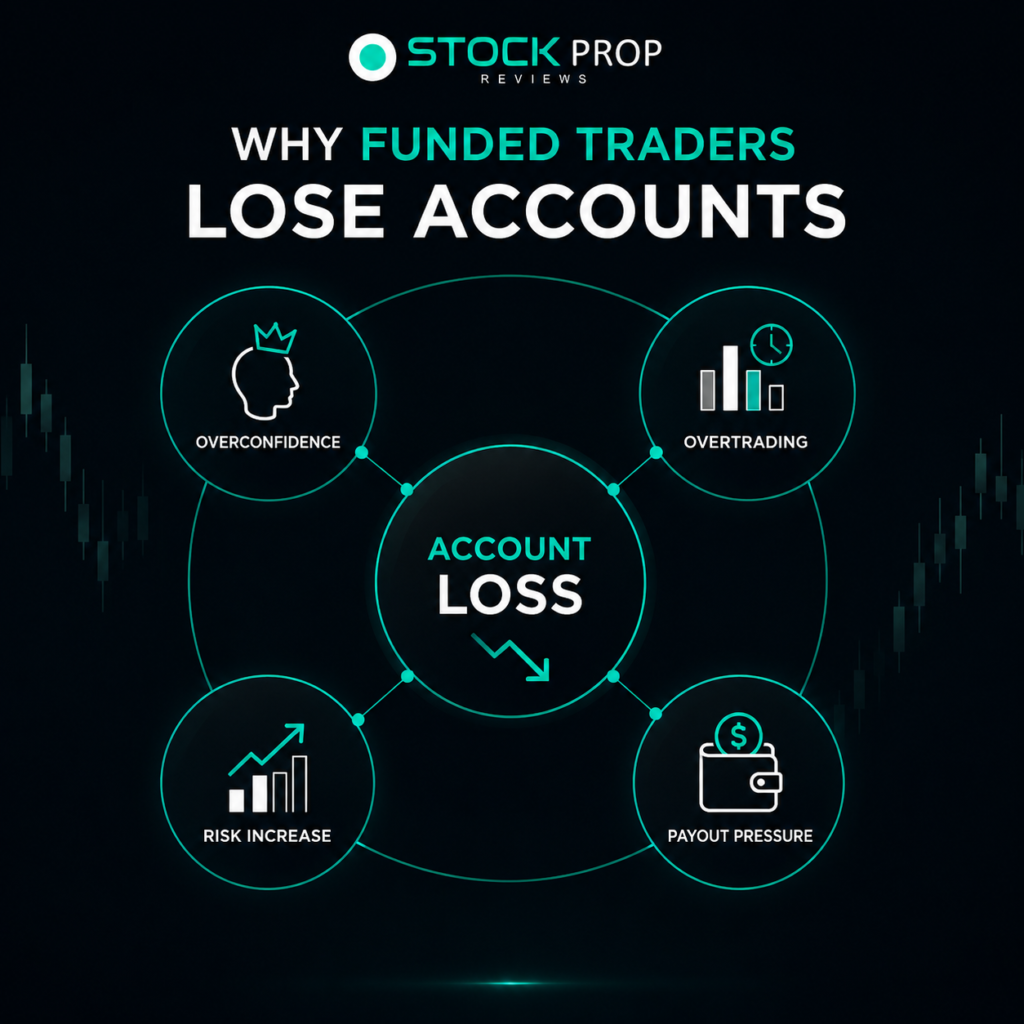
One of the most common examples is increasing position size too quickly. They’ve already proven profitable and traders convince themselves that a little bump is justified. Unfortunately, larger positions also amplify mistakes and speed up drawdowns.
Another frequent problem is over trading. Traders often wait for the best setups during evaluations. Once you get paid, patience tends to disappear. More trades are taken, but they tend to be of lower quality.
Some traders have the opposite problem. Rather than getting angry, they get scared. They get a payout and then they’re obsessed with profit protection. Trades are closed too early, good opportunities are missed, and confidence slowly dies.
Either reaction can hurt performance.
The Psychology Behind Account Blowups
First payout syndrome is the result of a number of behavioural biases.
Overconfidence is likely the most obvious. The successful evaluation and the first withdrawal may give an impression that trading has become easier. Risk management controls that once seemed essential now seem restrictive.
There is the house money effect as well. Traders often treat their original capital differently from their profits. When money is withdrawn, the remaining account may feel psychologically less valuable and decisions may be made that would never have been made during the challenge phase.
Another factor is outcome based thinking .
Pro traders tend to judge themselves on execution quality. Traders who struggle often judge themselves by short-term profits.
After a payout, many traders will stop asking themselves if they followed their rules, and start asking themselves if they made enough money. This change can have a profound effect on performance.
How Experienced Funded Traders Think Differently
The traders who keep funded accounts for months or years usually approach payouts differently.
They do not see a withdrawal as evidence that they can now increase risk. They see it as evidence that their existing process is working.
Because of that mindset, they often keep doing exactly what helped them succeed in the first place.
Risk remains stable.
Position sizing remains consistent.
Trading frequency stays relatively unchanged.
Instead of chasing larger withdrawals, they focus on preserving the conditions that made the first payout possible.
This sounds simple, but it is surprisingly difficult in practice.
Many traders underestimate how much emotional pressure success can create.
Healthy vs Unhealthy Post-Payout Behaviour
| Healthy Approach | Risky Approach |
| Maintains risk parameters | Increases risk immediately |
| Focuses on execution | Focuses on payout size |
| Accepts losing periods | Tries to recover losses quickly |
| Waits for quality setups | Trades constantly |
| Reviews mistakes regularly | Assumes recent success will continue |
| Prioritises account survival | Prioritises fast growth |
The differences are not dramatic on any single day. Over time, however, they often determine whether an account survives.
Does the Prop Firm Matter?
Trader psychology is the biggest factor, but firm structure can also play a role.
Transparent rules tend to reduce uncertainty. When traders clearly understand drawdown limits, payout requirements, and account expectations, there is less temptation to take unnecessary risks.
This is one reason many traders compare different firms before committing capital. For example, readers exploring stock-focused funding models may find our TradeThePool review useful. As a regulated stock prop firm, it is known for relatively clear risk parameters and account rules.
Readers can get up to 10% discount when purchasing through our TradeThePool link.
No prop firm can prevent psychological mistakes, but transparent rules can remove some of the confusion that contributes to them.
How to Avoid First Payout Syndrome
No better strategy exists to avoid first payout syndrome. It’s often about preserving the habits that made success possible in the first place.
One practical way is to hold the risk constant for a fixed period after the first payout. Some traders will decide to trade the same size position for a few months no matter how they are doing.
It also helps to journal regularly. Behavioural drift often shows up in a trading journal before it is a big problem. Traders can identify rising risk, deteriorating setup quality, or emotional decision making before those issues damage the account.
Perhaps most importantly, traders should stop viewing payouts as targets.
Payouts are outcomes.
Execution is the process.
When traders become obsessed with the outcome, they often damage the process that produced it.
Who Is Most Vulnerable?
First payout syndrome affects traders at all experience levels, but it is especially common among newly funded traders.
The combination of excitement, confidence, and financial expectations can be difficult to manage.
Traders who rely on prop firm withdrawals as immediate income are also more vulnerable. When monthly bills become tied to trading results, emotional pressure naturally increases.
On the other hand, traders who view funding as a long-term opportunity rather than a short-term payday generally adapt more successfully.
Other Resources Worth Reading
If you are comparing funded trading opportunities, our prop firm comparison guide looks at how different funding models impact risk and trader behaviour.
You might also find our FTMO review and TradeThePool review useful, especially if you are evaluating rule structures and payout systems.
Another place where trader expectations often differ from reality. Check out our article on funded trading: skill or luck? to read more about the psychology of trading.
The Real Lesson Behind First Payout Syndrome
The first payout syndrome is not a strategy problem.
Most traders who experience it have already demonstrated enough skill to pass an evaluation and generate profits.
The challenge is maintaining the same discipline after success arrives.
Markets do not become harder after the first withdrawal. What changes is often the trader’s mindset.
The traders who survive longest are rarely the ones chasing the biggest payouts. More often, they are the ones who continue following the same process that earned the first payout in the first place.
FAQs
What is first payout syndrome?
First payout syndrome is the syndrome where funded traders, after getting their first withdrawal, tend to become undisciplined and take on more risk, often leading to account loss.
Why do traders lose funded accounts after their first payout?
Many traders change their behaviour after success. They may increase risk, trade more frequently, or focus too heavily on future withdrawals instead of execution quality.
Is first payout syndrome a strategy issue?
Usually not. In most cases, the strategy remains unchanged. The problem is that traders stop following the process that originally made the strategy profitable.
How can traders prevent first payout syndrome?
Maintaining consistent risk, continuing to journal trades, focusing on execution rather than payouts, and accepting normal drawdowns can help prevent it.
Is first payout syndrome common?
Yes. It is one of the most common psychological challenges faced by newly funded traders and is frequently responsible for otherwise avoidable account failures.