Drawdown risk is higher in news trading than in normal sessions as major economic releases can widen spreads, increase slippage and move price through stop levels faster than traders can react. That’s important for prop firm traders because even one news event can eat a large chunk of a daily loss limit or max drawdown.
For beginner, funded and evaluation stage traders trading forex, indices, commodities or futures around economic releases. This is not for traders looking to make oversized bets around NFP, CPI, FOMC or other high impact events. News trading can be an opportunity but often the execution risk is greater than what the chart suggests.
What is news trading drawdown risk?
News trading drawdown risk is the incremental risk to the account involved when trading around periods of unusually high volatility, caused by scheduled or unscheduled news events.
The key difference is planned risk versus realized risk.
The trader can now enter a position where he risks 0.5% based on the distance between entry and stop loss . However if the market moves violently after a major release the actual loss can be larger due to spread expansion, slippage, gaps or rapid price movement.
A stop loss is the exit point for the trader. It might not always ensure the exact execution price in abnormal market conditions.
This is a big hole in the discussion about news trading. Traders often care about being right or wrong in their prediction. The key question for prop firms is: does the loss of the account remain within the risk limits of the firm?
Why news can accelerate drawdown
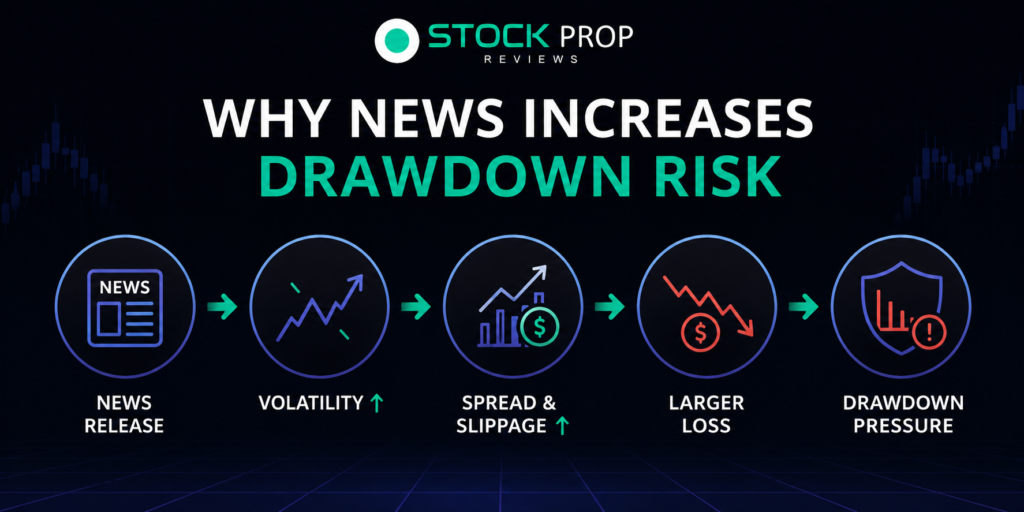
High impact releases have a temporary effect on market conditions. Liquidity can dry up, spreads can widen and prices can jump from level to level.
MaxPower Risk Management also points out three other major additional risks in news trading: spread widening, slippage and rapid price spikes. It is a practical point to remember that the stop shown on the chart is not necessarily the same as the final loss in the account.
Consider a simple example.
A trader has a $50,000 evaluation account with a 5% maximum drawdown. The trader normally risks $250 per trade, or 0.5%.
Before CPI, the trader sees a clean setup and keeps the same position size. The stop represents a planned $250 loss.
The release produces a sudden move. The spread expands, the stop is triggered, and the fill is worse than expected. The trader loses $400 instead.
That single trade has now consumed 0.8% of the account rather than the planned 0.5%.
The trader did not necessarily make a bad directional call. The problem was that normal-session risk assumptions were applied to an abnormal market.
News trading and prop firm drawdown rules
The relationship between news and drawdown becomes more important when a trader is close to a firm’s limits.
| Risk factor | Normal session | High-impact news | Drawdown implication |
| Spread | Usually stable | Can widen sharply | Entry and exit become more expensive |
| Slippage | Often limited | Can increase rapidly | Actual loss may exceed planned loss |
| Price movement | More structured | Fast and irregular | Stops can be reached quickly |
| Liquidity | More predictable | Can deteriorate | Execution becomes less reliable |
| Position sizing | Standard model may work | Often needs reduction | Same size creates greater exposure |
| Multiple entries | Manageable | Can compound quickly | Drawdown can accelerate |
Prop firm rules also differ significantly.
Some firms prohibit opening trades around selected economic releases. Others allow news trading but restrict the time around releases, void profits from affected trades, or apply different rules to evaluation and funded accounts. Audacity Capital’s current guide describes these as common rule models and specifically warns traders to check the exact rules for their account and stage.
That distinction matters because news trading can create two separate risks.
The first is market risk.
The second is rule risk.
A trader can correctly predict CPI, make money on the move, and still have a problem if the firm’s rules prohibit the trade or exclude its profit.
What competitors often miss about news trading
A lot of news trading advice concentrates on timing the release. That is only half the problem.
The more important question for a prop trader is:
How much of my available drawdown am I willing to expose to an event where execution conditions can change within seconds?
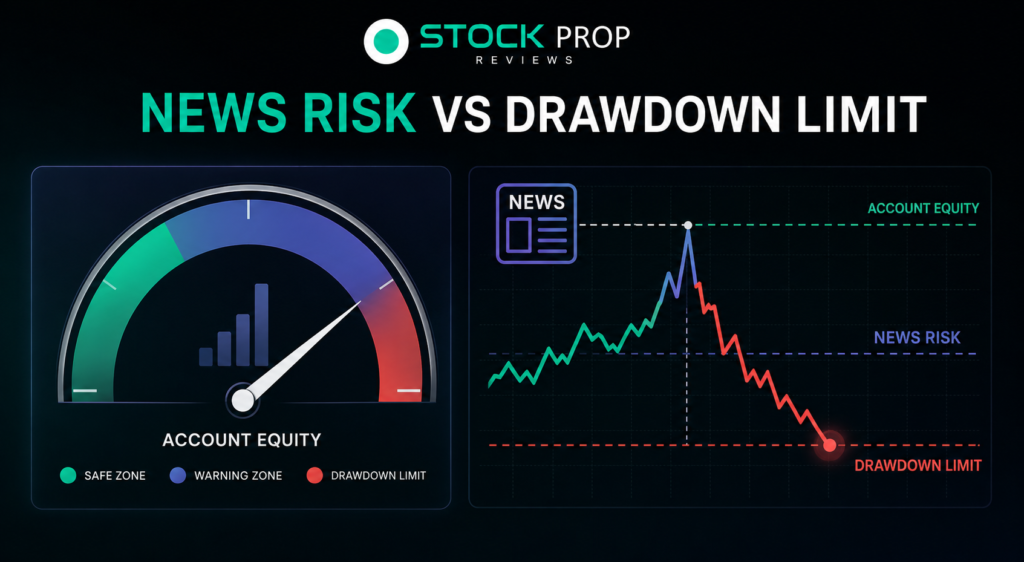
Suppose your firm gives you 5% maximum drawdown and you have already lost 3.5%. You technically have 1.5% remaining.
That does not mean you should risk another 1% during NFP.
Your remaining drawdown is a survival boundary, not a target.
A trader in that situation should probably reduce exposure substantially or skip the release altogether. The closer an account gets to its limit, the less room there is for execution surprises.
This is where many traders fail. They calculate risk from the original account balance instead of the amount of drawdown they can actually afford at that moment.
The real failure pattern
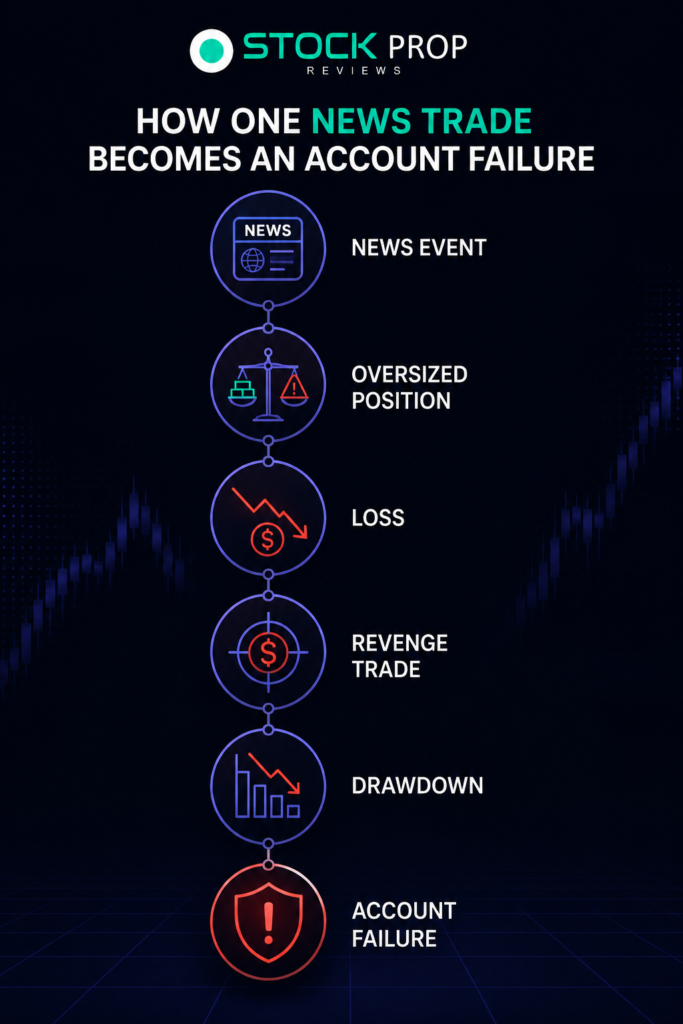
News-related account failures often follow a predictable sequence.
A trader sees a major release coming.
They expect a large move and increase their position size because the opportunity appears bigger than usual.
The first move goes against them.
Instead of accepting the loss, they wait for the reversal.
The market makes another sharp move.
The trader either closes at a much larger loss or adds another position.
The account is suddenly close to its daily loss limit.
Then comes the psychological mistake: trying to recover before the trading day ends.
EdgeClear makes a similar point from the futures perspective. Its guidance emphasizes deciding in advance whether to participate in peak volatility or wait for the initial move to settle, reducing size, and using predefined execution plans rather than making decisions while the market is moving rapidly.
The important lesson is that the first losing trade is rarely the entire problem.
The combination of volatility, oversized exposure, and emotional follow-up trades is what turns a manageable loss into a drawdown event.
The position sizing problem
One of the simplest ways to reduce news trading drawdown is to reduce position size before the event.
For example, imagine a trader normally risks 0.5% per trade.
Instead of automatically using 0.5% during CPI, the trader might decide that the maximum acceptable event risk is 0.25%.
The exact percentage should depend on the strategy, account rules, market, and execution conditions. There is no universal “correct” news risk percentage.
The principle is more important than the number:
When execution uncertainty increases, exposure should generally decrease.
A wider stop combined with the same position size does not solve the problem. It can actually increase the dollar risk.
If the technical stop needs to be wider because volatility has expanded, position size should usually fall so the total risk remains controlled.
Your stop loss is not the whole risk model
This is probably the most important practical point for news traders.
A trader might calculate:
Risk = Account Equity × Risk Percentage
Then:
Position Size = Risk Amount ÷ Stop Distance
The mathematics is straightforward.
The difficulty is that the stop distance does not capture every component of news risk.
Spread, slippage, gaps, liquidity conditions, and execution speed can all affect the final result.
MaxPower Risk Management recommends thinking in terms of an “effective stop”, where the trader adds an execution buffer to the technical stop when estimating risk.
For example, if a technical stop is 20 pips away and the trader expects another 5 pips of potential execution impact, the risk model can be built around 25 pips rather than pretending the 20-pip distance represents the entire exposure.
It will not predict the actual fill.
It simply prevents the trader from building a risk model that assumes perfect execution.
Trading the release versus trading the aftermath
Not every form of news trading carries the same risk.
There is a meaningful difference between entering seconds after an economic release and waiting for the first move to stabilize.
Trading the release
This approach attempts to capture the immediate reaction.
The potential reward is obvious. Prices can move quickly.
The drawbacks are also obvious:
- Increased risk of slipping
- Large spreads
- Quick turnarounds
- Tough place to put stops
- Increased uncertainty of execution
- Higher chance of exceeding the planned risk
Trading the aftermath
The trader waits for the initial volatility to settle and then looks for a structured setup.
This can mean waiting for a trend to establish, a pullback to form, or a key level to be retested.
It does not remove risk. The market can still reverse.
But it changes the execution environment.
Audacity’s news trading guide similarly recommends waiting for the aftermath, with its example suggesting traders allow roughly 15 to 30 minutes for conditions to settle before looking for a structured opportunity.
For many prop traders, the aftermath approach makes more sense because the objective is not to capture every tick of the news move. The objective is to remain within the firm’s risk framework while taking trades that fit the strategy.
Common news trading mistakes
Using normal position size
This is probably the most common mistake.
A trader normally uses two contracts, two lots, or a particular share size and simply carries that size into CPI or NFP.
The market is different, but the exposure is not.
Placing stops based only on the chart
A technically sensible stop can still produce an unexpectedly large loss if execution conditions deteriorate.
Adding to a losing news position
Averaging down can be particularly dangerous in a fast market. A short-term spike can turn into a longer-term repricing.
Ignoring pending orders
In limited windows, pending orders can cause accidental exposure. In particular, Audacity states that if a pending order is triggered during a prohibited news window, it may be considered as opening a trade.
Trading because the account is behind target
This is a psychological problem rather than a market problem.
A trader who is behind a profit target may see a major release as a shortcut. That is precisely when position size can become disconnected from sensible risk.
Treating the daily loss limit as a risk budget
If a firm allows a 5% daily loss, that does not mean you should risk 5%.
The firm’s limit is the boundary at which the account can fail. Your personal trading risk should be considerably smaller.
Who should avoid news trading?
News trading is probably a poor fit for traders who need predictable execution.
It is also unsuitable for traders who:
- Increase size after losses
- Frequently move or remove stops
- Trade mainly because of profit targets
- Do not check economic calendars
- Cannot accept missing a large move
- Have very little drawdown remaining
- Have not verified their firm’s news restrictions
- Depend on extremely tight stops
Beginners should be especially careful. Learning market structure and risk management during normal conditions is difficult enough without adding event-driven execution risk.
Funded traders who already have a profitable non-news strategy also need to ask whether news trading actually improves their expectancy. A strategy does not become better simply because the market moves more.
When avoiding the news is the better trade
Sometimes the best news trading decision is no trade.
If you are close to the daily loss limit, already carrying a losing position, or emotionally trying to recover previous losses, a major release can create exactly the environment you should avoid.
The same applies when your strategy has not been tested during high-impact events.
A trader does not need to participate in every CPI, FOMC decision, NFP release, or central-bank announcement.
Skipping an event costs nothing from your drawdown.
Entering an event without a tested process can cost the account.
Where TradeThePool fits
If you are a trader that prefers stocks to forex or futures, TradeThePool offers a different risk framework. According to its published program terms, its trading environment and account conditions are governed by its current program terms including position sizing, exposure, volatility, drawdown, daily loss and execution rules.
StockPropReviews also covers TradeThePool in its reviews and comparisons, particularly for traders who prefer stock-focused trading and defined risk controls.
TradeThePool can be viewed as a regulated stock prop firm option for traders who value clear rules and risk transparency, although traders should always verify the firm’s current legal and program status rather than relying on a third-party description. Its own terms state that the evaluation environment is simulated and that the company is not a broker-dealer.
Readers can get up to 10% discount when purchasing through our TradeThePool link.
How to build a safer news trading plan
A useful plan does not need to be complicated.
Before every major release, answer five questions.
What is the event?
Know whether you are dealing with CPI, NFP, FOMC, an earnings release, inventory data, or another catalyst.
Am I trading the release or the aftermath?
Do not decide this while the price is already moving.
What is my maximum event risk?
Set this before entering.
What happens if the stop slips?
Your account should still have enough room to survive the scenario.
When do I stop trading?
Define the maximum number of attempts or maximum loss before the event begins.
This turns news trading from a reaction into a predefined process.
News trading drawdown: the practical takeaway
News does not automatically make a strategy bad.
It makes the trading environment less predictable.
That distinction matters.
A trader with a tested news strategy, smaller position size, strict event limits, and a clear understanding of the firm’s rules may be able to trade around major releases responsibly.
A trader who increases size because the market is moving faster is doing the opposite.
The biggest mistake is assuming that a stop loss makes the risk fixed. During major releases, execution quality can change quickly. The trader’s job is therefore not just to choose an entry and stop. It is to make sure the account can survive a worse-than-expected fill.
The same goes for traders who are researching firms that are comparing programs. A firm with appealing headline drawdown figures can be a bad fit if its news restrictions are not compatible with your strategy. low-drawdown prop firms coverage helps put those differences into context, while individual reviews like TradeThePool review and Apex Trader Funding review show why drawdown structure matters differently across asset classes.
The most useful question is not “Can I trade the news?”
It is:
“If the news trade goes wrong faster and costs more than expected, does my account still have room to survive?”
If the answer is no, the trade is probably too large.
FAQs
Can news trading increase the risk of drawdown?
Yeah. Higher volatility, spread and slippage can come with high-impact releases. The circumstances might cause losses beyond the stop distance calculated using the chart.
News trading against prop firm rules?
Yeah. Some firms prevent opening or closing trades around certain releases . Others restrict or nullify profits on trades made during a specified window of news . Rules may also differ between evaluation accounts and funded accounts.
Is trading the news safer than trading the release?
It can reduce execution risk because traders can wait for the spreads and price action to settle. It does not promise better results but generally avoids some of the more rapid price movements and worse execution conditions.
Lower position size ahead of major news?
One sensible way to limit exposure is to reduce position size as volatility and execution uncertainty increase. The correct reduction depends on the strategy, the instrument, the accounting rules and the risk model of the trader.
Can a stop loss save a prop firm account during news events?
A stop can minimize risk when normal execution is possible, but during fast markets there is no guaranty of the actual fill price. Because of slippage and gaps, the actual loss can be greater than the intended stop loss risk.
Can News Be Traded by Beginners?
Not normally as a starting point. To start with, it is better to learn how to size positions consistently, manage stops and enforce rules in more stable market conditions first. News trading can be added later after it has been implemented and its risk characteristics have been tested.
Risk disclaimer: This article is for educational purposes only and is not financial advice. The trading of leveraged markets carries significant risk. All prop firm rules, drawdown calculations, news restrictions, program terms are subject to change, therefore traders should confirm current rules directly with the relevant firm before trading.