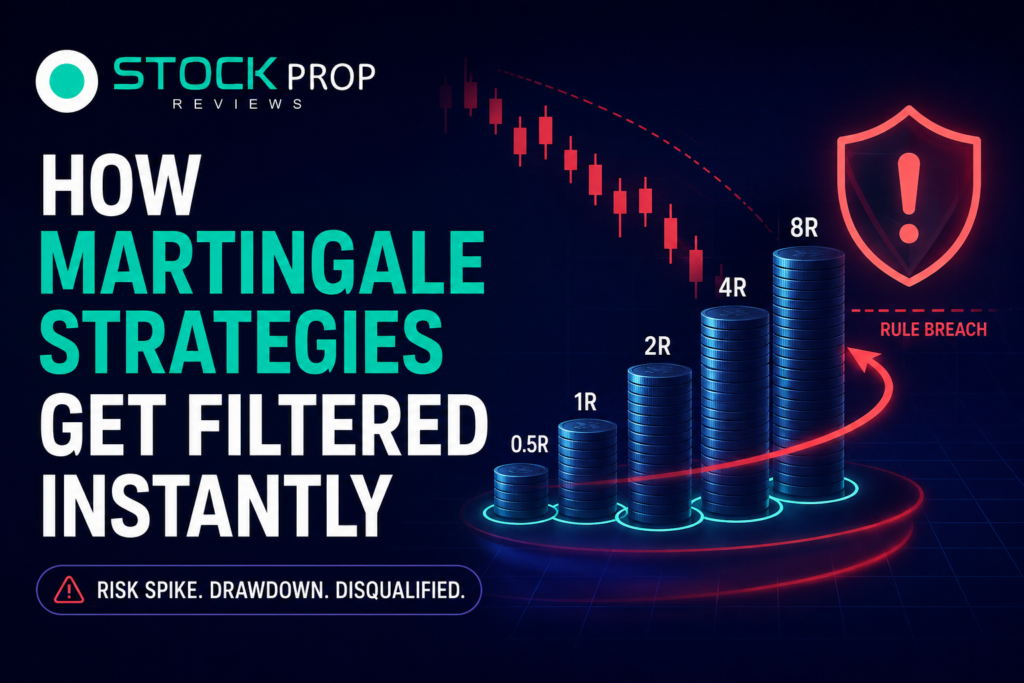
Usually, the failure of the Martingale challenge occurs because the strategy increases risk when the trading account has less room to absorb another loss. The trader might start with a small position, take a few manageable losses, then double the next trade. The account may appear to be doing well until a further losing streak exposes it to the firm’s drawdown, daily loss or position limits.
This article is for beginner, funded, forex, futures and scalping traders looking at Martingale or recovery-type position sizing. This is not for traders who want a low-risk way to recover losses, as Martingale does the opposite: it increases the risk after the strategy has already been proven wrong.
The point here is that prop firms don’t have to wait for a Martingale sequence to destroy an account. Their risk controls can prevent it much earlier.
What is Martingale trading?
Martingale trading is a position-sizing method where the trader increases the size of the next position after a loss, traditionally by doubling it. The idea is that one eventual winning trade will recover the accumulated losses and leave a small net profit.
For example:
| Trade | Position | Result | Cumulative loss |
| 1 | $100 | -$100 | -$100 |
| 2 | $200 | -$200 | -$300 |
| 3 | $400 | -$400 | -$700 |
| 4 | $800 | +$800 | +$100 |
The fourth trade appears to solve the problem. That is what makes Martingale attractive.
The weakness is what happens when trade four also loses.
The next position becomes $1,600. Then $3,200. Then $6,400. The strategy does not increase risk gradually. It increases exposure exponentially.
Martingale is also covered by trading education sources, which also point out that basic problem. ZForex: “Doubling up after losses can very quickly eat up available capital.” MoonTrader: “If the market moves against you for too long, your Martingale position may become too large for the account to support.”
Why Martingale gets filtered in a prop challenge
A personal trading account gives you considerably more freedom to decide how much risk you are willing to accept.
A prop challenge does not.
The firm has predefined limits. Once your equity, position size, trading frequency, or exposure crosses those limits, the evaluation can be terminated regardless of whether you believe the market will eventually reverse.
This creates a fundamental mismatch.
Martingale depends on having enough capital and time to survive a losing sequence.
A prop challenge is specifically designed to limit how much capital can be lost.
The strategy therefore runs directly into the account’s risk framework.
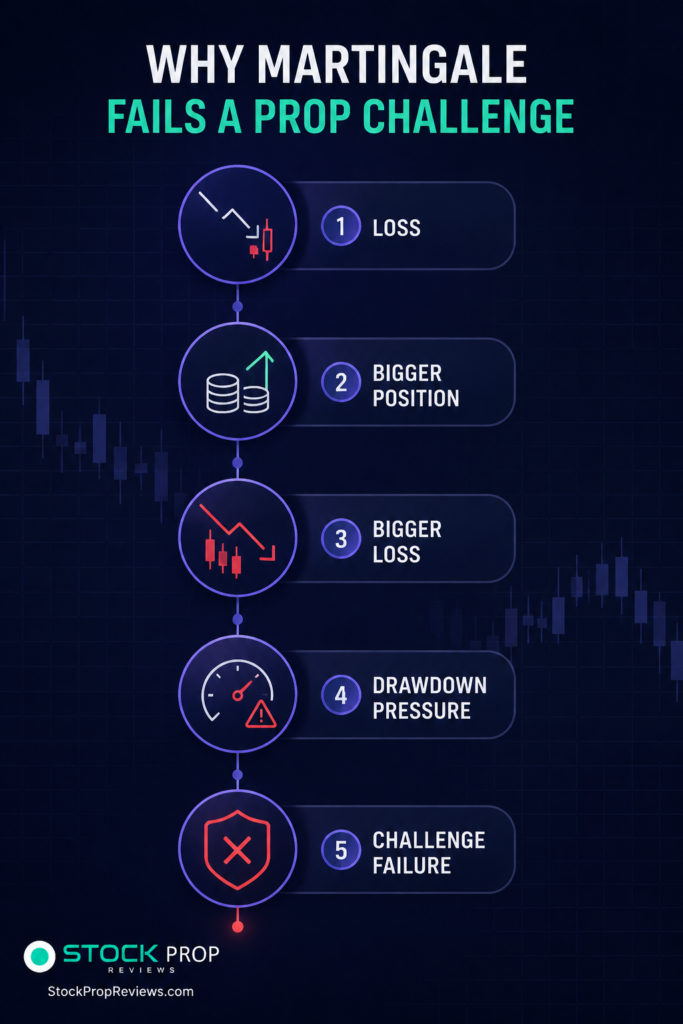
The first problem is drawdown
Suppose a trader has a $50,000 evaluation with a $2,500 maximum loss.
The trader starts with a $250 risk and loses.
Instead of accepting the $250 loss, the trader doubles to $500.
Another loss takes cumulative losses to $750.
The next position risks $1,000.
One more loss produces $1,750 in cumulative losses.
The trader now has only $750 of remaining drawdown.
But the next Martingale step would require $2,000 of risk.
The strategy has effectively become impossible before the trader has completed the recovery sequence.
This is the part many basic Martingale explanations miss. The mathematical system assumes sufficient capital to continue increasing the stake. A prop evaluation deliberately removes that assumption.
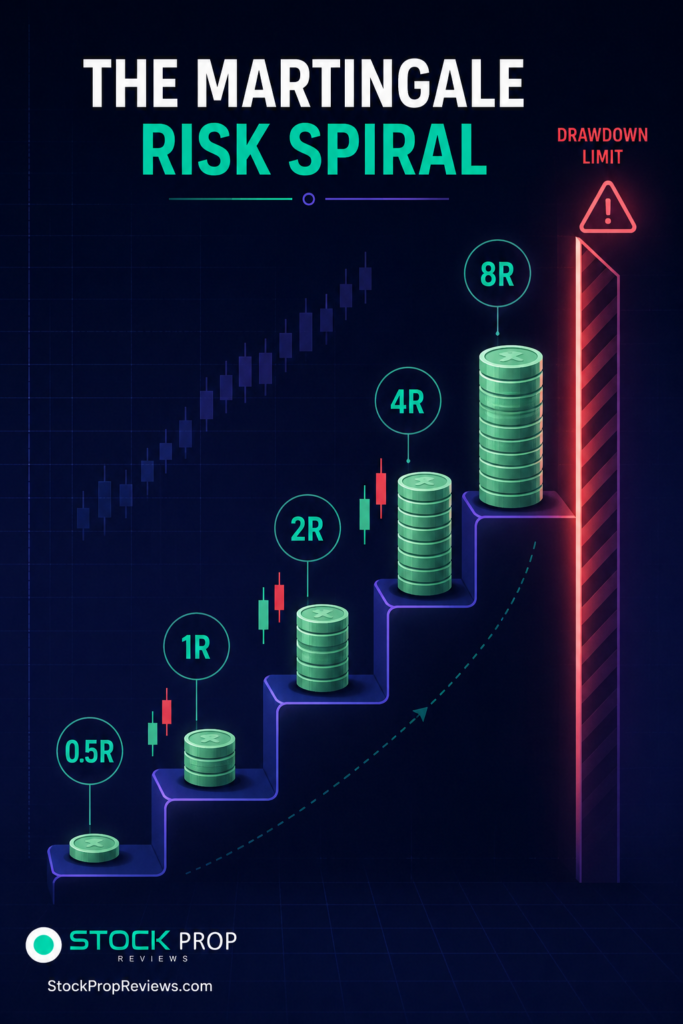
Martingale challenge failure is usually a position-sizing problem
A trader may describe the losing sequence as bad luck.
From a risk-management perspective, that explanation is incomplete.
The first loss may have been normal.
The second loss may also have been normal.
The problem is that the trader responded to those losses by increasing the amount exposed to the next market outcome.
That changes the risk profile of the entire strategy.
A fixed-risk trader might lose:
$250 → $250 → $250 → $250
A Martingale trader might lose:
$250 → $500 → $1,000 → $2,000
Both traders experienced four losing trades.
Their account damage is completely different.
The fixed-risk trader loses $1,000.
The Martingale trader loses $3,750.
That difference is why Martingale can appear harmless during the first few trades but suddenly become an account-ending problem.
The rules that expose Martingale traders
Prop firms do not all use the same rules, so traders should always check the current terms of the specific program. However, several common restrictions create problems for recovery-based systems.
| Risk control | Why Martingale struggles |
| Maximum drawdown | Losing sequences consume the account’s loss buffer rapidly |
| Daily loss limit | Several recovery trades can breach the daily threshold |
| Position size limits | Larger recovery orders may exceed permitted exposure |
| Volume limits | Multiple entries can become too large relative to market volume |
| Consistency rules | A final large winning trade can distort profit distribution |
| Trade duration rules | Holding a losing sequence while waiting for reversal may be restricted |
| Slippage and commissions | Larger positions increase execution costs |
| Risk review | Unusual exposure patterns can attract additional scrutiny |
TradeThePool provides a useful example of how these controls can operate in practice. Its current program terms include maximum-loss rules, daily pause parameters, position-volume restrictions, and requirements concerning the size of opening trades relative to recent market volume. The firm states that multiple trades in the same instrument can be aggregated for enforcement purposes, meaning splitting a large order into smaller orders does not necessarily avoid the volume restriction.
That last point matters for Martingale traders.
A trader cannot assume that five smaller recovery orders are safer from a rule perspective than one large order.
The hidden danger of averaging down
Martingale is not every form of averaging.
The trader could buy equal sized positions at pre-agreed levels. Or another trader might build position size slowly. The classic Martingale is a way of increasing exposure after losses, generally through a doubling sequence.
MoonTrader explains this well: averaging can be done with equal sized orders, martingale increases the size of subsequent orders.
This distinction is important because traders sometimes use the word Martingale to describe any averaging strategy.
The real risk question is simpler:
Does the amount of money at risk increase because the previous trade lost?
If the answer is yes, the trader is moving toward Martingale-style recovery logic.
A realistic prop challenge failure scenario
Consider a trader using a mean-reversion setup on a volatile index.
The strategy normally risks 0.5% per trade.
The first trade loses.
The trader believes the move was temporary and enters again at twice the original size.
That trade loses too.
Instead of stopping, the trader enters again at four times the original risk.
Then a major economic release sends the market sharply in the opposite direction.
The fourth trade loses.
At this stage, several things can happen simultaneously.
The daily loss limit may be breached.
The overall drawdown may be close to its maximum.
The position size may exceed the firm’s limits.
The trader may be unable to place the next recovery trade.
And the psychological pressure becomes much higher because the trader now feels that the next trade has to work.
The original strategy has effectively disappeared.
The trader is no longer trading the setup.
The trader is trading the need to recover.
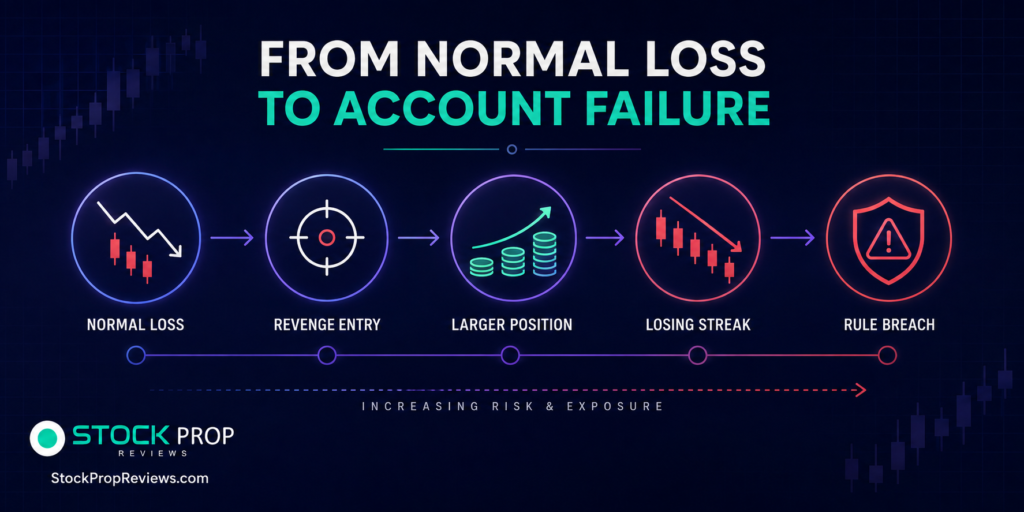
That is how a normal losing sequence becomes a prop challenge failure.
Why a high win rate can hide the problem
One of the strongest arguments made in favour of Martingale is that it can produce a high percentage of winning cycles.
That observation can be true while the strategy remains dangerous.
Imagine a strategy that produces 20 profitable recovery cycles, each making $100.
The trader has earned $2,000.
Then one extended losing sequence produces a $2,500 loss.
The trader finishes the sample with a net loss despite having won most of the time.
This is the key difference between win rate and risk-adjusted performance.
A prop trader should care about:
- Average loss
- Maximum losing streak
- Maximum position size
- Maximum drawdown
- Recovery time
- Risk per trade
- Worst historical sequence
A 90% win rate means very little if the remaining 10% of trades can destroy the account.
What competitors often miss about Martingale
Most Martingale explainers correctly describe the doubling mechanism and warn about unlimited capital requirements.
The prop trading problem goes further.
The trader does not actually have unlimited capital.
They are operating inside a narrow risk corridor.
That means a strategy that might survive six consecutive losses in a large personal account can fail after three losses in an evaluation.
There is also a timing issue.
Markets do not owe the trader an immediate reversal.
A currency pair can trend for days. A stock can gap through a support level. A futures contract can move sharply after economic data. A momentum stock can continue running in one direction while the trader keeps adding to a losing position.
Real Trading similarly points out that doubling down becomes dangerous when the expected reversal never arrives.
This is where Martingale conflicts with the basic objective of a challenge.
The challenge is testing whether the trader can control losses.
Martingale attempts to avoid accepting the loss.
The psychology behind Martingale failure
The mathematics explains the exposure.
Psychology explains why traders keep using it.
After the first loss, the trader thinks:
“I can get that back.”
After the second:
“I only need one winner.”
After the third:
“The setup is still valid.”
After the fourth:
“I cannot stop now.”
This is loss-recovery thinking.
The position size becomes emotionally connected to the previous loss.
That is dangerous because each new trade should be judged independently.
A good setup is worth the risk due to the probability of the setup and the expected return, not because the last trade lost money.
This is also why a trader that normally has a disciplined, fixed risk strategy can suddenly act differently during an evaluation. The challenge fee, profit target and desire to pass can put pressure to recover quickly.
Our analysis of the Prop firm risk management myth looks at the wider problem of how fixed firm rules change trader behaviour.
Why stop losses do not automatically make Martingale safe
Some traders argue that Martingale becomes safe when every position has a stop loss.
A stop loss limits the individual trade.
It does not automatically limit the entire sequence.
Suppose the trader risks:
1% on trade one
2% on trade two
4% on trade three
8% on trade four
If every trade hits its stop, the sequence has lost 15%.
The stop losses worked exactly as designed.
The problem was the position-sizing system.
A stop protects a trade.
A risk model protects the account.
Those are not the same thing.
Can a limited Martingale approach work?
A trader can cap the number of Martingale steps or use a smaller multiplier such as 1.25x or 1.5x instead of doubling.
That reduces the speed at which exposure grows.
It does not remove the underlying problem.
The trader is still increasing risk after losing.
For a prop challenge, a more robust alternative is usually to reduce size after losses rather than increase it.
For example:
| Result sequence | Fixed risk approach | Defensive approach |
| First loss | 0.50% | 0.50% |
| Second loss | 0.50% | 0.25% |
| Third loss | 0.50% | 0.25% |
| Fourth loss | 0.50% | 0.125% |
The defensive approach does not recover losses quickly.
That is precisely the point.
It keeps the trader alive while the market is proving whether the strategy still has an edge.
What traders should use instead
A better recovery mechanism is not larger size.
It is better trade selection.
If a strategy has a genuine edge, the trader does not need to recover every losing trade individually. A series of properly sized trades can recover the account over time without requiring a single oversized winner.
A practical framework is:
- Before you enter, set your maximum risk.
- Never up your risk because your last trade was a loser.
- Establish a daily stop before the session begins.
- Keep a record of the most probable losing run
- Cut size after abnormal volatility or consecutive losses.
- Once the conditions for the strategy are not present anymore, stop trading.
This is less exciting than Martingale.
It is also much more compatible with challenge survival.
TradeThePool as an example of rule-first trading
For stock traders, TradeThePool is worth examining because its current program documentation puts considerable emphasis on defined risk controls, trading volume, drawdown, and consistency requirements. Its program is centered on stocks and ETFs rather than futures or forex.
One factual point is important here: TradeThePool should not be described as a regulated prop firm. Its own website says the online prop trading arena is not yet regulated and its terms state that the company is not a broker-dealer or financial institution.
It is more accurate to describe TradeThePool as a stock-focused proprietary trading firm with defined rules and a risk framework.
Readers can get up to 10% discount when purchasing through our TradeThePool link.
If you are considering it, read the current rules rather than relying on older reviews. The firm’s current program terms can change, and the rules themselves take priority over examples or promotional material.
For a broader look at how firms differ, our Best prop firms comparison covers drawdown models, consistency rules, and strategy fit.
Who should avoid Martingale in a prop challenge?
Martingale is particularly unsuitable for traders who already struggle with drawdown control.
It is also a poor fit for traders who:
- Need a high percentage of trades to feel profitable
- Increase size after emotional losses
- Trade highly leveraged instruments
- Use wide stops without calculating total sequence risk
- Hold losing positions waiting for a reversal
- Have not tested the strategy through extended losing periods
Scalpers should be especially careful. A fast market can trigger several entries before the trader has time to reassess the underlying setup.
Futures traders face another problem because leverage can accelerate the consequences of increasing position size. MoonTrader specifically describes futures Martingale as particularly dangerous because leverage amplifies the effect of an adverse move.
Two practical alternatives
Fixed Fractional Risk
The first alternative is fixed fractional risk. Risk the same percentage on every qualified setup and accept that some trades will lose.
Anti-Martingale Sizing
The second is anti-Martingale sizing. Instead of increasing risk after losses, the trader increases exposure after successful trades and reduces it after losing trades. This puts more capital behind periods when the strategy is working and less behind periods when it is not.
Neither method guarantees profitability.
The advantage is structural. Neither requires the trader to make the next trade larger simply because the previous trade failed.
Our TradeThePool stock prop firm review and The Funded Trader review provide additional examples of how specific firm rules can interact with different trading behaviours.
The bottom line for challenge traders
Martingale does not usually fail because traders misunderstand the doubling formula.
They fail because the formula assumes something a prop challenge does not provide: unlimited room to continue increasing risk.
A losing trade is normal.
A second losing trade is normal.
Even five consecutive losses can be normal for a legitimate trading system.
The dangerous response is making the sixth trade substantially larger because the first five lost.
That turns a normal drawdown into a recovery mission.
For prop traders, the priority should be survival first, edge second, and recovery third. If the strategy needs an oversized position to recover ordinary losses, the position-sizing model is probably the problem.
FAQs
Can a Martingale Challenge be passed with a prop firm?
It can generate profitable results in the short run, but that doesn’t make it reliable. A long losing streak can easily break drawdown or daily loss limits before the recovery trade arrives.
Why Martingale Fails So Fast on Funded Accounts
Funded accounts have loss limits in place. Martingale increases exposure after losses, so the trader eats up available drawdown faster on every step.
Martingale is not the same as averaging down.
Not much. Averaging equal sized is not Martingale. Martingale in particular increases position size after losses, typically by a multiplier.
Is Martingale safe with a stop loss ?
No. A stop loss can limit each individual trade, but it doesn’t stop the total loss from getting too big when position size grows after every loser.
Martingale is better than what for prop challenges?
In general, fixed-risk position sizing is easier to control. Some traders also employ anti-Martingale techniques in which position sizes are scaled down after losses and scaled up when the strategy is performing well.