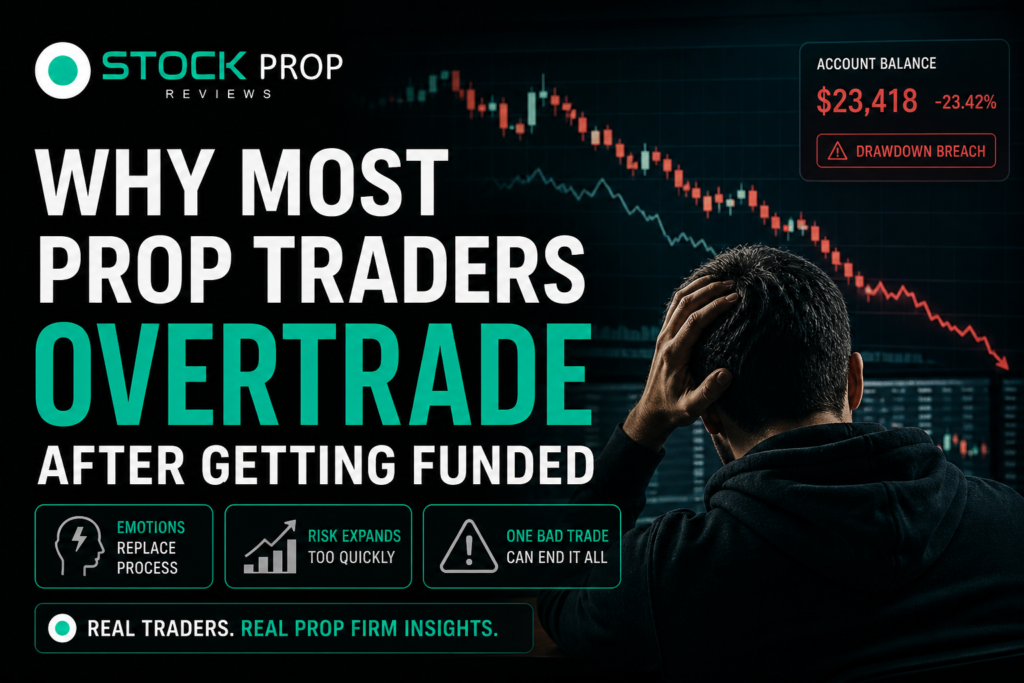
A trader can be calm and disciplined during an evaluation, then after being given a funded account, become reckless. The setups are getting worse, the trading frequency is going up and risk management is slowly disappearing.
This is one of the main reasons traders lose prop firm access, traders overtrade funded accounts.
This article is for the newer funded traders, scalpers, and challenge passers trying to hold accounts for the long haul. This is not for traders who want to take high risk shortcut strategies or expect unrealistic payout expectations.
The truth is, most traders blow funded accounts not because their strategy suddenly stopped working. They lose them because their behaviour changes when they get access to capital.
What Overtrading Funded Accounts Really Means
Most traders think overtrading simply means taking too many trades.
That is only part of it.
In prop trading, overtrading usually means trading emotionally instead of systematically. A trader starts forcing setups, increasing size after losses, jumping between markets, or trying to recover too quickly.
Sometimes the damage comes from five bad trades.
Sometimes it comes from one emotional trade that breaks all the rules.
A trader can take multiple trades in a session and still remain disciplined if the setups follow a tested system. Another trader can destroy an account with very low trade frequency simply because every decision is emotional.
The problem is not only activity.
It is loss of control.
Why Traders Change After Getting Funded
This is the part many prop firm articles barely explain.
During an evaluation, traders are focused on passing. They trade carefully because they know one mistake can fail the challenge.
Once funded, the mindset changes.
Now the trader starts thinking about payouts.
That shift creates pressure almost immediately.
A trader who was risking 0.5% during evaluation may suddenly start risking much more because the account balance looks larger. Others start trading every session because they feel they should “use” the funded account as much as possible.
In reality, funded accounts reward consistency, not constant activity.
Most traders understand this too late.
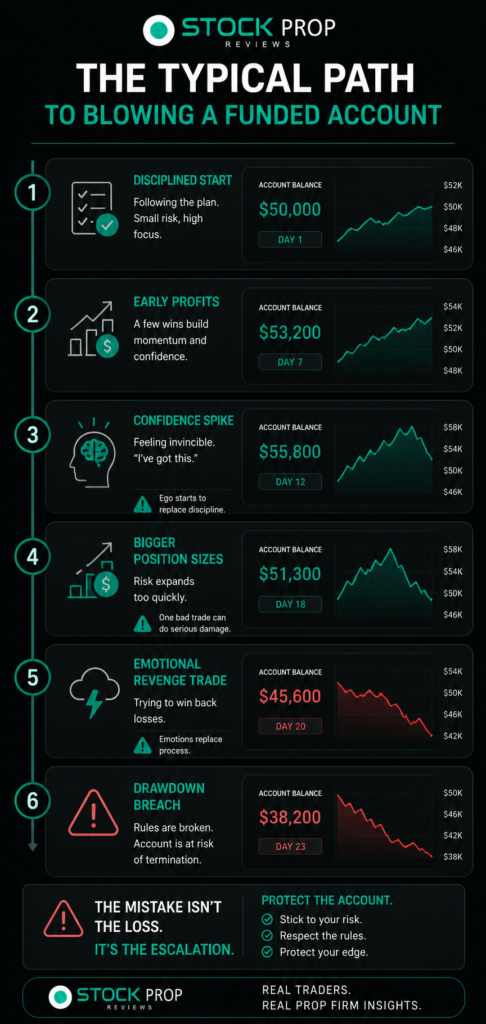
The Pattern Behind Most Blown Accounts
Funded accounts rarely fail slowly.
The process usually looks very similar:
| Stage | What Happens |
| Strong start | Trader follows the plan carefully |
| Early profits | Confidence increases too quickly |
| Bigger sizing | Risk expands faster than skill |
| Emotional loss | Trader tries recovering immediately |
| Rule violations | Discipline disappears |
| Account breach | Drawdown gets hit fast |
The strategy itself is often not the main issue.
Many traders who blow funded accounts were capable enough to pass the evaluation in the first place.
The bigger problem is emotional decision-making once real pressure appears.
What Most Competitors Miss About Overtrading
Much of the prop trading content is about minimising overtrading to discipline problems.
The reality is more complex.
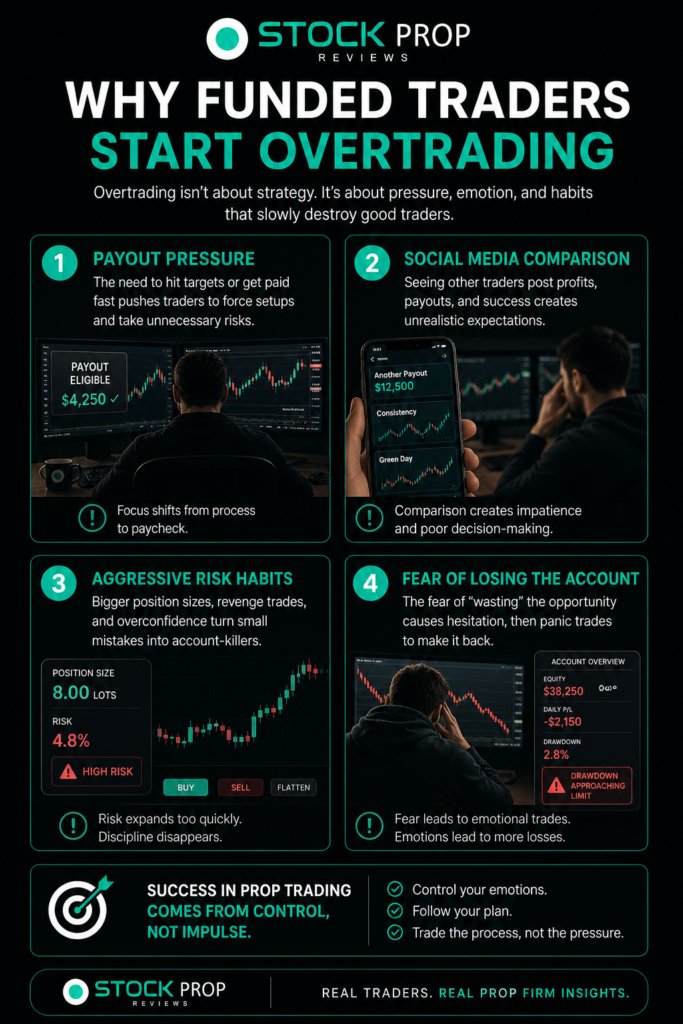
Funded accounts give a false sense of urgency.
Many traders believe they should get fast payouts because they paid challenge fees, monthly platform costs, or spent weeks trying to get funded. Some of them even get to lean on prop trading income before they prove consistency.
Pressure changes the behaviour.
Traders begin to look for action rather than waiting for quality setups to present themselves.
That’s where the overtrading begins.
Another issue is that some traders pass challenges with aggressive risk that was never sustainable in the long term. Once funded, they continue to use the same oversized positions until volatility finally catches up to them.
The outside observer would think the trader suddenly forgot his discipline.
In fact the risk model was fundamentally unstable.
Why Scalpers Struggle More Often
Scalping is not automatically bad for prop firms.
But fast trading styles naturally create more emotional pressure.
Scalpers make more decisions in shorter periods. That means more opportunities for revenge trading, impulsive entries, and emotional mistakes.
This becomes even worse during:
- News volatility
- Losing streaks
- Tight daily drawdown limits
- Low liquidity sessions
A swing trader might only face two or three major decisions in a day.
A scalper may face fifty.
That constant exposure increases the chances of emotional trading.
It is one reason many scalpers pass evaluations but struggle to survive funded stages long term.
Social Media Makes the Problem Worse
This is not often spoken about in an honest way.
Funded accounts have changed the way traders think about social media.
Payout screenshots and fast pass videos set false expectations. Traders start to believe that they should be making big returns each week.
What is not always shown is the other side:
- Accounts that failed
- Multiple attempts
- Spirals of emotional trading
- Months without pay-outs
- Traders quietly exit prop shops
Many funded traders overtrade because they feel behind.
They look at highlight clips to compare themselves instead of focusing on their process.
Such attitude kills patience.
The Difference Between Active Trading and Overtrading
Not every active trader is overtrading.
Some futures traders execute high-frequency systems with strict structure and consistent risk management.
The difference comes down to intent and control.
| Active Trading | Overtrading |
| Trades planned setups | Trades emotional impulses |
| Uses fixed risk | Changes size randomly |
| Accepts losses calmly | Tries forcing recovery |
| Follows routine | Reacts emotionally |
The number of trades matters far less than the quality behind those decisions.
Why Beginners Often Fail After Getting Funded
Newer traders usually spend all their energy learning how to pass challenges.
Very few spend time learning how to manage funded accounts properly.
Those are completely different skills.
Passing a challenge sometimes rewards short-term aggression. Keeping a funded account usually rewards patience and controlled execution.
That is why some traders pass evaluations quickly, then lose funded accounts within days.
They prepared for the challenge.
They did not prepare for the pressure that comes after it.
Prop Firm Rules Can Increase Emotional Trading
Different rule structures impact trader psychology in different ways.
If traders are not prepared, tight daily loss limits, trailing drawdowns and consistency rules can all add to the emotional pressure.
Here’s a simple example.
The trader builds a nice profit cushion and then sees the trailing drawdown tighten up underneath their account. They feel pressure to lock in profits fast and instead of being patient, they start forcing trades.
Then another trader gets too defensive and starts scalping random low quality setups just to avoid bigger swings.
And neither of those is healthy.
That’s not to say prop firm rules are unfair.
Before buying the challenges, traders should know how a particular rule affects behaviour.
Common Signs You Are Overtrading
Most traders notice the problem too late.
Some early warning signs include:
| Behaviour | Likely Cause |
| Trading out of boredom | Lack of patience |
| Increasing size after losses | Emotional recovery trading |
| Ignoring stop losses | Hope-based execution |
| Constant chart switching | Lack of confidence in strategy |
| Taking trades outside plan | Fear of missing moves |
These behaviours usually appear before major drawdown problems.
Practical Ways Traders Reduce Overtrading
Most advice on overtrading seems to be too generic.
When the pressure is on to spend real money, “just be disciplined” is of little assistance.
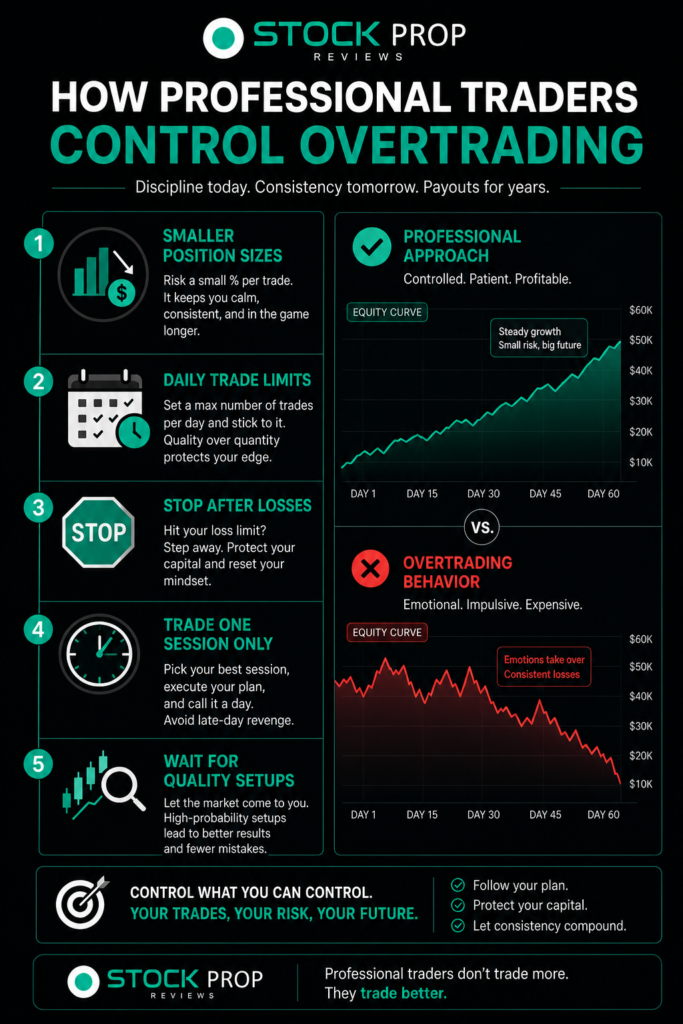
The traders who survive in funded environments build restrictions around themselves.
Some restrict the number of trades you can make per day.
Some people quit the game after two losses. Many dramatically cut their size once they are funded, because smaller positions reduce the emotional pressure.
The pros also understand that a part of trading is not trading.
A funded account does not require daily action to survive.
Sometimes, the best option is no option.
Where TradeThePool Fits In
Some traders perform better in slower stock-focused environments instead of highly aggressive futures conditions.
TradeThePool is often mentioned by traders looking for more transparent risk structures and regulated stock prop trading conditions.
No prop firm removes emotional pressure completely, but traders generally make better decisions when rules are clearly understood before funding.
Readers can get up to 10% discount when purchasing through our TradeThePool link.
Who Should Avoid Funded Accounts
Not all traders are ready for prop firms.
Not an insult. That is. That’s just the way it is.
If you are one of the following traders, it’s best to steer clear of funded accounts for now:
- Always revenge trade.
- Immediately count on trading income
- Never pay attention to stop losses
- Can’t stay calm with small losses
- Not shown consistency on demo or personal accounts
Prop firms tend to magnify existing weaknesses.
A funded account seldom fixes emotional trading issues.
Related Reading for Prop Traders
When evaluating prop firm models, it’s also helpful to review our guides on best futures prop firms and daily drawdown rules explained before buying challenges.
When firms blow up directly, our review of The 5%ers and E8 Funding shows how different rule structures affect trading behaviour.
Also, you can read our opinion article on why most traders fail prop firm challenges if you keep resetting the evaluations without consistent progress.
The Truth Most Traders Learn Too Late
Getting the funding is exciting.
The hard part is keeping the account.
The evaluation phase mainly examines if traders can follow rules for a limited time.
The funded phase considers emotional stability over time.
As a result, many traders look good for a few weeks and then they disappear.
The market always finds the emotional soft spots, sooner or later.
Long term funded traders aren’t usually the most aggressive people online.
They are the traders who are careful to protect capital, who are emotionally controlled and who don’t need to prove themselves every day.
To an outsider, that approach seems boring.
But boring trading usually lasts longer.
FAQs
Why are funded traders over-trading?
Most funded traders overtrade, because the pressure increases after funding. They start focusing on payouts, on recovery trading, on not hitting drawdown limits, rather than on trading their system.
Is overtrading primarily psychological?
Yeah, sorta. But poor risk management, oversized positions and unrealistic expectations also play a huge role.”
Traders who pass the evaluations but fail the funded accounts. Why?
Some traders will use aggressive risk during evaluations that is difficult to sustain long term. Others have a hard time emotionally when the real payout pressure comes.
Are scalpers more prone to overtrade?
Usually. Yeah. More frequent trades mean faster decisions and greater emotional exposure for scalpers.
How can traders reduce overtrading on funded accounts?
Traders can stay emotionally balanced by reducing position size, limiting the number of trades per day, quitting after a loss and following strict risk rules.
Is TradeThePool better for slower traders?
Some stock and swing traders like TradeThePool because it has clear rules and is stock centric. Readers can get up to 10% off if they purchase using our TradeThePool link.