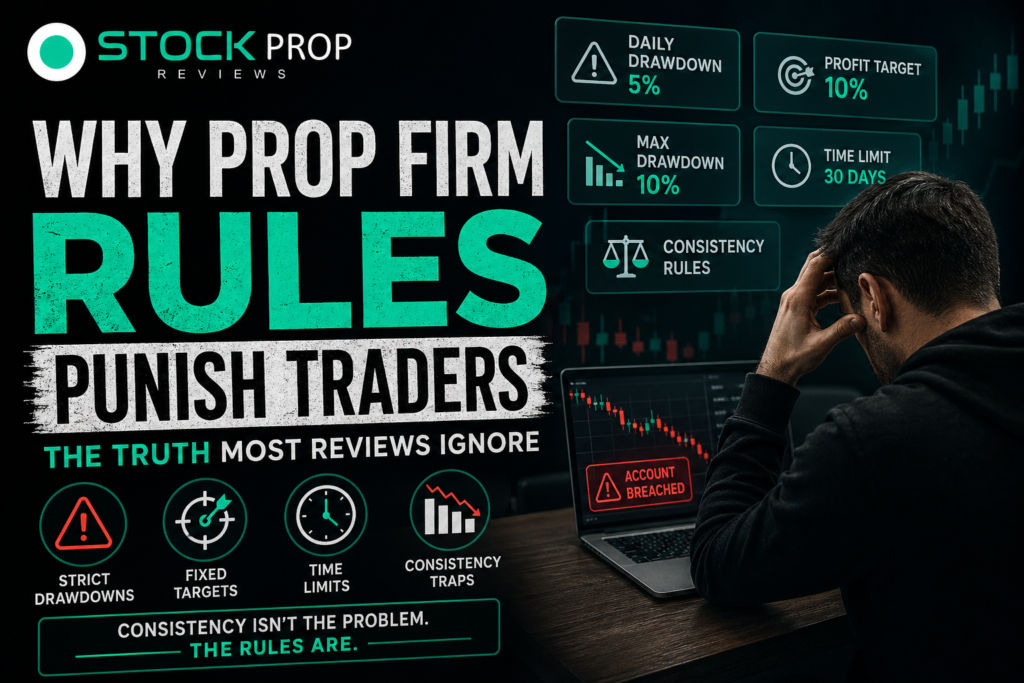
If you pay for trading advice, you’ll hear the same thing. Be consistent, stay disciplined, and don’t take too many risks. That advice is good when you really trade. It doesn’t work very well during prop firm evaluations.
It’s not an overstatement to say that prop firm rules hurt traders. It talks about how the structure doesn’t match. Many businesses prefer short bursts of work over steady work over time.
This article is for traders who already have a plan but are still having trouble getting or keeping their funded accounts. It’s not for beginners who want to win quickly or use aggressive growth strategies.
It’s not your discipline that’s the problem. It’s how the rules make you act.
What This Actually Means in Practice
When traders say that prop firm rules are unfair, they usually mean one rule. Limits on losses or goals for profits every day. The real question is how all the rules work together.
A trader who is consistent usually does three things:
They put small amounts of money at risk with each trade.
They wait for setups that are of high quality.
They are okay with slow growth.
Most prop firm models quietly punish all three.
You need to hit a set return in a set amount of time while staying within a small range of risk. That mix makes you make decisions that you wouldn’t have to make in normal trading.
Quick Verdict
Long-term consistency is not what prop firms are based on. They are designed to limit the company’s exposure to risk.
That makes a pattern:
Traders who push harder often get there faster.
Traders who are careful with their trades often run out of time or fall short of their goals.
The model is not broken, though. It means you need to know what game you’re playing.
How the Rules Look on Paper
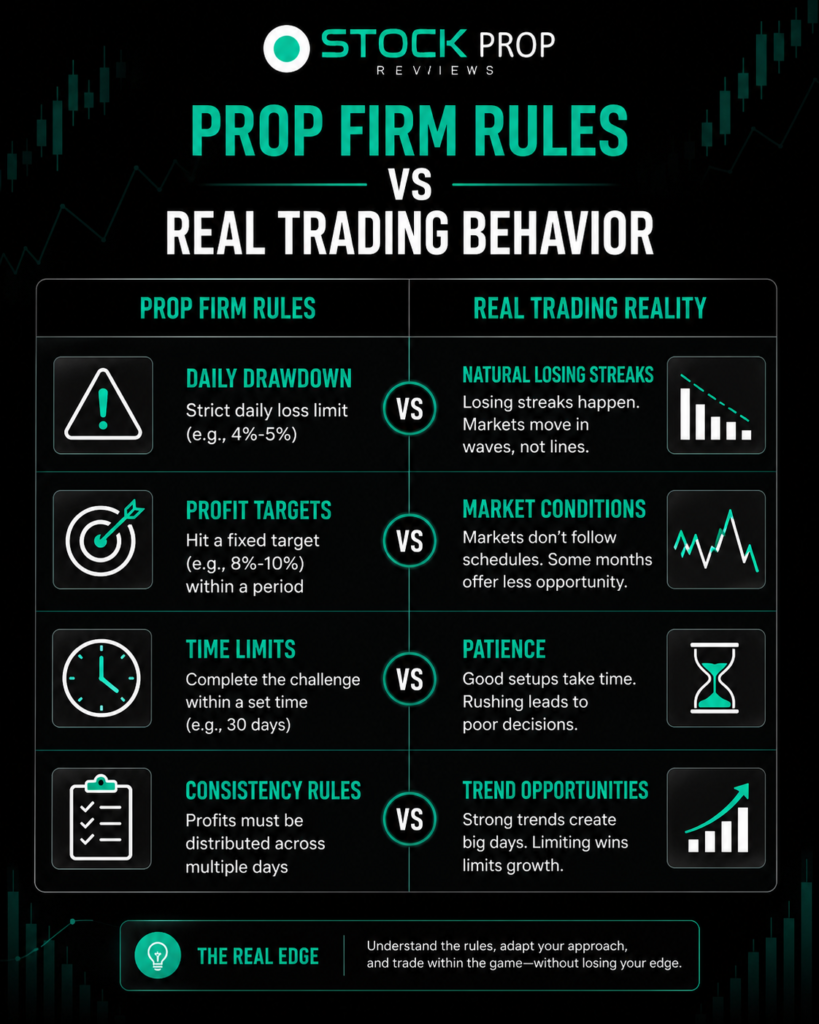
Most firms use a similar structure. The numbers change, but the framework stays the same.
| Rule | Typical Range | What It Feels Like in Practice |
| Daily drawdown | 4% to 5% | Cuts trades early, adds pressure after small losses |
| Max drawdown | 8% to 12% | Limits recovery after a slow start |
| Profit target | 8% to 10% | Encourages larger position sizing |
| Time limit | 20 to 30 days | Removes patience from decision making |
| Consistency rule | Often applied | Forces artificial trade distribution |
None of these rules look unreasonable on their own. The tension shows up when you try to follow all of them at once.
Where Consistent Traders Get Trapped
Slow growth vs fixed targets
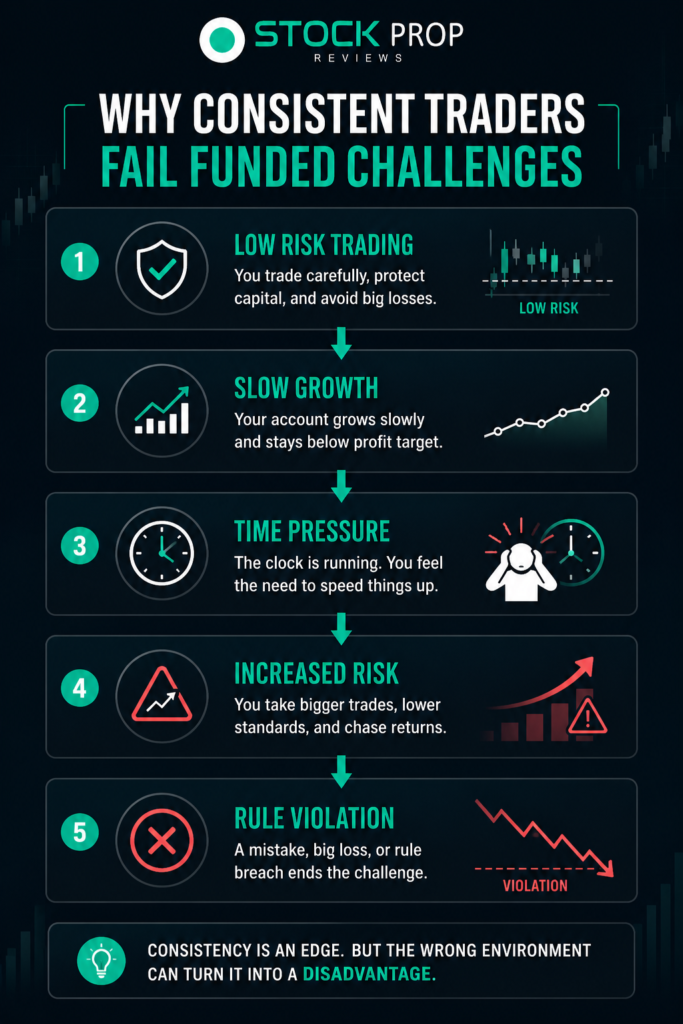
A trader risking 0.5% per trade with a solid edge might average 2 to 4 percent per month. That is realistic. It is also not enough to pass most evaluations within the time allowed.
So the trader adjusts. Slightly bigger size. Slightly more trades. Slightly lower quality setups. The system starts to drift.
The failure does not come from a bad strategy. It comes from forced acceleration.
Drawdown rules vs normal variance
Even systems that make money sometimes lose. It’s not uncommon to lose five or six times in a row.
That sequence can get you close to a daily or overall limit in a prop account. After that, the choices you make next change. You get defensive or, even worse, reactive.
A lot of accounts are lost not at the start of a drawdown, but right after it, when the trader tries to make up for it too quickly.
Time pressure changes behavior
Without a deadline, a trader can sit out slow markets. With a deadline, inactivity feels like failure.
You start taking trades you would normally skip. Not because they are good, but because time is running.
This is one of the least discussed problems. The clock quietly pushes traders away from their own rules.
Consistency rules distort winning days
Some companies put a cap on how much money can be made in a single day or require results to be spread out.
That makes sense until you have a strong trend day and have to cut back to avoid breaking the rule.
You start to work around restrictions instead of letting your edge play out. That hurts performance over time.
What Most Reviews Leave Out
You can guess what a company is about if you read regular reviews or comparison posts about it. Costs, sharing profits, and how quickly you get paid. People don’t often talk about how rules fit together. A trader may stick to their risk limits and follow their plan, but they may still fail because the structure doesn’t give them enough time or flexibility to make the plan work. Another gap is psychological pressure. The rules do more than just keep you safe. They make people act differently. You think again after you lose. When the deadline is near, you rush. You keep small profits safe instead of letting trades grow. This isn’t a problem with you. Based on the situation, it is a response that can be predicted.
A Realistic Scenario
Give two traders the same basic skill.
The first trader makes bigger trades when they are close to their goal and trades more often. They hit their goal in a strong week and passed.
The second trader sticks to a fixed risk and only trades when they see a good opportunity. They grow steadily, but by the end of the period, they are only 5 percent. They don’t work.
The second trader is more stable over time. The first trader moves up faster in the prop firm structure.
That’s the trade-off.
Common Mistakes That Make It Worse
One mistake is not paying attention to the maths that goes into the rules. Most of the time, traders don’t figure out how many losses they can take before they hit their limits or how much risk they can take on each trade to stay on track.
Another is to treat a funded account like your own. The goals are not the same. When you trade for yourself, staying alive is the most important thing. In prop trading, getting through the phase is the most important thing.
A third mistake is only thinking about the profit goal. When traders focus on that number, they start to act in ways that raise the risk without even realising it.
Who Should Think Twice Before Joining
Some traders are naturally misaligned with these structures.
If you prefer higher timeframes, trade a few times a week, and focus on capital preservation, most traditional prop firm models will feel restrictive.
It does not mean you cannot pass. It means the environment will constantly push you away from your strengths.
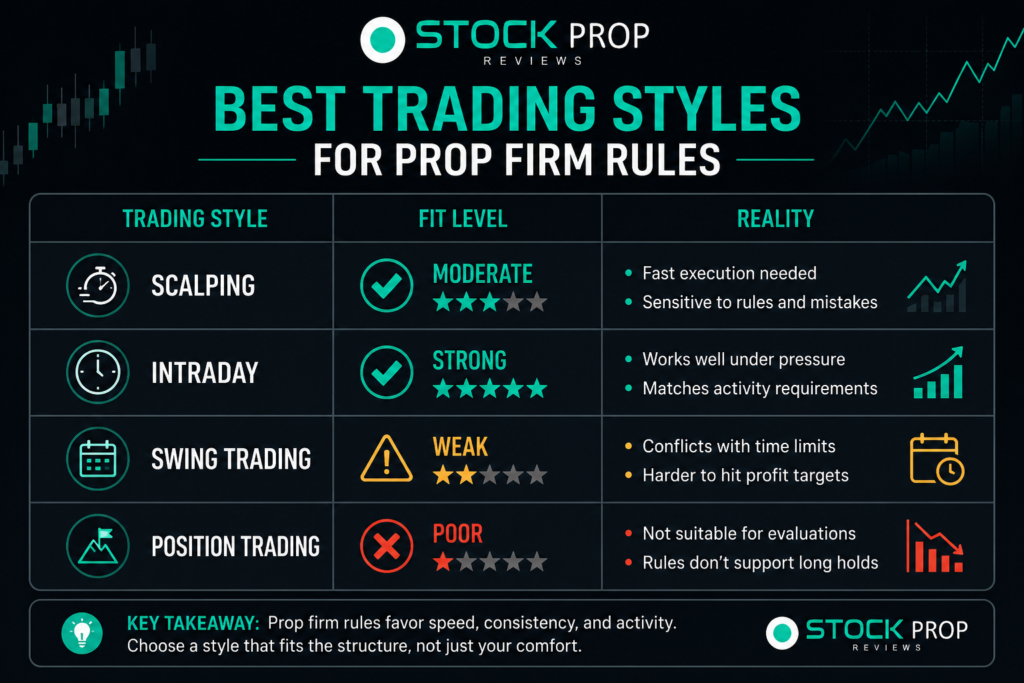
Strategy Fit in Simple Terms
| Style | Fit Level | Reality Check |
| Scalping | Moderate | Can hit targets but sensitive to rules and execution errors |
| Intraday | Strong | Matches activity requirements and time pressure |
| Swing trading | Weak | Time limits and drawdowns conflict with holding trades |
| Position trading | Poor | Structure does not support long holding periods |
Consistency-based strategies tend to need more time than most evaluations allow.
Are There Better Options
Some newer models work to lower friction. They get rid of time limits or make rules about consistency less strict. These aren’t perfect, but they’re more like how real trading works.
There are also accounts for instant funding. They skip the challenge phase but make the ongoing controls stricter. The pressure changes instead of going away.
It’s worth talking about TradeThePool because it does things differently. It focuses on stocks and has clearer risk limits instead of having a lot of rules that don’t work together.
It is not easier, but it is clearer. For traders who care more about structure than speed, that matters.
Readers can save up to 10% by using our TradeThePool link to make a purchase.
A More Balanced View
It’s easy to blame prop firms completely, but the model has a reason for being.
Businesses need to manage risk across a lot of traders. That is possible because of fixed rules. They also keep out people who aren’t doing anything or are acting very badly.
From that point of view, the structure works.
The problem is that it picks a certain type of trader. Most of the time, those who can get things done quickly when they are under pressure.
You are at a disadvantage from the start if your edge depends on being patient and growing slowly.
The Key Takeaway
Being consistent in trading means managing risk over long periods of time and letting the statistical edge work out.
Rules for prop firms shorten time and limit flexibility. That compression changes the way you trade.
Once you get that, it’s easier to understand why you’re angry. It’s not always about making your strategy better. At times, it’s about adjusting to the structure or picking a model that fits the way you already trade. .
FAQs
What makes prop firms hard for traders who are always trading?
Because steady growth often takes longer than the time frame for the evaluation, and rules limit how that growth can happen.
Do prop firms pay people who trade in risky ways?
Not directly, but the way the market is set up can help traders who are willing to take more risks to reach their goals quickly.
Can disciplined traders still do well?
Yes, but they usually change the size of their positions and how often they trade to fit the rules instead of trading exactly like they would on a personal account.
Is every prop firm the same?
No. Some have rules that are more flexible, especially when it comes to time limits and rules for consistency.
What is the safest way to pass?
First, learn the rules, then make a plan that works within those rules instead of trying to fit your usual way of doing things into them.