This E8 Funding review is written from the point of view of a trader, not a list of features. The company has a clean setup, good profit splits, and a pretty standard evaluation process. On paper, nothing seems extreme. But once you start trading under the rules, things change. E8 Funding is best for traders who are already good at managing risk and can stay consistent under pressure. It is not for beginners, aggressive scalpers, or anyone who tends to make up for losses by increasing size. If you are still working on your discipline, the rules will probably show that quickly.
Quick verdict
E8 Funding is a place for traders who are disciplined. It rewards doing things right but punishes being inconsistent.
The structure is not unfair. The issue lies in the conduct of traders within it. Most of the time, you fail when you push too hard for your goals or don’t deal with losses well.
E8 Funding rules explained in practical terms
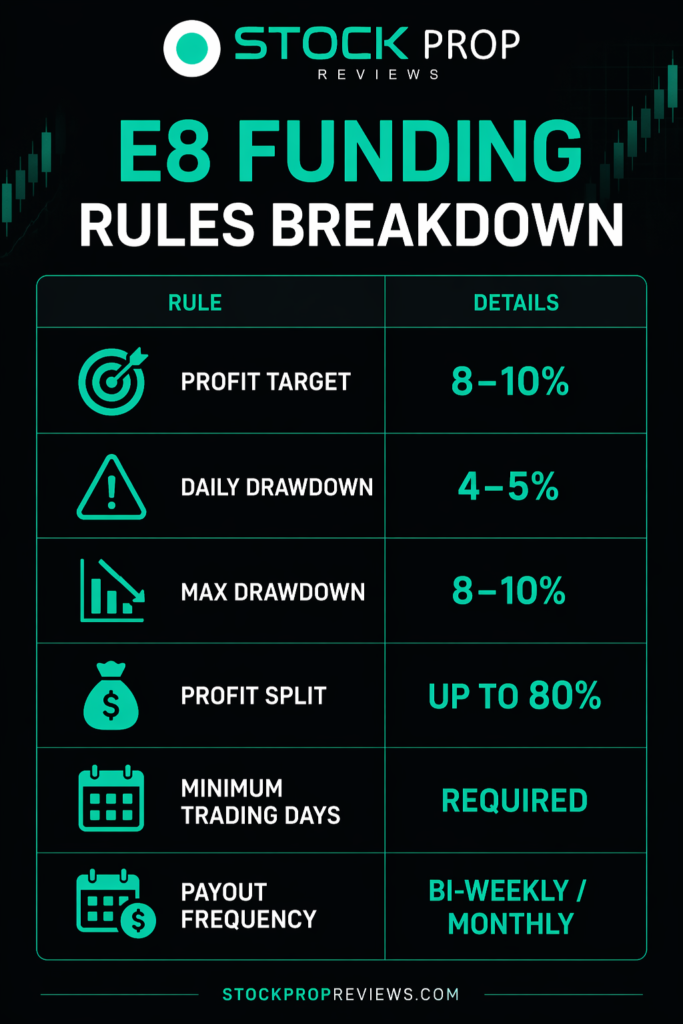
Here is a simplified view of what you are working with:
| Rule Type | Typical Range |
| Profit Target | 8% to 10% |
| Daily Drawdown | 4% to 5% |
| Max Drawdown | 8% to 10% |
| Profit Split | Up to 80% |
| Trading Days | Required |
| Payouts | Bi-weekly or monthly |
Nothing here stands out compared to other firms. The challenge is not the numbers. It is how they affect decision-making during real trades.
A 5% daily drawdown sounds reasonable until you have two losing trades early in the session. At that point, your entire plan for the day changes.
Where most reviews fall short
Most competitor articles describe rules but don’t explain how those rules feel in live trading.
Drawdown limits shape your behavior
Daily drawdown becomes the main constraint. Not overall drawdown.
If you lose early, you are forced into one of two choices:
- stop trading and protect the account
- continue trading with reduced confidence and tighter margin for error
Many traders choose the second option and that’s where problems start.
Profit targets create subtle pressure
An 8% target is realistic. The problem is achieving it while staying within drawdown limits.
You cannot simply trade normally and hope to get there quickly. You need a sequence of controlled wins with minimal losses. That requires patience most traders don’t maintain.
This often leads to overtrading or increasing risk halfway through the challenge.
Consistency is the hidden rule
Even when not explicitly enforced, consistency matters.
Traders who hit targets through one or two large trades often struggle afterward. They either try to repeat it or become overly cautious. Both lead to uneven performance.
How traders actually fail with E8 Funding
Most of the time, failures have nothing to do with strategy. They come from how people react.
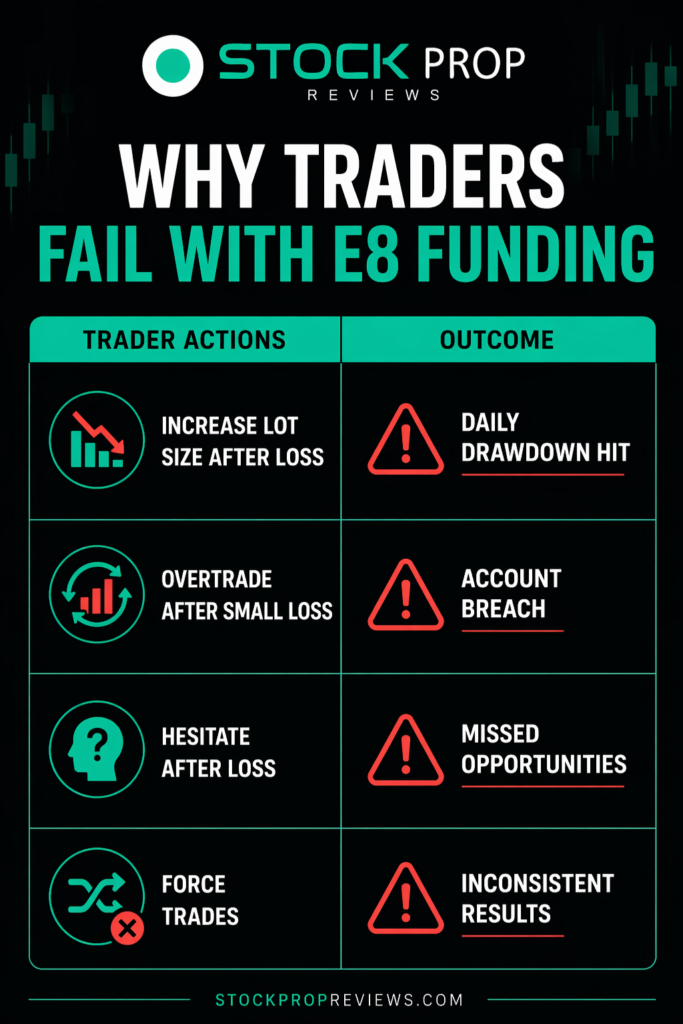
This is what a common pattern looks like:
A trader does well at first and gains confidence. They make their positions bigger after a small loss to get back on track faster. The second loss reaches the daily limit. The account is gone after one session.
Another pattern is just as common but slower. After losing, the trader gets too careful, misses good setups, and then trades out of anger later.
The rules don’t make these things happen, but they do make them more likely if there isn’t already discipline in place.
Strategy fit: who this firm works for
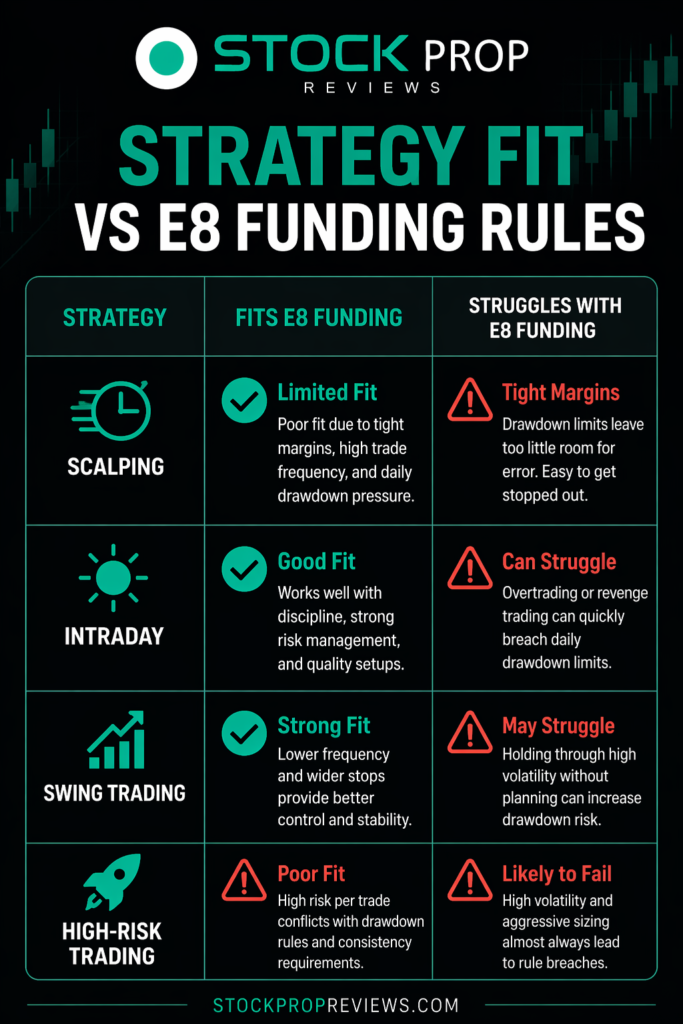
E8 Funding is good for traders who already have a plan.
It works well for day traders who only take a few high-quality setups and are okay with stopping early when the market isn’t right. Swing traders who don’t trade often and have limited exposure can also change.
Scalpers who trade a lot of times don’t like it. There isn’t enough room for mistakes, and spreads or the timing of trades can quickly turn them into losses. It also doesn’t work well for traders who change their risk based on how they feel. .
Real risk vs perceived flexibility
E8 Funding seems flexible at first glance. There aren’t any strange rules or limits that stand out.
The problem is how quickly you lose your ability to be flexible when you’re under stress.
A few losses make it harder for you to carry out your plan. You either push too hard or cut back too much. Both have an effect on performance.
This is why a lot of traders pass the evaluation but fail when they get money. The pressure changes when real money is on the line.
Payouts: realistic expectations
One of the best things about E8 Funding is that it offers competitive profit splits. But you have to stay consistent over time to get paid.
A lot of traders only think about passing the challenge and don’t think about what comes next. Discipline is more important during the funded phase.
If a trader makes 8% in a few days but then gives back half of it, they will have a hard time reaching payout thresholds. Speed is not as important as stability.
E8 Funding compared to other firms
Compared to similar prop firms, E8 Funding sits in the middle.
| Feature | E8 Funding | General Market |
| Drawdown Pressure | Moderate to high | Moderate |
| Profit Split | Competitive | Competitive |
| Flexibility | Average | Average |
| Beginner Friendly | Low | Low to medium |
It is not the strictest firm, but it is not forgiving either. The difference comes down to execution discipline.
Alternatives to consider
If your trading style does not align with E8, there are better fits.
A TradeThePool review analysis often highlights a different approach. TradeThePool operates as a regulated stock prop firm with clearer structure and risk transparency, which some traders find easier to follow.
Readers can get up to 10% discount when purchasing through our TradeThePool link.
You may also benefit from reading a prop firm comparison guide to understand how different rule sets affect performance. Many traders pick firms based on profit split and ignore how rules interact with their strategy.
For a broader perspective, a funded trading reality check article can help you understand why most traders fail regardless of the firm they choose.
What most traders misunderstand
The biggest mistake is thinking that the goal is to hit something.
No, it is not.
It’s about taking risks while working toward that goal.
If you treat it like a race, you probably won’t win. Your chances of success go up if you treat it like a process.
Another common mistake is thinking that a strategy that works will always work. Strategy is important, but execution under pressure is even more important.
Example of a typical failure cycle
This is what a normal week looks like:
The trader starts off with a small profit and feels like they are in charge. The next day, you lose, which makes you feel like you have to make up for it. The size of the position goes up a little. Another loss comes after this.
At this point, people lose faith. The trader either stops believing in the system or tries to make things happen. Both of these things make trades bad.
The account is either hacked or very close to being hacked by the end of the week.
This isn’t strange. That’s how most accounts get lost.
Who should avoid E8 Funding
Some traders should not consider this firm at all.
If you struggle to stop trading after a loss, this environment will make things worse. If you rely on increasing risk to recover, the daily drawdown will catch you quickly.
It is also not suitable for traders who are still testing strategies or learning basic risk management.
Balanced view: is E8 Funding fair?
The firm itself is fair. The rules are clearly defined and consistent with the industry.
The problem is expectation. Many traders expect flexibility that does not exist once real trades are placed.
From a structural standpoint, E8 Funding does what it is supposed to do. It filters out undisciplined trading.
Final thoughts
The rules for E8 Funding make it easy. It’s hard because of how those rules affect how people act.
The company is a good choice if you already know how to manage risk well and can stick to your plans. If you’re still working on being disciplined, it will probably show those gaps quickly.
You shouldn’t pick a prop firm based on how easy it looks. You should choose the one that fits how you already trade.
FAQs
Is E8 Funding a good choice for beginners?
No. Beginners often have trouble with drawdown limits and consistency requirements.
How hard is it to get E8 funding?
It is possible to pass. Most traders fail to keep their funded accounts up to date.
Is it possible to scalp with E8 Funding?
Scalping is possible, but it’s not the best way to go. It is hard to manage risk well when drawdown limits are too tight.
How do payments work?
Payouts depend on making money consistently and keeping your account stable, not just hitting the target once.
What is the biggest danger?
The biggest risk is hitting a daily drawdown because of emotional decisions or trying to get back money quickly.