This is what most traders ask after seeing big funded accounts online. It’s easy to see why: trading with someone else’s money must be easier than risking your own.
The truth is more uncomfortable.
It’s not about how easy it is to trade with or without money. It’s about control versus constraint.
This article is for people who are new to trading, struggling traders, and anyone who is trying to figure out what to focus on. It’s not for traders who want to make money quickly or find a quick way to do things. If you want to take the easy way out, you will probably end up going back and forth between the two and failing at both.
Quick verdict
Funded trading is easier to access but harder to maintain.
Personal trading is harder to grow but easier to manage long term.
Most traders underestimate how much rules change their behavior. That is where the real difference shows up.
What funded trading vs personal trading actually means
If you pass an evaluation and trade under a company’s rules, you are funded. You get to keep some of the profits.
When you trade personally, you use your own money and there are no outside rules other than those set by your broker.
It looks like funded trading is an improvement on paper. More money, less risk for you. In real life, the structure changes how you make trades.
A trader who is calm and steady on a $1,000 personal account can become nervous or aggressive on a $100,000 funded account. The plan stays the same. The environment does.
The rules that make or break traders
Here is where the gap really opens.
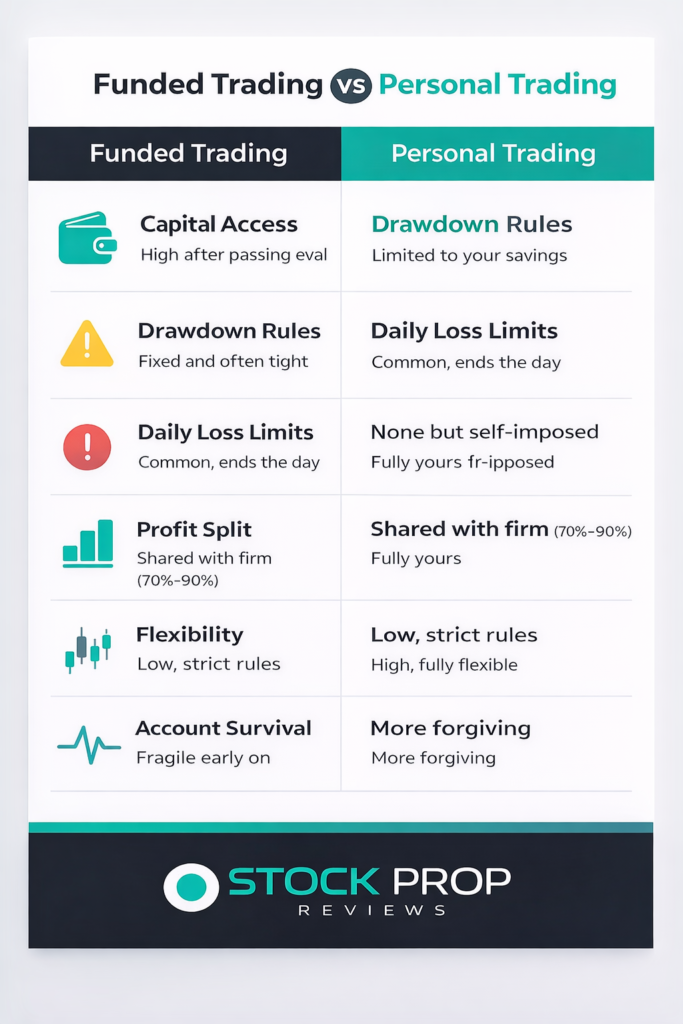
| Factor | Funded Trading | Personal Trading |
| Capital | High access after passing | Limited to savings |
| Drawdown | Fixed and often tight | Self-managed |
| Daily loss limits | Common | None unless self-imposed |
| Profit split | Shared | Fully yours |
| Flexibility | Low | High |
| Account survival | Fragile early on | More forgiving |
The important line here is drawdown and daily limits. That is what most traders fail to respect.
A personal trader can take a step back after a bad week. A funded trader often cannot recover from a bad day.
Why funded trading feels easier at the start
There is a reason so many traders move toward prop firms.
The upfront risk feels smaller. Paying a challenge fee is psychologically easier than risking a large account.
The capital looks attractive. Even experienced traders get drawn in by the idea of scaling quickly.
There is also a sense of structure. Rules give the impression that discipline is built in.
All of this creates a smooth entry. But it does not last.
Where funded trading gets difficult
The difficulty shows up once real trading begins.
Drawdown pressure
Most traders don’t realise that trailing drawdown is the most important thing.
You can still lose the account even if you’re making money overall. That makes you have to protect your profits, which often means cutting winning trades short.
Daily limits
Daily loss caps seem like a good idea, but they change how people act.
If a trader loses money early in the session, they might rush into setups just to get back on track before they hit their limit. This is where discipline fails.
Evaluation habits
Many traders pass evaluations by pushing risk slightly higher than normal.
Once funded, they try to trade “properly” again, but now under tighter constraints. The transition fails because the behavior that got them funded is not sustainable.
What most competitors miss
Most comparisons stop at capital and profit split. That is surface level.
The real issue is that funded trading forces you to trade differently.
A scalper might need precise execution that does not tolerate hesitation. Add a strict loss limit and that hesitation increases.
A swing trader may be fine with drawdowns in a personal account. In a funded account, the same drawdown ends the account.
This mismatch between strategy and rules is why traders with a real edge still fail.
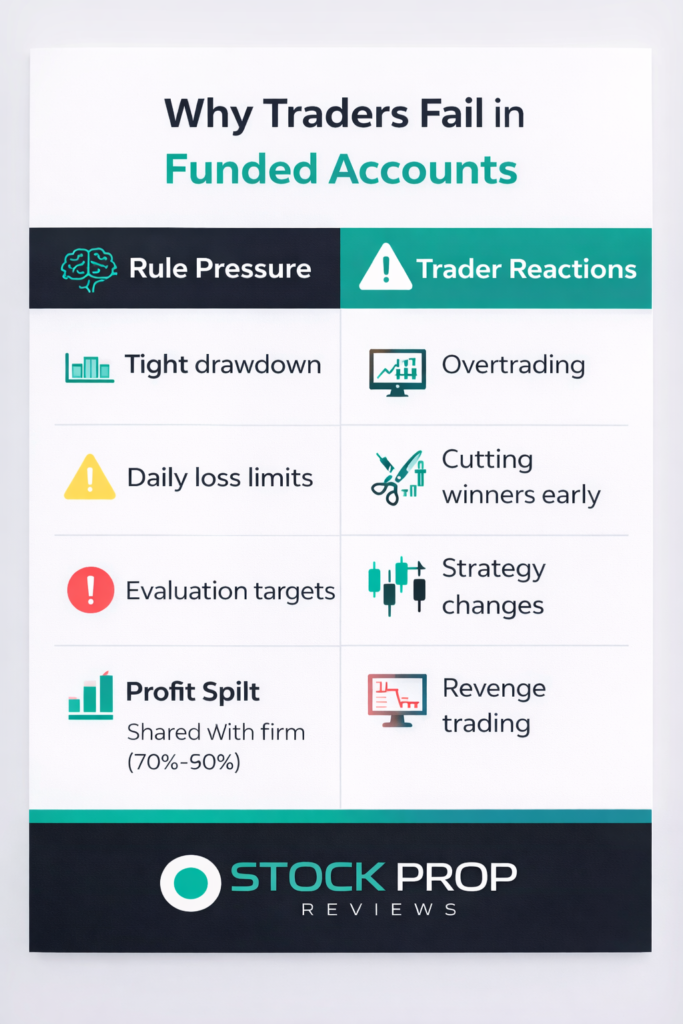
How traders actually fail funded accounts
It is rarely because they do not understand the market.
More often, it comes down to adjustments that seem logical but break the system.
Reducing stop losses to avoid hitting drawdown limits leads to more frequent losses.
Closing trades early to protect equity reduces the reward side of the strategy.
Taking multiple correlated trades increases exposure without realizing it.
Trying to “make the most” of the account leads to overtrading.
These are not beginner mistakes. They are reactions to constraints.
Personal trading is not easier, just different
There are problems that come with it.
Slow growth. It takes time to build a small account, and most traders give up.
Losses hit home more. This can make people hesitate or miss out on good trades.
You have to make your own structure. Without rules from outside, a lot of traders become inconsistent.
But there is one big benefit.
You can get through mistakes.
A bad week doesn’t mean your account is over. That changes how you deal with risk over time.
Where personal trading has the edge
The main benefit is control.
You choose how much to risk, when to stop, and how to get back on track.
Swing trading and other strategies that need breathing room work better when there aren’t strict limits.
You don’t have to meet your goals by a certain date either. This makes the trading rhythm more natural.
For traders who want to be consistent over the long term, this is more important than having access to a lot of money.
Strategy fit matters more than the model
Each setup works differently with different styles.
Scalpers can work in funded environments, but only if they keep their emotions in check and do a good job. Mistakes that are small can cost a lot of money very quickly.
Funded accounts are usually best for intraday traders, but daily limits can still get in the way of normal losing streaks.
Swing traders often have trouble with funded rules. Tight drawdowns don’t work well with overnight exposure and wider stops.
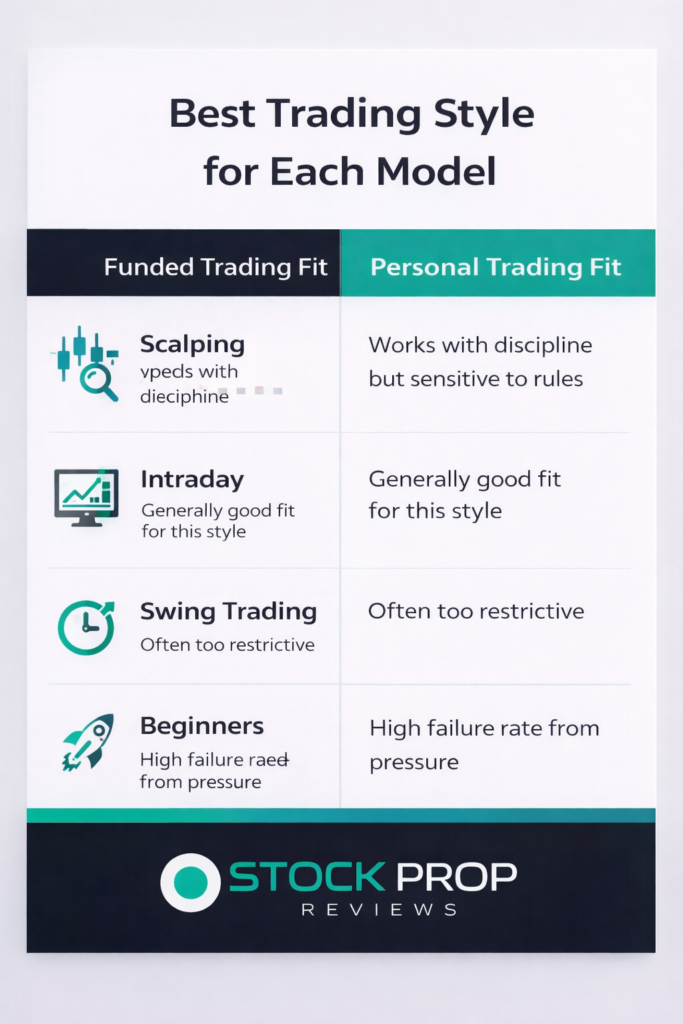
People who are new to trading often don’t realise how much pressure there is in funded accounts. Starting small with your own money often leads to better habits.
Real comparison scenario
Imagine a trader who is okay with losing 1% on every trade.
Even if they lose a lot of money on their own account, they can still trade. The main thing to think about is what will happen in the future.
If your account is funded and has a low drawdown, a short losing streak could wipe it out completely.
The same plan works out differently because there is less room for mistakes.
Alternatives worth considering
Some traders do better when they use both methods together.
Having a small personal account along with funded challenges takes some of the stress off. It also keeps your process on track.
It can also help to pick companies with simpler rules. It is usually easier to work with static drawdown models than trailing ones.
TradeThePool is another option that is more structured. It focuses on stock trading and has clearer risk parameters. It works for traders who like clear models over aggressive scaling models.
When readers buy through our TradeThePool link, they can get up to 10% off.
The psychological difference
Funded trading introduces external pressure. You are trading under rules that can end your account quickly.
Personal trading creates internal pressure. There is no one stopping you from making mistakes except yourself.
Some traders perform better with structure. Others perform better with flexibility.
Problems start when traders assume one will fix weaknesses without changing behavior.
FAQs
Is trading with money easier than trading on your own?
Because there is less risk and more money at the beginning, it seems easier. Over time, it gets harder to stick to strict rules.
Why do a lot of traders fail with funded accounts?
Most failures happen because people don’t follow the rules. Traders change the size of their positions, when they exit, or how often they trade in ways that go against their strategy.
Can a personal trader who makes money fail at funded trading?
Yes. The limits on funded accounts can make people act in ways that would otherwise be profitable.
Is trading for yourself safer?
It depends on how disciplined you are. You are fully responsible for risk management because there are no outside limits.
What should a beginner pick?
Starting with a small personal account usually helps you get into the habit of trading with real money.
Final take
It’s not a matter of which model is easier. It is which one shows your weaknesses more quickly.
Poor discipline gets punished quickly in funded trading.
Over time, personal trading punishes people who don’t have patience.
You can pick the environment that fits your current stage and avoid making the same mistakes in both if you know how each one affects your decisions.