A lot of traders look for the best prop firms in 2026 and expect to find a simple list. In reality, picking a prop firm has less to do with which one is “best” and more to do with which set of rules fits your trading style.
Most websites that let you compare prices show how much money you can make and how much you have to pay to enter a challenge. Those numbers look good, but they don’t always show if a trader will stay in the program.
What matters more are the drawdown models, the rules for consistency, the payout policies, and how the company deals with risk breaches. These things have an effect on real trading decisions every day.
This comparison is written for retail traders who are considering a prop firm evaluation or who already trade funded accounts and want to switch firms. It is also useful for traders deciding between forex, futures, or equity prop firms.
It is not written for traders looking for quick funding or guaranteed payouts. Passing a prop firm challenge requires consistent risk control, and most traders fail their first attempts because they underestimate the rule structure.
The goal of this guide is simple. Show how the major prop firms operate in practice, highlight the limitations competitors rarely discuss, and help traders avoid expensive mistakes.
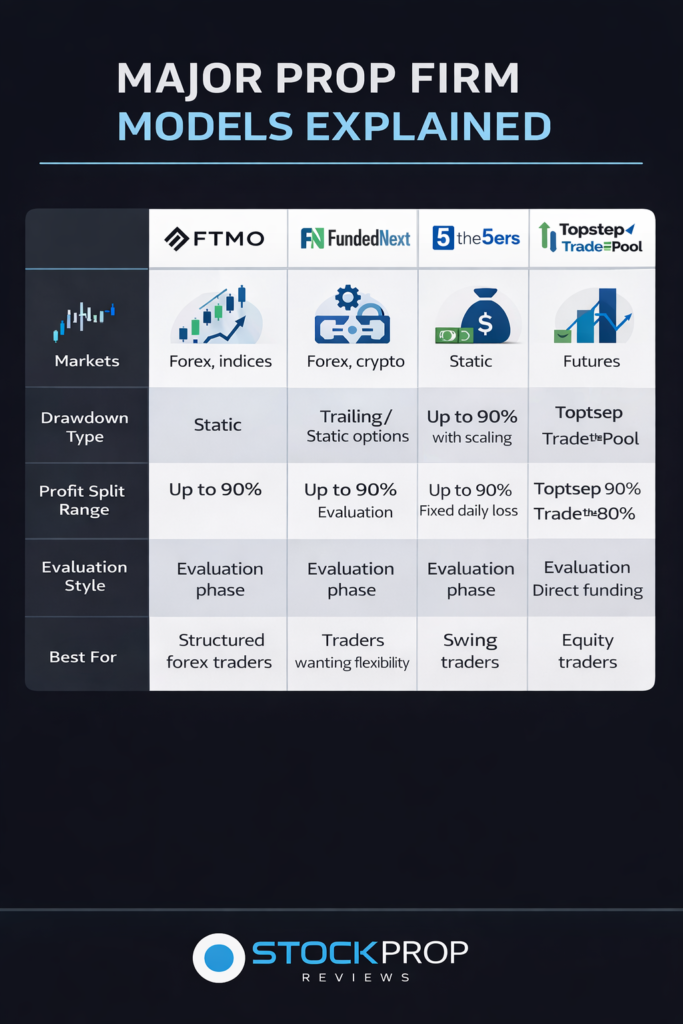
Prop Firm Comparison Table (2026)
| Prop Firm | Markets | Profit Split | Max Drawdown | Account Type | Best For |
| FTMO | Forex, indices | Up to 90% | Static | Evaluation | Structured forex traders |
| FundedNext | Forex, crypto | Up to 90% | Static / Trailing | Multiple models | Flexible strategies |
| The5ers | Forex | Up to 100% scaling | Static | Growth program | Swing traders |
| Topstep | Futures | Up to 90% | Trailing | Evaluation | Futures traders |
| TradeThePool | Stocks | Up to 80% | Fixed daily loss | Direct funding | Equity traders |
At first glance these firms appear similar. The marketing language is almost identical across the industry. But the rule structures differ in ways that significantly affect trader performance.
For example, the difference between static and trailing drawdown alone can change how a strategy behaves during a profitable streak.
What Most Prop Firm Comparisons Miss
A large number of “best prop firm” articles focus almost entirely on profit splits. That approach ignores the reality of trading inside these programs.
A 90 percent profit split sounds attractive, but if the drawdown model constantly tightens as the account grows, traders often close positions early or reduce risk unnecessarily. Over time this behaviour can damage strategy performance.
Another issue is consistency rules. Some firms quietly limit how much profit can be made in a single day or require profits to be spread across multiple sessions. Traders who rely on occasional high-impact trades often discover these restrictions only after starting the evaluation.
These details rarely appear in marketing pages, yet they are exactly what determine whether a trader passes or fails.
FTMO Review
FTMO
Quick verdict
FTMO remains one of the most recognised names in the forex prop firm industry. Its evaluation model is strict but transparent, which explains why many experienced traders still consider it a benchmark.
Core rules
| Rule | Value |
| Phase 1 target | 10% |
| Phase 2 target | 5% |
| Daily loss limit | 5% |
| Maximum drawdown | 10% static |
| Profit split | Up to 90% |
The static drawdown model is one of the key advantages. The maximum loss limit remains tied to the starting balance rather than rising with profits.
How the rules affect real trading
Imagine a trader grows a $100,000 evaluation account to $104,000.
With a trailing drawdown system, the allowed loss level might move upward along with the equity. If the account then pulls back during a normal market correction, the drawdown limit could be breached even though the trader is still profitable overall.
FTMO avoids this problem by keeping the drawdown fixed.
Where traders struggle
The difficulty is not the rules themselves but the combination of targets and time pressure. A trader trying to reach a 10 percent target while respecting a 5 percent daily loss limit has a relatively narrow margin for error.
Many traders start increasing position size after early losses. That behaviour often triggers the daily drawdown rule.
Who FTMO works best for
Traders who already have a consistent forex strategy and understand strict risk management usually adapt well. Swing traders also benefit from the static drawdown model.
A detailed breakdown of this firm is available in our FTMO review, which covers rule nuances and common trader experiences.
FundedNext Review
FundedNext
Quick verdict
FundedNext has expanded quickly by offering several different funding models. That flexibility attracts traders who want alternatives to the traditional two-phase evaluation.
Core rules
| Rule | Value |
| Profit split | Up to 90% |
| Account types | Multiple |
| Drawdown type | Static or trailing |
| Scaling plan | Available |
The main difference compared with many competitors is the variety of account structures. Traders can choose between models designed for faster funding or more traditional evaluations.
Real trading considerations
Flexibility can be helpful, but it also creates confusion. Each account model has slightly different rules regarding consistency, daily limits, or profit distribution.
For example, some models restrict how much of the total profit can come from a single trading day. A trader who captures one large market move might discover that the gain does not fully count toward the challenge target.
Common mistake
Traders often select the cheapest evaluation option without carefully reviewing the rule structure. Later they realise that their strategy does not fit the account model they chose.
Alternatives
FTMO offers a simpler rule environment, while The5ers focuses more heavily on long-term scaling.
Our FundedNext review explains how the different funding models change risk exposure.
The5ers Review
The5ers
Quick verdict
The5ers takes a slower approach to trader development. Instead of pushing traders to hit aggressive short-term targets, the firm emphasises gradual capital growth through scaling.
Core rules
| Rule | Value |
| Profit split | Up to 100% with scaling |
| Drawdown model | Static |
| Markets | Forex |
| Scaling structure | Multi-stage |
Unlike many competitors, The5ers encourages traders to treat the program more like a long-term trading career.
Trading environment
Swing traders and position traders often perform better under this structure. Because the evaluation pace is slower, traders feel less pressure to force trades.
However, the scaling process requires patience. Expanding account size typically takes multiple profitable stages.
Where traders get frustrated
Some traders expect rapid growth after their first profitable cycle. When scaling happens more gradually than expected, they lose interest or move to faster evaluation programs.
Who should avoid it
High-frequency scalpers who depend on rapid account expansion may find the program too slow.
Topstep Review
Topstep
Quick verdict
Topstep remains one of the most recognised futures prop firms. It focuses exclusively on futures trading, which gives it a more specialised environment than many multi-asset firms.
Core rules
| Rule | Value |
| Markets | Futures |
| Drawdown type | Trailing |
| Profit split | Up to 90% |
| Evaluation model | Futures challenge |
The trailing drawdown model is the defining feature.
How the drawdown affects trading
With trailing drawdowns, the maximum loss level rises when the account reaches new equity highs. That means a trader who earns early profits must protect those gains carefully.
In practice, this changes behaviour. Traders tend to close winning positions earlier than they might in a personal account.
Psychological effect
This structure encourages disciplined risk management but can also reduce the ability to let profitable trades run.
Who Topstep suits best
Dedicated futures traders who already understand trailing risk models generally adapt well.
TradeThePool Review
TradeThePool
Quick verdict
TradeThePool stands out because it focuses specifically on stock trading rather than forex or futures.
For traders who specialise in equities, the environment feels closer to a traditional proprietary trading desk.
Core rules
| Rule | Value |
| Markets | US stocks |
| Profit split | Up to 80% |
| Daily loss rule | Fixed |
| Scaling | Available |
The firm emphasises daily risk management rather than large overall drawdown limits.
Real trading example
A day trader focusing on momentum stocks during the US session must stay within the daily loss limit. As long as that rule is respected, the strategy can operate normally.
This clarity around daily risk thresholds helps traders understand exactly where the boundaries are.
TradeThePool is also positioned closer to regulated market environments than many retail prop firms. That transparency appeals to traders who want clearer rule frameworks.
Readers can get up to 10% discount when purchasing through our TradeThePool link.
Who it works best for
Equity traders who already understand stock market behaviour, liquidity, and volatility patterns.
Forex traders often struggle to adapt their strategies to stock markets.
Strategy Fit Analysis
Choosing the best prop firm depends heavily on trading style.
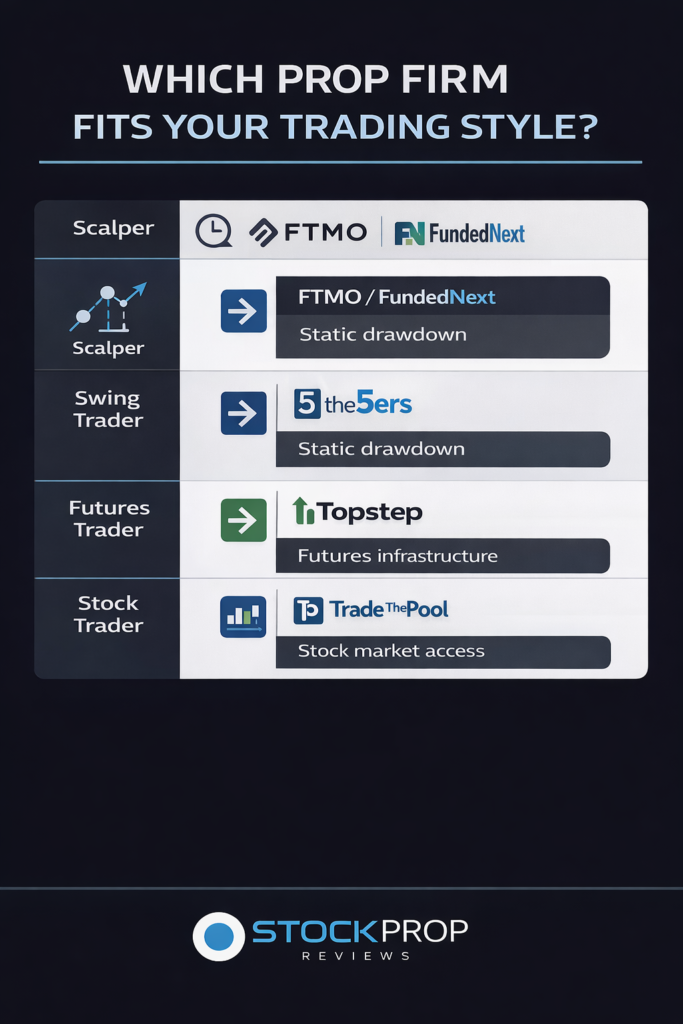
Scalpers usually perform better with firms that allow frequent entries and flexible execution conditions. FundedNext and FTMO are often the most compatible in that category.
Swing traders benefit from static drawdown systems because trades can develop over several days without constantly tightening loss limits. FTMO and The5ers often work better for this approach.
Futures traders typically prefer specialised firms such as Topstep because the infrastructure is built specifically for futures platforms and instruments.
Stock traders rarely find suitable conditions at forex-focused firms. Equity-specific firms such as TradeThePool provide a more natural environment.
Why Most Traders Fail Prop Firm Challenges
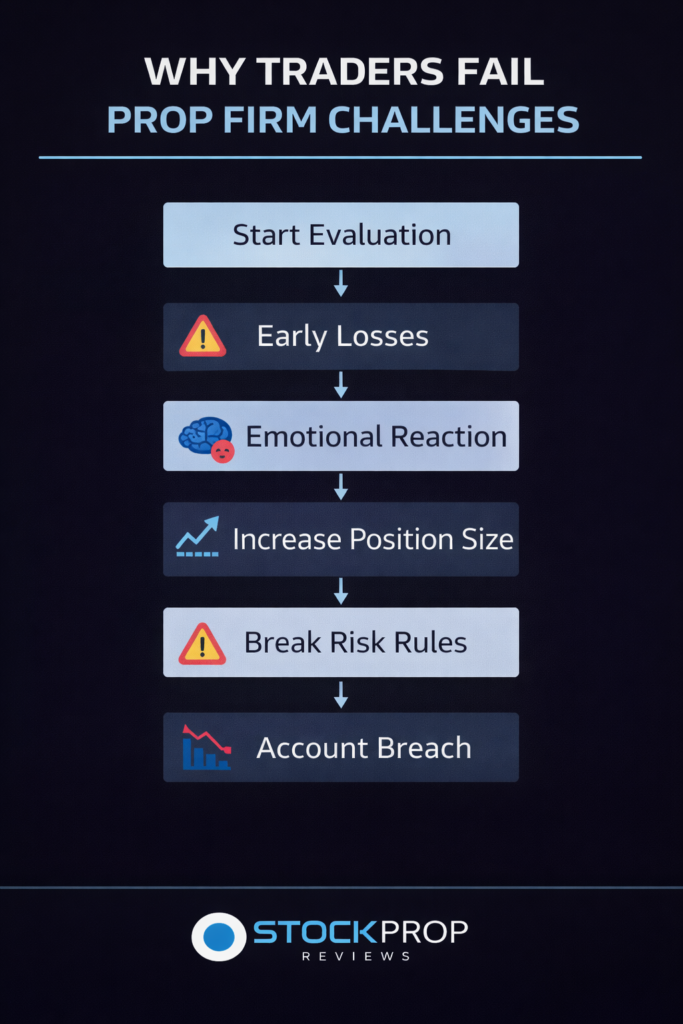
Many traders assume their strategy is the problem when they fail an evaluation. In reality, behaviour under pressure is usually the real issue.
A common pattern begins with a small series of losses early in the challenge. Instead of maintaining consistent risk, the trader increases position size to recover faster. The daily drawdown rule is then breached within a few trades.
Another frequent mistake is misunderstanding how trailing drawdown systems work. Traders see early profits and believe they have more room to manoeuvre than they actually do.
Overtrading during high-impact news events is another cause of failure. Market volatility increases, spreads widen, and slippage becomes more severe. These conditions often lead to rule violations.
The psychological progression behind these mistakes is discussed in our article explaining how trading turns into gambling.
Retail Prop Firms vs Traditional Proprietary Firms
Retail prop firms are fundamentally different from traditional trading desks.
Many retail firms operate challenge programs designed to filter traders through risk simulations. Only a small percentage of participants reach funded status.
Traditional proprietary trading desks usually operate within regulated financial markets and recruit traders directly rather than selling evaluations.
Equity-focused programs such as TradeThePool move slightly closer to that traditional model by emphasising clear rules and market transparency.
Readers can get up to 10% discount when purchasing through our TradeThePool link.
How to Choose the Right Prop Firm
Instead of searching for the highest profit split, traders should evaluate three practical factors.
First, the drawdown structure. Static drawdowns provide stability, while trailing models require more defensive trading.
Second, trading restrictions. News trading limits, weekend holding policies, and platform constraints can significantly affect strategy performance.
Third, psychological compatibility. If a rule structure constantly forces early profit taking, it may conflict with the way your strategy captures market moves.
Our online prop firms vs regulated prop firms comparison explores how different risk frameworks affect trader behaviour.
FAQs
What is the best prop company in 2026?
There isn’t one best company. Forex traders still like FTMO, futures traders use Topstep a lot, and TradeThePool is all about trading stocks.
Which prop firm has the easiest challenge?
Easier challenges often have stricter hidden rules, like trailing drawdowns or limits on how often you can win. Instead of looking at the marketing claims, traders should look at the whole rule structure.
Is it safe to work for a prop firm?
Established companies do pay traders, but there is still a financial risk with prop firm challenges. A lot of traders fail evaluations not because their strategies are bad, but because they break the rules.
Do prop firms let people scalp?
Some companies let scalping happen, but others don’t let high-frequency trading or trading around news events happen. Each company’s risk policy decides what strategies are allowed.
Should new traders work with prop firms?
Before trying prop firm challenges, beginners usually do better if they work on consistency on demo or small personal accounts. Going straight to evaluations often ends in failure.
Finding the best prop firms in 2026 shouldn’t just be about the rankings. The company that fits your trading style, risk tolerance, and trading psychology will always be more important than the one that makes the most aggressive marketing claims.