If you are asking are prop firms worth it in 2026, you are probably trying to decide whether funded accounts are a real opportunity or just another expensive loop. The honest answer is that prop firms still work for a small group of traders, but they quietly punish everyone else.
This article is for retail traders who are thinking about evaluations, already funded traders trying to stay consistent, and futures or forex traders comparing prop firms to personal capital. It is not for anyone looking for fast income, guarantees, or a shortcut around discipline.
There is no hype here. How prop firms really work in real life.
Quick verdict
If you already trade with little risk, little hope, and a lot of patience, prop firms might be worth it. They aren’t worth it if you rely on recovery trades, big wins, or making decisions based on how you feel. Bad entries aren’t the main reason for most failures in 2026. They are about the stress that rules cause.
What prop firms really are in 2026
After you pass an evaluation, a prop firm lets you trade with a bigger account. You trade within set risk limits and split the profits with the company. In most cases, especially in forex and futures, the trading environment is not real; it is simulated.
This is important because the rules are meant to keep the company safe first. The trader comes in second.
A lot of people still don’t get this. You don’t get freedom just because you pass an evaluation. The funded phase is more strict than the challenge phase in most companies.
That’s where most traders go wrong.
Why prop firms still attract traders
It’s clear why they want it. You can manage a big notional account without putting your own money at risk. You get clear limits on how much you can lose. You feel like you’re trading like a pro.
The problem is that structure seems helpful until it starts to hurt you.
The majority of traders do not fail due to prop firms being fraudulent. They fail because the structure shows flaws that personal accounts don’t show.
How traders actually lose funded accounts
Competitor articles usually talk about payouts and profit splits. What they avoid explaining is how traders lose accounts after they are funded.
A very common pattern looks like this.
A trader passes the evaluation using aggressive size. They get funded. Early profits move the trailing drawdown up. A normal pullback now feels dangerous. The trader hesitates, misses setups, then forces trades to recover. One average losing day violates the account.
This isn’t unusual. It happens all the time, especially in futures companies that have trailing drawdowns.
Another example is a forex trader who is fine with trading on their own account but can’t handle a drawdown that doesn’t reset. One bad session puts the account in survival mode for weeks.
These are not failures of the heart. They don’t fit together structurally
This pattern shows up clearly in our detailed TopStep review, where trailing drawdown pressure quietly becomes the reason most funded accounts don’t survive.
.
The rules that matter more than profit split
Most of the time, the percentages of profit split are just for marketing. There are a few rules that are very important for survival but don’t get enough attention.
Maximum drawdown tells you how much room you really have to breathe. Daily loss limits set a limit on how many mistakes you can make in a single session. Profit goals make traders trade too much during evaluations. Time limits hurt traders who trade slowly and steadily.
If your strategy barely fits within these limits, the account will eventually break you.
Are prop firms worth it for beginners
Most of the time, prop firms are not a good idea for beginners.
The evaluation model gives points for short-term success, not for doing the same thing over and over. Beginners often get ahead by taking risks they can’t handle. When they get money, the same behavior ends their account.
A small personal account helps you learn better habits. You feel losses, but you also learn to be patient without having to follow rules.
Most traders who do well with prop firms learn how to be consistent outside of them first.
Are prop firms worth it for experienced traders
In 2026, prop firms can still make sense for traders who already know their stats.
The main difference is what you expect. Traders with a lot of experience don’t think of funded accounts as guaranteed income. They see them as a way to get money, but with conditions.
A lot of people now spread their money across different companies, take it out early, and know that they could lose their accounts even if they trade well.
This change in thinking is what makes survivors different from people who buy resets over and over again.
Futures vs forex prop firms
Most futures prop firms use trailing drawdowns that go up and down with unrealized gains. This rewards accuracy but punishes changeability. Success at first often makes things harder instead of easier.
Most of the time, Forex prop firms use static drawdowns with higher leverage. This gives you options, but it can also hide risk until one bad session causes damage.
By default, neither model is better. The strategy fit is more important than the asset class.
Strategy fit matters more than skill
Scalpers often have trouble with daily loss limits, spreads, and news rules. Day traders do better when they are okay with slower growth. Swing traders often run into time limits and rules about how long they can hold a position.
If your strategy needs space to breathe, prop firms will feel too tight. If your strategy already trades with low risk, they might seem easy to handle.
What competitors don’t explain about evaluations
Evaluations are not objective assessments of competence. They work as filters.
High profit goals make people want to focus. Time limits reward differences. Reset fees put companies in a retry loop that helps them make money.
A lot of the time, passing an evaluation means you changed for a short time. That doesn’t mean your method will work in the long run.
That’s why a lot of traders pass once and then fail over and over again.
Psychological pressure most traders underestimate
Trading someone else’s capital changes behavior.
Losses feel heavier near drawdown limits. Giving back profits feels unacceptable. Traders start protecting unrealized gains instead of executing their plan.
This pressure causes traders to abandon rules that worked on personal accounts.
It is one of the biggest reasons funded accounts fail quietly.
Regulated stock prop firms as an alternative
Stock prop firms that are regulated work in a different way.
DealFor instance, ThePool lets you trade stocks with fixed risk limits, clearer rules, and a structure that is more like a traditional prop desk. You don’t have to deal with trailing drawdowns that change during the day or rules that aren’t clear.
This doesn’t make trading any easier. It makes what people expect clearer.
When you buy through our TradeThePool link, you can get up to 10% off, but you still need to be disciplined. There is no structure that can take the place of risk control.
Comparison: online prop vs regulated stock prop
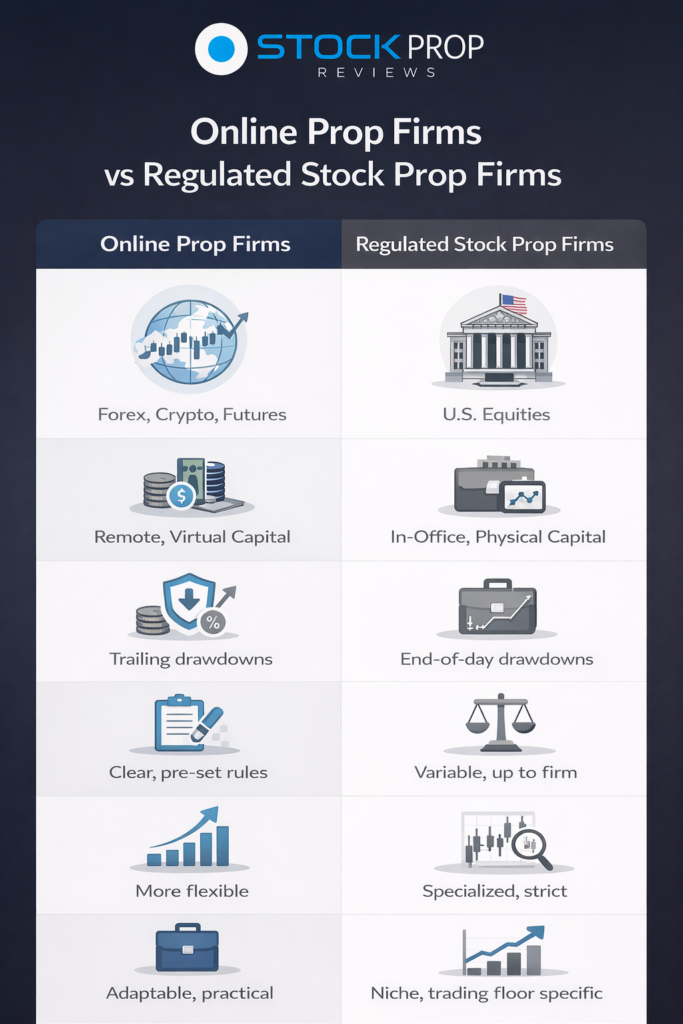
Most of the time, online forex and futures companies work in fake environments where things can change without warning. Regulated stock prop firms buy and sell stocks in real time and have clearer rules about risk.
In 2026, this difference will matter more to traders who care about skill transfer and clear rules than it did a few years ago.
Best fit and worst fit traders
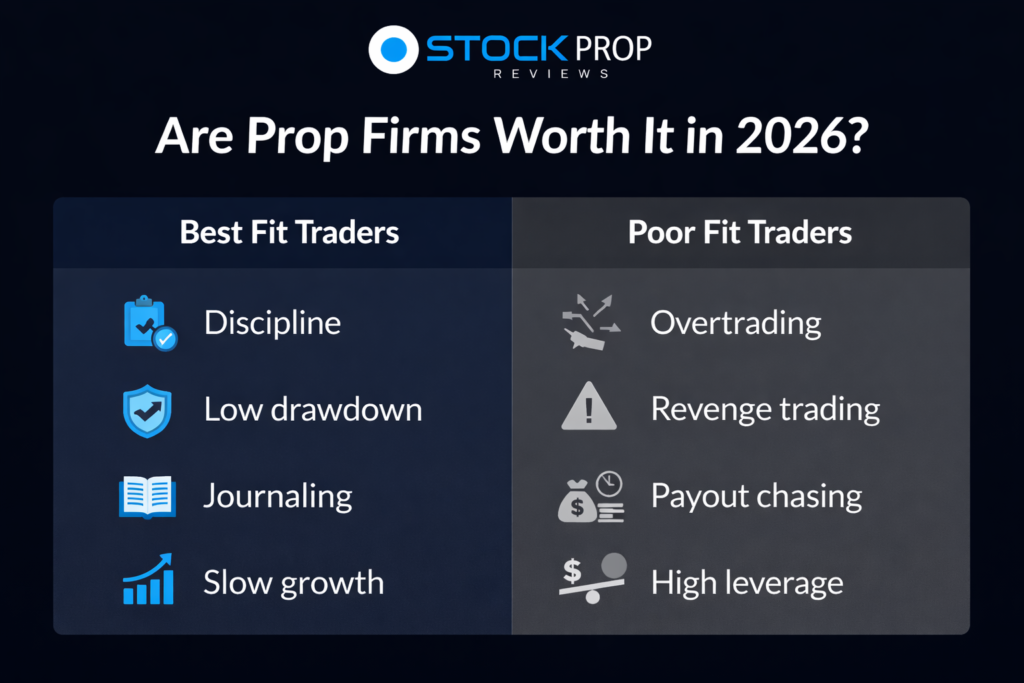
Traders who already trade small drawdowns, keep a journal, and are okay with slow growth are the best candidates for prop firms.
They don’t work well for traders who are trying to get payouts, who are relying on recovery trades, or who are treating funded accounts like paychecks.
This gap is the reason for most complaints online.
Common mistakes traders keep making
Overtrading to meet evaluation goals. Not paying attention to how drawdown math adds up. Scaling too quickly after the first payment. Trading with more than one company that has its own rules. Assuming that payments will keep coming.
The same consistency issues appear repeatedly in our Funded Trader review, where passing the challenge does not guarantee long-term account stability.
None of these are new errors. Every year, they do the same things.
Alternatives worth considering
It takes longer to grow a personal account, but it’s better for your mental health. Regulated stock prop firms give equity traders a more realistic place to work. Some traders combine their own money with one funded account instead of stacking evaluations.
Your personality, not your goals, will help you make the best choice.
Are prop firms getting worse in 2026
Things are getting stricter.
Risk monitoring is more strict. Faster rule enforcement. There is less room for mistakes. This protects businesses, not traders.
From the point of view of a trader, only strategies that already respect risk will last over time.
Balanced truth
By default, prop firms are not scams. Some traders do take money out on a regular basis.
But most traders lose accounts because their strategy doesn’t fit with the structure. Saying this is bad luck misses the point.
Prop firms make you a better trader than you already are.
Final perspective
There are still prop firms. They are not simple. Not everyone will like them.
They can be helpful if you already trade with discipline. If you are still working on that discipline, they will quickly show you where you are lacking.
BusinessThePool and other regulated stock prop firms give traders who value honesty and clear rules a different way to trade. When you buy through our TradeThePool link, you can get up to 10% off, but the results still depend on how well you execute.
The real question is not if prop firms are worth it. It’s whether your trading fits within their rules.
FAQs
Are prop firms worth it for new traders in 2026?
No, not for most beginners. The structure usually makes bad habits worse.
Can traders make steady money from prop firms?
Some people can, but they need to be very careful with their money and have realistic goals.
Are prop firms safer than trading with your own money?
They lower the risk of losing money, but they raise the risk of psychological and rule-based problems.
Do prop companies trade with real money?
Most online businesses use fake environments. Regulated stock prop firms trade in real time.
Why do most accounts that get money fail?
Not knowing the rules for drawdown and trading too aggressively when under pressure.