
Can you live off prop firm trading? Yes, but far fewer traders manage it than social media suggests. This article is for funded traders with at least several months of consistent results. It is not for beginners who just passed a challenge or anyone still relying on high risk setups to hit targets.
I am going to show you the real numbers, where the pressure builds, and why most traders fail when trading becomes their only income.
What “Living Off” Prop Trading Actually Means
Living off of trading doesn’t mean getting one $8,000 payout every month. It means that your average net income, after splits and bad months, is enough to cover:
- Rent or a mortgage
- Utilities and food
- Taxes
- Savings for emergencies
You need to make more money than $3,000 every month if you want to trade. Not once. Not two times. Again and again.
That’s when reality starts to look different from screenshots.
If you’re new to funded trading, it helps to understand how stock prop firms work before thinking about income potential.
The Real Math Behind Prop Firm Income
Let’s use a common example.
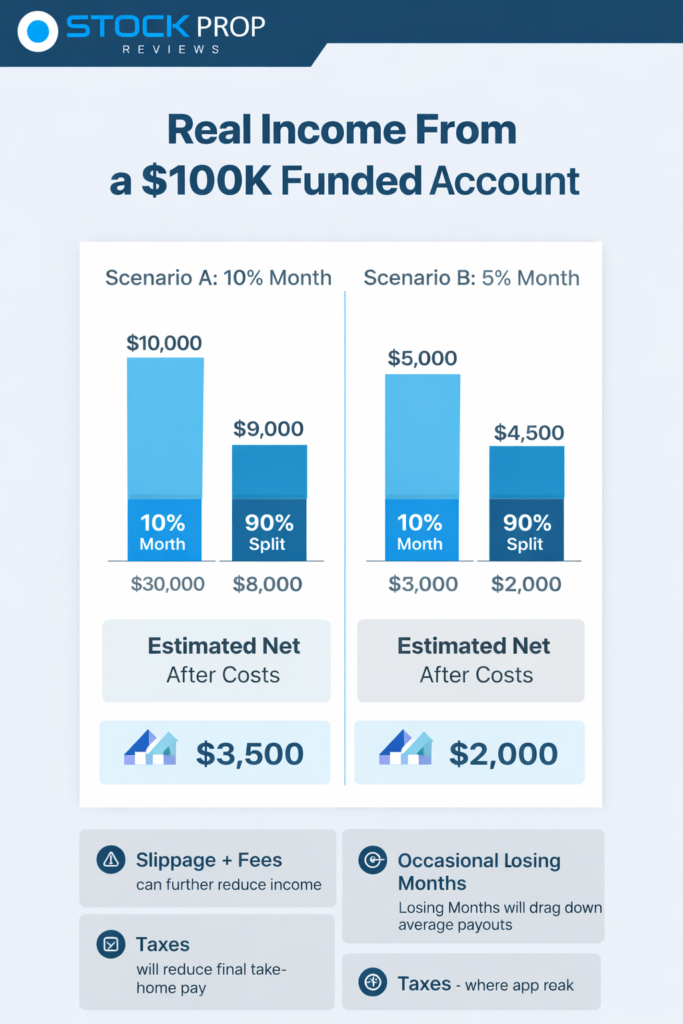
A trader has a $100,000 funded account with a 90% profit split and a 5% drawdown. A 10 percent month on paper looks like $9,000 after the split.
But most traders can’t keep making 10 percent a month. Long-term, disciplined traders usually make between 3% and 6% a month, and sometimes less.
At 5% a month, you would make $5,000 in gross profit and $4,500 after the 90% split.
Now take into account:
- Months when you lose money
- Commissions and slippage
- Fees for evaluation or resetting
- Taxes
That average of $4,500 can quickly feel like $3,000 in real money that you can use.
And that means there is no breach of the account.
The Drawdown Structure Changes Everything
The biggest factor in whether you can live off a prop account is not the profit split. It is the drawdown model.
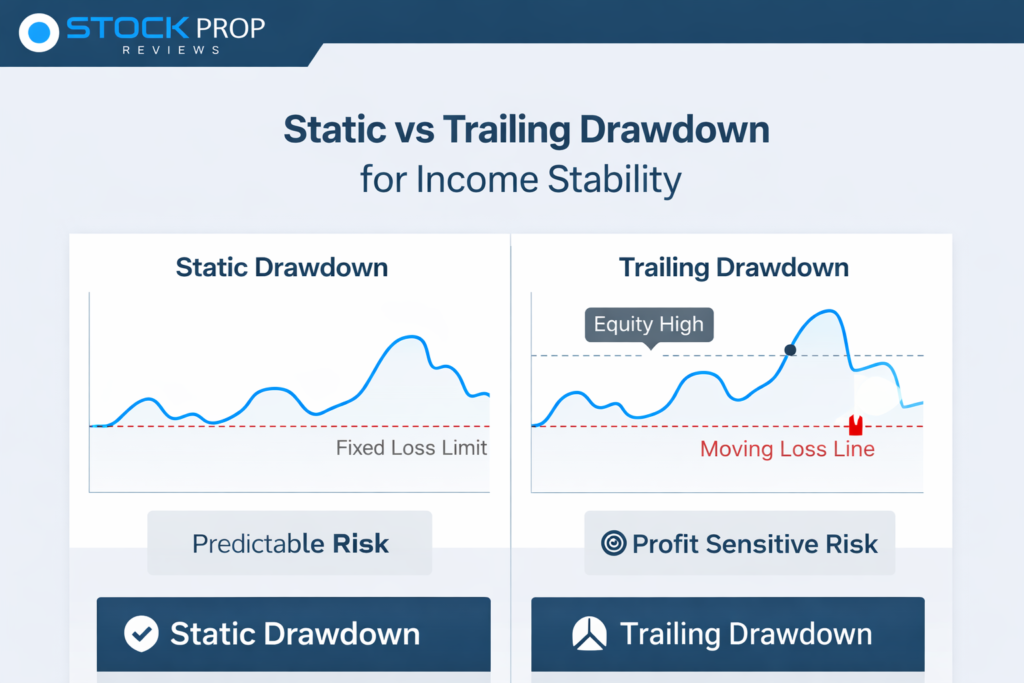
Static drawdown gives you a fixed loss limit. If it is 5 percent, that is your boundary. It does not move.
Trailing drawdown rises with your equity high. That means if you make a strong push upward and then pull back too far, you can lose the account even while still technically profitable overall.
This is where many traders break accounts after their first payout. We covered that behaviour pattern in our article on why traders lose funded accounts after payouts, and it is almost always tied to increasing risk under income pressure.
The real constraint on prop firm income is not just profit targets but the strict daily vs overall drawdown rules traders must operate within.
When your rent depends on performance, discipline becomes harder, not easier.
How Much Capital Do You Actually Need?
Let’s be realistic.
If you want to make $4,000 a month and get 4% returns on average, you need about $100,000 in capital before splits. That gets you close to your goal in a good month after a 90 percent split.
But that still means:
- No losing months
- No breaking the rules
- No drop in performance
Many full-time traders with funding have more than one account to deal with market fluctuations. A single $50,000 account doesn’t usually give you steady income unless your living costs are low.
The problem is that if you want to get meaningful payouts, you have to take on more risk with smaller accounts. Higher risk makes it more likely that a breach will happen. It turns into a cycle.
What Most Articles Do Not Explain
Competitor articles, which often talk about changing from prop trading to live trading, often talk about mindset. They don’t often talk about the stress that comes from being dependent on payouts.
When trading is your only source of income:
- You are unsure near drawdown limits
- You end trades early to make sure you get paid on time.
- You feel rushed at the end of the month.
- You sometimes make trades happen.
This is not a flaw in the character. It is how people act when they are short on money.
Trading edge can handle randomness. It has trouble when its income goes down.
The Psychology Shift When It Pays Your Bills
There is a big difference between trading to grow and trading to stay alive.
If trading is just a way to make extra money, you can skip setups that aren’t very good. If it’s your main source of income, you might feel like you have to do it every day.
That small change makes decisions better.
Even traders with good backtested strategies can see their performance drop when they start taking money out on a regular basis. The emotional burden gets heavier. Losing streaks that are small feel bigger. Drawdown feels like it’s about you.
Most of the traders who failed to get funding didn’t suddenly lose their skills. They lost their cool.
Many traders assume passing an evaluation means consistent payouts, but the real challenge starts after funding. Our breakdown of why most traders fail after funding explains the behavioural shift that happens once real payouts are involved.
How Traders Actually Blow Funded Accounts
This pattern is familiar:
A trader passes the test with a little bit of aggressive risk. They get their first payment. Confidence goes up. Increasing the size of your position will speed up your income.
Then one unstable session sends them into trailing drawdown.
Account is gone.
Another common situation is trading to get back at someone after a small losing week. One impulsive day can undo months of hard work if you are under financial stress.
Before you even think about going full-time, read our list of common mistakes made by funded traders if you are still not consistent.
Is It Different With Futures or Stock Prop Firms?
Structure is more important than the instrument.
Futures companies may offer clearer contract sizes and execution based on exchanges. Stock prop firms work in different ways. In our article comparing futures and stock prop firms, we looked at how their structures are different.
The math for income stays the same. You still need consistent percentage returns on your capital and strict control over your drawdown.
One thing to keep in mind is that there are rules. Companies like TradeThePool are regulated stock prop firms with clear rules about risk and daily loss limits. That clarity can help people understand the limits of execution and risk better.
When readers buy through our TradeThePool link, they can save up to 10%.
This isn’t about making money easier. It has to do with structure and openness.
The Tax Reality
Most of the time, this is not taken into account.
Most of the time, prop payouts are considered business income. Depending on where you live, you may have to pay income tax and other taxes. If you take out $60,000 in a year, your net take-home pay may be much lower.
A lot of traders use gross payout numbers to help them make decisions about their lives. That is dangerous.
Always look at net income after taxes.
When Living Off Prop Trading Makes Sense
It makes sense if:
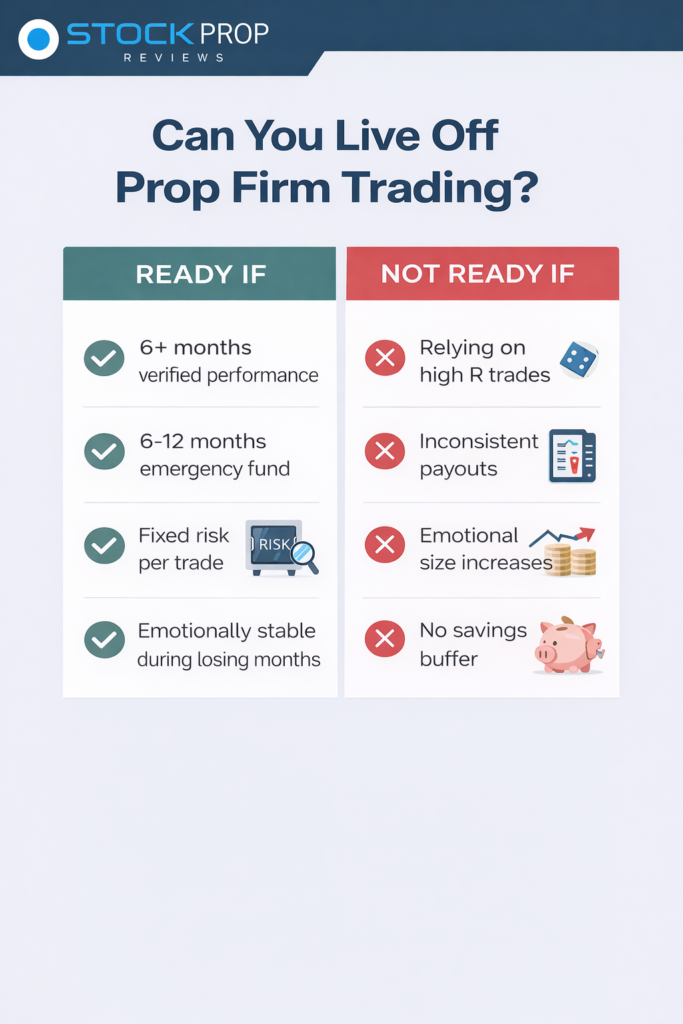
You have at least six months of verified funded performance.
You have a cash buffer covering at least six to twelve months of expenses.
Your strategy uses fixed, controlled risk per trade.
You can emotionally tolerate two losing months in a row.
It does not make sense if you are still relying on large R trades to pass challenges or if you increase size after every good week.
A gradual transition is usually smarter. Many experienced traders keep part time income while building consistent withdrawal history.
A More Realistic Path
Instead of quitting right away, trade funded accounts while you’re still working.
Take out some of your profits.
Keep track of monthly averages for at least six months.
Use the money you make from trading to build an emergency fund.
If your average net trading income is clearly higher than your costs over time, then the choice is based on logic rather than feelings.
The Honest Verdict
Yes, you can make a living by trading for a prop firm.
But only if: Your returns are steady and small
- You follow the rules for drawdown
- You handle mental stress well.
- You make plans for losing months.
- You figure out your net income, not your screenshots.
Most traders fail not because prop firms are unfair, but because they depend on their income to change their behaviour.
If you’re still trying to get evaluation passes, pay attention to the process. If you already have stable, funded results, take your time and run the numbers before making any big decisions.
FAQs
How much money can a funded trader really make in a month?
Traders who trade regularly usually make 3% to 6% a month. That could mean about $2,700 to $5,400 before taxes on a $100,000 account with a 90 percent split.
Is one funded account enough to work full-time?
No, not for most traders. Having more than one account or putting more money into one account lowers pressure and income volatility.
Are trailing drawdown companies harder to work for full-time?
They need equity curves that are smoother. Trailing models make it harder for volatile strategies to work.
Should new traders try to make a living by trading for prop firms?
No. New traders should work on building verified consistency before relying on trading income.
Is a stock prop firm that is regulated safer?
TradeThePool and other regulated structures make it easier to understand the risks, but the trader is still responsible for keeping their discipline and managing their risks.
If you really want to make money from trading, you need to run it like a business. Keep track of data. Take charge of risk. Make plans for change. And don’t let one big payout make you think that volatility is gone.