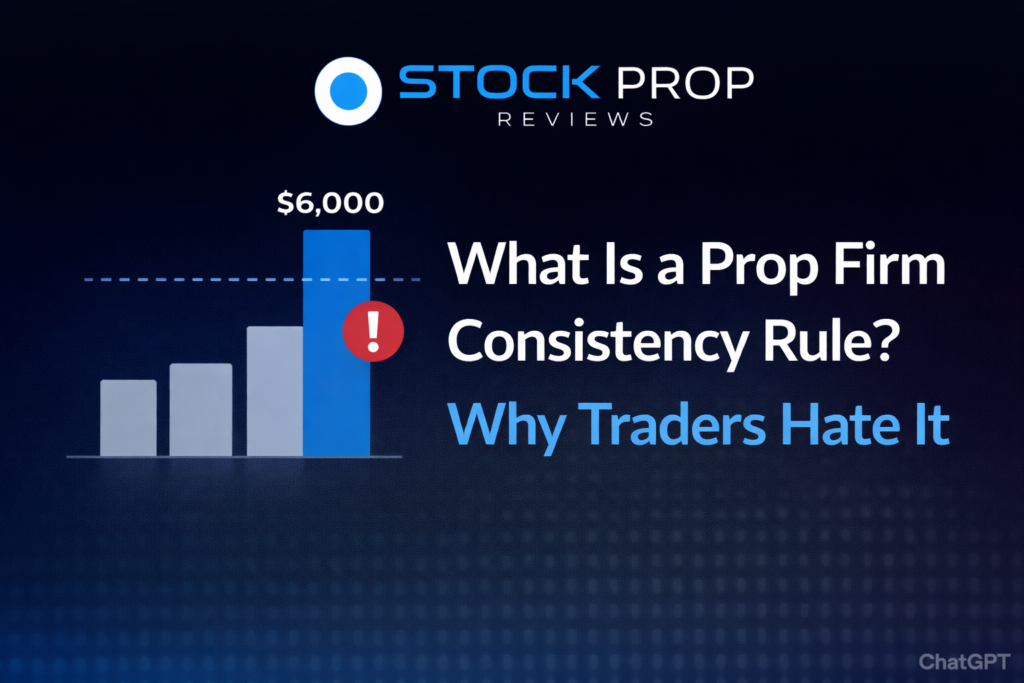
The percentage of your overall profit that can be derived from your best trading day or trade is restricted by a prop firm consistency rule. You must keep trading until your results are more evenly distributed if you make too much of your profit in a single session.
This article is intended for novice and experienced traders who wish to avoid losing a payout due to a technicality or failing an evaluation, particularly in futures. It is not for traders who think that demonstrating skill with a single big win is sufficient. The majority of businesses that employ consistency rules don’t agree with that notion.
Let’s examine the practical implications of this rule, potential pitfalls for traders, and its suitability for your approach.
What is the prop firm consistency rule in simple terms
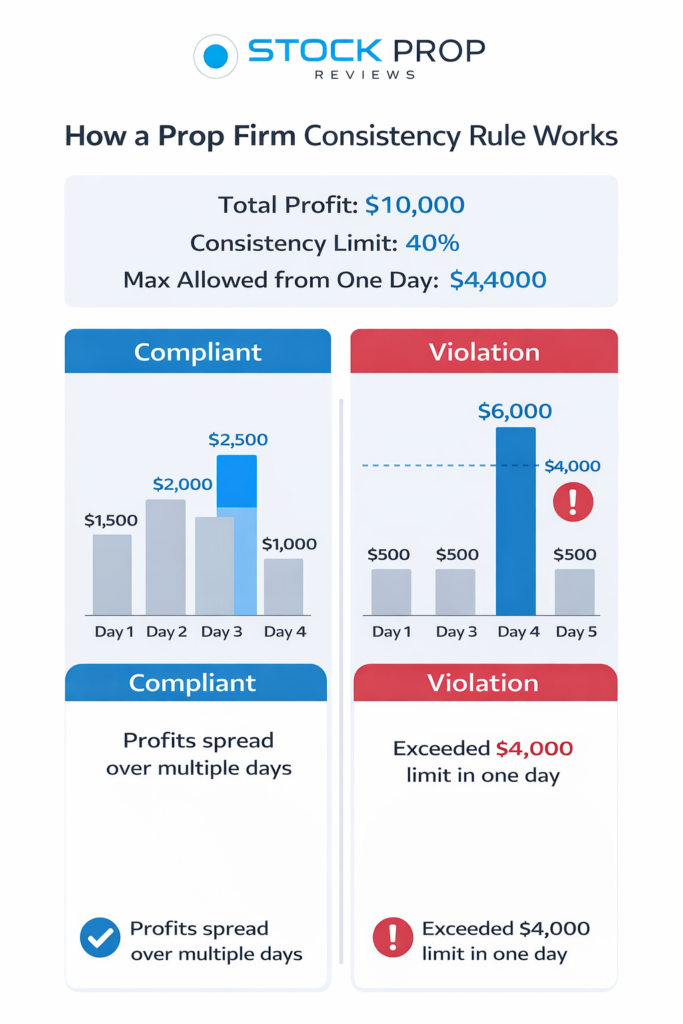
The rule says that a single day can’t make up more than a certain percentage of your total profits.
For example:
* Goal for total profit: $10,000
* Rule of consistency: 40%
* The most you can get in one day is $4,000.
You have technically broken the rule if you make $6,000 in one strong session and only $4,000 over the rest of the time. You need to keep trading until that $6,000 is less than 40% of the total.
The reasoning is clear. The results are not.
For more on how prop firm evaluations work, including profit targets and drawdown limits that often interact with consistency rules, see our breakdown of the evaluation process in stock prop firms.
Why prop firms introduced consistency rules
The rule keeps traders who make one lucky move from getting through to the next round. It also lowers the amount of money that is paid out when events are very volatile.
It often feels like traders are being punished for doing well when they trade.
Both points of view can be correct at the same time.
A company is doing business with some risk. You want to make money off of an edge. The rule about consistency is in the middle of that tension.
Where traders actually fail
Most traders don’t break the consistency rule because they’re careless. They fail because their plan naturally leads to profits that aren’t evenly spread out.
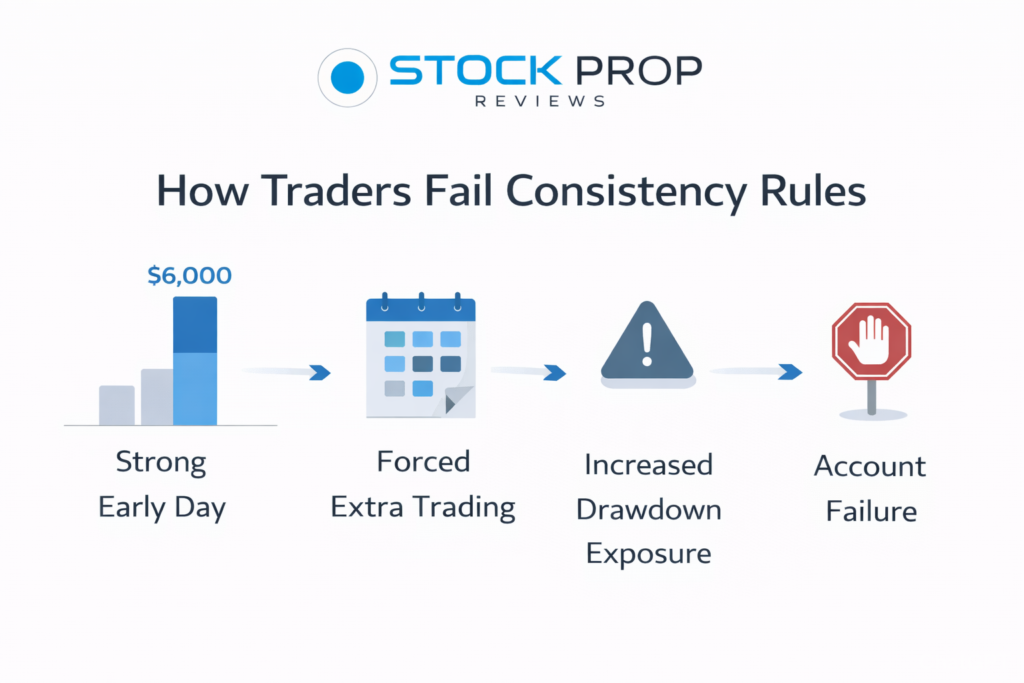
Strong early performance
In two days, a trader reaches 70% of their profit goal. They now have to stretch their performance over more sessions instead of being done. Every extra day makes you more familiar with the rules for drawdown.
The longer you trade, the more statistical variance hurts you.
News-based opportunity
A futures trader makes a big profit within their risk limits by catching a clean CPI breakout. That one move made half of the total profit. The deal was real. The rule still makes people trade more.
Position sizing adjustment
After a busy day, traders cut back on their size to stay below the percentage limit. When things are smaller, you often have to make trades just to “smooth” the results. The quality goes down.
People don’t talk about this much in marketing.
The interaction most people ignore
There are no rules for consistency that stand alone. They talk to:
* The most drawdown
* Limits on daily losses
* Limits on time
If you have to keep trading to keep your profits in line, you are more likely to hit a drawdown limit.
Some traders think that this rule is less about discipline and more about getting more exposure.
Is the rule about discipline or control
Companies say it’s discipline. In reality, it’s a tool for controlling volatility.
Professional trading companies care about how stable their returns are. The firm thinks that a trader’s equity curve is unstable if it depends on rare, big events.
The problem is that a lot of profitable strategies are lumpy by nature. Trend following, breakout systems, and swing trading often depend on a few big wins.
Those strategies are structurally weak when there is a strict rule about consistency.
Strategy fit analysis
Scalpers with set R targets usually do well. Their results are spread out over a lot of trades.
Intraday traders who keep their positions the same can also follow the rule, but they may need to change their sizes on days with strong trends.
Swing traders have a harder time. A multi-day position that makes a big move can change how profits are spread out.
Most of the time, news traders are the worst fit. Their advantage is mostly in certain events. That focus is in direct conflict with the limits on consistency.
If you’re trying to adapt your plan to meet consistency requirements, our guide on how to pass a prop firm challenge has practical steps for balancing profit targets and risk management.
What competitors do not explain clearly
A lot of articles talk about the rule but don’t talk about its real-life problems.
First, it changes how people act. Instead of looking for market opportunities, traders start trading for percentage balance.
Second, it gives you more time in the market. More time means more chances for mistakes, tiredness, and random things to happen.
Third, it could go against systems that expect good things to happen. A strategy that wins 30% of the time and has big winners will naturally break the rules for how profits are shared.
These are problems with the structure, not with feelings.
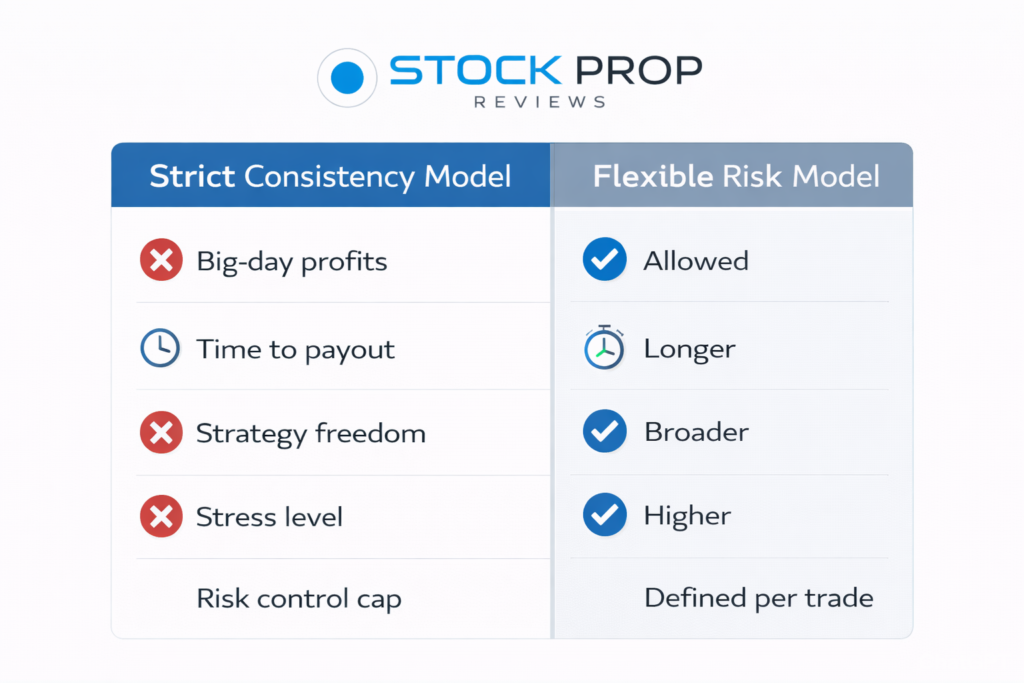
Comparison: consistency-heavy vs flexibility-focused models
| Feature | Strict Consistency Model | Flexible Risk Model |
| Large single-day profit | Capped | Allowed |
| Trading duration | Often extended | Shorter if target hit |
| Strategy freedom | Narrower | Broader |
| Behavioral pressure | Higher | Lower |
Some traders like the way strict rules are set up. Others do better when risk is set for each trade instead of for the whole profit distribution.
For instance, TradeThePool doesn’t have strict rules about how to share profits; instead, they use clear risk parameters and drawdown information. That way works for traders whose results are not always the same but are still under control.
When readers buy through our TradeThePool link, they can save up to 10%.
When it comes to futures, companies like Topstep and Earn2Trade use daily loss and trailing drawdown rules more than strict best-day profit caps, but the details of the programs differ.
Not the other way around: your strategy should fit the structure you choose.
Who should avoid strict consistency rules
People who trade with asymmetric payoff structures should think things through. If your system depends on a few big wins each month, the math might always be against you.
If you feel stressed out after good days instead of confident, the environment might not be right for you.
Rules for consistency reward sameness. They punish outliers, even those that make money..
Are consistency rules unfair
Not always. These are clear terms of the contract. The problem isn’t fairness; it’s compatibility.
If a company tells its customers about the rule ahead of time and sticks to it, it’s just part of the way they do business.
Before paying for an evaluation, traders need to know how the rule affects their strategy.
Internal context for deeper analysis
If you’re comparing companies, check out our article on how trailing drawdown works and our article comparing futures and stock prop firms. You should also check out our opinion piece on whether prop firm models match up with real trading conditions. Those talks show how consistency rules fit into the bigger picture of risk.
FAQs
What is the rule for consistency in a prop firm?
It limits how much of your total profit can come from one trade or day.
What do traders not like about it?
Because it can make them keep trading after they reach their profit goals, which increases their risk.
Can you fail even if you are making money?
Yes. A big gain in one day can mean that payouts are delayed or that more trading is needed.
Are all prop firms required to follow rules about consistency?
No. Some people pay more attention to daily loss and drawdown limits than to profit distribution caps.
Is the rule good for people who are just starting out?
It can help you size up steadily, but beginners should know the math before thinking it teaches discipline.
Final perspective
People often get the prop firm consistency rule wrong, but it’s not a scam. It protects businesses from payouts that change. It also affects how traders act.
Plan out how your strategy will make money before you join any company. The rule might not be a problem if your edge is steady and happens over and over again. If your edge is based on big moves that happen every now and then, you might always feel limited.
It’s hard enough to trade without structural friction. The goal isn’t just to pass the test. It is to trade in a setting that is in line with how you really make money.