Even a strategy that looks profitable in backtesting can lose money with prop firms. Backtesting prop firm strategies on historical data can be useful, but past performance does not take into account drawdown limits, execution issues, trading rules, payout policies or the mental strain of having a funded account.
This article is for beginners building their first systematic approach, and for funded traders trying to understand why a previously profitable setup stopped working. It’s not for traders who want a guaranteed backtesting method or a simple historical win rate predicting future prop firm performance.
The biggest mistake is taking a backtest as proof that a strategy will survive a prop firm’s rules. It is evidence, not proof.
What backtesting actually tells you
Backtesting means applying a defined trading strategy to historical market data to estimate how it might have performed.
A useful backtest can show:
- historical win rate
- average reward-to-risk
- maximum historical drawdown
- losing streaks
- trade frequency
- expectancy
- performance across different market conditions
But a backtest normally answers a narrower question:
“How would this set of rules have performed on this historical data?”
A prop firm trader needs to answer a different question:
“Can this strategy continue operating within this firm’s risk and execution constraints?”
Those questions overlap, but they are not identical.
A strategy can have positive expectancy and still be unsuitable for a particular prop account.
For example, say you have a strategy with a historical win rate of 55% and an average reward-to-risk ratio of 1.5 to 1. That looks attractive on paper.
But it has an eight-loss streak in its historical history sometimes.
If the strategy risks 1% per trade, that losing streak could lead to something like an 8% drawdown before accounting for slippage, commissions, differences in execution or other losses.
A prop firm’s maximum drawdown may not leave enough room for the trader to experience that normal statistical variation.
The strategy may not have failed.
The strategy-account mix isn’t working. .
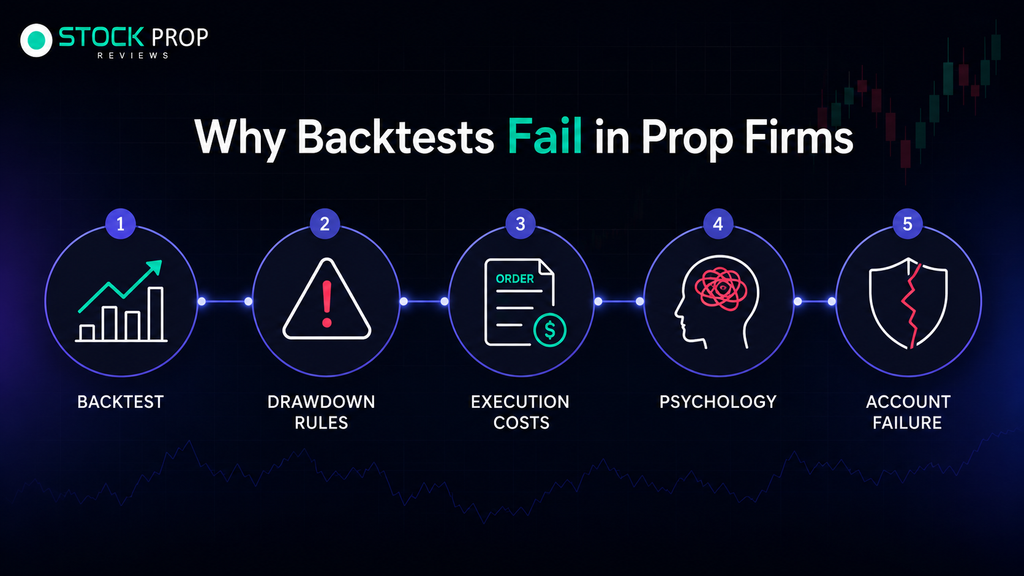
Why backtested strategies fail in prop firms
There are several recurring reasons.
The most important is that traders often backtest the strategy but do not backtest the environment in which the strategy will operate.
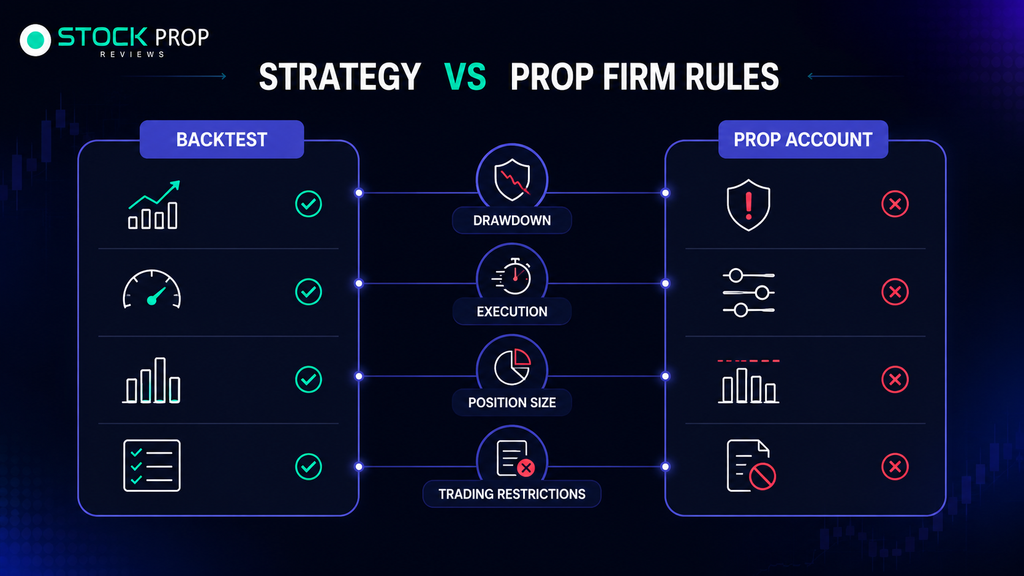
A personal trading account and a prop evaluation can have very different constraints.
| Factor | Backtest may assume | Prop trading reality |
| Drawdown | Strategy survives historical maximum DD | Firm may impose a much tighter loss limit |
| Position size | Size can remain constant | Firm rules may restrict exposure |
| Execution | Historical price fills | Slippage and real execution can differ |
| Trading frequency | Unlimited opportunities | Daily loss or consistency rules may interfere |
| Holding period | Positions can remain open | Overnight or news restrictions may apply |
| Psychology | No emotional pressure | Losses can trigger rule-breaking |
| Profit target | Not always relevant | Trader may need to reach a specific target |
| Market conditions | Historical sample | Future conditions can be different |
This is why a high backtest return should never be considered sufficient evidence on its own.
The drawdown problem most backtests underestimate
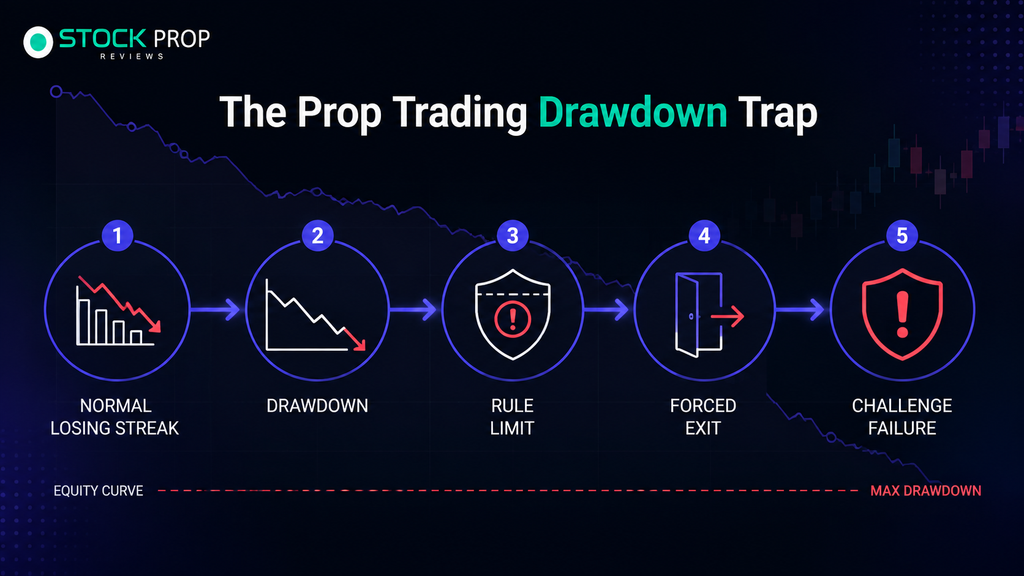
Drawdown is one of the biggest reasons a profitable strategy can fail a prop challenge.
Suppose a backtested strategy has:
- 50% win rate
- 2:1 average reward-to-risk
- 1% risk per trade
- historical maximum drawdown of 7%
A trader might conclude that a 10% maximum drawdown account provides enough room.
That conclusion could be wrong.
Historical maximum drawdown is not the same thing as maximum possible drawdown.
The backtest only tells you what happened in the sample.
The next losing sequence could be worse.
This matters even more when the prop firm’s drawdown is calculated differently from the trader’s backtest.
A trader might model drawdown using end-of-day equity while the firm calculates losses intraday. A strategy that appears comfortable in the backtest could therefore breach the account during a temporary intraday move.
This is one reason our Stop Loss Placement Affects Challenge Passing Rate is relevant when evaluating whether historical risk actually fits a prop firm’s limits.
A profitable strategy can still fail the profit target
There is another problem that gets less attention.
A strategy can be profitable but too slow for an evaluation.
Imagine a system with a genuine 0.25R average expectancy per trade. It makes money over a large sample, but it produces only a handful of trades each week.
If the evaluation requires a relatively large profit target within a limited period, the trader may feel pressure to increase position size or trade additional setups.
This is a dangerous cycle:
Slow strategy → pressure to hit target → larger positions → bigger losses → drawdown breach
The backtest didn’t necessarily fail.
The evaluation structure required faster results, so the trader changed the risk profile.
Backtesting does not reproduce execution perfectly
Historical charts make entries and exits look cleaner than in real trading.
For example, a backtest may enter at a price because the historical candle hit that price. .
In live trading, the order might fill several cents away, particularly in a fast-moving stock.
For a long-term swing system, a small difference may have limited impact.
For a short-term strategy with a tight stop, it can materially change the result.
This is particularly important for scalpers.
If a strategy makes small gains on each trade, commissions, spread, slippage and execution delays can consume a significant portion of the expected edge.
A backtest that ignores these costs can produce an inflated result.
The overfitting trap
One of the most dangerous backtesting mistakes is overfitting.
Overfitting happens when a trader keeps modifying a strategy until it performs exceptionally well on historical data.
For example, a trader tests a moving average crossover.
The results are mediocre.
They then change the moving average lengths.
Then they add a volatility filter.
Then a time-of-day filter.
Then a volume condition.
Then a specific exit rule.
Eventually, the historical results look excellent.
That does not necessarily mean the strategy became better.
It may simply mean the trader optimized the system to explain the past.
The more variables added after repeatedly inspecting historical results, the greater the risk that the strategy is fitted to noise.
A backtest with a 75% win rate can therefore be less useful than a simpler strategy with a 55% win rate if the first result depends heavily on optimization.
Why sample size matters
A strategy tested over 30 trades can look exceptional by chance.
Thirty trades are not enough to understand many important characteristics of a trading system.
The trader needs to know what happens across different environments.
For example:
- trending markets
- range-bound markets
- high volatility
- low volatility
- strong news periods
- quiet sessions
- different years or market cycles
A strategy that works beautifully in one particular market regime may have little evidence behind it outside that environment.
This is particularly relevant when traders backtest only the most recent few months.
Recent performance can create false confidence.
A trader might test a breakout system during an unusually strong trending period and conclude that breakouts are highly reliable.
When the market returns to a range, the same strategy may produce repeated false signals.
Backtest rules can differ from prop firm rules
This is where many articles about backtesting stop too early.
A prop firm does not simply evaluate whether your strategy is profitable.
It evaluates your trading activity against its own rules.
Consider a strategy that normally holds positions overnight.
If the chosen account does not allow that type of exposure, the backtest is not testing the same strategy that the trader will actually use.
The same applies to news restrictions, daily loss limits, maximum position size, consistency requirements and other account-specific conditions.
The firm’s rulebook effectively becomes part of the trading system.
This is why our Best Prop Firms in 2026 focuses on factors beyond headline profit splits. A strategy that fits one firm’s structure may be uncomfortable under another’s.
Backtesting prop firms requires rule-aware testing
A better approach is to build the prop firm’s constraints into the test.
For example, suppose your historical strategy has a daily loss limit of 3%.
Do not simply calculate the strategy’s total return.
Ask:
How many times would the strategy have hit the daily loss threshold?
Then test maximum drawdown under the firm’s calculation method.
Also examine what happens if:
- the trader hits the daily drawdown limit
- position size is lowered after a losing streak
- trading is disallowed at certain times
- overnight positions are flattened
- a daily profit cap or consistency condition is imposed
- commissions and realistic slippage are factored in
The result may look very different from the original backtest.
That is useful information.
A practical example
Consider a futures trader with a breakout strategy.
The historical test produces a 60% win rate and a 2:1 average reward-to-risk ratio.
The trader believes the system is strong enough for a prop challenge.
But further testing reveals something important.
Most of the strategy’s profits come from a small number of large trend days.
On normal days, the system produces several small losses.
Now add a prop firm’s daily loss limit.
The trader could reach the daily loss threshold before the large winning move eventually appears.
The backtest may still show positive expectancy.
But the prop account cannot necessarily tolerate the path required to realize that expectancy.
This is the difference between terminal profitability and path dependency.
A strategy does not only need to finish profitably.
It has to survive the journey.
Psychology changes the backtest
A historical test does not experience fear.
The trader does.
This sounds obvious, but it changes execution.
Imagine the backtest shows that a strategy can tolerate six consecutive losses.
A trader may intellectually accept that fact before starting.
After losing three trades in a funded evaluation, however, they may skip the fourth setup.
After the fifth loss, they may reduce size.
After the sixth, they may abandon the strategy.
Then the system finally produces its winning sequence.
The trader never participates.
This is one of the reasons profitable systems can produce poor real-world results.
The problem is not always the strategy.
It can be the trader’s inability to execute the distribution they already accepted in the backtest.
Our Why Profitable Traders Still Fail Prop Firms explores the broader relationship between strategy quality, account rules and trader behaviour.
Backtesting cannot measure every operational risk
There are also risks that are difficult to model accurately.
Platform interruptions can occur.
Liquidity can change.
A stock can halt.
Spreads can widen.
An order can fill differently from the historical assumption.
Market data can contain errors.
A trading strategy can also depend on information that was not available in exactly the same form at the historical decision point.
These issues do not make backtesting useless.
They simply define its limits.
The correct response is not to abandon historical testing. It is to avoid treating the backtest as a perfect simulation of the future.
What competitors often miss
A common explanation is that backtested strategies fail because markets change.
That is true, but incomplete.
The bigger issue is often the interaction between strategy, account rules and trader behaviour.
A strategy can remain profitable in the market and still become unsuitable for a prop account.
For instance, a swing strategy historically needed a 6% drawdown to recover from typical losing periods. A prop account with a much smaller effective drawdown buffer may force the trader to reduce risk so much that it is impossible to reach the firm’s target.
That is not simply a market problem.
It is a strategy-fit problem.
The same issue appears when traders compare firms using only advertised account sizes or profit splits.
Our FTMO Review and TradeThePool Review illustrate why the actual account framework matters when deciding whether a strategy fits.
How to make a backtest more useful for prop trading
A stronger testing process has several stages.
First, test the basic strategy without excessive optimization.
Second, use enough historical data to expose the system to different market environments.
Third, include realistic transaction costs and slippage.
Fourth, calculate maximum drawdown and losing streaks rather than focusing only on return.
Fifth, apply the actual prop firm’s trading restrictions to the historical results.
Sixth, test lower risk than the maximum permitted.
Finally, forward-test the strategy before relying on it with meaningful account risk.
The objective is not to create a perfect historical equity curve.
The objective is to discover how badly the strategy can behave while still remaining manageable.
That information is far more useful to a prop trader.
Should you reject a strategy because the backtest looks bad?
Not necessarily.
A weak backtest may reveal a strategy that needs refinement.
But a strategy with a spectacular backtest should not automatically be trusted either.
A sensible trader should be more interested in robustness than perfection.
For example, if changing a parameter from 20 to 21 completely destroys performance, that may indicate fragility.
If the strategy performs reasonably across a broad range of parameters and market conditions, the evidence is more encouraging.
The same principle applies to drawdown.
A strategy that produces 20% historical returns with a 15% drawdown may be less suitable for a prop account than a strategy producing 12% returns with a 4% drawdown.
The highest return is not necessarily the most useful result.
Where TradeThePool fits
For stock traders, TradeThePool can be relevant because its program is focused on equities and publishes detailed information about trading requirements, risk management, evaluation and funded-account conditions. Its current program terms also make clear that the evaluation environment is simulated and that traders must adapt their strategies to the firm’s defined rules.
There is an important accuracy point regarding regulation. TradeThePool’s own disclosures state that it is a proprietary trading firm and not a financial institution or regulated entity outside the applicable regulatory framework. Its AML policy also describes the company as operating as a proprietary trading firm rather than a regulated financial institution.
So traders should not treat TradeThePool as a regulated stock prop firm. What can reasonably be highlighted is its published rule documentation and risk transparency. Readers can get up to 10% discount when purchasing through our TradeThePool link.
That distinction matters because regulatory status and rule transparency are not the same thing.
Common backtesting mistakes
The most common mistake is optimizing for return instead of survival.
Other problems include using too little data, ignoring trading costs, assuming perfect fills, testing only favourable market conditions and changing rules after seeing the results.
Another major mistake is using the backtest to justify a predetermined decision.
A trader who wants a particular strategy to work can unconsciously keep adjusting it until the historical chart agrees.
The better question is not:
“How can I make this backtest profitable?”
It is:
“Under what conditions does this strategy stop working?”
That question produces more useful risk information.
The bottom line for prop traders
Backtesting is valuable, but a backtested strategy is not automatically a prop-firm-ready strategy.
The strategy must survive more than historical market conditions. It has to operate within drawdown limits, execution costs, trading restrictions, profit targets and the trader’s own psychology.
The most dangerous assumption is that a strong historical equity curve proves future success.
It doesn’t.
Robustness is a better measure.
Try out different market environments. Add realistic costs. Mirror the firm’s real rules. Study losing streaks Reduce risk to let the strategy space breathe. Forward-test before committing major capital or evaluation fees.
If the strategy only works when everything goes right, then it’s probably not ready for a prop account.
The evidence is much more useful if it still behaves reasonably when conditions become uncomfortable.
FAQs
Can a profitable backtested strategy fail a prop challenge?
Yes. A strategy can be historically profitable but still breach the firm’s daily loss or maximum drawdown limits before its statistical edge has time to play out.
How much backtesting is enough for a prop strategy?
There is no universal trade count. The test should cover enough trades and different market environments to reveal losing streaks, drawdowns and changes in performance rather than relying on a small favourable sample.
Why does my live strategy perform worse than my backtest?
Common reasons include slippage, commissions, execution differences, changing market conditions, overfitting and psychological changes that prevent the trader from following the tested rules.
Should I optimize my strategy for a prop firm’s rules?
The rules should be included in your testing, but excessive optimization is dangerous. A strategy should remain reasonably robust rather than being engineered around one historical period or one specific parameter set.
Is backtesting enough before joining a prop firm?
No. Backtesting should be combined with forward testing, realistic execution assumptions and a detailed review of the firm’s current rules. The goal is to establish whether your strategy and the account structure are compatible.