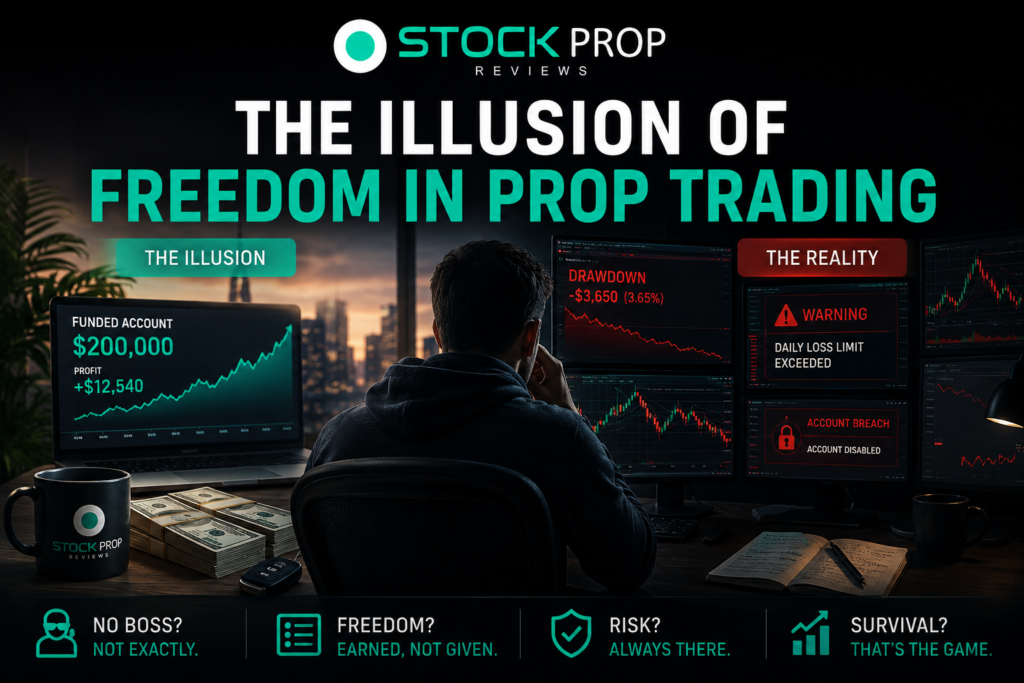
The online trading industry sells a powerful concept.
Work from home Trade huge money. Retain most of the profits. Break free from the traditional 9-to-5.
Many people see prop firms as a shortcut to financial independence.
The reality of prop trading is a bit less glamorous.
Funded accounts can help skilled traders scale but they also add a level of pressure most beginners don’t expect. Traders learn fast that freedom in prop trading still comes with restrictions, emotional stress and constant performance pressure.
This article is for traders who are considering opening a funded account or want to understand why so many people lose them again and again. This isn’t for people looking for motivational trading content or unrealistic success stories.
The Prop Trading Reality Behind “Freedom”
Most prop firms market flexibility.
You can trade from anywhere. You can access larger capital than your personal account. Some firms offer profit splits above 80%.
None of that is false.
The problem is that traders often confuse access to capital with financial freedom.
A trader with a funded account is still operating inside a strict rule structure. Daily drawdowns, consistency requirements, lot size restrictions, and payout conditions shape almost every trading decision.
Many beginners do not realise how mentally exhausting that becomes after several weeks.
At first, the structure feels exciting.
Then reality starts showing up:
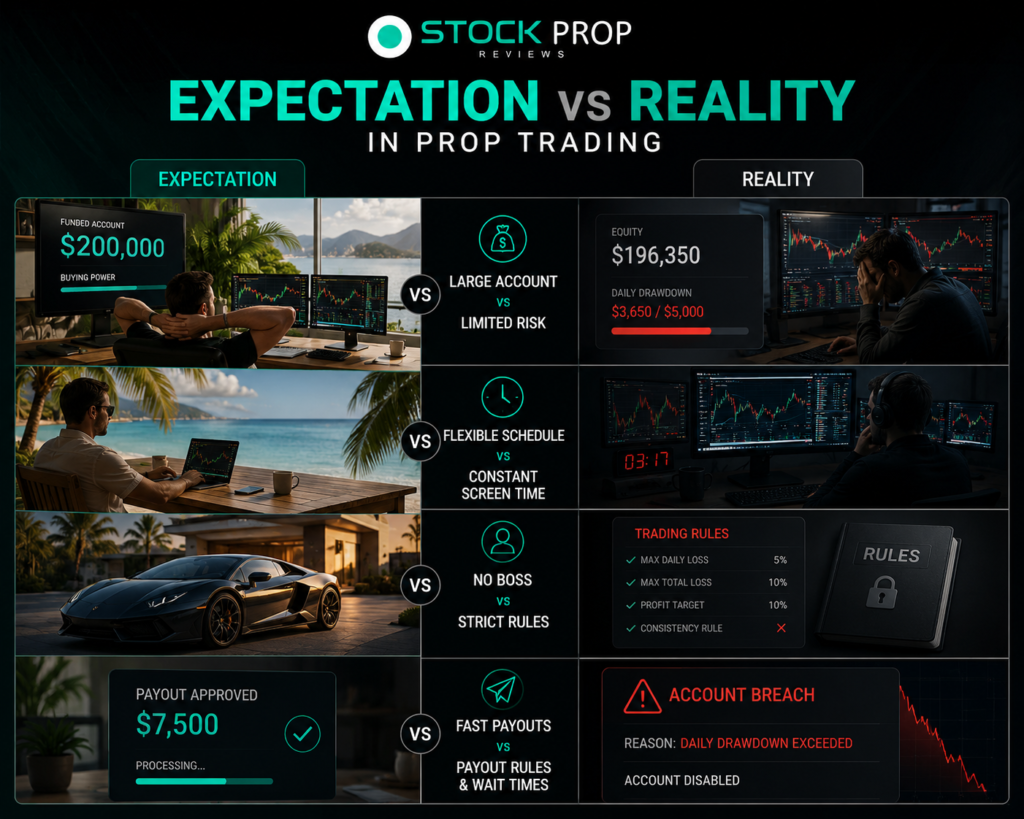
| Expectation | What Usually Happens |
| Large funded account | Small usable risk before breach |
| Flexible schedule | Traders stay glued to charts all day |
| Fast payouts | Pressure to force trades |
| No boss | Rules replace the boss |
| Trading freedom | Emotional pressure increases |
A lot of traders enter the industry thinking the challenge is passing evaluation.
The real challenge starts after funding.
Why So Many Traders Fail After Getting Funded
One thing competitors rarely explain properly is how trader behaviour changes after funding.
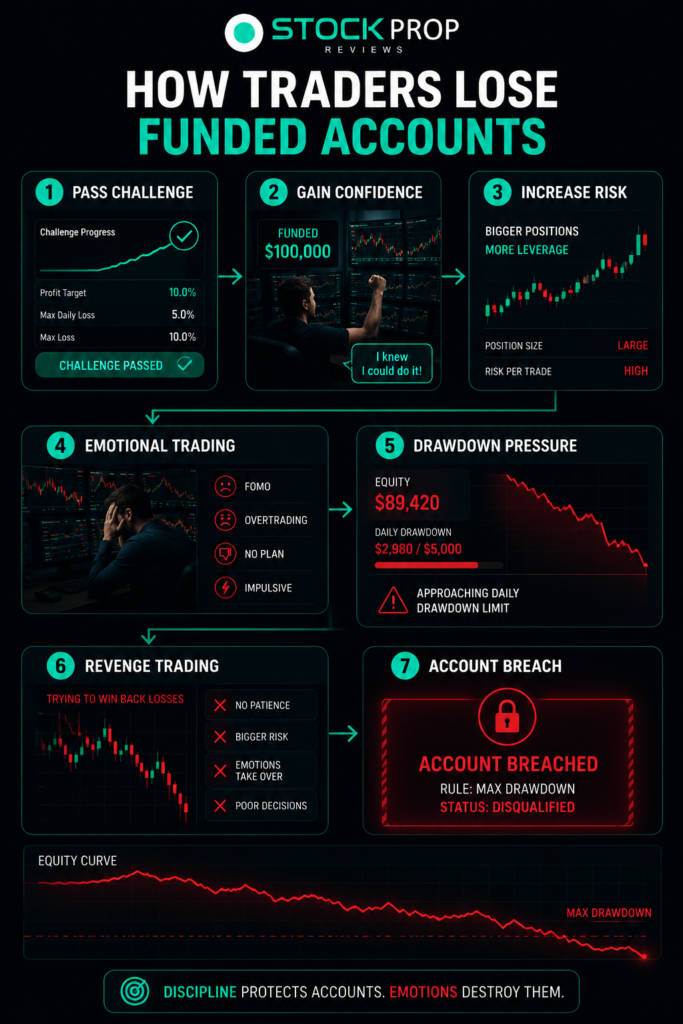
During evaluations, traders often become aggressive because they want quick results. They increase position sizes, overtrade volatile sessions, or take setups they would normally avoid.
Sometimes that works.
A trader passes the challenge and suddenly feels confident.
Then the funded phase begins.
Now every trade feels heavier because the account can actually be lost. The trader who passed in five days suddenly struggles to remain consistent for five weeks.
This is where the prop trading reality becomes obvious.
Most traders are not losing because their strategy completely stopped working. They lose because pressure changes their decision making.
A few common situations:
- A trader tries to recover losses too quickly after a bad morning.
- Someone trades news volatility even though it does not fit their system.
- A trader keeps entering mediocre setups because payout day is approaching.
- Scalpers increase risk after two losing trades.
The strategy may still be fine.
The execution becomes emotional.
Prop Firms Are Not Designed for Gambling
There are a lot of traders complaining about the strict prop firm rules.
Some criticism is deserved, particularly when firms sell “freedom” but impose heavy restrictions.
But there’s a reason for most rules.
Many traders would wipe out accounts quickly without risk controls through overleveraging and revenge trading.
That is why firms rely on structures like:
| Rule | Why Firms Use It |
| Daily drawdown | Prevents emotional account destruction |
| Maximum loss limit | Protects capital exposure |
| Consistency rules | Discourages one lucky trade |
| News restrictions | Reduces volatility risk |
| Minimum trading days | Encourages patience |
The issue is not that rules exist.
The issue is that traders often underestimate how difficult it is to perform consistently inside those limits.
A 5% drawdown sounds manageable on paper.
It feels very different when a trader is down before the New York session even opens.
Social Media Distorted Trading Expectations
One of the biggest reasons beginners have problems is that the online industry is far from real trading.
Social feeds are flooded with screenshots of challenge passes, clips of luxury lifestyles, payout certificates and ridiculous profit claims.
Very few people have:
- No payments for months
- Psychological burnout
- Failed assessments
- Emotional overtrading
- Periods of flat performance
That creates false expectations.
Many traders start to think that professional trading should provide a steady income in the short term.
The reality is even the best traders have hard times.
There are slow months.
Some months are rough.
Some months are just about preservation of capital.
This is one reason why many funded traders quietly vanish after early success.
We didn’t think the pressure would be this hard.
The Hidden Psychological Cost
The hardest part of funded trading is usually psychological, not technical.
Most traders already know basic concepts like support and resistance, trend structure, or risk-to-reward ratios.
The bigger issue is emotional consistency.
Trading from home sounds attractive until every losing streak starts affecting confidence, sleep, and personal life.
A trader can spend weeks building profits and lose the account in two emotional sessions.
That creates a dangerous cycle.
The trader feels pressure to recover quickly.
So they buy another challenge immediately.
Then another.
Eventually, challenge fees become part of the emotional cycle instead of part of a structured trading plan.
This is something many competitors avoid discussing because it damages the fantasy surrounding funded trading.
What Competitors Usually Leave Out
A lot of content around prop firms focuses almost entirely on opportunity.
The uncomfortable parts get ignored.
Large Accounts Can Create False Confidence
A trader with a $200,000 funded account may psychologically feel successful.
But practical risk flexibility is often much smaller than expected.
Once drawdown rules are applied, the usable margin for mistakes becomes limited.
The account size sounds impressive online, but the real challenge is surviving long enough to benefit from it.
Payout Pressure Changes Behaviour
Many traders behave differently near payout deadlines.
Instead of waiting patiently, they begin forcing setups because they want to lock in profits.
That usually reduces trade quality.
Remote Trading Can Become Unhealthy
The idea of working from anywhere sounds appealing.
But many traders slowly become isolated, overstimulated, and mentally exhausted from staring at charts all day.
Freedom without structure can become unhealthy surprisingly fast.
Common Mistakes Funded Traders Make
Most failed accounts come from repeated behavioural patterns.
The same mistakes appear again and again.
Risking Too Much Early
New traders when they get funded often want to maximise returns immediately as opposed to protecting the account.
“Professional traders think differently.
Survival first, they’re focused on.
Trading Every Session
Some traders follow the Asian, London and New York daily.
Over weeks of mental fatigue silently building up, the quality of decisions deteriorates.
Not trading. An art form.
Copying Social Media Strategies
A strategy copied from social media may work temporarily, but traders who do not understand the logic behind it usually collapse during difficult market conditions.
Treating Challenges Like Gambling
A surprising number of traders approach evaluations with a casino mindset.
Instead of building consistency slowly, they try to hit targets aggressively in a few days.
That behaviour occasionally passes challenges, but it rarely survives long term.
Who Should Avoid Prop Trading?
Not every trader should start with funded accounts.
Some people would genuinely improve faster by trading a small personal account first.
Prop trading may not be ideal for:
| Trader Type | Main Problem |
| Complete beginners | Pressure arrives before skill development |
| Emotional traders | Drawdown stress increases impulsive decisions |
| Traders needing monthly income urgently | Desperation affects execution |
| Overaggressive scalpers | Tight rules punish inconsistency |
| Traders chasing social media lifestyles | Unrealistic expectations |
There is nothing wrong with slower growth.
The internet makes patience look boring, but patience is usually what keeps traders alive long term.
A More Balanced View of Prop Firms
Despite the criticism, prop firms are not automatically bad.
For certain traders, they can be useful.
An experienced trader with a proven system may benefit from external capital access without risking large personal savings.
Some firms also provide clear risk structures that force discipline.
The difference usually comes down to mindset.
Strong traders treat funded accounts like professional business capital.
Weak traders treat them like lottery tickets.
That difference changes everything.
Comparing Different Prop Trading Models
Not every prop model works for every trader.
This is where many beginners get it wrong. They select companies based on marketing instead of compatibility.
| Model | Better For | Usually Bad For |
| Instant funding | Experienced disciplined traders | Beginners chasing fast payouts |
| Two-step evaluations | Patient swing traders | Emotional scalpers |
| Futures firms | Structured intraday traders | Traders holding overnight often |
| Stock prop firms | Equity-focused traders | Traders looking for extreme leverage |
A better question is not “Which prop firm is best?”
The better question is:
“Which structure actually matches my personality and trading style?”
Why Rule Transparency Matters
One positive development in the industry is that traders are paying more attention to transparency.
Clear rules matter more than flashy marketing.
TradeThePool, for example, positions itself as a regulated stock prop firm with relatively structured risk conditions and transparent evaluation models.
That does not guarantee success.
No prop firm can do that.
But firms with clearer communication generally help traders understand expectations better before committing money.
Readers can get up to 10% discount when purchasing through our TradeThePool link.
The more important point is understanding whether a firm’s structure actually fits your trading behaviour.
The Real Meaning of Trading Freedom
For beginners, trading freedom is often defined as:
- Home working
- No administration.
- Flexible working hours
- Major capital access
It is usually defined differently by experienced traders.
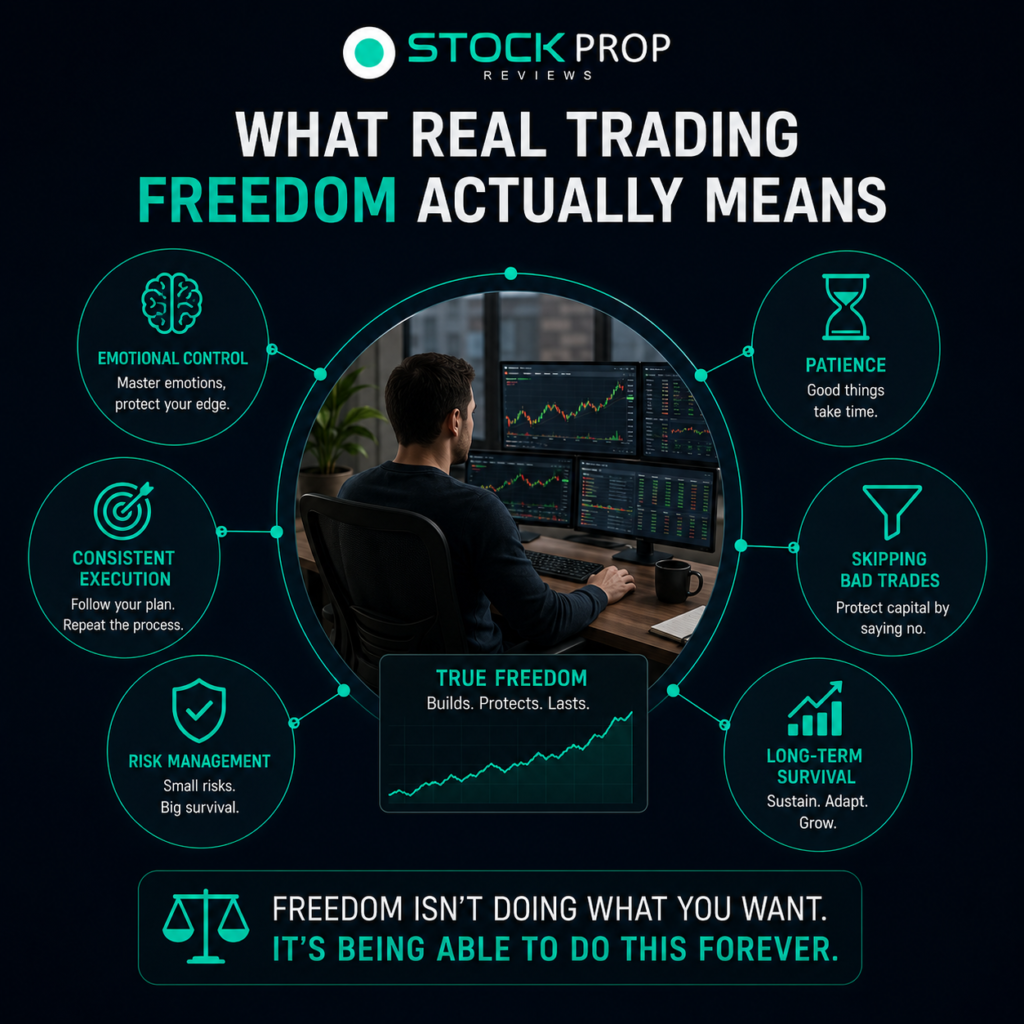
Real freedom in trading means this:
- Stability of emotions
- Risk under control
- Consistent play
- The ability to avoid bad markets
- Less pressing payments
That kind of freedom takes years to build up.
It’s not just going out and buying another evaluation challenge.”
Final Thoughts on the Prop Trading Reality
Prop trading is neither the golden goose the internet makes it out to be nor the total scam some critics try to make it out to be.
It’s a tough performance environment.
There are some traders who actually make money with funded accounts and scale up as time goes on.
Some get caught in a cycle of endless assessments, chasing quick results before ever developing emotional discipline.
The traders who are most likely to survive long-term, are not necessarily the smartest traders.
They are usually the most controlled.
They know that consistency is more important than excitement.
They respect the risk limits.
And they quit treating funded trading as entertainment.
If you are comparing firms, our analysis of funded account restrictions tells you how drawdown rules affect long term survival. Those traders who are interested in equities can also check out our TradeThePool review for a closer look at regulated stock prop environments. We also explored instant funding vs evaluation models for traders trying to make a choice between different prop structures. If you’re having trouble with the emotional side of trading, check out our article on why traders lose funded accounts repeatedly for more on the psychological side.
TradeThePool prospective readers should focus less on the marketing of account size and more on the rules that actually fit their trading personality. Readers can get a discount of up to 10% when buying through our TradeThePool link.
FAQs
Is it possible to earn a full-time income from prop trading?
Yes, for a very small minority of disciplined traders. Most beginners find it hard to trade full time at first because of inconsistent income and emotional pressure.
Why Traders Blow Funded Accounts So Fast?
Most accounts are lost due to emotional decisions, oversized risk, revenge trading and not being able to stay disciplined under drawdown pressure.
Funded accounts are safer than personal trading, but they do come with some risks.
They are less demanding in terms of huge personal capital, but they are also strict in rules and psychological pressure, which many traders underestimate.
Is passing a challenge a measure of your trading skill?
Sometimes not. Some traders go through aggressive short term risk taking but fails to maintain consistency after funding.
What kind of traders do well in prop firms?
Patient traders who have good emotional control and realistic expectations will tend to survive longer than traders who are only in it for the quick payouts.