Preferences for new proprietary trading firms enter the market with attractive profit splits, lower hurdles, larger account sizes, and aggressive advertising. However, setting up a prop firm is far simpler than the long road to building a viable, long-term business. New operators fail for many reasons: excessive marketing costs, bad risk management, technology issues, loss of trader confidence, etc.
Not all failed prop firms are operators who failed to attract clients. Some earn lots of challenge revenue but do not manage operating expenses and payouts. Others are plagued by platform disruption, loss of reputation due to inconsistent rules, or regulatory uncertainty.
This is an analysis for traders who want to learn more about what happens behind the scenes for evaluation-based funding and see red flags before buying a challenge. Not an assertion all startups bust in two years. There are no verified industry-wide statistics tracking a two-year failure rate.
Why New Prop Firms Struggle to Survive
It doesn’t take an hour to set up the prop firm, neither does a payment processor, a trading platform, and a website suffice. You need infrastructure, capital, risk controls, customer service, and contract terms to build a viable business.
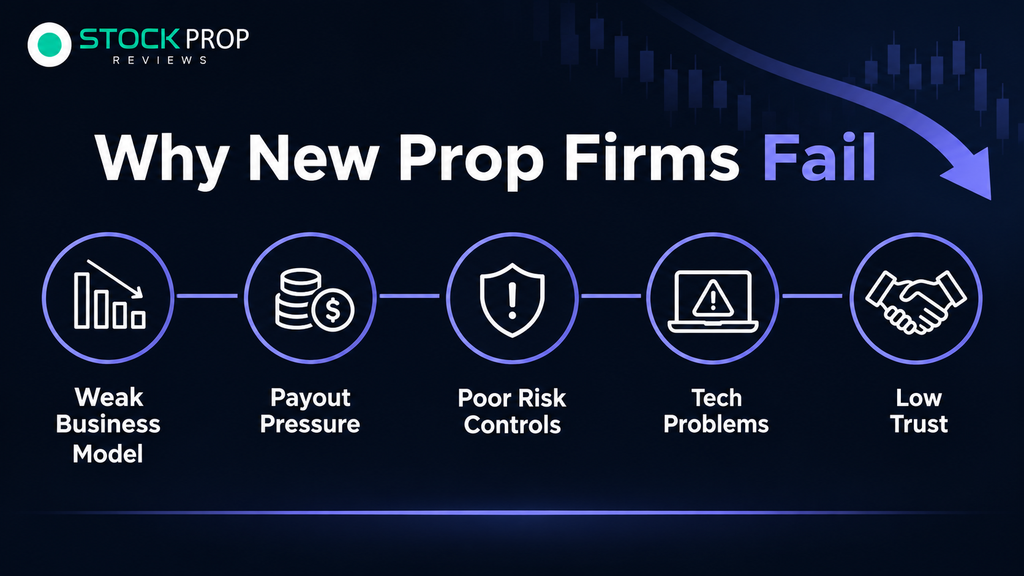
Several weaknesses can make survival difficult.
1. Dependence on Challenge Fees
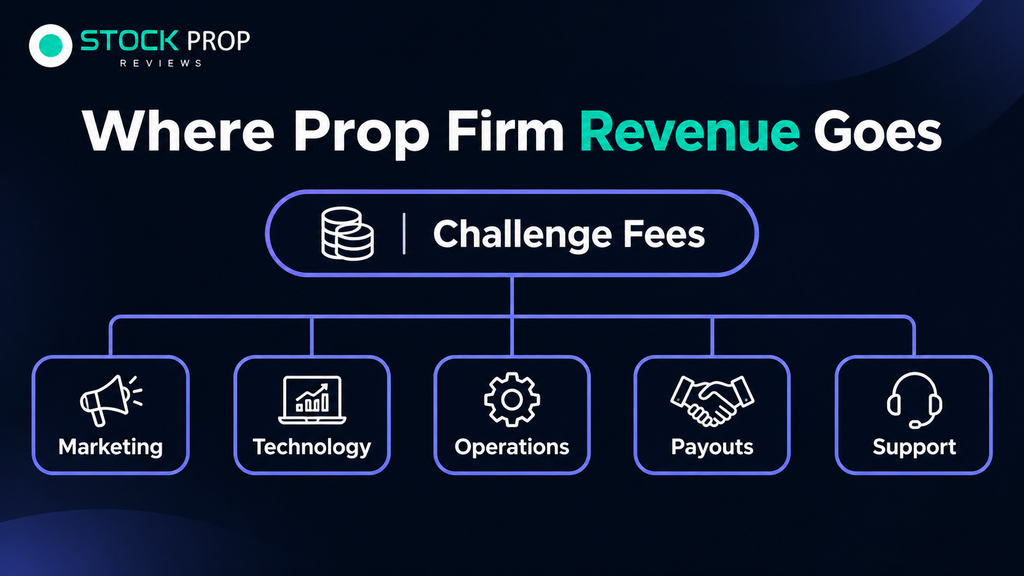
Many component prop firms that depend on evaluation courses make money from challenge and account reset buys along with other evaluation services.
Relying on this model can be highly lucrative, but it also can be a strength if the dependency on new purchases becomes too great. Imagine the fate of a company that depends on sales of evaluations if new purchase slows down.
If a company has 1,000 challenges at $100 apiece. Gross revenue is $100,000. But that is not the company’s profit.
The company must pay for marketing, payment processing, platform licensing, employees, customer service, refunds, and trader payouts.
The company may become bankrupt if costs increase at a higher rate than revenues. Or worse yet, if the company fails to account for existing financial liabilities when sales decline.
2. Unrealistic Profit Splits and Discounts
New companies will often try to attract traders with 90 or 95 percent splits of profits, a reduced evaluation, and promotional bonuses.
These are attractive offers, but they do not guarantee a sustainable business.
Large profit splits are not always a red flag. For instance, older organizations can afford terms that other competing organizations can’t. The issue is when the terms are overgenerous combined with healthy advertising, discounted evaluation, and ineffective financial planning.
For instance, a company that offers heavily discounted challenges may attract many customers initially. But if that company accumulates in acquisition costs and operating costs that are not balanced by revenue, the company may be in financial jeopardy.
Some companies cope with such problems by changing terms, freezing withdrawals, or postponing payments. Such decisions can quickly erode trader confidence.
3. Poor Risk Management
Risk management is more than simply limiting all drawdowns per trader. Prop firms also have to manage their financial and market exposure.
Depending on their business model, companies may use simulated trading, internal risk controls, external liquidity providers, or live market execution. All of these arrangements are accompanied with operational and financial risks.
There are winning traders and those who act consistently within the firm’s rules. But if the firm has not accounted for payout obligations, it will eventually run into trouble as well, even if those traders may have committed no illegal acts.
A good company will keep an eye on things like total exposure, intercorrelated positions, hedging costs, payout probabilities, and market volatility.
The size of an account in an advertisement does not indicate the financial strength of a company.
4. Technology and Platform Problems
Technology is another major cost that novice operators might not think of.
Traders need to have reliable price feeds, execution, calculations, and dashboards. Technical issues can directly affect trading results and account status.
Consider a trader who hits a daily loss limit. The dashboard is therefore a trick: the platform is not connected to the company’s risk-management system and displays an incorrect balance. The trader has a breach on the back end and enters it into the log but continues to trade thinking he has a good drawdown.
Unless it is a technical issue, not done with intent, a trust gap will develop between the trader and firm.
New companies must always pay for platform licensing, servers, market data, cybersecurity, account monitoring, and technical support. Technology is a continuous operating expense and not a one-time investment.
5. Regulatory Uncertainty
Regulatory uncertainty can also be a problem for new prop firms.
Measuring firms can be less similar to traditional securities brokerage firms. They will be treated legally based on what they do, in what jurisdictions, in what business structures, and with whom they have relationships.
Merely stating that a business is a proprietary trading firm does not insulate it from all regulated activity.
Depending on the activities of each company, it may need to satisfy customer verification, anti-money laundering requirements, consumer protections, data privacy, and licensing requirements.
The diversity of legal obligations around the world complicates this for foreign companies.
Traders also need to understand the difference between company registration and financial regulatory authorization. Registration does not mean that a business is authorized to provide all types of financial services.
6. Aggressive Marketing and Customer Acquisition Costs
Prop trading is a competitive area of the market. New companies are often busy trying to attract customers via influencers, affiliates, sponsored reviews, discount campaigns, etc.
Marketing is necessary, but if a firm spends too much, it will jeopardize profitability.
For example, consider a hypothetical company paying $60 to acquire a customer who pays $50 for an evaluation. The first order is losing money even before you factor in platform fees and the cost of service and payout liability.
Perhaps the company believes that it can recover these costs through repeat purchases and/or account resets. But repeat purchases are never guaranteed.
If customer retention falls or advertising costs rise, the company may not be able to maintain this revenue.
7. Payout Disputes and Weak Customer Support
Prop firms can’t afford to alienate trader confidence.
Traders know that trading is a game of risk, and losing an evaluation isn’t necessarily a bad thing. However, refusing withdrawals for no reason and delaying payouts time and again can irreparably affect a firm’s reputation.
Common complaints include slow support response, contradictory rule interpretations, abrupt changes in withdrawal requirements, and unexplained account closures.
Even a single dispute over a payout does not indicate a company is insolvent. But many unresolved complaints indicate weaknesses by management in running its operations.
Before expanding the customer base, a company needs to be uncertain about payouts. Otherwise, the problems will only worsen with the growth of the customer base.
Real Examples of Prop Firm Closures
The industry has experienced several significant closures and operational disruptions.
| Firm | Reported development | Industry lesson |
| SurgeTrader | Closed in May 2024 | External platform dependencies create operational risks. |
| The Funded Trader | Suspended operations in 2024 before returning | Payout disputes and technology problems can damage confidence. |
| Funded Engineer | Closed in July 2024 | Operational and financial weaknesses can threaten continuity. |
Not all such cases should be identifiably tagged insolvencies. Temporary suspensions and modifications in business operations are not the same as permanent shutdowns.
The big takeaway is that companies with big customers can also get in major operational trouble.
What Competitors Often Miss About Prop Firm Failures
Much of the discourse on the reasons prop firms fail centers on the reasons traders fail prop firm evaluations. The usual suspects: revenge trading, sizing too large, emotional decisions, failing to follow drawdown rules, etc.
These are legitimate issues, but failing as a trader and failing as a company are two different things.
The failure of a single trader doesn’t prove the firm to be a healthy business. Similarly, one successful payout does not establish long-term financial stability.
4 more questions traders should ask:
Where is the revenue coming from? Lesson: Don’t believe that challenge sales provide stability. Determine whether the firm has a stable business model.
What are the payout terms? Examine withdrawal methods and the firm’s ability to satisfy its contracts.
How reliant is the company on third-party vendors? 5. Technology providers, trading platforms, and payment processors are exploitable.
But what if the sales to tackle slow down? This question goes beyond comparing account sizes and promotional profit splits as a sustainable company will have a plan for current traders and prospects pulled out and for customer communications.
These questions trump account size and even the split of promotional profits.
Common Mistakes Traders Make When Choosing New Prop Firms
These traders sometimes up their exposure and pick companies solely on the basis of promotions.
Mistake 1: Seeking the largest profit split. A 95% split sounds great, but doesn’t say much about financial strength or reliability of tenure.
The second mistake is thinking that a large social media following is relevant. Just because the company has a lot of followers and a few endorsements from influencers doesn’t mean he can run sustainably.
Another mistake is purchasing multiple challenges at once. If the company experiences operational problems, several accounts may be troubled at once.
Finally, traders might mistake company registration for regulatory approval. Always check the legal entity and seek the specific regulatory claims, not marketing patter.
Warning Signs of an Unstable Prop Firm
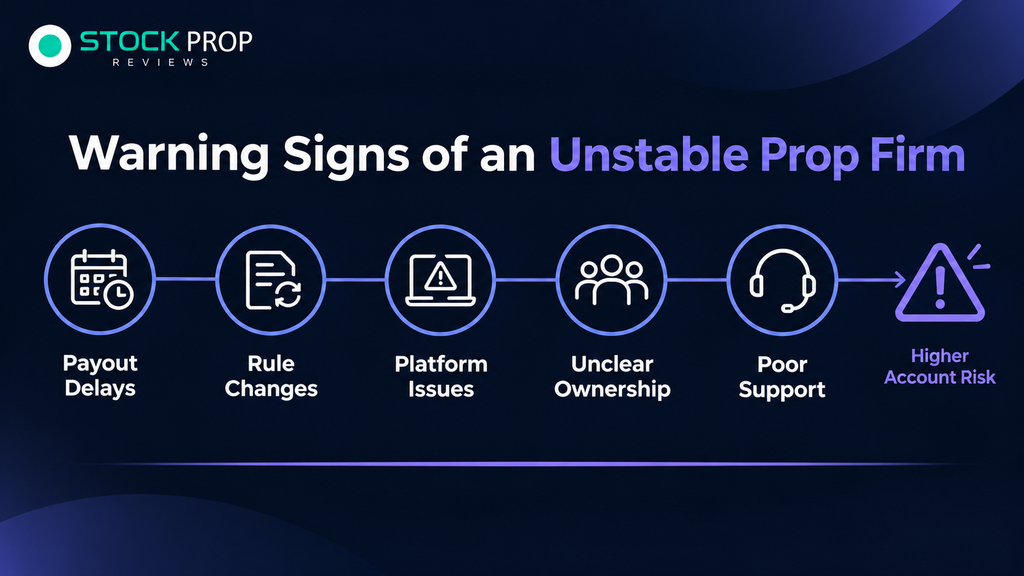
No single warning sign proves that a company will close. However, several problems appearing together deserve attention.
| Warning sign | Why it matters |
| Repeated payout delays | May indicate operational or financial difficulties. |
| Frequent rule changes | Makes contractual expectations unpredictable. |
| Aggressive discounts | May indicate pressure to generate immediate revenue. |
| Platform instability | Creates account-management risks. |
| Unresponsive support | Suggests limited operational capacity. |
| Unclear ownership | Makes accountability difficult. |
Before purchasing another evaluation, traders should check recent announcements, withdrawal procedures, company ownership, and the terms governing account termination.
Established Alternatives Worth Researching
The traders can compare the providers with longer trading history rather than going to a new house for cheap valuations.
- FTMO: An experienced evaluation forex & CFD provider. Review its drawdown rules, evaluation rules, and payout requirements.
- Topstep: A credible futures-supported provider. Review its evaluation model, contract limits, and funded-account rules.
- TradeThePool:Instrument Center: A prop trading firm that provides programs with specific conditions (such as risk rules) for stock traders.
These are alternatives to research, not guarantees of financial security. Each has different products, contractual terms, and eligibility requirements.
For additional research, readers can explore our FTMO review, Funding Pips review, and prop firm comparison guide. Our analysis of the prop firm marketing versus reality gap also explains why attractive promotional offers should never replace proper due diligence.
TradeThePool may also be worth considering for traders interested in stock trading rather than traditional forex or futures evaluations. Readers can get up to 10% discount when purchasing through our TradeThePool link. Review its current program terms and applicable regulatory disclosures before purchasing.
Can the Prop Trading Industry Become More Sustainable?
Not all of the prop trading industry is doomed to failure, shutdown, or issues.
There is an actuality around funding by evaluation. If rules, costs, and risks are well-explained, then such programs could be useful to traders who lack sufficient personal capital.
However, businesses that focus on financial discipline rather than an aggressive customer-acquisition program are likely to survive longer.
Three areas are particularly important:
Financial planning:
Companies need to account for operating expenses, customer acquisition costs, and potential payout obligations.
Operational transparency:
Clear contractual terms, consistent withdrawal procedures, and dependable customer support help establish trust.
Technology and risk controls:
Therefore, a proper infrastructure and a proper exposure management are required when the number of traders increases.
The strongest are not necessarily the most profitable companies. They will be companies that can deliver and fulfill their contract obligations.
Final Verdict
The cost of technology, competitive pressure, uncertain customer demand, and other financial and regulatory obligations weigh down new prop firms and make it hard for them to survive. Some just fail to gain customers at a profitable rate, while others get bogged down by payout obligations, platform dependencies, or poor operational management.
But there is no hard, industry-wide data set that says the majority of new firms fail in exactly two years.
So, practically speaking for traders, this means that your assessment of the company behind the challenge should weigh much more than, for example, the size of the account they’re promoting or the size of the profit split. Clear rules, a transparent payout process, an identifiable owner, and a solid infrastructure are more important than temporary promotions.
FAQs
1. Why do new prop firms fail?
Crypto failures occur due to a variety of reasons including bad financial planning, overspending on marketing, bad risk management, tech problems, payout problems, and regulatory uncertainty.
2. How long do prop firms last?
There is no reliable industry statistic that gives an average lifespan. Some companies go bankrupt within months, while others last for years or shift their business models.
3. Will traders lose pending payouts if a prop firm goes under?
Yes. If a company becomes insolvent or goes bust, recovering outstanding payouts can be difficult. It may or may not be recoverable, depending on the health of the company, legal issues, and contractual obligations.
4. Are established prop firms safer than new firms?
The longer a company has been around does provide you with more information about a company’s practices, but it doesn’t guarantee financial stability. Operations transparency, payout terms, and ownership still count.
5. How to Spot a Shady Prop Firm?
Watch out for vague customer service, complaints regarding payouts, unclear ownership, unreliable platforms, and arbitrary rules. And be especially wary if multiple red flags are present.