Quick Verdict: Is Instant Funding Easier?
Instant funding prop firms allow traders to access a funded style account without having to go through a traditional evaluation first. But instant access doesn’t mean easier payouts or lower risk when trading. The challenge becomes not hitting an evaluation target, but rather protecting the account, playing by the rules of the account and ultimately becoming qualified for withdrawals.
This guide is for both beginners comparing funding models and also for experienced traders looking for an alternative to evaluation challenges. This is not for traders who expect guaranteed income, instant withdrawals or lack of strict risk limits.
Disciplined traders with a proven strategy may find instant funding works for them but it’s a poor choice for traders who need to quickly recoup an account fee or who often take large risks.
What Are Instant Funding Prop Firms?
Instant funding prop firms provide access to a trading account without requiring a conventional evaluation before trading begins. Depending on the provider, the account may operate in a simulated environment or under another contractual arrangement.
Three terms should not be confused:
- Instant access: You can start trading without passing an evaluation first.
- Funded status: Your account has a designated status under the firm’s programme.
- Payout eligibility: You have met the conditions required to request a profit reward.
These are separate stages. An account can be available immediately while withdrawals remain conditional on profitability, minimum trading days, consistency rules, or other requirements.
Traders should also understand whether the programme involves simulated trading or live market execution. The word funded alone does not establish how the account operates.
Why Instant Funding Is Not Easier
1. Drawdown Limits Leave Less Room for Mistakes
The big question is how much the account can take before it fails.
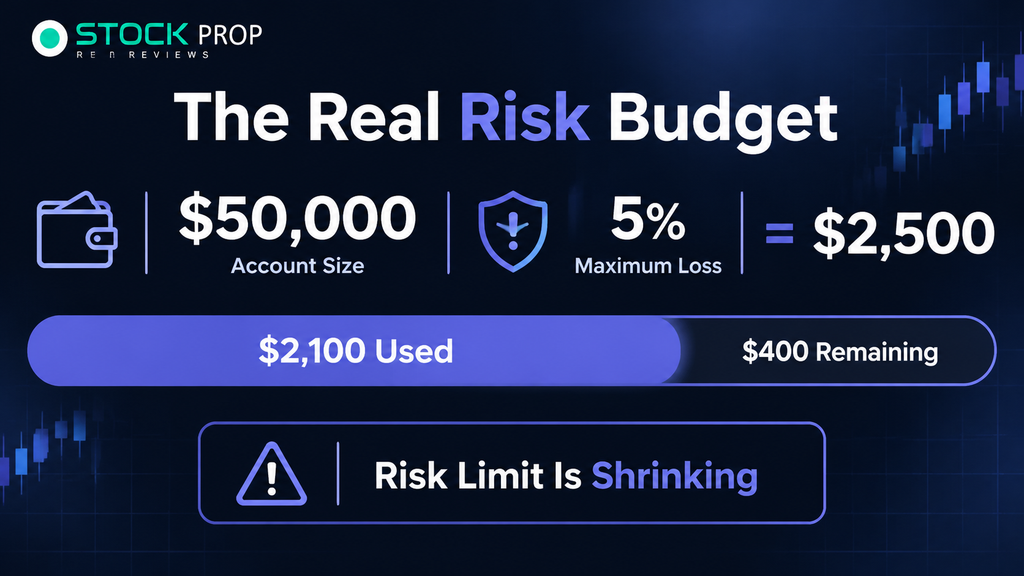
Assuming we have a hypothetical account of $50,000 and we allow a maximum loss of 5%. Loss of $2,500 depending on the method of calculation used by the firm.
If you lose $800 on one trade, $700 on another and $600 on a third, you have eaten through $2100 of that allowance. That’s only $400 short of the original cap, before any other adjustments.
If a trader is used to risking $500 on a trade, their normal position size may not be appropriate.
If a firm employs a trailing drawdown, the calculation gets more complicated. The breach threshold can track the account to new highs thus diminishing the room after a profitable run.
Before you buy, check if drawdown is static or trailing, if it uses balance or equity, and if floating losses count toward a breach.
2. The Account Fee Can Create Psychological Pressure
Instant funding might be more expensive up front than some evaluation accounts, but actual prices vary by provider and program.
It’s not just the cost that’s the problem. It’s how the traders respond to it.
Imagine you bought an account for $300 and then had two losing trades. You do not follow the original strategy but you increase your position size in an attempt to recover losses and to justify the purchase.
This is a common behavioral trap. That fee is gone. You’re not going to get it back by taking more risk. When to continue trading and when not to is based on your strategy and your risk tolerance, not on trying to make up for an upfront cost.
Never invest money you cannot afford to lose and that you may need to pay for essential expenses.
3. Payout Rules Can Replace the Evaluation Challenge
Some instant funding programmes have no traditional evaluation profit target. That does not mean traders can withdraw whenever they make money.
Depending on the programme, payout conditions may include minimum trading days, a minimum profit threshold, a consistency requirement, a waiting period, or a minimum withdrawal amount.
For example, a trader might generate $1,000 in eligible profits but still need to satisfy a minimum trading-day requirement before requesting payment.
Another trader might meet the timing requirement but fail a consistency condition because too much of the total profit came from one unusually profitable day.
Read the payout policy before purchasing. The relevant question is not simply how quickly you can start trading, but how realistically your strategy can meet the conditions for receiving a reward.
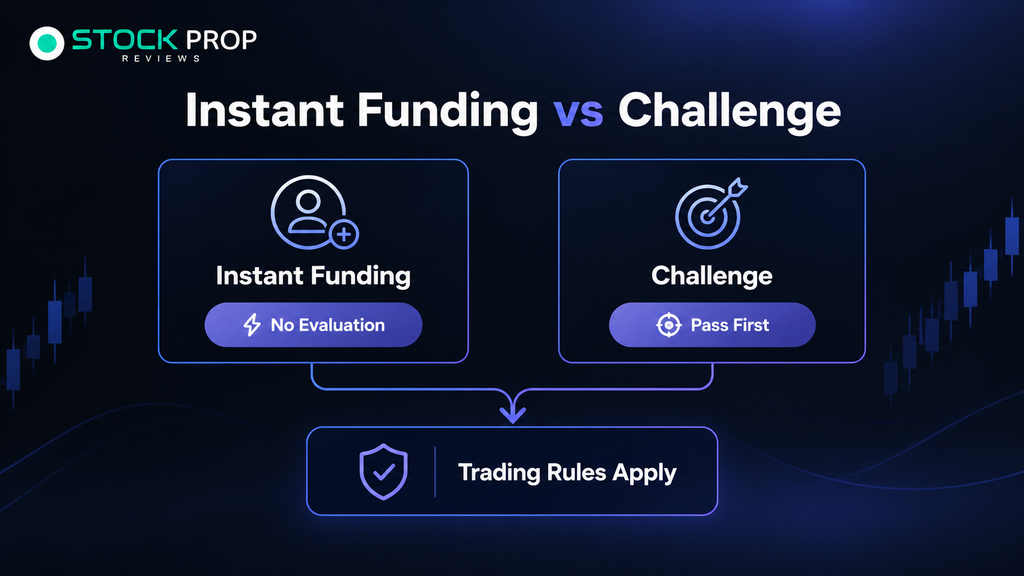
Instant Funding vs Challenge-Based Prop Firms
The following table compares common features. Individual firms may use different rules.
| Factor | Instant Funding | Challenge-Based Funding |
| Initial access | Usually immediate | After completing the evaluation |
| Evaluation target | Generally absent before access | Usually required |
| Drawdown rules | Apply from the start | Apply during evaluation and potentially the funded stage |
| Entry fee | May be higher for comparable programmes | Varies by provider and challenge |
| Payout conditions | Programme-specific | Funded-stage requirements apply |
| Main difficulty | Protecting the account and qualifying for rewards | Passing the evaluation and maintaining compliance |
Instant funding removes an initial hurdle, but the trader still needs a strategy that works within the firm’s restrictions.
Challenge accounts offer a structured means of demonstrating trading prowess before advancement. But they also put pressure on you to hit targets within set limits and passing an evaluation doesn’t guarantee you will get paid in the future.
There is no automatic superiority of any model. It is contingent upon the trader’s experience, risk appetite, strategy and budget which one is right.
What Competitors Often Understate
The Advertised Balance Is Not Your Risk Budget
With this simplified example in mind, a $100,000 account with a maximum loss allowance of 4% has an initial loss budget of $4,000 — not $100,000 of usable risk capacity.
If you trade risking $500 per trade then each full risk loss is 12.5% of that initial risk. A short losing streak can threaten the account.
Don’t just compare programs on the basis of their advertised account sizes, but also on the actual loss allowances and drawdown calculations.
Simulated Accounts and Live Capital Differ
Some prop trading programs use simulated accounts and pay eligible traders based on contractual reward arrangements. Some have different account structures.
A simulated program is not necessarily a bad thing, but traders need to know what they are buying. Review legal terms, reward terms, account status and restrictions prior to making payments.
A High Profit Split Does Not Guarantee Better Value
A 90% profit split advertised might seem more appealing than an 80% split. However, a larger percentage does not automatically make up for a tighter drawdown limit, restrictive payout conditions or a more expensive account.
Compare the whole arrangement. A smaller profit share may be more practical under rules that fit your strategy than a larger profit share under conditions that you find difficult to meet.
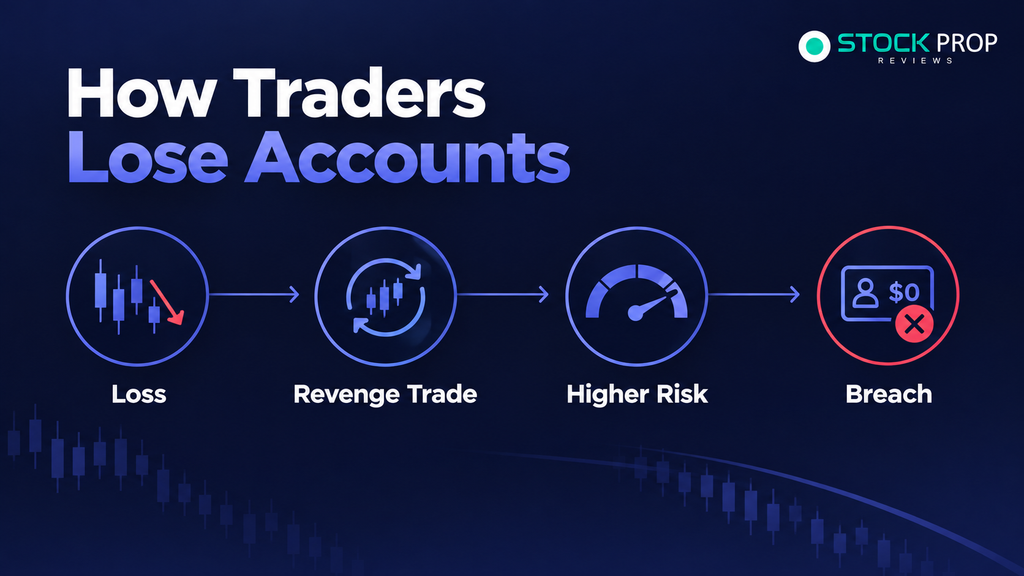
How Traders Fail With Instant Funding
Most account failures develop through repeated mistakes rather than one dramatic trade.
Overtrading after losses: A trader takes three hits in a row, and then ups the size of his position to recover. The next loss eats up too much of the remaining drawdown allowance. A daily loss limit and a rule to stop after poor execution can help avoid escalation.
Ignoring floating losses: The trader only looks at closed positions and doesn’t think about the fact that unrealized losses are part of an equity-based breach. It is important to understand how equity is calculated by the firm.
Forcing trades for payout eligibility: A trader who normally takes two high-quality setups per week starts trading daily to satisfy a minimum trading-day condition. Trade quality declines, and unnecessary exposure increases. Choose a programme whose requirements fit your natural trading frequency.
Changing a strategy to recover the fee:A trader abandons their plan because the account hasn’t generated profits quickly enough. This swaps out disciplined execution for financial pressure.
The lesson is that rapid access does not compensate for bad risk management.
Who Should Avoid Instant Funding?
Instant funding may be unsuitable for several types of traders.
- Unproven beginners: Traders without a tested strategy may not know whether their approach can survive the account’s loss limits. Demo trading first is a more cautious starting point.
- Aggressive traders: Strategies that rely on large positions or frequent recovery trades can conflict with strict drawdown limits.
- Traders with limited disposable income: Paying for an account should never jeopardise rent, bills, debt payments, or emergency savings.
- Traders who need predictable income:Trading performance is uncertain and payouts are conditional. An instant account is not an assured salary.
- Traders with incompatible strategies: Scalpers, news traders and swing traders need to look at execution rules, news restrictions, overnight holding policies and weekend conditions.
The important question is whether your normal trading process fits the programme, not whether the account is available immediately.
How to Choose the Right Funding Model
Start by calculating your actual loss allowance and determining how much you plan to risk per trade. Compare that risk with your historical losing streaks to assess whether the account provides enough room for normal strategy fluctuations.
Then check out the payout policy. Check out the first withdrawal requirements, frequency of payout, minimum profit conditions, consistency rules and any restrictions that may prevent you from trading like you normally would.
Finally, see how transparent the provider is. Drawdown calculations, prohibited practices, reward conditions and procedures for closing accounts shall be documented clearly. If you’re unsure about a key rule, get it in writing before you pay.
Also worth checking out for stock-focused programs is TradeThePool. It provides a stock trading program. The program rules and risk conditions are published which potential participants should review. Don’t assume that the word prop firm confers some particular regulatory status. The firm’s legal entity, applicable regulatory position and account structure must be independently verified.
Readers can get up to a 10% discount through our TradeThePool link. This is an optional offer and not a guarantee of trading success or a reason to buy an account that doesn’t suit your needs.
FAQs
Are instant funding prop firms easier than evaluation accounts?
Not necessarily. The first assessment is removed, but risk limits and payout conditions are kept in place. They may be more convenient, but they are not any more forgiving.
Do instant funding accounts pay immediately?
No. Immediate account access does not guarantee immediate payment. Traders must meet the provider’s applicable payout requirements.
Are instant funding accounts real funded accounts?
Not always in the sense of live brokerage capital. Some programmes use simulated trading and contractual reward arrangements. Check the firm’s legal documents to understand the account structure.
Is instant funding suitable for beginners?
It can be accessible to beginners, but inexperienced traders may struggle with tight risk limits. Developing and testing a strategy on a demo account first is generally more prudent.
What should I check before buying?
Check the maximum and daily drawdown rules, upfront fee, profit split, payout conditions, trading restrictions and account termination policy. Make sure your strategy matches the actual rules.
Final Assessment
Instant funding prop firms do have the benefit of not having to undergo the usual evaluation step but they do not eliminate the challenge of consistently trading.
The question is whether your plan can be implemented within the loss limits of the firm and still meet its payout criteria. If your risk allowance is too small for your approach, no big advertised balance, high profit split or fast access will compensate for it.
If you are a disciplined trader and have a proven strategy, instant funding could be a reasonable option. It could create more of a squeeze than expected on beginners, aggressive traders or anyone who needs quick payouts.
Before you pay, compare the rules, understand the payout terms and calculate your risk budget. The best funding model is the one that fits your trading process, not the one that gets you started the fastest.