
The marketing around prop firms can be an easy road to funded trading. Pass a challenge, follow the rules, pocket a profit split, cash out. The truth is more complicated. Traders have to manage drawdown thresholds, satisfy certain account criteria, pay fees and deliver consistent results under pressure. If a risk profile is not aligned with the rules of the firm, the successful strategy may not pass the evaluation.
This analysis is for both beginner and experienced retail traders considering a proprietary trading firm, specifically those looking at challenge prices, advertised account sizes, and payout claims. Not for those seeking guaranteed income or a fast track to financial freedom. The goal is to separate legitimate business propositions from the expectations that marketing creates so that traders can make decisions based on costs, rules and realistic performance.
Quick Verdict: Marketing Sells the Opportunity, Rules Define the Reality
Prop firm marketing is about communicating the possible advantages of their programs. Big nominal account sizes, nice profit splits, fast payouts and cheap valuations can make participation look possible. These features are not necessarily tricks. The problem is that the average is seen by traders as the best case scenario.
For example, a $100,000 funded account does not automatically mean a trader has control of $100,000 of their own capital or can lose that amount. The account can be simulated and the trader’s allowed losses can be limited to a small percent of the stated balance. The agreement explains how the account works, what a breach is and whether rewards are payable.
The key difference is simple, marketing describes the opportunity, but the contract and trading rules determine the actual conditions.
A prop firm could offer you a fair trial and still not be a good fit for your trading strategy, experience level or budget. In the same vein, a trader might not succeed in a fair assessment, not because of false marketing. Both sides of this equation are worth a look.
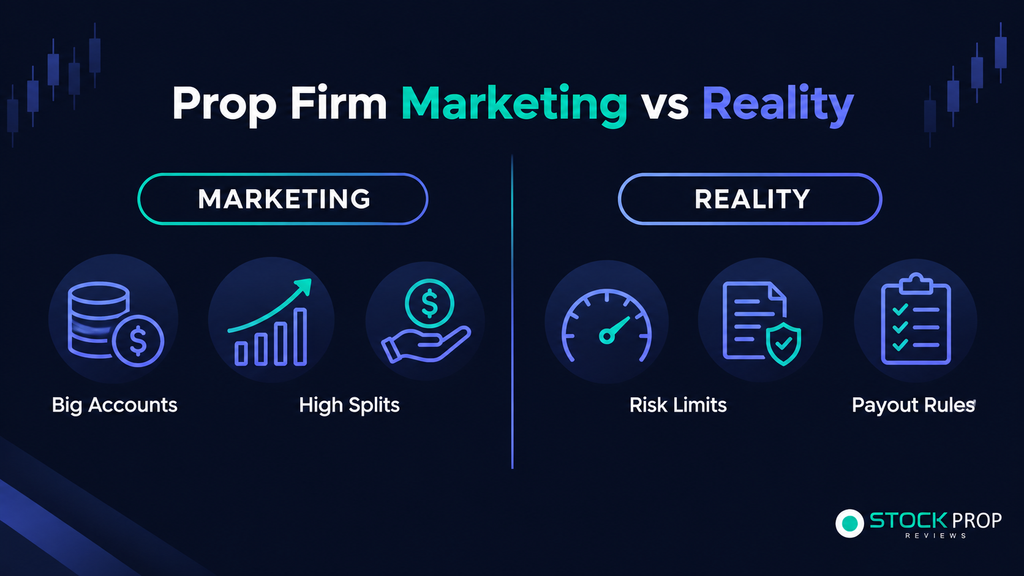
What Prop Firm Marketing Usually Emphasises
Most prop firm campaigns focus on a handful of features that are easy to understand and attractive to potential customers.
Large funded account sizes
A firm may advertise accounts worth $50,000, $100,000, or more. These figures attract attention because they resemble the capital allocation associated with professional trading.
However, the nominal size of the account is not the same as usable risk capital. For example, a $100,000 account with a 5% maximum loss limit could have a risk allowance of just $5,000, depending upon how the firm calculates drawdown and other conditions. A daily loss limit restricts how much risk you can take on any given day.
Traders should therefore compare drawdown limits, not just account sizes.
High profit splits
An advertised 80% or 90% profit split sounds attractive, but the percentage only matters if the trader generates eligible profits and satisfies the payout conditions.
For example, with an eligible profit of $1,000 and a 90% split, a trader may take home $900 prior to any applicable fees, adjustments or taxes. A trader who breaks an account rule before becoming eligible for a reward may get nothing for that trading period.
A high split is a possible benefit, not proof that getting a payout will be easy.
Fast payouts and success stories
Marketing tends to aim at traders who either trade fast or get large payouts. The following examples may be real, but individual success stories do not guarantee that a new customer will achieve the same.
The info that’s usually missing is a denominator: how many people bought an evaluation, how many passed, how many became eligible for payout, how many continued to get rewards over time?
Without that information, traders can’t reliably estimate their own chances of success from testimonials alone.
Low entry fees
The low challenge fee can make the first step seem pretty harmless. But a trader who buys ratings multiple times may spend far more than he expected.
If a $100 challenge is bought five times, the direct evaluation cost is $500, not including platform-related costs, commissions if applicable, and the opportunity cost of time. If the trader has no repeatable strategy, the other discounted challenge can simply repeat the same mistake.
The question is not whether a challenge is cheap. As though the trader has some reasonable reason to believe that the next try will be different.
Where the Gap Between Marketing and Reality Appears
The difference between the advertised opportunity and the actual trading experience becomes clearer when traders examine the conditions behind the headline figures.
| Marketing message | What traders need to verify |
| $100,000 funded account | Actual drawdown allowance and loss calculation |
| Up to 90% profit split | Eligibility conditions, reward limits, and payout requirements |
| Fast payouts | First-payout waiting period, review process, and documentation |
| Easy evaluation | Profit target, daily loss limit, overall drawdown, and trading restrictions |
| Trade your strategy | News, weekend holding, copy trading, EA, and consistency rules |
| Affordable challenge | Reset fees, repeat purchases, subscriptions, and other costs |
| Keep most of your profits | Conditions under which rewards can be reduced, delayed, or denied |
These differences are not proof that a firm is dishonest. They show why headline claims cannot replace a careful review of the actual terms.
The account size can distort risk perception
Say you have a $100,000 evaluation account and a 5% maximum loss allowance. The trader may feel that there is enough room in the account to absorb the normal fluctuations in the market. Depending on the rules, a loss of $5,000 might actually break the account.
If the trader risks 1% of the nominal balance of the account on each trade then each trade is risking $1000. Five straight complete losses could eat up the entire $5,000 allowance, before any daily limits, commissions, slippage or other restrictions apply.
This is why position sizing should be based on the firm’s real loss limits, not the impressive number in the account’s name.
Passing a challenge is not the same as earning consistently
Evaluation marketing can make passing seem like the main objective. But passing once does not prove that a trader can maintain performance over months.
A trader could hit a profit target by taking large positions in a favorable market. While under other conditions, the same process could lead to a rapid breach. Another trader might pass with a disciplined strategy but struggle later because the rules, reward conditions or emotional pressure of the funded stage are different than what they expected.
The more useful measure is not simply whether an account passed. It is whether the trader can repeat the process without taking excessive risks.
Payout eligibility can be more complicated than expected
It is not enough to be a profitable trader to have met all the requirements for a reward. These could be minimum days traded, payout schedules, consistency thresholds, identity verification, prohibited strategy restrictions, or other conditions specific to the account, depending on the firm’s model.
Traders should read the current payout policy before purchasing a challenge, not after making their first profit.
They should also distinguish between a documented payout delay, a request for additional verification, a legitimate rule dispute, and an actual refusal to pay. These situations are different and should not automatically be treated as evidence of misconduct.
What the Available Data Says About Prop Firm Success
One of the biggest weaknesses in prop firm marketing is the lack of comparable, independently verified information about the full customer journey.
Later industry analysis reported on a 2024 dataset from FPFX Technologies which showed about 14% of evaluation accounts reached funded status and about 7% of buyers were paid out. These numbers are a good context, but should not be considered as industry-wide probabilities. The dataset included accounts across participating firms and differences in firms, account models, customer behavior and measurement methods restrict the extent to which the results can be generalized.
It matters too to distinguish between accounts and people. The pass rate per account may not be the same as the percentage of individual traders that succeed, as one trader can purchase multiple challenges.
It doesn’t mean that all prop firms are unfair, or that all evaluations are set up to fail. They do advise traders to have a realistic approach to the opportunity and not to think of a funded account as a guaranteed result of paying an entry fee.
Why traders fail even when the rules are clear
Trading performance is only part of the problem. Many failures happen because traders change their behaviour to satisfy the challenge rather than follow a strategy they have tested.
Let’s say you have a trader who makes a small profit over a few weeks. The trader takes an evaluation with a small profit target then increases size to hit the target faster. Two losing trades would bring the account close to its daily limit. Instead of stopping, the trader takes another setup to recoup the loss.
The last breach could be a rule violation but the real problem is the mismatch between the trader’s strategy and the evaluation conditions and poor emotional control.
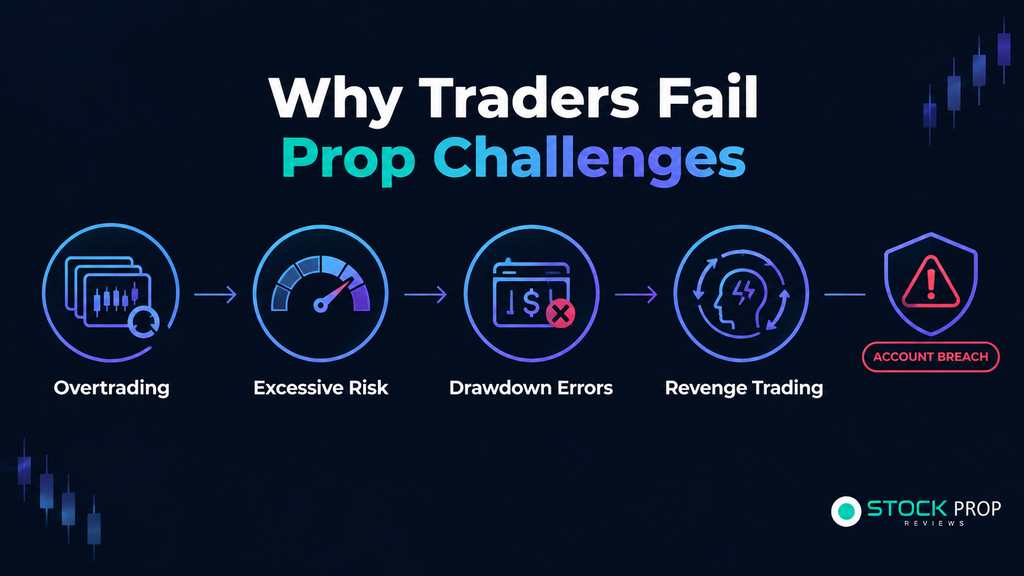
Other common failure patterns include:
- Overtrading: Taking low quality setups because the trader feels he has to pass fast.
- Excessive risk: Taking bigger positions than the strategy warrants, because the goal looks near.
- Not understanding draw down mechanics: Are limits static, trailing or based on equity and floating losses?
- Changing strategies mid-challenge: Abandoning a tested approach after a short losing streak.
- Buying repeated resets: Treating each failed evaluation as bad luck rather than reviewing the trading data.
The practical lesson is that a trader needs a repeatable process before buying an evaluation. A challenge should test an existing trading method, not serve as a substitute for developing one.
What Competitors Often Leave Out
Articles on prop firm success, challenge failures and first payouts give useful perspectives. For example, Convergent Trading’s discussion of the gap in retail trading success emphasizes structure, routine and accountability. FXNX tells you how the pass to paid process works and gives you the difference between passing an evaluation and completing verification, waiting periods and payout processing.
These are important things to consider, but traders should also be asking questions that you don’t normally see in the standard education materials.
Who benefits when a trader buys another challenge?
A prop firm’s commercial incentives deserve attention. Depending on its business model, revenue may come from evaluation fees, subscriptions, resets, trading-related services, or other sources. The exact mix varies by company and should not be assumed without evidence.
This creates a disconnect between what attracts clients and what helps them become consistent traders. Sure, a campaign promising a fast track to a big account might get more attention than a detailed explanation of position sizing, drawdown mechanics or the probability of receiving a reward.
That doesn’t mean every payout decision of a firm is motivated by its incentives or that its rules are unfair. Traders should look at the terms the firm publishes, its operating history and incentives, not just its advertising.
Are the rules easy to understand before purchase?
A rule can be publicly available and still be difficult to interpret. Important details may be spread across FAQs, help-centre articles, account-specific terms, and payout policies.
For example, a trader might see a general statement that news trading is allowed, but fail to see a restriction on opening or closing positions around certain announcements. Another trader might think a maximum drawdown is calculated only at the end of the day but the relevant account model uses a different measurement.
It’s not just about whether there is a rule. It is a question of whether the trader understands its practical consequences before he pays.
Can payout claims be independently verified?
Screenshots, testimonials, and social media posts can provide clues, but they are not comprehensive proof of a firm’s overall payout reliability. A screenshot may show that a payment occurred without establishing how common such payments are or whether the same conditions apply to other traders.
Look for things like good reporting by third parties, detailed and dated reviews, transparent company information, and clearly written payout terms. Anonymous accusations and promotional testimonials deserve skepticism alike: neither tells the whole story automatically.
What happens when rules change?
Terms can change as a business changes. Traders need to see if the changes apply to existing accounts, new purchases or both and if the company has explained how it communicates changes.
A publisher with transparent rules that has wide discretion over account decisions must also be carefully scrutinized. Traders should know how to make a complaint, what evidence is used to determine if a breach has occurred and what choices they have if they disagree with a decision.
How to Evaluate Prop Firm Marketing Before Paying
A practical review should focus on verifiable details rather than how convincing the firm’s advertising looks.
Use this checklist before purchasing a challenge.
- Read the current terms Verify legal entity, account model and applicable agreement.
- Calculate the real risk allowance: Translate daily and maximum drawdown percentages into dollar amounts.
- Check all trading restrictions: Review news trading, overnight positions, weekend positions, copy trading, EAs and banned strategies where applicable.
- Outline the payout process: Check eligibility dates, minimum trading days, consistency requirements, identity verification and withdrawal methods.
- Do the calculations. Include the challenge, possible resets, subscriptions and any other disclosed fees.
- Check your eligibility: Before paying, check residency, identity verification, payment access, and withdrawal availability.
- Read the independent evidence: Don’t just look at the one-off wins, but look for patterns that recur again and again in the more detailed trader reports.
- Test your strategy against the rules: Use historical data or a demo environment to test your normal risk management against the firm’s limits.
If a firm’s written terms are unclear, ask support for a specific question and save the response. A vague answer to a straightforward question about drawdown or payout eligibility is a reason to pause rather than assume the most favourable interpretation.
A simple cost example
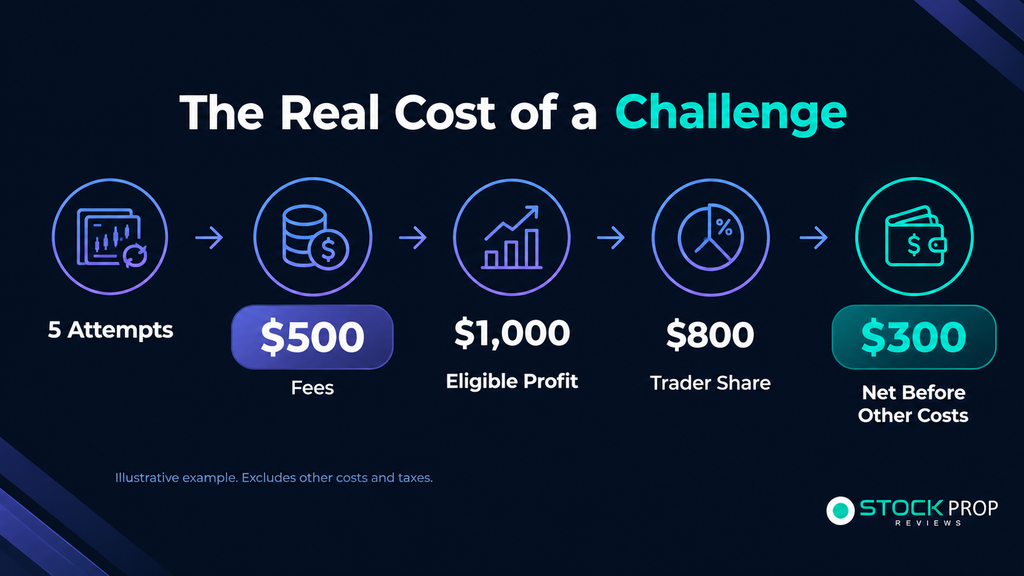
For example, a trader takes 100$ challenge and fails 4 times before he passed 5th time. You pay the same amount for each attempt . And there are no other fees . So you spend $ 500 on the challenge .
Now let’s say the trader passes and makes $1,000 eligible profit and has an 80% profit split. If the reward is approved and all conditions are satisfied, the trader’s share will be $800, before applicable deductions.
Even in this simple example the $ 800 reward is not the same as $ 800 net profit from the entire process. $500 remaining after 5 challenges then $300 remaining before costs and taxes.
This calculation does not predict outcomes for any individual trader . It shows why we should look at profit splits and headline account sizes when considering a cost to get to payout eligibility.
Choosing a Prop Firm That Fits Your Trading Style
No one is the best prop firm for anyone. A brokerage that is great for a disciplined intraday trader may not be the best fit for a swing trader who needs to hold positions overnight.
| Trader profile | What matters most | Potential problem |
| Scalper | Execution quality, commissions, minimum trade duration | Small costs can undermine an edge |
| News trader | News restrictions and execution rules | A profitable setup may violate timing conditions |
| Swing trader | Overnight and weekend holding policies | Positions may need to close earlier than planned |
| Futures trader | Trailing drawdown, contract limits, daily loss | A normal pullback can breach the account |
| Beginner | Affordable entry, understandable rules, realistic expectations | Repeated challenges can become expensive |
| Consistency-based trader | Reward eligibility and profit distribution rules | A large winning day may affect payout eligibility |
Before you decide, compare the trading history with the rules of the company. If your strategy requires wide stops and the occasional big loss, then an account with tight drawdown limits might not be for you. The restrictions around news events means that if your edge is holding through major announcements, another firm may be a better fit.
TradeThePool and stock-focused trading
One option for traders that specialize in US equities is to look at TradeThePool. Its published program documentation describes trading conditions and risk requirements that are focused on stocks. But its own disclosures describe trading in a simulated environment, and do not lend themselves to calling it a regulated stock prop firm. Published rules and regulatory status are separate issues.
Readers can get up to 10% discount when purchasing through our TradeThePool link. Consider the offer only after reviewing the current program terms, eligibility conditions, and payout requirements.
For a closer look at its strengths and limitations, read our TradeThePool review. Traders comparing different account models can also consult our prop firm comparison before deciding.
Who Should Avoid Prop Firm Challenges?
Prop firm challenges are not suitable for every trader. Consider avoiding them, at least for now, if you:
- Do not yet have a strategy with documented results across a meaningful sample of trades.
- Frequently increase risk after losses or struggle to stop trading when your daily limit is reached.
- Need immediate income to pay essential expenses.
- Cannot afford to lose the evaluation fee without affecting your financial obligations.
- Have not checked whether your strategy complies with the firm’s rules.
- Expect a funded account to guarantee employment, stable income, or access to withdrawable capital.
A trader who is still learning may benefit more from practising in a demo account, keeping a detailed journal, and testing position sizing than from repeatedly buying evaluations.
This is not an argument against prop firms. It is an argument for choosing the right time to use one.
FAQs
Is prop firm marketing deceiving?
Not always. Marketing can accurately reflect the size of the accounts, the profit split and the features of the program. The problem is that traders treat these claims as proof of likely earnings, without checking the rules, costs and conditions related to them.
The most significant gap between prop firm marketing and reality is what?
The biggest gap is often the gap between gaining access to an evaluation and consistently getting payouts. Passing will depend on meeting evaluation conditions and payouts may depend on additional eligibility, verification, trading and compliance requirements.
Why Do So Many Traders Fail Prop Firm Challenges
The reasons are usually too much risk, overtrading, not knowing how to handle drawdowns, inconsistent trading and pressure to make a quick profit. A trader may also have a profitable strategy that is not compatible with the constraints of a particular firm.
How do I determine if a prop firm is legitimate?
See the legal entity, the current terms, account model, payout conditions, rule-change policies, independent reports from traders. One testimonial or one payment screenshot is not proof of overall reliability. If key terms are unclear, ask the firm for written clarification.
Are prop firm challenges worth the cost?
They may be worth it for traders with a proven strategy, sound risk management and a clear understanding of the rules. They are less suitable for beginners who need to learn consistency or for anyone who can’t comfortably afford the fee. The decision should be based on strategy fit and total cost, not just advertised account size.
Final Takeaway
It’s not whether prop firms have exaggerated claims or not, it’s about the difference between prop firm marketing and reality. It’s also about how traders interpret those claims. Do they understand the conditions behind the opportunity?
The big account sizes, good profit splits and nice payout schedules add value. There is no guarantee of trading experience. The actual work is done before you buy: understanding the drawdown model, checking you are eligible for payouts, working out total costs and establishing if your strategy can work within the rules.
For further reading, see our FTMO review for a closer look at risk conditions, our FundingPips rules analysis for how account restrictions affect trading, and our article on the reality of prop firm payouts for a related discussion of reward conditions.
Prop firms should be viewed as a business transaction with costs, terms and risks, not an income guarantee. The trader who knows the difference is better positioned to determine if the opportunity fits his circumstances.