Prop trading influencers can help traders understand the challenges, trading platforms, payout process and risk management. But some creators on YouTube present an incomplete picture of proprietary trading, focusing on large payouts, challenge passes, and promotional partnerships, while ignoring the risks and costs.
The problem is not all prop trading influencers are bad. The trouble is that viewers often take cherry-picked results, sponsored content and personal anecdotes as valid proof of what they can expect to experience themselves.
This article is for beginner and intermediate traders that use YouTube to research prop firms, evaluate trading strategies, or whether they should buy a funded account challenge. This is not to discredit all trading creators or say all prop firm reviews are fake. The idea is to give traders a way to distinguish useful education from content that could have an effect on their decisions without giving enough context.
Why Prop Trading Influencers Can Give a Misleading Impression
Prop trading influencers exist in a universe where attention is a commodity. A video showing a five figure payout or a challenge passed in two days will generally garner more interest than a detailed explanation of drawdown calculations, losing streaks or payout limitations.
This provides an incentive to focus on the outcomes rather than the entire trading process.
Consider a creator who publishes a video showing a $5,000 payout from a prop firm. The payout might be genuine, but the video does not automatically establish how much the creator spent on challenges, how many accounts they failed, whether the payout was received through a promotional arrangement, or how consistently they have withdrawn profits.
A trader watching that video may conclude that buying the same challenge offers a realistic route to earning similar money. That conclusion goes beyond the evidence presented.
A prop trading influencer is misleading when content gives a false impression of performance, risk, commercial incentives or the likelihood of success. This can be accomplished through intentional deception, selective reporting or simply by a lack of understanding.
The distinction is important because traders can lose money on advice that sounds convincing but is based on incomplete information.
The Business Model Behind Prop Trading YouTubers
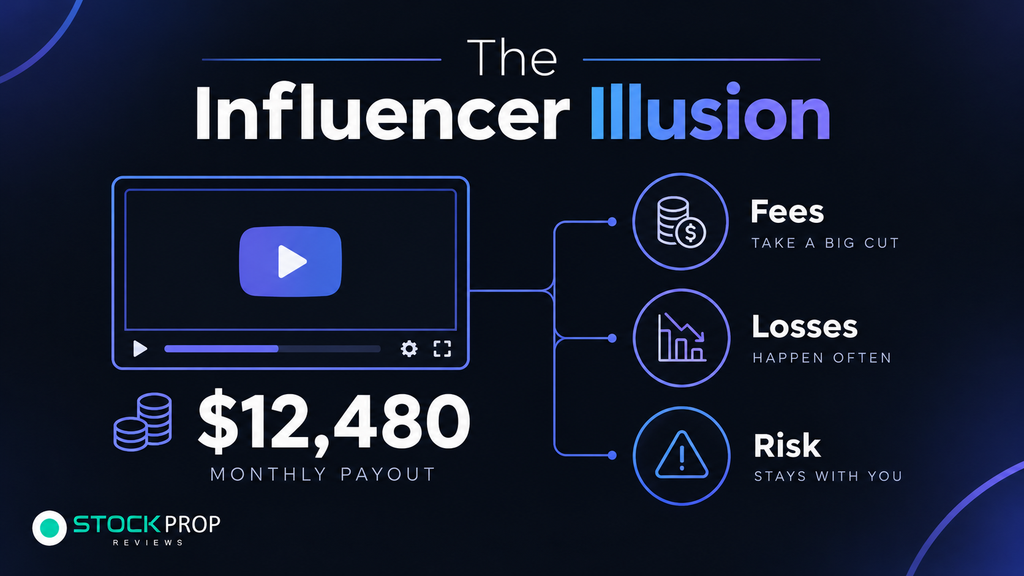
Not all trading channels make money the same way. Some creators educate their audience, others make money through advertising, sponsorships, paid communities, courses, referral links or affiliate commissions.
These income sources don’t necessarily make a creator untrustworthy. The big question is whether the commercial relationship affects the way a product or company is portrayed.
Affiliate commissions can influence recommendations
Some prop firms offer referral or affiliate arrangements under which creators receive compensation when viewers sign up or purchase challenges through their links.
This can create a conflict of interest. A creator may benefit financially when a viewer buys a challenge, even if that viewer is not ready to trade under the firm’s rules.
For example, a video may talk about a challenge being affordable and achievable, but not talk very much about things like reset fees, account restrictions, payout eligibility or losing the challenge.
The recommendation may still be genuine, but the viewer has a right to know whether the creator has a financial incentive to push purchases.
Look for clear disclosures of sponsorship and explanations of how the creator is paid; And see if the review discusses disadvantages with the same care as benefits.
Discount codes are not proof of quality
A discount code can help you save money on the initial purchase, but it’s not proof that a prop firm is right for your strategy or that their payout process is trustworthy.
Creators can promote companies with attractive affiliate arrangements repeatedly. Meanwhile, companies with less generous marketing budgets may get less attention even if their rules suit certain traders better.
Traders need to look at the actual terms that firms use, such as drawdown limits, allowed strategies, payout conditions, fees and restricted trading practices.
A discount is a benefit of price, not a credibility marker.
The Problem With YouTube Payout Proof
Some of the most compelling prop trading content is payout videos because they look like they show a concrete result.
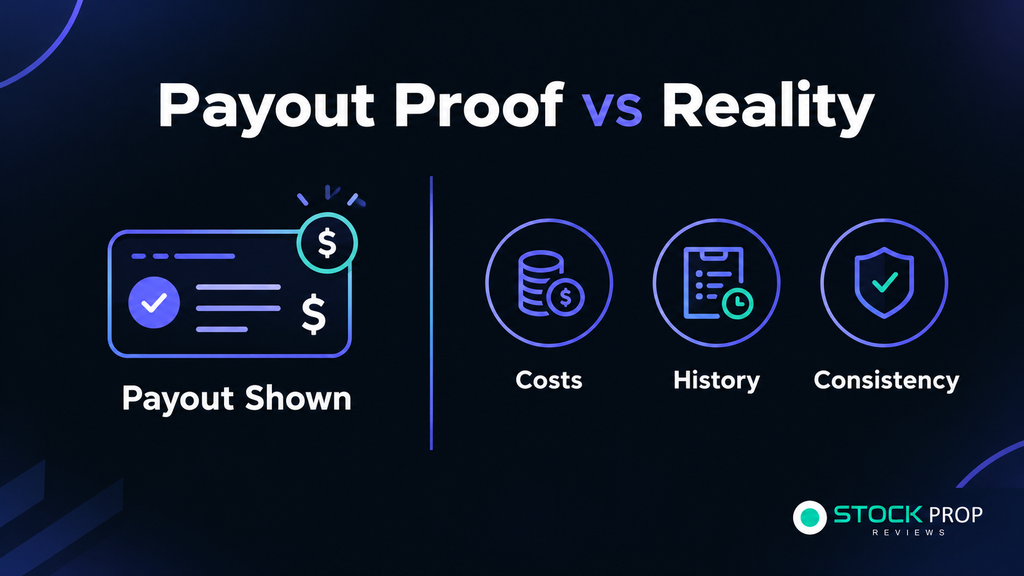
But the payout screenshot or payment notification is not as convincing as many viewers might think.
A screenshot may display a payment amount but doesn’t always show the complete trading history behind it. It may not show the cost of past difficulties, bad accounts, resets or other expenses. Nor does one profitable withdrawal mean the system is profitable in the long run.
There is also an important distinction between a trading account displaying a profit and money actually reaching a trader’s payment account.
A useful review should explain which stage the evidence demonstrates.
| Evidence shown | What it may establish | What it does not establish by itself |
| Trading dashboard | An account displays a profit | That the profit is withdrawable |
| Payout request | A withdrawal was requested | That the payment was approved |
| Payment confirmation | A payment appears to have been processed | Long-term profitability |
| Multiple payout records | Several payments may have occurred | Overall net earnings or future results |
| Trading history | Recorded account activity | Complete financial results across all challenges |
More solid evidence. Consistent documentation, explicit explanation about the type of account and clear reporting of relevant costs and failed attempts.
Even then, viewers shouldn’t expect what happens to one trader will happen to them.
Why Challenge Pass Videos Show Only Part of the Story
Passing a prop firm challenge is an achievement, but it is not the same as building a sustainable trading record.
Most challenge-based models require traders to reach a profit target while staying within specified risk limits. Depending on the firm and account model, traders may also face daily loss limits, overall drawdown restrictions, minimum trading-day requirements, or restrictions on particular strategies.
A creator who passes a challenge quickly may produce an engaging video. Yet the result can hide important details about the trading process.
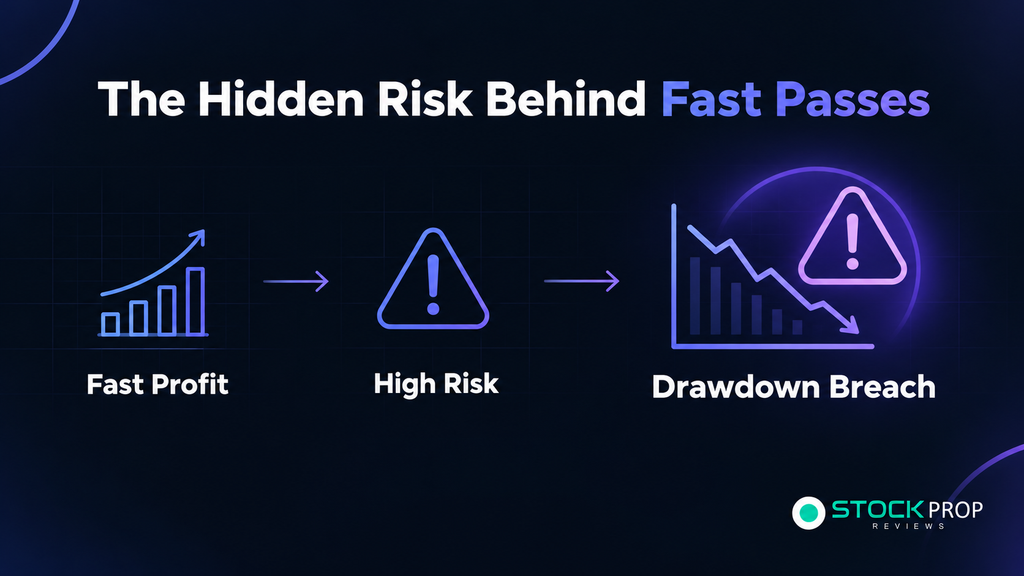
Imagine a trader who earns 8% in three trading sessions by taking large positions around volatile market events. The challenge may be passed, but the strategy could expose the trader to a substantial chance of breaching the drawdown limit during an ordinary losing streak.
Another trader may reach the same target slowly with small positions and pre-defined stop-losses. The second method might not be as flashy on YouTube, but it might be more in line with the account’s risk rules.
Neither example is proof that some specific strategy will work. The point is that the speed of a challenge pass tells viewers little about the quality of the risk management.
A funded account is not guaranteed income
A funded account means a steady income for a trader many people think.
In practice, the trader still needs to comply with the relevant rules, maintain qualifying performance and meet the firm’s payout conditions. Depending on the provider and program, the arrangement may be simulated trading rather than direct access to live market capital.
Account status, eligibility for payout and payment terms vary by firm.
Check the current account agreement and see what happens if you break a rule, ask for a payout or stop trading for a long time before you rely on claims made in a video.
How Prop Trading Influencers Can Misrepresent Risk
Risk is often the least exciting part of a trading video, but it is one of the most important factors in deciding whether a strategy is suitable.
Several patterns deserve particular attention.
Showing profits without discussing losses
A creator can share many winning trades and just not include the losing trades in the video. This may lead to a non-consistent strategy looking consistent.
A more useful assessment uses the whole record, including losing trades, maximum drawdown, risk per trade, and the number of observations supporting the claimed performance.
A short winning streak does not demonstrate a sustainable trading advantage.
Making aggressive risk look normal
Traders passing challenges with oversized positions make for good videos but make unrealistic expectations.
You may make a quick profit if the trade works out, but you will also risk a good portion of your allowed daily loss on one trade. However, if the market moves against the position, the account could be close to breaching its limits after one mistake.
Traders should determine whether the displayed risk is appropriate for their account rules and their own financial situation, and not follow the position size of a successful creator.
Treating personal experience as universal advice
A creator may prefer a particular firm because its platform, instruments, or drawdown model suits their strategy. That does not mean the same firm will suit a trader using a different approach.
A scalper, news trader, swing trader, and futures trader may have very different requirements. Rules regarding holding positions overnight, trading during news events, minimum trading days, or consistency can change the suitability of a program.
Advice becomes unreliable when these differences are ignored.
What Competitors Often Fail to Explain
Many prop firm videos concentrate on comparisons, discount codes, payout announcements, and challenge results. Those subjects can be useful, but they do not always answer the questions a trader needs to consider before spending money.
Four issues deserve closer attention.
First, the overall cost of participation. The advertised challenge fee may not cover the full cost if you need a few attempts. Reset fees, repeat purchases, platform costs and other applicable charges can add up to the amount spent before a trader receives a payout.
Second, the calculation of drawdown is precise. Static drawdown, trailing drawdown and daily loss limits are different. A strategy that seems safe under some models may be inappropriate under another. Traders should know if limits are on balance, equity or other calculation, per rules.
Third, payment terms. You can’t just pull all the profit out right away because you passed a challenge. May Have Eligibility Requirements, Review Procedures, Payout Schedules, Consistency Conditions & Prohibited Practices.
Fourth, the creator’s complete commercial relationship. An easy affiliate disclosure is a good start , but viewers should also check that the content discusses the company’s drawbacks , compares rival providers objectively and separates proven facts from personal views .
These details are less likely to make for a dramatic video title, but they’re often a lot more important than a big payout screenshot.
How to Identify Misleading Prop Trading Influencers
You do not need to assume every creator is dishonest to evaluate their content critically. Instead, look for evidence that supports the claims being made.
| Warning sign | What to check |
| Frequent payout flexing | Are losses, fees, and failed challenges disclosed? |
| Guaranteed-sounding claims | Does the creator acknowledge uncertainty and risk? |
| Constant discount promotions | Is the financial relationship disclosed? |
| Vague rule explanations | Are official terms linked and explained accurately? |
| Only winning trades shown | Is there a complete, meaningful performance record? |
| Pressure to buy quickly | Is there a genuine reason for the deadline? |
| One firm presented as perfect | Are limitations and alternatives discussed? |
Pay attention to how a creator responds to difficult questions. A reliable educator should be able to explain the difference between an account’s profit target and its drawdown limit, identify relevant restrictions, and correct outdated information when a firm’s rules change.
Be cautious when a creator relies on insults, urgency, or claims that anyone questioning their results simply lacks trading ability. Confidence is not evidence.
How to Research a Prop Firm Without Depending on YouTube
Youtube can be a good starting point, but it shouldn’t be your end point.
Start with the company’s official rules and account agreement. Please check the current challenge format, loss limits, trading restrictions, payout conditions, refund requirements and eligibility for your country.
Check your own strategy against the firm’s rules. If you are holding positions overnight, check the relevant holding rules. Someone who trades around economic releases should check for news restrictions. Futures traders should review the specific contract, session, and drawdown conditions applicable to their account.
Then calculate the cost of a realistic sequence of attempts. Do not assume that you will pass on the first try, and never use money needed for essential expenses to purchase challenges.
Finally, consult independent reviews and trader discussions to identify recurring concerns. Individual complaints are not conclusive proof of misconduct, but consistent reports about the same issue can help identify questions that deserve further investigation.
For additional context, read our coverage of prop firm reviews and prop firm comparisons.
Are All Prop Trading Influencers Misleading?
No. Some of these creators do provide genuinely useful education, explain risk management in detail, publish losing trades, disclose commercial relationships and correct mistakes when information changes.
Experienced traders can benefit from strategy demonstrations, platform tutorials, trading psychology discussions, and detailed explanations of how specific rules work.
The issue is not the platform or the fact that a creator earns money. It is whether the content gives viewers a fair understanding of the risks and limitations involved.
A creator can also be profitable and still produce misleading educational content. Trading ability and the quality of a review are separate questions.
Likewise, a creator who has never received an affiliate commission can still make poor recommendations. The strongest approach is to evaluate the evidence, incentives, and reasoning rather than judging credibility by one characteristic alone.
Where TradeThePool Fits Into Your Research
Traders who prefer stock-focused proprietary trading programs can also investigate TradeThePool. It is a stock prop trading firm that presents account rules and risk parameters for traders to evaluate before participating.
Check the current program terms, eligibility rules, fees and payout conditions yourself, not just relying on a creator’s experience. If there are claims about the firm’s regulatory status, check the relevant official records before treating the firm as regulated.
Readers can get up to 10% discount when purchasing through our TradeThePool link.
A discount may reduce the purchase price, but it does not remove the risk of failing an assessment or make a program suitable for every strategy. Read the rules first and make the decision based on your own trading requirements.
Common Mistakes Traders Make When Watching Prop Trading Videos
Even when viewers recognise that YouTube content can be selective, they can still make avoidable mistakes.
One is copying a creator’s strategy without understanding its risk profile. A position size that appears manageable on one account may breach another account’s daily loss limit.
Another is the conflation of revenue with profit. A creator can earn money through payouts, affiliate commissions, sponsorships, courses, or a mix of these. A payout video does not show the full financial situation of the creator.
The third mistake is buying a challenge because a video makes you feel like you have to act now. A limited time discount is not a reason to ignore the rules, and a creator’s success doesn’t mean you are ready to trade the same program.
Finally, traders sometimes skip a proper evaluation process after seeing someone say a certain firm is easy to pass. The challenge is made easier or harder depending on the rules, market conditions, strategy, discipline and individual trading ability.
The best way is to define your strategy first, calculate your risk and shortlist firms matching your criteria.
Final Verdict: Treat Prop Trading Influencers as Sources, Not Authorities
Prop trading influencers can be a good source of information but their videos should not be a substitute for independent research. Large pay-outs, fast-track challenge passes and strong endorsements don’t make a company trustworthy or a strategy sustainable.
The most helpful creators describe the successful outcome and how they got there. They show the relevant financial incentives, separate personal experience from facts that can be verified, discuss the limitations, and point viewers to the current rules.
Before you purchase a challenge, ask yourself three questions. Are the claims verifiable? Do I understand the rules of the firm? If I fail, can I take on the cost?
Do more research if you are uncomfortable answering those questions.
The best trading decision is not the one that the most convincing youtube personality makes. It is the one that is backed by facts, realistic expectations and a clear understanding of risk.
FAQs
Why are prop trading influencers spreading lies?
There are prop-trading influencers who only post selected payouts, winning trades, or challenges won, but they don’t talk about losses, total costs, commercial incentives, or withdrawal conditions. There are other people who do provide accurate education so you should judge each creator on their own merit.
Do you trust YouTube prop firm payout proofs?
Payout proofs are not 100% proof of profitability, they are just supportive evidence. A screenshot can prove that a payment was made, but it doesn’t prove overall costs, net profits, long-term stability, or even if other traders can achieve the same results.
Can YouTubers in Prop Trading Make Money Using Affiliate Links?
Some make commissions when viewers purchase challenges using referral links. Others make money through sponsorships, ads, courses or paid communities. Always examine the creator’s disclosures to determine if commercial incentives might be influencing the advice.
How can I tell if a prop firm review is real?
Look for clear disclosures about how the product is sold, links to the official rules, a balanced discussion of disadvantages, clear explanations of the conditions under which you could lose your money or get paid, and evidence to back up specific claims. When doing reviews, don’t just use one source,use several.
Should beginners follow prop trading influencers?
Good creators can teach the language, platform features, and risk management to newbies, but they should verify important claims themselves. Don’t copy position sizes or buy challenges from somebody else’s results. First, understand the account rules and if they are compatible with your strategy.