The FTMO risk rules are built around one basic principle: you must achieve the necessary profit target while not exceeding the defined loss limits for your account equity. The most important thing is not just knowing FTMO’s 5% daily loss limit and 10% maximum loss. You need to get to grips with how those limits are calculated, when they are reset and how open positions can affect them.
This guide is for beginners, funded traders and forex traders who are considering an FTMO evaluation. This is not for traders looking for maximum leverage, aggressive news trading or a challenge structure that gives them plenty of room to recover after a big losing day.
FTMO has the 1-step and 2-step structures and the rules for risk are very different between the two.
Quick verdict on FTMO risk management
FTMO has one of the more clearly documented risk frameworks in the retail prop firm industry. The advantage is predictability. You can calculate your maximum daily and overall loss before placing a trade.
The catch is that the rules are stricter in practice than they look on a percentage table.
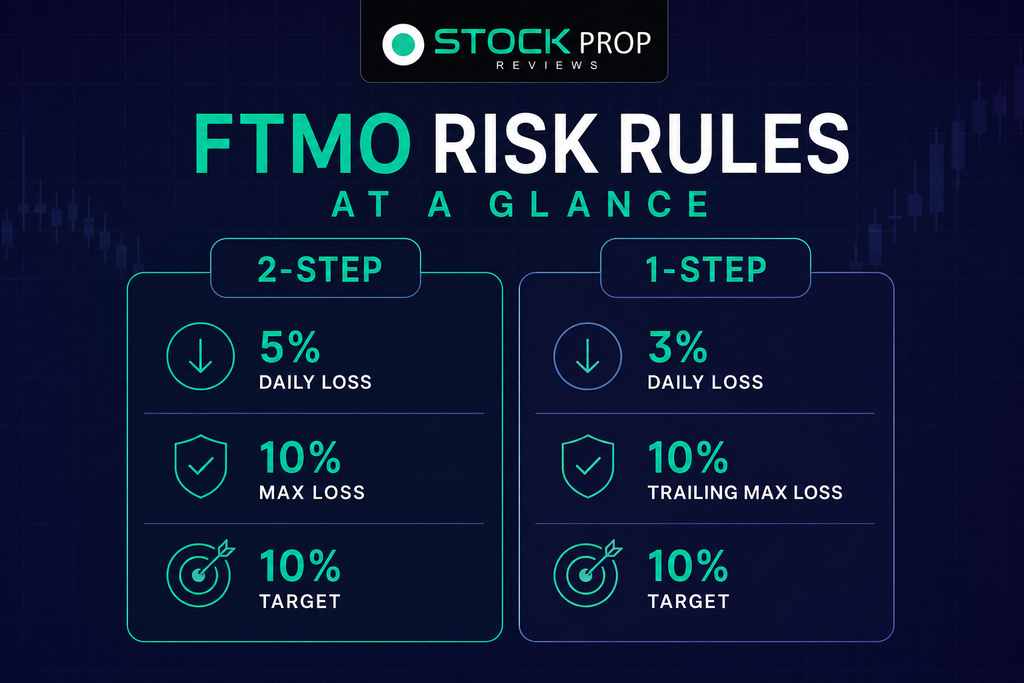
For the current 2-Step model, the daily loss limit is 5% and the maximum loss is 10%. The Challenge has a 10% profit target, while Verification requires 5%. There is also a four-day minimum trading requirement and no overall time limit.
The 1-Step model has a 3% maximum daily loss, a 10% maximum loss using an end-of-day trailing mechanism, a 10% profit target, no minimum trading-day requirement, and a 50% Best Day rule.
That makes the choice between the two more important than simply looking at the account size.
FTMO risk rules at a glance
| Rule | 2-Step FTMO | 1-Step FTMO |
| Challenge profit target | 10% | 10% |
| Verification target | 5% | Not applicable |
| Maximum Daily Loss | 5% | 3% |
| Maximum Loss | 10% static | 10% end-of-day trailing |
| Minimum trading days | 4 | None |
| Trading period | Unlimited | Unlimited |
| Reward | Up to 90% | 90% |
| Best Day rule | No | 50% |
FTMO’s current comparison table confirms these differences.
The headline numbers matter, but the calculation method matters more.
How the FTMO maximum daily loss works
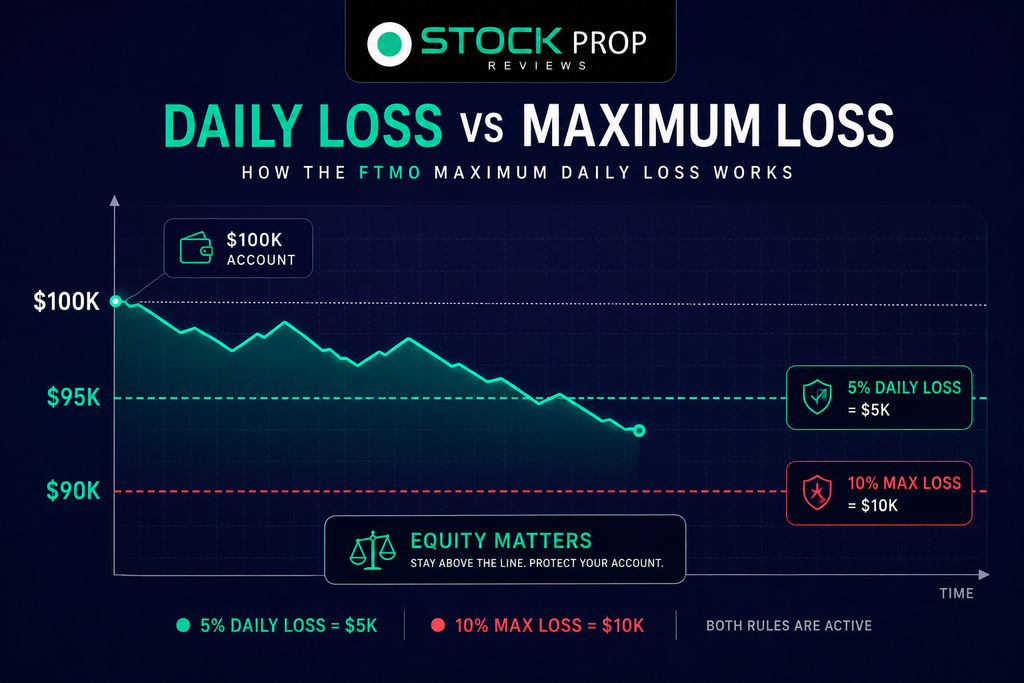
The Maximum Daily Loss is an equity-based limit. That means FTMO does not look only at your closed trades.
Your equity includes your balance, open-position profit or loss, swaps, and commissions. If equity falls below the applicable daily threshold at any point, the rule can be violated.
For the 2-Step model the daily loss amount is 5% of the initial simulated capital.
Take for instance an account of $100,000.
The first day limit is:
$100,000 – $5,000 = $95,000
The next midnight balance is $102,000. The threshold for the next day is then:
$102,000 – $5,000 = $97,000
This is where many traders get the rule wrong. The daily loss amount is still related to the original account size but the threshold itself can change due to the change of the balance at midnight of the previous day.
There’s another important detail, FTMO calculates the daily reset at midnight CE(S)T, not necessarily midnight where you live. Traders that have positions across that reset need to know the precise time in their own timezone.
Why equity matters more than balance
Imagine a trader has a $100,000 account and finishes the previous day with a $102,000 balance.
The next day’s 2-Step daily floor is $97,000.
The trader opens a position and the account temporarily shows:
- Balance: $102,000
- Floating loss: $4,500
- Equity: $97,500
The trader has not lost $4,500 in closed trades. But the floating loss still counts toward the daily equity calculation.
Now imagine the position moves another $600 against them.
Equity becomes $96,900.
The trader has crossed the daily threshold even though the original $100,000 account is still showing a $3,100 overall gain in the example.
This is the part competitor articles often explain too briefly. A profitable account can still breach the daily loss rule.
FTMO maximum loss explained
The Maximum Loss is the account-level survival boundary.
For the 2-Step model, it is straightforward: equity cannot fall below 90% of the initial simulated capital. On a $100,000 account, that means the account must not fall below $90,000.
This is different from the daily limit.
Think about it this way:
Maximum Daily Loss protects the trading session.
Maximum Loss protects the entire account.
A trader can therefore be perfectly safe from the overall drawdown while still being close to a daily violation.
That distinction is essential when deciding position size.
The 1-Step risk engine is different
The 1-Step model deserves separate attention because simply copying a 2-Step risk plan is not enough.
The 1-Step model has a 3% Maximum Daily Loss. Its Maximum Loss is 10%, but FTMO describes this as an end-of-day trailing limit. The limit is recalculated from the highest relevant balance recorded at the daily reset and can move upward but not downward.
For example, if a trader starts with $100,000 and later records a $105,000 balance at the relevant daily reset, the maximum-loss threshold can move upward based on that higher balance.
This changes the psychology of the account.
With a static drawdown, a trader can make profits and still retain the same absolute downside boundary.
With an end-of-day trailing structure, profitable progress can eventually raise the floor.
That does not automatically make the 1-Step model worse. It simply means traders need to understand the mechanics before choosing it.
What the FTMO risk engine really means for traders
The phrase “risk engine” can make the system sound more complicated than it is.
In practical terms, FTMO’s risk framework is a set of calculations that continually compares your account’s equity and balance against predetermined limits.
This is different from the risk engines used by derivatives exchanges, where systems can calculate margin requirements, liquidation prices, portfolio exposure, and stress scenarios. A broader risk-engine explanation from Cube Exchange illustrates that distinction.
For an FTMO trader, the practical questions are much simpler:
How much can I lose today?
How much can the account lose overall?
Does my open floating loss count?
When does the daily calculation reset?
Can my risk limit change after profits?
Those questions are more useful than trying to treat FTMO’s rules as a mysterious automated system.
What competitors don’t explain clearly
Many prop-firm risk guides correctly discuss daily loss and maximum drawdown, but they tend to stop at the definitions.
The real problem begins when those rules interact with trading behaviour.
MaxPower Risk Management, for example, correctly highlights equity versus balance, daily drawdown, position sizing, correlated exposure, and revenge trading as important prop-firm risk issues.
But the practical FTMO-specific issue is the relationship between risk remaining and trader behaviour.
A trader who has a $5,000 daily allowance does not really have $5,000 of sensible trading room.
If they risk $1,000 per trade, five consecutive full losses could theoretically consume the entire allowance before considering spreads, commissions, slippage, floating losses, or correlated positions.
That is why the official limit should not become the trader’s personal risk target.
A trader who waits until the platform tells them they are close to the maximum is already operating too aggressively.
How traders actually fail FTMO evaluations
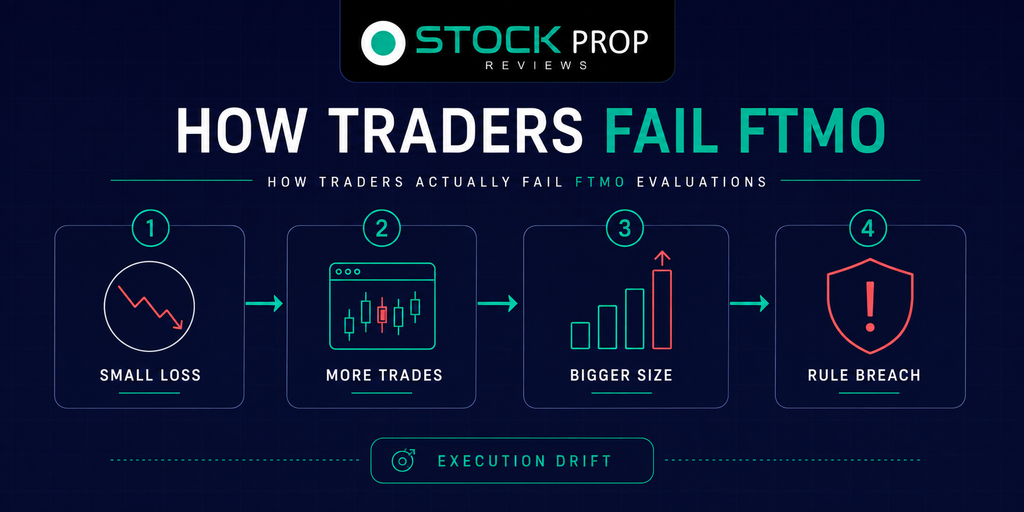
The most common failure pattern is usually not one catastrophic trade.
It looks more like this:
A trader loses 0.5R.
They take another trade.
That trade loses.
They increase position size because they believe the next setup is stronger.
A third trade loses.
Now the trader is no longer trading the original strategy. They are trading the need to recover.
This is where the FTMO risk framework becomes psychologically important.
A daily loss limit does not stop a trader from making bad decisions before the limit is reached.
The trader can still lose 2%, 3% or 4% and be technically compliant. The problem is that the quality of the decision may drop well before the hard limit is reached.
The same failure patterns repeat themselves in prop-trading research and practical risk-management guidance: revenge sizing, overtrading, correlated exposure, and trying to hit the profit target too quickly.
A realistic FTMO trading scenario
Let’s assume a 2-Step trader risks 0.5% per trade on $100,000.
Every full stop is about $500.
The trader is down some $1,500 (before execution costs) after three consecutive losses.
This is uncomfortable but doable.
Now compare that with a trader risking 2% per trade.
Three losses represent approximately $6,000.
The trader could be approaching or exceeding the daily risk boundary depending on the account’s current calculation and trading conditions.
The second trader does not necessarily have a worse strategy.
They have a risk structure that gives normal variance far less room to occur.
That is the critical distinction between strategy risk and account risk.
Common FTMO risk-rule mistakes
Treating 5% as a trading budget
A 5% daily loss limit is a maximum boundary, not a recommended amount to lose.
Traders should create their own daily stop below the firm’s limit.
Watching balance instead of equity
An open losing position can reduce equity even when the balance still looks good.
Forgetting the reset time
The daily calculation uses CE(S)T. Holding positions through the reset can therefore produce results that surprise traders who are thinking in local time.
Increasing size after profits
A profitable morning often creates overconfidence. Traders then increase size because they believe they have “house money.”
The account does not recognize house money. The risk calculation continues.
Trading harder near the profit target
Being 1% away from the target can create more pressure than being 5% away.
That often produces unnecessary trades.
The better approach is to preserve the same risk process that generated the gains.
Who FTMO is best for
FTMO is a better fit for traders who already have a defined strategy, fixed position-sizing rules, and enough discipline to stop trading when conditions deteriorate.
The 2-Step model is particularly understandable for traders who prefer a static 10% overall loss boundary and can work with a 5% daily limit.
The 1-Step model may suit traders who prefer a single evaluation phase and are comfortable with its tighter 3% daily loss and end-of-day trailing maximum-loss structure.
Who should avoid FTMO
FTMO is probably a poor fit for traders who regularly:
- Increase size after losses
- Depend on very large single-day gains
- Trade without predefined stops
- Hold large floating losses
- Need wide room for recovery trades
- Treat the firm’s maximum loss as their normal risk allowance
It is also not a good environment for someone who has not yet demonstrated that their strategy works with consistent position sizing.
A prop evaluation should not be used as a substitute for developing that process.
FTMO compared with alternatives
| Firm/model | Main market focus | Drawdown approach | Best suited to |
| FTMO | Forex and related markets | Daily limit plus static/trailing overall model depending on plan | Structured forex traders |
| The5ers | Forex | Model dependent, with programs designed around longer-term development | Patient traders |
| Topstep | Futures | Futures-specific drawdown structure | Futures traders |
| TradeThePool | U.S. stocks | Stock-focused risk framework | Equity traders |
The important point is that there is no universal “best” risk engine.
A futures trader should not automatically choose a forex-focused firm because it has a higher advertised profit split. Likewise, a stock trader may be better served by an equity-focused environment.
Our FTMO Review goes deeper into the firm’s overall conditions, while the TradeThePool Review is more relevant for traders who specialise in equities. Our prop firm comparison also shows why drawdown structure and strategy fit matter more than headline profit splits.
For the psychology behind these failures, our analysis of why profitable traders still fail prop firms is also worth reading. The key distinction is between a strategy loss and an execution loss.
What I would change in an FTMO risk plan`
I would not build a trading plan around the maximum FTMO limits.
I would build it around a personal risk ceiling comfortably below them.
For example, a trader might decide before starting an evaluation that:
- Single fixed trade risk
- Personal stop well in front of FTMO’s hard limit on daily losses
- The size of the position never grows because of a losing trade
- Correlated positions are one combined risk
- Continuous surveillance of floating losses
- The profit target never changes the normal process of trade selection
The exact percentages should come from the trader’s strategy and historical drawdown rather than an arbitrary internet rule.
The principle is more important than the number: leave enough room for normal losing variance that one bad session cannot destroy the evaluation.
Is FTMO’s risk model fair?
There is a reasonable argument on both sides.
From FTMO’s perspective, daily and overall limits provide a straightforward way to control simulated account risk and identify traders who can operate within defined boundaries.
From the trader’s perspective, a hard daily equity limit can interfere with strategies that naturally experience temporary floating drawdowns or volatile intraday swings.
Neither point makes the system inherently good or bad.
The real question is whether your trading strategy produces an equity curve that fits the constraints.
That is the part many comparison sites miss.
A strategy with a 45% win rate, controlled losses, and modest drawdown can be a better fit than a 70% win-rate strategy that occasionally suffers a large intraday loss.
The rule structure has to match the distribution of your returns, not just your average win rate.
A note on TradeThePool
TradeThePool is worth a look for stock traders looking beyond the forex-centric firms, as it focuses on equities and provides extensive information about its trading environment and risk structure. There is a major accuracy problem with the requested description: TradeThePool should not be presented as a regulated stock prop firm currently. It’s own published material explains that evaluation accounts are simulated and that the online prop-trading arena is not itself regulated.
This difference matters. Traders should check the firm’s current legal and broker-dealer status and should not rely on the word “regulated” in marketing copy.
Readers can enjoy up to 10% discount by buying via our TradeThePool link.
FAQs
What is the FTMO Maximum Daily Loss?
For the current 2-Step model, Maximum Daily Loss is 5% of the initial simulated capital. It is calculated based on equity, so open position losses, commissions and swaps can impact the calculation. Daily limit of 3% on 1-Step model
Is FTMO maximum loss based on equity or balance?
FTMO’s Maximum Loss rule is based on account equity. For the 2-Step model, the maximum loss is 10% of the initial simulated capital.
Does FTMO’s daily loss reset at midnight?
Yes. The daily calculation resets at midnight CE(S)T. Traders in other time zones should convert that reset time to their local time, particularly if they hold positions overnight.
Which FTMO model has the lower daily loss limit?
The current 1-Step model has a 3% Maximum Daily Loss, compared with 5% for the 2-Step model. The 1-Step model also uses an end-of-day trailing Maximum Loss, while the 2-Step model uses a static 10% Maximum Loss.
What is the biggest FTMO risk-rule mistake?
Treating the firm’s maximum loss as a normal trading budget. A trader can remain technically compliant while taking unnecessarily large risks that make a later losing streak much more dangerous. The safer approach is to establish a personal risk ceiling well below the firm’s hard limits.
Bottom line: FTMO’s risk engine is not complicated once the calculations are understood. The difficult part is trading in a way that keeps equity comfortably away from those boundaries. The traders who last are usually not the ones using the most of the available risk. They are the ones who rarely need the limits tested.
Risk disclaimer: This is educational and not financial advice. The rules of prop-firms, account models, trading conditions and reward structures are subject to change. Always check the latest FTMO terms before you buy an evaluation or trade.