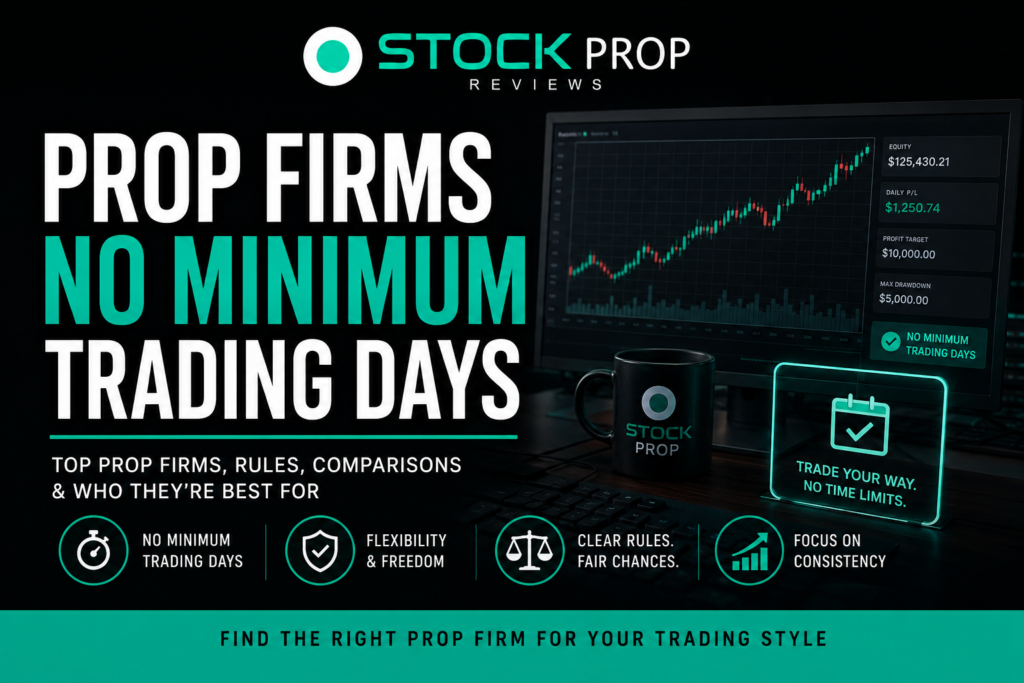
Most traders looking for prop firms with no minimum trading days are usually frustrated with one thing.
They don’t want to wait five or ten trading days after hitting the profit goal.
I can see why you would be frustrated. If a trader hits the target in two sessions, following the rules, it can seem like a waste of time to wait around.
Still, no minimum trading days doesn’t necessarily mean a better prop firm.
Companies tend to remove time constraints since more buyers are drawn to faster evaluations. What matters more is how the risk model works after the excitement of passing wears off.
This article is designed for traders who have a strategy and want more flexibility in evaluations. Probably not the best route for traders still learning discipline or who struggle with emotional trading.
What Does No Minimum Trading Days Mean?
A prop firm with no minimum trading days allows traders to complete an evaluation as soon as the profit target is reached.
For example, if a trader reaches an 8% target in one session without violating drawdown rules, the account can move to the next phase immediately.
Traditional firms often require five or more active trading days. Those rules were originally designed to slow traders down and reduce gambling behaviour.
The newer fast-track models remove that waiting period.
That sounds appealing, especially for scalpers and aggressive intraday traders, but there is another side to it.
Many traders begin forcing trades because they know they can finish quickly.
That behavioural shift is where problems usually begin.
Comparison Table
| Prop Firm | Minimum Days | Max Drawdown | Daily Drawdown | Profit Split | Best For |
| FundedNext | None on selected models | Up to 10% | 5% | Up to 90% | Forex traders with experience |
| Goat Funded Trader | None | 8% to 10% | 4% to 5% | Up to 95% | Fast intraday traders |
| FTMO | Usually required | 10% | 5% | 80% to 90% | Traders focused on consistency |
| The5%ers | Flexible on some accounts | Varies | Varies | Scaling-focused | Swing traders |
| Trade The Pool | Different evaluation structure | Risk-based | Risk-based | Performance based | Stock traders |
Rules change often, so traders should always verify conditions directly before purchasing a challenge.
FundedNext
FundedNext became popular partly because traders could move through evaluations quickly without waiting for minimum trading days.
That flexibility helps traders who already know exactly how they trade.
A disciplined trader can take two or three clean setups, hit the target, and move on without wasting additional days.
The problem is that many traders do the opposite.
Instead of trading normally, they suddenly start treating the challenge like a race.
That usually leads to oversized positions, emotional entries, and unnecessary exposure during volatile market conditions.
Key Rules
| Feature | Details |
| Minimum Trading Days | None on many models |
| Daily Drawdown | Around 5% |
| Maximum Drawdown | Around 10% |
| Overnight Holding | Allowed on several accounts |
| Profit Split | Up to 90% |
What Traders Often Miss
Most reviews focus heavily on payout percentages and challenge speed.
What gets ignored is the psychological pressure that comes with fast evaluations.
A trader who normally risks 0.5% per trade may suddenly risk 3% because the account can technically be passed in one session.
That behaviour usually does not continue successfully after funding.
The evaluation becomes disconnected from how the trader would manage real capital.
Who Should Avoid It
FundedNext is probably not ideal for:
- Traders with poor impulse control
- Traders who revenge trade after losses
- Beginners looking for quick payouts
For experienced traders with stable execution, the flexibility can genuinely be useful.
Goat Funded Trader
Goat Funded Trader built its reputation around flexibility and aggressive evaluation models.
For scalpers and momentum traders, the no minimum trading days structure naturally looks attractive.
A trader can catch one strong move during London or New York sessions and potentially complete a challenge quickly.
That freedom works well for some trading styles.
It also destroys a lot of accounts.
Key Rules
| Feature | Details |
| Minimum Trading Days | None |
| Daily Drawdown | Around 4% to 5% |
| Maximum Drawdown | Around 8% to 10% |
| News Trading | Depends on account type |
| Profit Split | Up to 95% |
Best Fit
This type of model suits traders who already:
- Have tested strategies
- Understand volatility risk
- Keep consistent position sizing
- Can stop trading after reaching daily goals
The last point matters more than most traders realise.
A lot of failed evaluations happen after profit targets are nearly reached.
A trader makes good progress, becomes impatient, then gives back gains trying to finish immediately.
The Real Risk
No minimum day rules are often marketed as lower pressure.
For many traders, they create more pressure instead.
The trader starts calculating how fast they can finish instead of focusing on execution quality.
That mindset change is subtle, but it completely changes behaviour.
Why FTMO Still Matters
FTMO still has minimum trading day requirements on their standard evaluations.
Some traders don’t like that structure.
Others come to understand the reason for it.
FTMO is slower paced, so you have to split your performance over multiple sessions, rather than one aggressive move.
You might feel restricted during winning streaks, but it also filters out emotional trading.
If a trader can’t stay disciplined for a few days he usually has problems after funding anyway.
Best For
FTMO is generally suited for traders who:
- Slower pacing is preferred
- Be quick, not consistent
- Keep positions open longer
- Treat trading as a business already
Not Ideal For
It is less attractive for traders trying to pass evaluations as quickly as possible.
Still, slower evaluation structures sometimes create better long-term habits.
That part rarely appears in prop firm marketing.
The5%ers
The5%ers takes a different approach from many challenge-heavy firms.
The focus is more on gradual scaling and long-term trader development.
Because of that, the environment feels less centred around rushing through evaluations.
That difference matters more than most traders expect.
A slower pace often leads to calmer decision-making.
Where It Fits Well
The5ers tends to work better for:
- swing trader
- Lower frequency traders
- Traders avoid high pressure assessment models
This structure may be less attractive to scalpers looking for quick challenge completions.
But for traders looking for a more stable environment, this can sometimes be a better place.
TradeThe Pool
TradeThe Pool deserves mention because it operates differently from many forex prop firms.
Instead of building the entire experience around challenge speed, the company focuses more on stock trading behaviour and transparent risk rules.
For some traders, especially those moving away from highly leveraged forex models, that structure feels more realistic.
Readers can get up to 10% discount when purchasing through our TradeThePool link.
That should not be the main reason to choose any prop firm.
The better question is whether the rules match the way you naturally trade.
Better Fit For
Trade The Pool may suit:
- Stock traders
- Traders preferring structured risk models
- Traders tired of ultra-aggressive challenge environments
It is less suitable for traders expecting very high leverage or rapid-fire scalping conditions.
The Biggest Problem With Fast Evaluations
Most of the comparison articles are about the speed of pass for traders.
Few people talk very seriously about what happens next.
The fast evaluations tend to encourage unrealistic behaviour.
A trader who usually looks for consistent monthly returns is now attempting to make 8% in 24 hours because that’s the challenge
This develops habits that exist in funded locations almost never.
Trading professionally is boring often.
In fact, many prop firm reviews actually promote the opposite.
That disconnect is why traders pass evaluations, but fail funded accounts over and over.
Which Traders Benefit Most?
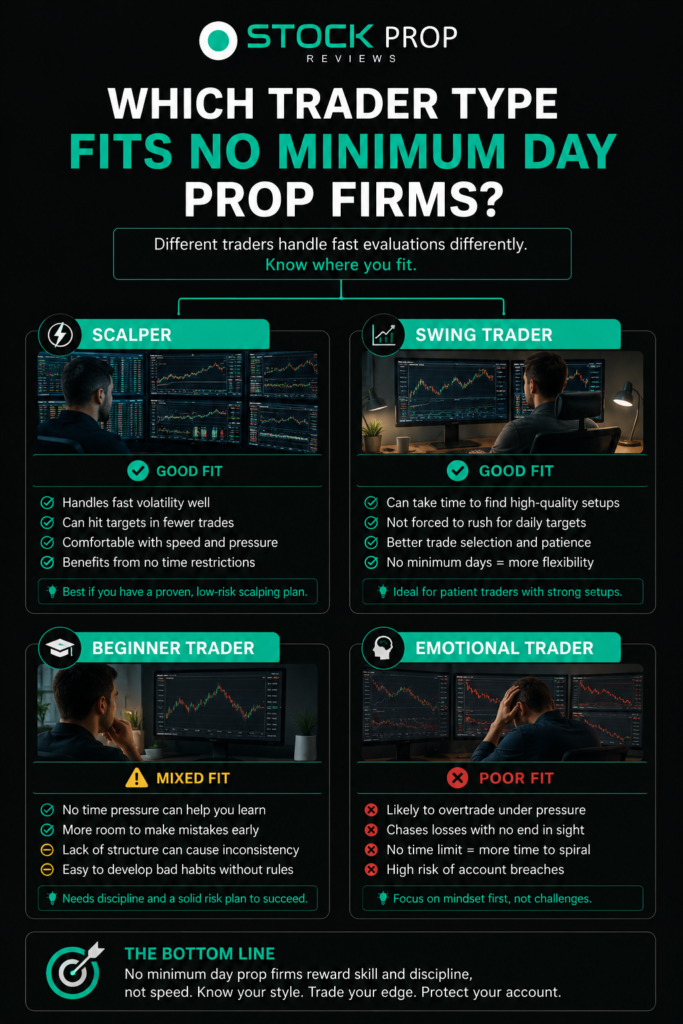
There are no minimum trading day prop firms that can be great for the trader who already has structure.
Scalpers and momentum traders with experience can sometimes benefit, as they naturally trade around short bursts of volatility.
If a trader has already detailed statistics and controlled risk management he might find the flexibility appealing.
That’s a different ballgame for beginners.
Quick assessments frequently enhance emotional decision-making.
The trader begins to force setups, because the objective is to be done fast, not to trade properly.
It usually ends badly.
What Most Competitor Articles Ignore
After reviewing top competitor content, a few trends are consistently appearing.
First, many articles discuss challenge speed but not survival after funding.
Passing is just one piece of the puzzle.
The story is more important to keep.
Second, there are very few comparisons explaining how traders change their behaviour under fast evaluation models.
That’s surprising as usually psychology is the deciding factor.
Third, many reviews seem more like advertisements than actual analysis.
The truth is there are no minimum trading days that can simultaneously help disciplined traders and hurt undisciplined traders.
They can both be true.
Alternatives Worth Considering
Some traders would probably benefit more from structured evaluations.
A slower model forces patience and reduces impulsive trading.
Others may prefer instant funding accounts instead of challenge-based systems altogether, although those usually come with stricter risk controls.
There are also regulated stock-focused firms like Trade The Pool that place more emphasis on transparent rules rather than fast progression.
Readers can get up to 10% discount when purchasing through our TradeThePool link.
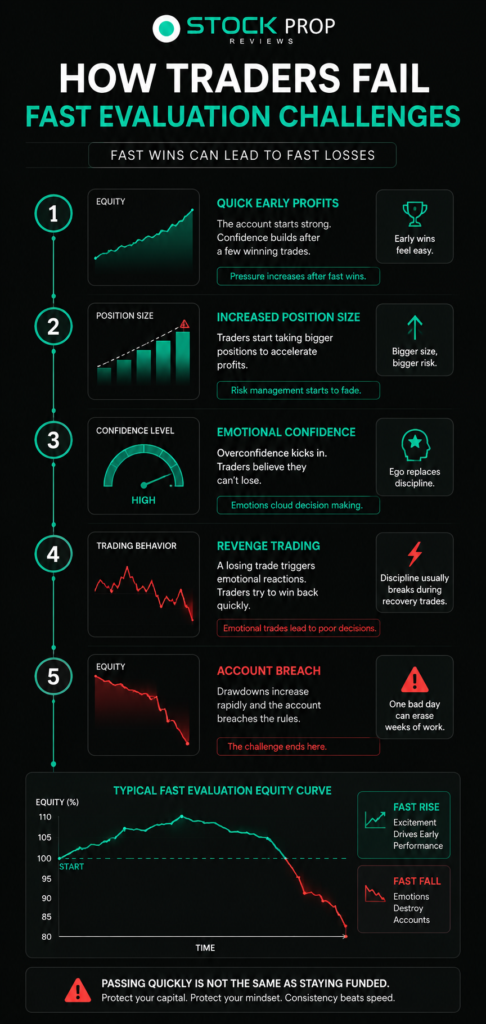
How Traders Usually Fail These Accounts
The pattern is familiar.
The trader starts well.
A few strong trades create confidence.
Then position size increases because the trader wants to finish faster.
One losing trade appears.
Instead of slowing down, the trader tries to recover immediately.
At that point, discipline disappears.
The account usually follows shortly afterward.
This is why evaluation structure alone is never the full story.
The trader’s behaviour matters far more.
Final Thoughts
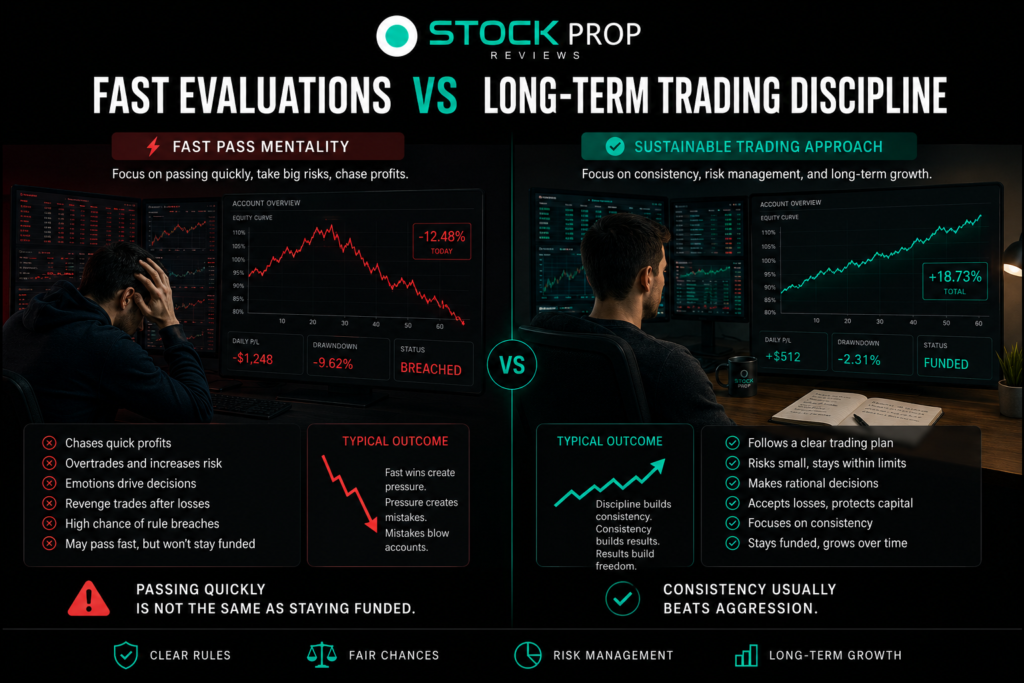
When combined with the right trader, prop firms with no minimum trading days can be useful.
If you’re a disciplined trader with a proven edge, there’s no reason to sit around and wait.
But for emotional traders, that same flexibility can often become dangerous.
The fastest assessment isn’t always the best.
A good prop firm should be able to fit with the way a trader already works, not force them to behave completely differently simply to pass a challenge.
If you’re still comparing firms, it helps to read deeper breakdowns on trailing drawdown rules, funded trader psychology and how consistency models affect long-term survival.
FAQs
Which prop firms do not have minimum trading days?
Some firms offer assessments without minimum days of trading, such as FundedNext and Goat Funded Trader on select models.
Are there no minimum trading day prop firms that are better for scalpers?
Traders are not forced to spread trades over multiple days unnecessarily which makes them attractive to scalpers.
Why do some prop firms still have minimum trading days?
Originally the rule was intended to reduce gambling behaviour and encourage more stable trading performance.
Are no minimum trade day firms good for beginners?
Not normally. Beginners often increase risk too aggressively when rapid progression is possible.
Can traders overcome these obstacles in one day?
Yeah, but aggressive 1 day passes usually entail more risk taking which is hard to maintain after funding.