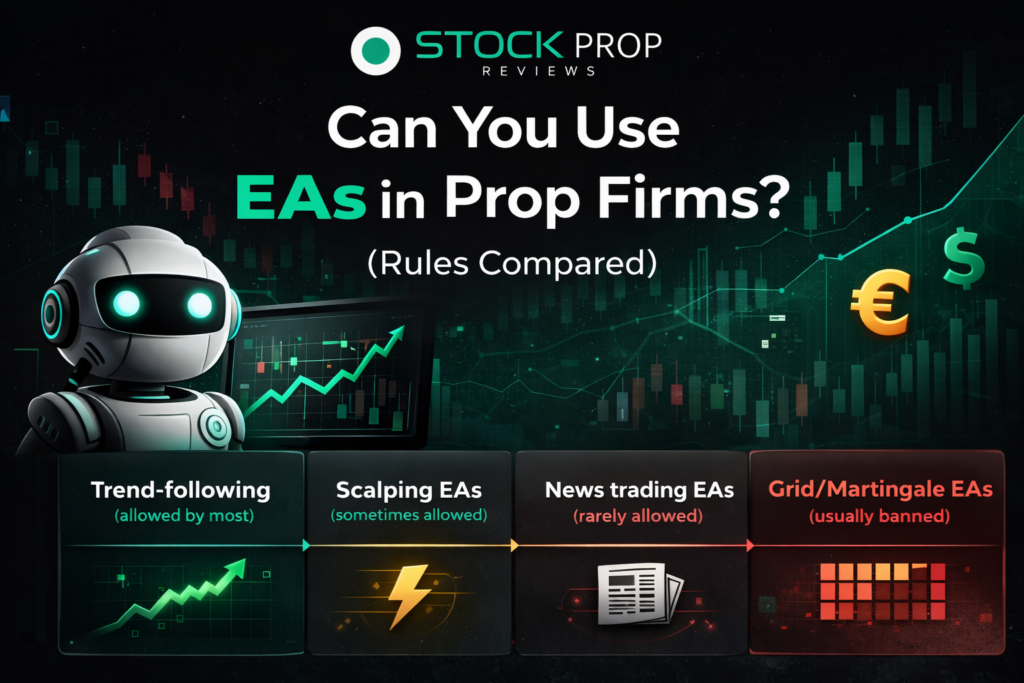
You can use EAs in prop firms, but only in certain ways. Most businesses allow automation to happen, but not all strategies are allowed. The difference is in how your EA handles risk, how it makes trades, and whether it gives you an unfair advantage.
This guide is for forex traders, algo users, and funded traders who are thinking about using automation in a prop environment. It is not for traders who want a “set and forget” system or quick money that doesn’t require any work. You will probably have problems if you can’t explain how your EA acts when it is in drawdown.
In short, many prop firms allow EAs, but the rules about them are stricter than most traders think they are.
What EAs Mean Inside Prop Firms
An Expert Advisor is simply a piece of code that places trades based on rules. In retail trading, that is usually enough. In prop firms, it is not.
Firms are not evaluating your tool. They are evaluating your risk profile.
This is why two traders can both use EAs, but only one keeps the account. The one who survives is usually running a system that behaves like a disciplined human trader, not an aggressive recovery machine.
A common misunderstanding is that “EA allowed” means full automation freedom. In practice, it means the firm is willing to accept automation as long as it does not break their risk model.
How Prop Firms Judge EA Strategies
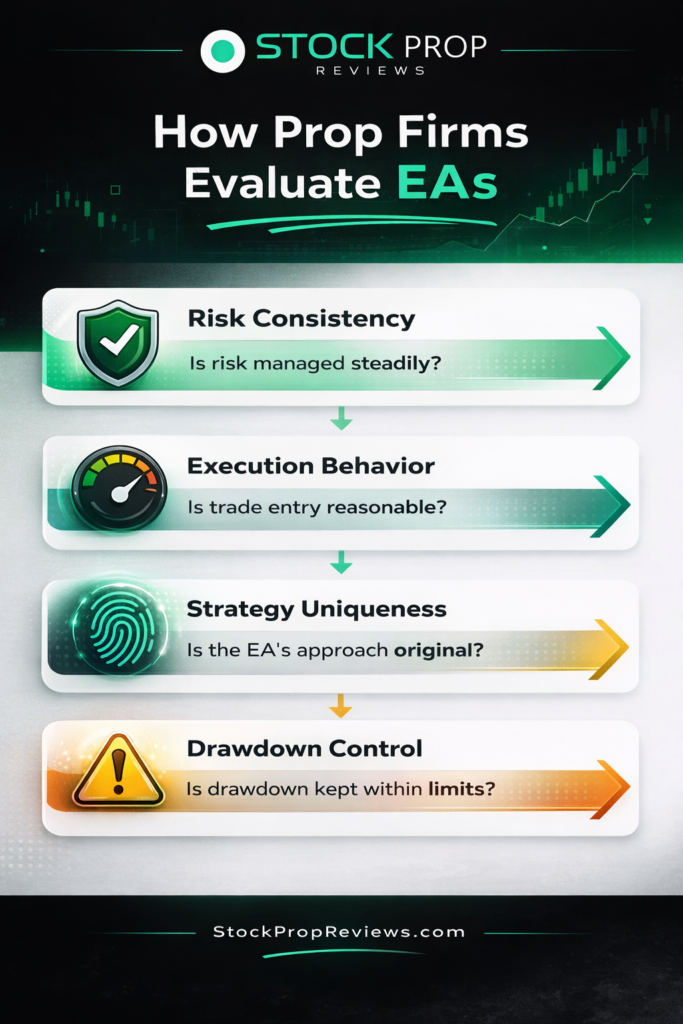
For a business, the most important thing is consistency. If the risk stays under control, it doesn’t matter if trades are done by hand or by machine.
Traders get into trouble when their EA shows patterns that seem unstable or hard to handle on a large scale. For instance, systems that increase the size of a position after a loss may seem fine at first, but they can become dangerous over time.
Companies also keep an eye on how people act when they execute. If trades are set up in a way that looks like they are taking advantage of latency or copying the same thing across accounts, that is a red flag. This is one of the main reasons why traders who use public or shared EAs have problems, even when the strategy works.
Rules Compared Across Prop Firms
Rules vary, but most firms fall into three broad categories.
| Rule Area | Strict Firms | Moderate Firms | Flexible Firms |
| EA usage | Allowed with review | Allowed with limits | Generally allowed |
| Copy trading | Not allowed | Restricted | Sometimes allowed |
| Grid or martingale | Usually banned | Case by case | Occasionally tolerated |
| News trading | Restricted | Limited | Often allowed |
| Execution style | Closely monitored | Moderately monitored | Less strict |
The key detail most competitors miss is this: firms are less concerned about the EA itself and more concerned about how predictable and controllable the outcomes are.
A Real Trading Scenario Most Articles Ignore
Consider a trader who passes a challenge using a grid-based EA. The system builds positions gradually and closes them once the market retraces. During the evaluation, conditions are stable, so the strategy looks consistent.
Once funded, the market trends strongly in one direction. The EA continues adding positions against the move. The account does not hit the maximum loss immediately, but the floating drawdown grows quickly.
Even if the account survives that moment, it is now operating close to risk limits. One more move and the account is gone.
This is why many EAs that perform well in challenges fail after funding. The environment changes, and the rules become less forgiving.
Types of EAs and How They Fit
Not all EAs behave the same way, and prop firms do not treat them equally.
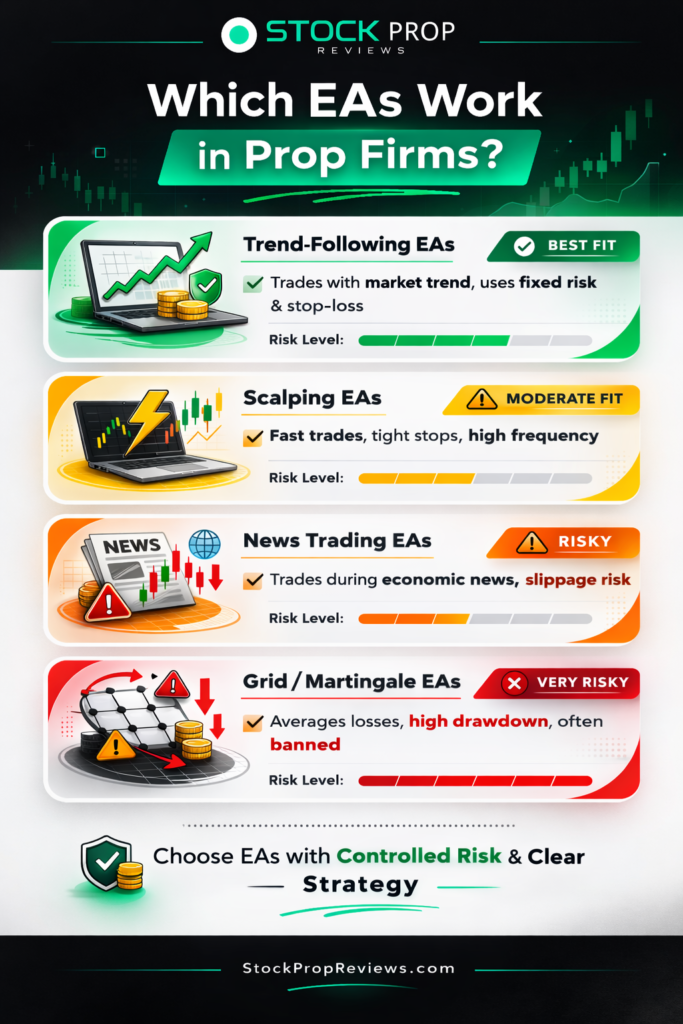
Scalping systems can work, but only if they avoid execution tricks like latency arbitrage. If trades rely on tiny price differences and ultra-fast execution, they are more likely to be flagged.
Trend-following systems tend to fit better because they use defined stops and do not rely on recovery logic. They may experience drawdown, but it is usually easier to manage within firm limits.
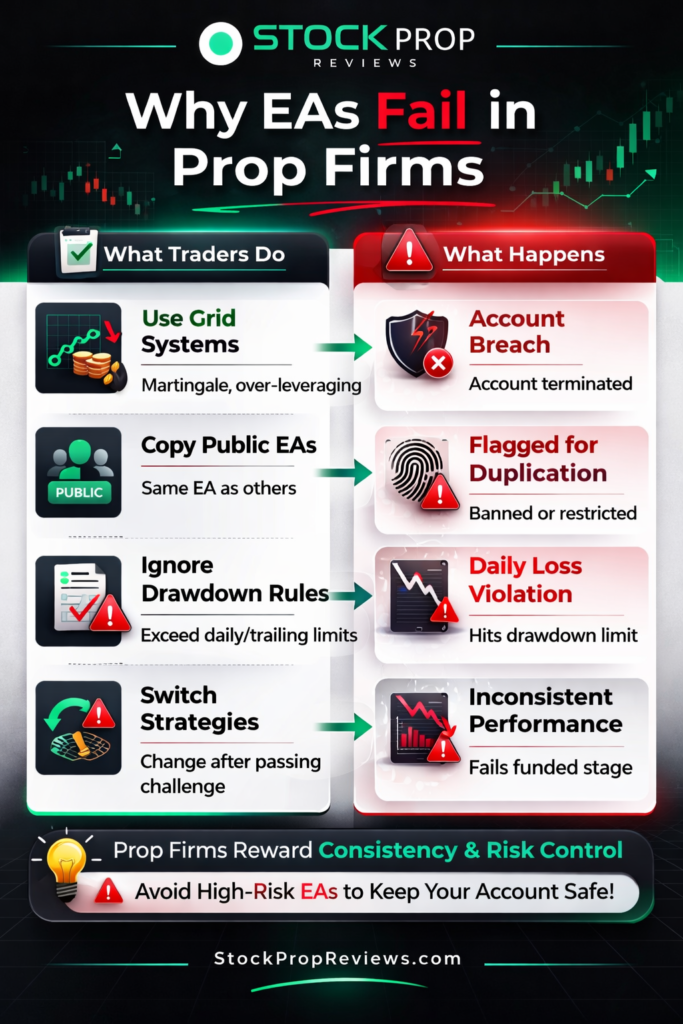
Grid and martingale systems are where most problems start. These strategies are built on the idea of recovering losses by increasing exposure. In a prop firm account with strict drawdown rules, that approach often leads to a breach.
News trading EAs sit somewhere in the middle. Some firms allow them, others restrict them heavily. Even when allowed, slippage and execution delays can turn a good setup into a loss.
What Competitors Often Miss
A lot of articles talk about companies that let EAs work for them. In practice, that doesn’t help much.
People don’t often explain the most important points.
First, having the same strategies on more than one account is a big problem. If a lot of people use your EA, your trades may be the same as theirs. Companies can see this pattern, and it could result in account restrictions or termination.
Second, backtests don’t matter much in this case. Having a strong historical curve doesn’t mean you won’t break a daily drawdown rule when you trade live.
Third, just because an EA passes a challenge doesn’t mean it will work in a funded account. Traders often don’t realize that the evaluation phase gives them more room for mistakes than they think.
Common Mistakes Traders Make
One of the most common mistakes is switching to an EA after passing manually. The trader changes the entire risk profile of the account without fully testing it under prop firm conditions.
Another issue is over-optimisation. Many EAs are tuned to perform well on past data but fail when market conditions shift even slightly.
There is also a tendency to underestimate drawdown. An EA might be profitable over time but still violate daily or trailing limits in the short term. In prop firms, short-term rule breaches matter more than long-term performance.
Finally, using public or shared EAs increases risk. Even if the strategy works, the lack of uniqueness can create problems.
Who Should Avoid Using EAs
EAs are not suitable for every trader.
If you are new to trading, it is difficult to judge whether an EA is behaving correctly or drifting into dangerous territory. Without that understanding, automation can do more harm than good.
Traders who rely on signals or third-party bots should also be cautious. In prop firms, accountability matters. If you cannot explain your trades, you are exposed to unnecessary risk.
In many cases, manual trading or a semi-automated approach is more stable, especially in the early stages.
Alternatives to Full Automation
There are other options besides full automation.
After entering a trade, some traders use simple tools to manage their positions. This keeps decisions in the hands of people while lowering the number of mistakes made when carrying them out.
Some people use partial automation, where the EA only does certain tasks and doesn’t control the whole strategy. This method usually works better with the rules of prop firms.
Another option is to pick a company that is more open and has a clearer structure. In the stock market, TradeThePool is one example where the rules are clearer and easier to understand. When readers buy through our TradeThePool link, they can save up to 10%. Traders who like controlled execution over aggressive automation tend to do well in this environment.
Strategy Fit Matters More Than the Tool
How your strategy works is more important than whether or not you use an EA.
A disciplined manual trader and a well-made EA can get the same results. An EA that isn’t well thought out can ruin an account faster than any human error.
This is why a lot of experienced funded traders end up making their systems easier. They stop using complicated automation and instead focus on being consistent.
Your EA has a chance to work if it acts like a careful trader, respects risk, and stays away from extreme patterns. It will have a hard time if it needs recovery, speed, or duplication.
Related Reading for Better Context
It’s easier to understand EA rules when you look at how companies as a whole handle risk.
For instance, our guide on strict vs. flexible prop firm models talks about why some firms are more open to automation than others.
A detailed prop firm comparison article can help you figure out where automation works and where it doesn’t when you’re looking at your options.
You should also read a balanced article about whether prop firm trading can last for a long time. That conversation shows how automation can change payouts and the life of an account.
Looking at breakdowns like a FundedNext review or FTMO review can help you understand how rules are really used in practice for a specific company.
Final Thoughts
EAs can work in prop firms, but only when they are aligned with the firm’s risk model. The problem is not automation itself. The problem is how most EAs are built and used.
Traders who treat EAs as tools, not shortcuts, tend to last longer. Those who rely on them without understanding the risks usually face rule violations sooner or later.
FAQs
Are EAs allowed in most prop firms?
Yes, but there are some limits. The EA’s strategy must follow the company’s rules for risk and execution.
Can a prop firm fire you after you pass?
Yes. The account can be closed if the EA’s behavior changes or breaks the rules during the funded stage.
Do EAs help you in prop trading?
They can help with consistency, but they also add risks, especially when it comes to drawdown and execution.
Is it safer to trade by hand?
Yes, for a lot of traders. When strict prop firm rules are in place, manual trading gives you more control and freedom.
Can you use the same EA on more than one account?
This is dangerous. If you see the same trading patterns over and over, you may have problems with your account.