A trailing drawdown prop firm rule is a moving loss limit that rises as your account grows. If your account drops below that moving level, the account is closed.
This guide is written for beginner and newly funded traders trying to understand why accounts fail even when trades look “mostly right.” It is not aimed at advanced traders looking for firm-specific rule loopholes or statistical modelling.
Most explanations stop at the definition. The problem is not understanding what it is. The problem is how it behaves once real trades, emotions, and normal drawdowns come into play.
Simple Definition of Trailing Drawdown
A trailing drawdown starts below your initial balance and moves upward as your profits increase. It never moves back down.
Think of it as a floor that keeps rising behind your account.
If your balance falls below that floor at any point, you lose the account.
That sounds straightforward, but the impact is not.
A Practical Example Most Traders Recognize
Let’s walk through a realistic situation instead of a textbook one.
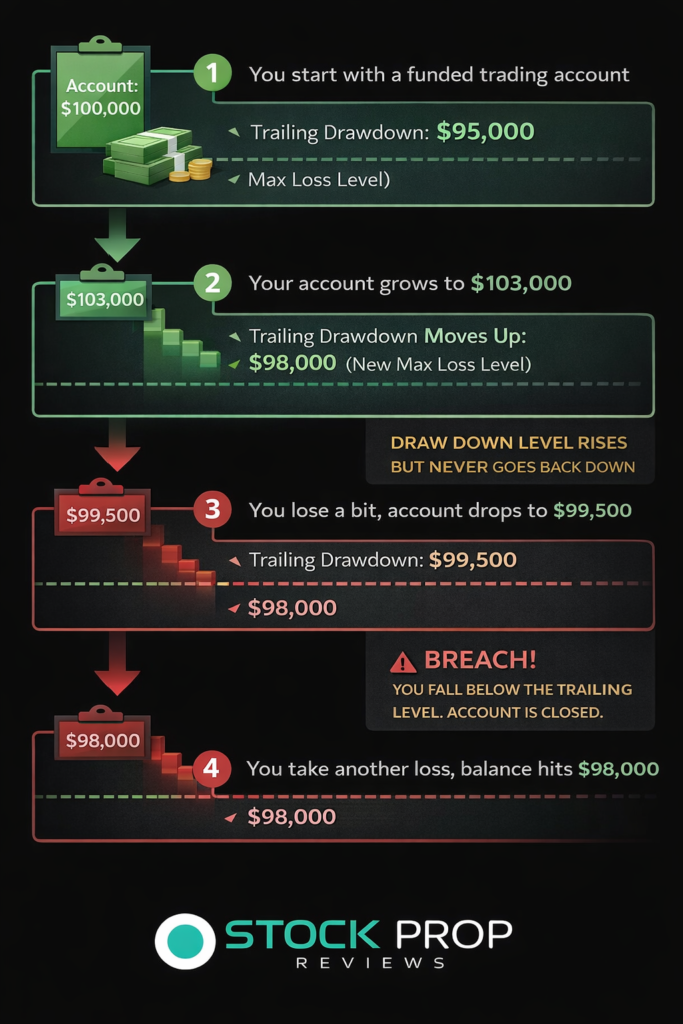
You start with a $100,000 account and a $5,000 trailing drawdown.
- Your minimum level is $95,000
- You make $3,000 over a few trades
- Your account is now $103,000
The drawdown follows you up. It might now sit around $98,000.
At this point, you feel comfortable. You are up on the account.
Then a normal losing sequence happens. Not a disaster, just a pullback.
- You lose $2,000
- Then another $1,500
Your balance drops to $99,500.
You are still in profit overall. But your trailing level is $98,000. One more losing trade, even a small one, can end the account.
That is where most traders get caught. The rule does not care about your total profit. It only cares about the distance from the moving threshold.
Why Trailing Drawdown Feels Easy at First
The rule seems reasonable at the beginning of an account.
There’s space for you. Your drawdown is a long way off. Trades with standard sizing are acceptable.
After early profits, the issue arises.
The trailing level rises as your balance does. Depending on your trading style, your buffer between current equity and the limit gets tighter.
On day five, the same tactic that proved effective on day one begins to seem dangerous.
This is where a lot of traders go wrong. Assuming that the risk remains constant, they continue to trade in the same manner.
It isn’t.
Intraday vs End of Day Trailing Drawdown
Not all trailing drawdown rules work the same way. A lot of the time, traders don’t think about this when they compare companies.
At the end of the trading day, some companies update the drawdown. Some people keep track of it in real time.
Your limit is based on your closing balance when you do end-of-day trailing. The threshold doesn’t change right away when there are intraday swings. This gives you some space.
With intraday trailing, you can see your equity in real time. If your open trade goes into drawdown, your limit could be hit even before you close it.
This difference is more important than most traders think.
A scalper with tight stops might be able to handle trailing during the day. A trader who lets trades breathe will have a hard time with it.
Where Most Traders Misread the Rule
People often think that trailing drawdown is just a “maximum loss.”
There is no set limit. It is a moving limit that changes your risk level over time.
Another common mistake is only looking at closed trades. A lot of companies use equity, not just balance, to figure out drawdown. In other words, trades that are open count.
Even if a position later makes money, it can still be a breach if it is temporarily losing money.
This is one of the most annoying ways that traders lose their accounts.
The Real Reason Traders Fail With Trailing Drawdown
Based on my experience with funded accounts, one bad trade doesn’t usually lead to failure.
This is how it usually looks:
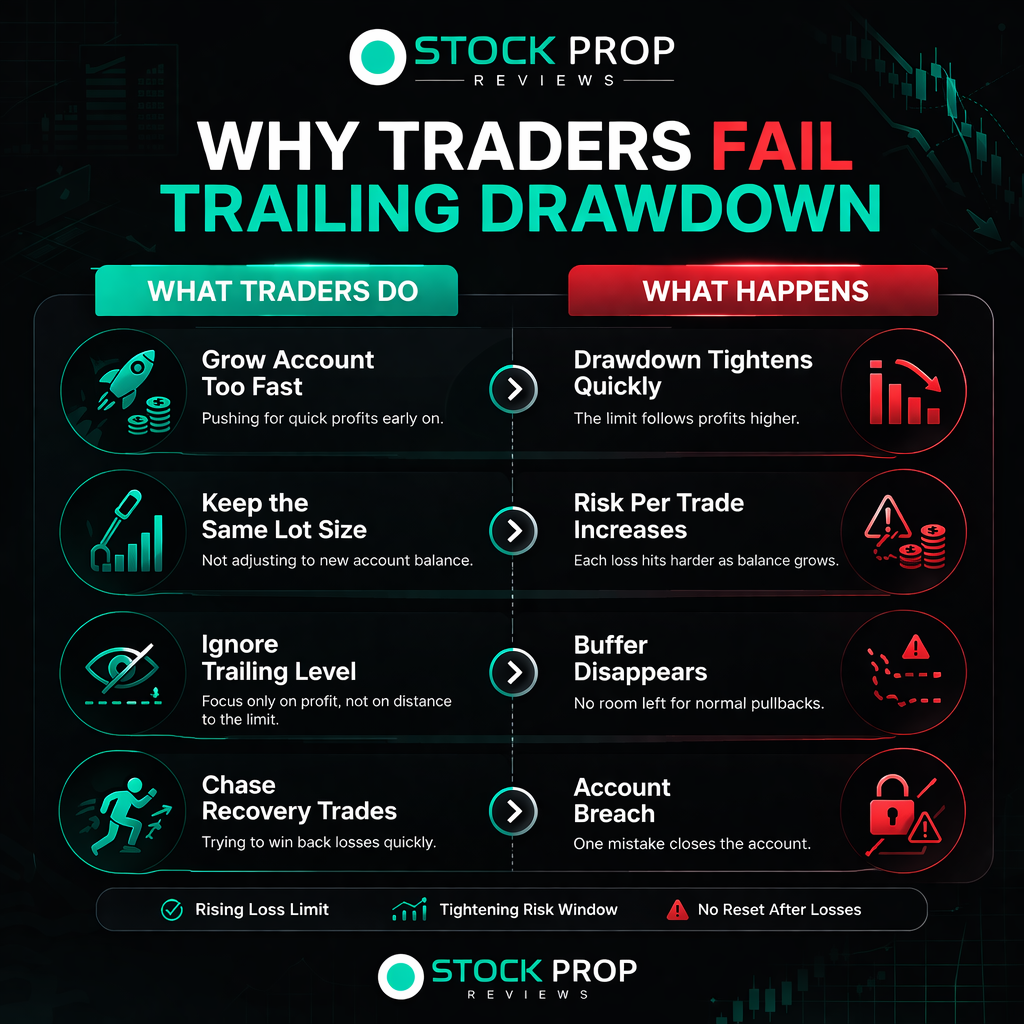
A trader makes money early on, and often quickly. That makes the trailing level go up. After that, the trader goes through a normal losing phase. It’s nothing out of the ordinary; it’s just part of trading.
But now there is less room for mistakes.
The trader either keeps the same amount of money in the trade or tries to get back to break even faster. Both methods make things more difficult.
At some point, a regular drawdown becomes a rule break.
This is why traders say, “I was doing well, but then I failed.” It seems sudden, but the risk was growing before.
The Psychological Side Most Guides Ignore
Trailing drawdown makes you think differently about trades.
When your buffer is small, every loss seems bigger than it is. You stop carrying out your plan and start protecting the account instead.
Some traders close winning trades too soon to protect the trailing level. Some people don’t want to take valid setups because they are too close to the edge.
This break makes the edge less sharp. It doesn’t help performance; it makes it worse over time.
Traders sometimes go the other way. They push harder to get farther away from the trailing level, which makes them trade too much.
The same pressure causes both reactions.
Strategy Fit Matters More Than People Think
Not all strategies are affected the same way by trailing drawdown.
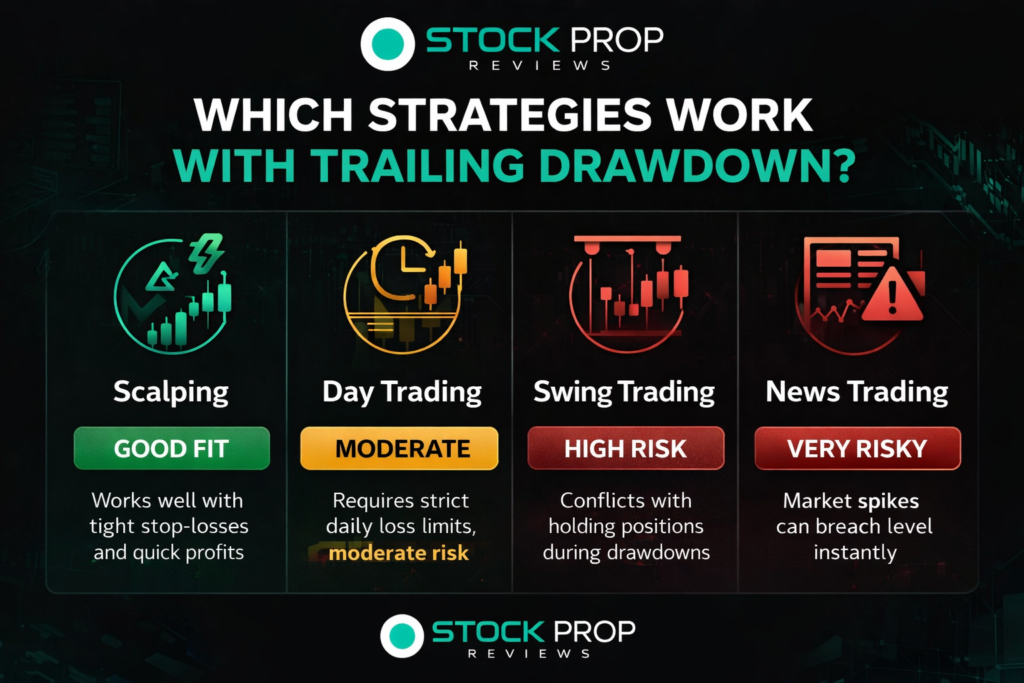
A trader who uses tight stop losses and makes small wins often can deal with it. The account grows steadily, and pullbacks are kept in check.
A swing trader, on the other hand, lets trades go up and down before they make money. That natural change can happen at the same time as a rising drawdown level.
Even if the strategy works in the long run, it might not be able to follow the rule.
News traders have the same problem. Before you have time to react, sudden spikes can hit the trailing threshold.
This is why knowing your own trading style is more important than picking the “best” firm.
What Competitors Often Leave Out
Most competitor articles explain how trailing drawdown works, but they rarely explain how it changes over time.
They also tend to ignore how early profits can actually make the account harder to manage later.
Another missing piece is position sizing. As the trailing level rises, your effective risk per trade increases unless you adjust.
Without that adjustment, the account becomes fragile.
These are practical issues traders face daily, not theoretical ones.
A Better Way to Think About It
Instead of focusing on your account balance, think in terms of your distance from the trailing level.
That distance is your real margin of safety.
As your account grows, that margin does not automatically grow at the same pace. In many cases, it shrinks relative to your trading behavior.
If you treat your trailing threshold as your “true balance,” your decisions tend to become more stable.
AlternativesTraders Often Consider
Some traders move away from trailing drawdown models after a few failed attempts.
Static drawdown is the most common alternative. The loss limit stays fixed, which makes planning easier.
There are also hybrid models where the drawdown trails up to a certain point and then becomes fixed.
These structures tend to suit traders who rely on consistency rather than aggressive growth.
Where TradeThePool Fits Into This Discussion
TradeThePool takes a more structured approach to risk. As a regulated stock prop firm, the focus is on clear rules and consistency rather than aggressive trailing mechanisms.
For traders who find trailing drawdown restrictive or confusing, this type of model can feel more predictable. It does not remove risk, but it reduces uncertainty around how that risk is calculated.
Readers can get up to 10% discount when purchasing through our TradeThePool link.
Internal Reads That Help Put This in Context
If you are comparing firms or trying to choose a model, it helps to look beyond just drawdown rules.
You can explore our breakdown of strict vs flexible prop firm models to see how different rules affect long-term survival.
Our analysis of FTMO review insights shows how trailing drawdown plays out in real accounts.
And if you want the bigger picture, the article on why most funded traders fail connects these rules to trader behavior.
Final Take
Trailing drawdown is not complicated on paper, but it is demanding in practice.
It rewards consistency and controlled risk. It punishes volatility, even when that volatility is part of a profitable strategy.
Most traders do not fail because they misunderstand the definition. They fail because they do not adjust their behavior as the rule tightens.
If you understand that early, you have a much better chance of keeping a funded account.
FAQs
Can you lose money in a funded account even if you’re still making money?
Yes. This is one of the most common things that happen when you have a trailing drawdown. A pullback after making money can cause a breach.
Is trailing drawdown more difficult than static drawdown?
Yes, for most traders. As the account grows, it needs more changes.
Does trailing drawdown always go up?
It goes up when it makes money and then stops going down. It never goes back down after losing.
Why do prop companies use trailing drawdown?
Limiting how much profit can be given back before closing an account helps control risk.
Is trailing drawdown a good choice for beginners?
Beginners usually have trouble with it because they are still learning how to handle risk in a consistent way.