Prop firms advertise simple evaluation rules, but many traders only realize how strict they are after a violation happens. If you break prop firm rules, the usual outcome is immediate failure of the challenge or termination of the funded account. The system is normally automated and does not allow warnings or manual overrides.
This guide explains what actually happens after a rule violation, why these rules exist, and how traders unintentionally break them during normal trading activity.
It is written for beginner and intermediate traders considering prop firm challenges who want to understand the real risks before paying evaluation fees. It is less useful for experienced institutional traders who already work within professional risk limits.
The goal is not to criticize prop firms or defend them. It is simply to explain the mechanics behind rule violations and why they happen so frequently.
What “Breaking a Prop Firm Rule” Actually Means
Breaking a prop firm rule means a trader violates one of the predefined risk limits set by the firm during a challenge or funded stage.
These rules are designed to protect the firm’s capital exposure and maintain consistent risk control across thousands of traders.
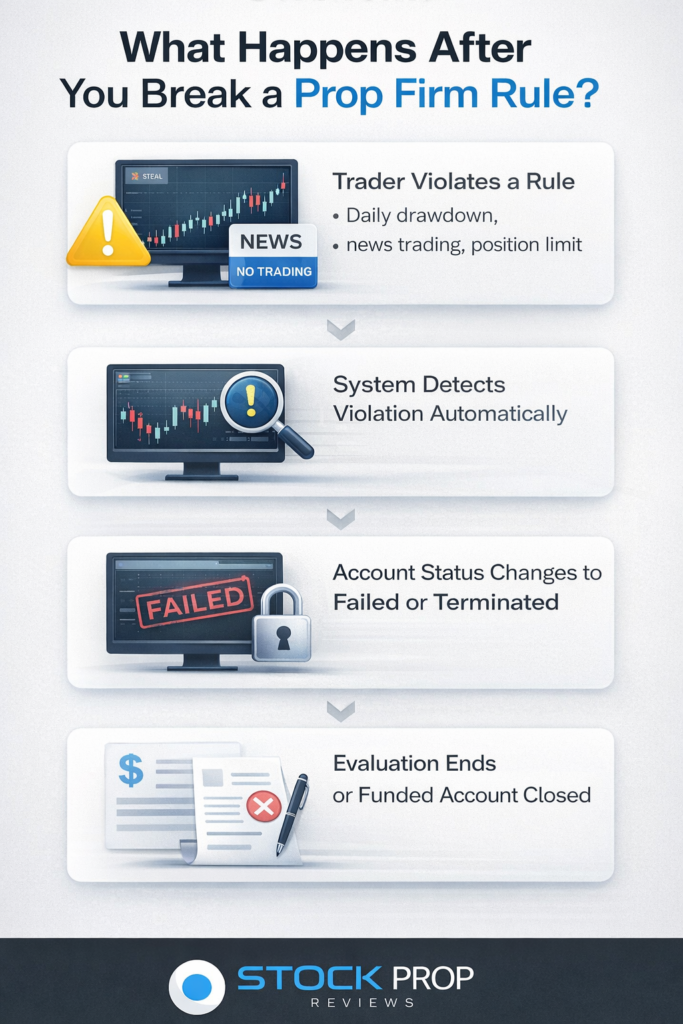
Most prop firms enforce rules through automated monitoring systems connected directly to the trading platform. When a violation occurs, the account status changes instantly.
Typical rules include drawdown limits, trading restrictions, or activity requirements.
A simplified overview of common rules looks like this.
| Rule | What It Controls | Typical Limit |
| Maximum daily drawdown | Maximum loss allowed in a single day | 3 to 5 percent |
| Maximum overall drawdown | Total loss allowed on the account | 6 to 10 percent |
| Profit target | Profit required to pass evaluation | 8 to 10 percent |
| Minimum trading days | Required number of trading sessions | 5 to 10 |
| News trading restrictions | Limits around economic releases | Varies by firm |
Some firms add additional rules such as consistency requirements or restrictions on holding trades over weekends.
Even experienced traders occasionally break these rules because they behave differently from traditional brokerage risk management.
What Happens Immediately After a Rule Violation
The exact consequence depends on whether the account is in the evaluation stage or already funded.
During a Challenge
Most firms treat rule violations during the evaluation phase as an automatic failure.
Once the violation occurs, the system typically disables the account. Open trades may close immediately, and the trader loses the evaluation fee they originally paid.
This can happen faster than many traders expect. A single trade that exceeds the daily loss limit can end the challenge instantly.
Many beginners believe they will receive a warning or that the firm will allow them to continue trading if the violation was small. In reality, that rarely happens.
The rules are usually enforced automatically and consistently across all accounts.
During the Funded Stage
If a rule is broken after a trader becomes funded, the consequences can be more complicated.
Common outcomes include the following.
The funded account may be terminated.
Profits generated after the violation may become ineligible for payout.
The trader may need to restart a new evaluation.
Some firms allow account resets, but these typically require paying an additional fee.
Traders often discover this only after reaching the funded stage, which is why understanding the rules beforehand matters.
Many traders only realise how strict rule enforcement is after failing once, which is something we break down in our TopStep review, where most failures happen after funding rather than before.
Why Prop Firms Enforce Rules So Strictly
A common belief among new traders is that prop firms design rules mainly to make traders fail.
The reality is more practical.
Prop firms manage large numbers of traders simultaneously. Even if each account is simulated, risk control still matters because payouts must come from real revenue.
Strict rules filter traders who cannot manage risk consistently.
From the firm’s perspective, the biggest problem is not a single losing trade. The real risk comes from traders who dramatically increase position size after losses or chase profit targets with excessive leverage.
Automated rule enforcement removes the need for subjective decisions.
If the limit is breached, the account fails. The system does not evaluate intent or strategy.
The Most Common Ways Traders Break Prop Firm Rules
Most violations are not deliberate. They usually happen because traders misunderstand how rules are calculated or underestimate market volatility.
Several patterns appear repeatedly.
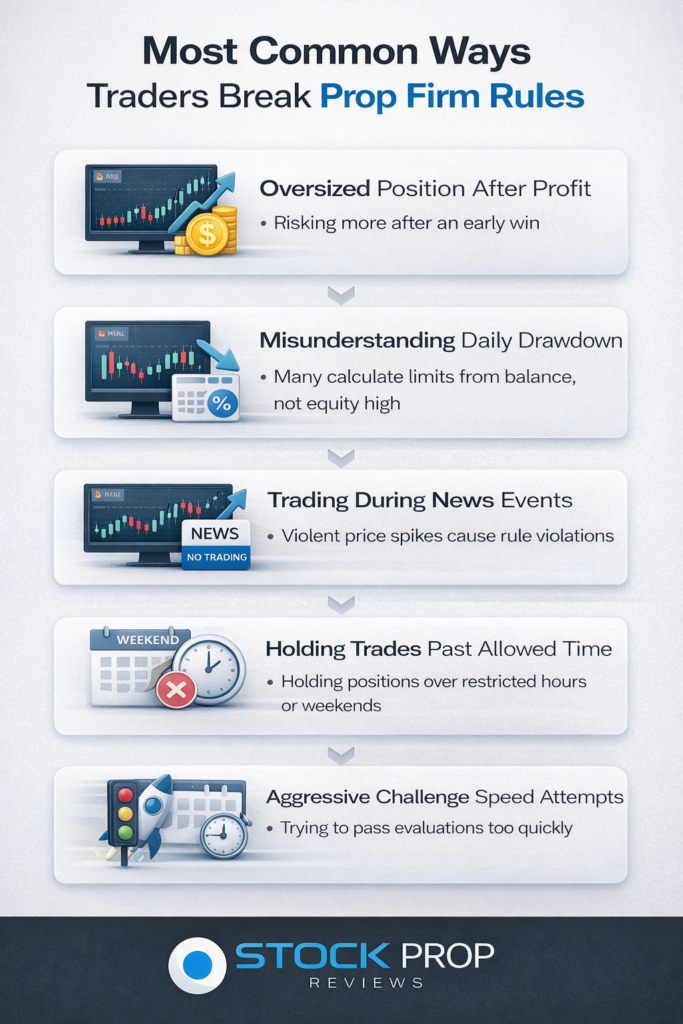
Misunderstanding Daily Drawdown
Most of the time, traders break the rule about daily drawdown.
A lot of traders think that the limit is based on the day’s starting balance. Some companies, on the other hand, figure it out based on the highest equity value reached during the session.
Think about a simple example.
A trader has $100,000 in their account when they start the day.
They make $2,000 in the morning session, bringing their equity up to $102,000.
If the daily drawdown limit is 5%, the maximum loss might now be $102,000 instead of $100,000.
If the market goes the other way and the trader loses more than the allowed amount, the system marks it as a violation.
Even though the account was making money earlier in the day, this can still happen.
Oversized Trades After Early Profit
Another common situation occurs when traders increase position size after a profitable start.
Many evaluations require around eight percent profit to pass. When traders reach half that target quickly, they sometimes try to finish the challenge in a single trade.
If the position size becomes too large, a normal losing trade can exceed the daily drawdown limit.
The challenge ends immediately.
Experienced prop traders usually maintain consistent risk per trade instead of increasing exposure during the evaluation period.
Trading During Major News Events
Volatility during economic releases can trigger rule violations even when the trade setup appears valid.
Large spreads and slippage can cause losses larger than expected.
Some firms restrict trading around major announcements such as CPI or interest rate decisions. Traders who open positions shortly before the release may unknowingly violate the rule.
Scalpers are particularly vulnerable because they rely on precise execution and tight stops.
Holding Trades Past the Allowed Time
Certain firms prohibit holding positions overnight or over the weekend.
This rule is easy to overlook, especially for traders used to swing trading.
If a position remains open past the allowed cutoff time, the system can mark the account as violating the rules. Even if the trade itself was profitable, the account may still fail.
What Many Competitor Articles Miss
Most articles about prop firm rules simply list the limits. They rarely explain how rule violations occur during real trading conditions.
Several details are often overlooked.
One issue is platform execution.
Stop losses do not always guarantee a precise exit price. During volatile conditions the actual fill price can be worse than expected. If the slippage pushes the loss beyond the daily limit, the system still counts it as a violation.
Another factor is floating drawdown.
Some firms calculate risk based on equity rather than closed balance. This means temporary unrealized losses count toward the limit even if the trade eventually recovers.
Traders who hold positions for longer periods often struggle with this structure.
Finally, profit targets themselves can create pressure. When traders feel close to passing the challenge, they sometimes abandon their normal risk management rules.
Ironically, that moment often leads to the rule violation that ends the evaluation
For example, our FundingPips review shows how traders misunderstand trailing drawdown, where even unrealised profits can tighten your loss limit and trigger violations..
Real Trading Scenarios Where Violations Happen
Seeing real-life examples makes the risk clearer.
A forex trader might open a position just before an important report on inflation. The price goes up and down very quickly. The spread gets bigger, and the trade ends up losing more money than expected. The account goes over the daily drawdown limit and fails right away.
During the first week of an evaluation, another trader might make steady profits. They up their position size on the next trade because they are only a few percent away from their goal. The market goes against them, and one loss wipes out days of progress.
There are also problems with gaps on the weekend. A trader who holds gold or currency positions over the weekend could see a big opening gap on Sunday. If weekend holding was not allowed, the rule would still be broken even if the trade later makes money..
Which Traders Break Prop Firm Rules Most Often
Certain trading styles have a higher probability of violating risk limits.
High leverage scalpers are one example. Their strategies rely on large position sizes relative to account equity. Small market moves can therefore produce large drawdowns.
News traders face a different challenge. Their strategy intentionally targets volatile events, which can produce unpredictable execution.
Another group includes traders trying to pass challenges extremely quickly. Some traders attempt to reach the profit target in one or two days. This approach requires unusually large risk per trade, which dramatically increases the chance of breaking prop firm rules.
This pattern is also visible in our MyForexFunds review, where traders often fail not because of strategy, but because they increase risk under pressure and breach daily limits.
How Rule Structures Differ Between Firms
Not every prop firm uses identical risk calculations.
Understanding these differences helps traders choose firms that fit their strategy.
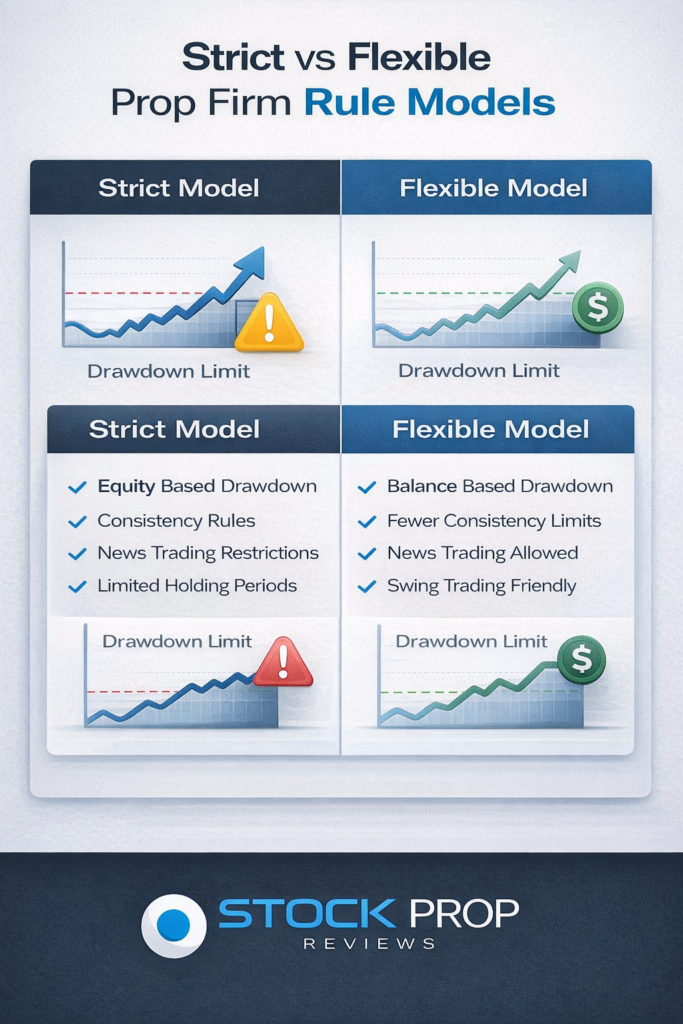
| Feature | Strict Model | Flexible Model |
| Daily drawdown calculation | Equity based | Balance based |
| Consistency requirements | Often mandatory | Sometimes absent |
| News trading rules | Often restricted | Sometimes allowed |
| Weekend holding | Frequently banned | Sometimes permitted |
A trader using swing strategies may prefer firms with balance based drawdown rules. Day traders might find stricter models manageable if they keep position sizes small.
For example, some traders compare rule structures when researching firms like those discussed in our FTMO review or the detailed breakdown in the FundedNext review.
These reviews explain how drawdown calculations differ and how that affects real trading performance.
For a broader perspective, the best prop firms comparison guide highlights how different evaluation models affect trader success rates.
How Transparent Rules Help Traders Avoid Violations
One area that separates prop firms is how clearly they present risk limits.
Some dashboards show only account balance and profit. Others display real time drawdown levels and rule thresholds.
Clear risk dashboards help traders monitor how close they are to violating limits.
For example, the regulated stock prop firm TradeThePool focuses heavily on transparent rule explanations and platform based monitoring tools. This helps traders understand their risk exposure at all times.
Readers can get up to 10 percent discount when purchasing through our TradeThePool link.
Transparency does not eliminate trading risk, but it reduces the chance of accidental violations caused by unclear calculations.
Practical Ways Traders Reduce Rule Violations
Experienced prop traders usually treat evaluation accounts as risk management exercises rather than profit races.
They often keep risk per trade between 0.5 and 1 percent of account equity. This allows several losing trades without reaching drawdown limits.
Many also avoid trading during high impact news events, even if the firm technically allows it. Volatility can distort execution and invalidate normal risk calculations.
Another habit is focusing on steady progress rather than trying to complete the challenge quickly. Passing in two weeks instead of two days dramatically reduces the chance of breaking prop firm rules.
Monitoring equity rather than just account balance also helps traders anticipate drawdown issues before the limit is reached.
Are There Alternatives if You Keep Breaking Rules?
Some traders have trouble with strict evaluation structures and start looking into different prop firm models.
Some companies have static drawdown limits that don’t change when the equity changes. Swing traders may find this structure easier to understand.
Some people take away the need for consistency or let holding periods be more flexible.
Some traders also move to prop firms that focus on stocks, where risk rules are often set up differently than they are for forex evaluations.
TradeThePool is one example of an equity trading site that traders who like stock markets like because it has clear rules and is regulated.
If readers decide that structure fits their strategy, they can get up to 10% off when they buy through our TradeThePool link.
FAQs
If you break a rule at a prop firm, do you always lose?
Yes, most of the time. Breaking important limits, like the maximum drawdown, usually means that the account will fail right away. The system usually makes sure that rules are followed on its own.
If you break a rule, can you keep the money?
No, usually not. The company may cancel the profits made on that account if the violation happens before the payout request is approved.
What rule do traders break the most?
The most common violation is going over the daily drawdown limit. A lot of the time, they happen because of big trades or sudden changes in the market.
Do all prop firms have the same rules?
No. Every company has its own way of figuring out drawdowns, trading limits, and how to evaluate things. Before starting a challenge, it’s important to know what these differences are.
Are prop firm rules really going to help traders succeed?
Yes, but you have to be very careful with your money. Traders who cut back on their positions, stay away from news events that make the market jump, and focus on steady gains tend to live longer.
If you break just one rule in a prop firm account, it may seem like a small mistake, but in most cases it ends the evaluation or funded account right away.
Not all of the traders who last the longest are the most aggressive. They are usually the ones who see the challenge as a chance to make money quickly rather than a chance to manage risk like a pro.