A lot of new traders end up asking the same thing: is prop trading a form of gambling?
The truth is more complicated than most online conversations make it seem. Trading on your own is not gambling. It is a structured financial activity in which traders use money given to them by a company and follow strict rules about risk. But if you don’t pay attention to discipline and probability, trading can quickly turn into gambling.
This article is for people who are new to trading and people who are already trading and want to know if prop trading is a real way to trade or just another way to gamble. It uses real trading situations, probability, and risk management rules that professional traders use to show the difference.
People who want quick profits or viral trading strategies shouldn’t read it. The point of this is to explain how prop trading really works and why a lot of traders don’t get the risks.
What Prop Trading Actually Means
Proprietary trading refers to trading with capital provided by a firm rather than personal funds. Instead of risking their own money, traders operate within a defined risk framework and share profits with the firm.
The structure usually includes several key rules. A trader might receive a $100,000 evaluation account but must respect limits such as a daily loss cap, a maximum drawdown level, and sometimes a minimum number of trading days. If the trader generates profits while respecting those rules, they receive a percentage of the gains.
A typical structure might look like this:
| Rule | Typical Range |
| Profit target | 8% to 10% |
| Daily drawdown | 4% to 5% |
| Maximum drawdown | 8% to 12% |
| Profit split | 70% to 90% |
These rules exist to protect firm capital and force traders to operate within controlled risk parameters. In other words, the system is designed around risk management, not random outcomes.
Traders who are new to funded trading often misunderstand how these firms operate. Our guide explaining how stock prop firms work breaks down the evaluation process, profit splits, and risk rules that govern most funding models.
Why Prop Trading Sometimes Looks Like Gambling
Despite this structure, the industry often appears similar to gambling from the outside. There are several reasons for that perception.
The first reason is failure rates. A large percentage of traders do not pass prop firm evaluations. Estimates vary, but many firms see failure rates above seventy percent. When people see those numbers, they assume the outcome must be random or stacked against the trader.
The reality is usually different. Most failures happen because traders violate risk rules rather than because the market is unpredictable.
Another reason is the behaviour encouraged by social media trading culture. Traders frequently share screenshots of massive profits made in a single day. That type of content creates the impression that passing a prop challenge requires aggressive position sizing and fast results. New traders often try to replicate this behaviour, which leads to rapid drawdowns.
The final factor is the structure of evaluation targets. If a trader needs to reach a ten percent profit target while avoiding a ten percent drawdown, the margin for error is small. Traders who rush to hit the target often increase risk beyond sustainable levels.
When that happens, trading decisions start to resemble gambling behaviour.
The Real Difference Between Trading and Gambling
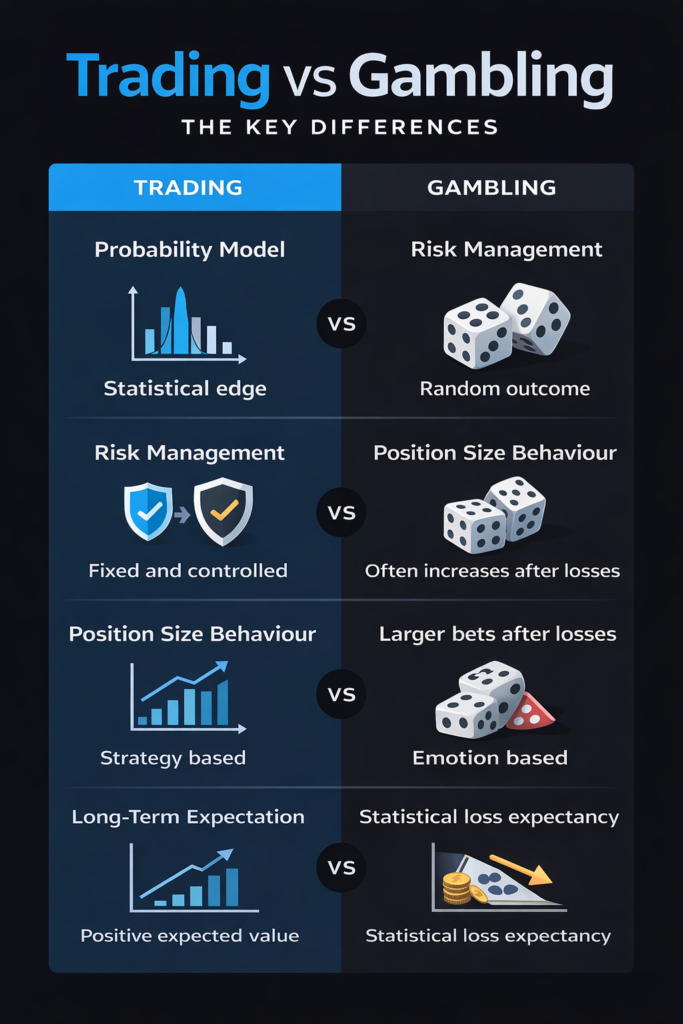
The key difference between trading and gambling lies in probability and risk control.
A casino game has fixed odds that favour the house. Even if a player wins occasionally, the long-term probability is negative.
Trading works differently. A trading strategy can have positive expected value if the relationship between win rate, average profit, and average loss is favourable.
Consider a simple example.
Imagine a strategy that wins 45 percent of the time. At first glance, that seems weak. But if the average winning trade is twice the size of the average losing trade, the numbers change.
Over one hundred trades the outcome might look like this:
| Metric | Result |
| Winning trades | 45 |
| Losing trades | 55 |
| Average win | 2R |
| Average loss | 1R |
| Net outcome | +35R |
Even with more losses than wins, the trader finishes with a positive result. That is the foundation of professional trading. The edge does not come from guessing correctly every time. It comes from managing risk relative to reward.
Gambling rarely follows that framework.
How Risk Rules Change Trader Behaviour
One of the biggest differences between personal trading and prop trading is how strict risk rules influence behaviour.
A trader using their own account may tolerate a large drawdown. If they lose fifteen percent of their capital, they can simply continue trading and try to recover gradually.
Prop firm accounts usually do not allow that flexibility. The trader might face a five percent daily loss limit and a ten percent maximum drawdown. If those thresholds are breached, the account is closed.
These limits force traders to manage position size carefully. A trader risking three percent per trade could fail an evaluation within a few losing trades.
For that reason, most experienced traders operating in prop environments keep risk very small. Many risk less than one percent per position. This approach allows the strategy to play out over a larger number of trades.
Understanding drawdown limits is critical because most prop firms enforce strict risk caps. Our breakdown of daily drawdown vs overall drawdown rules explains how these limits affect position sizing and why many traders fail evaluations.
How Traders Accidentally Turn Trading Into Gambling
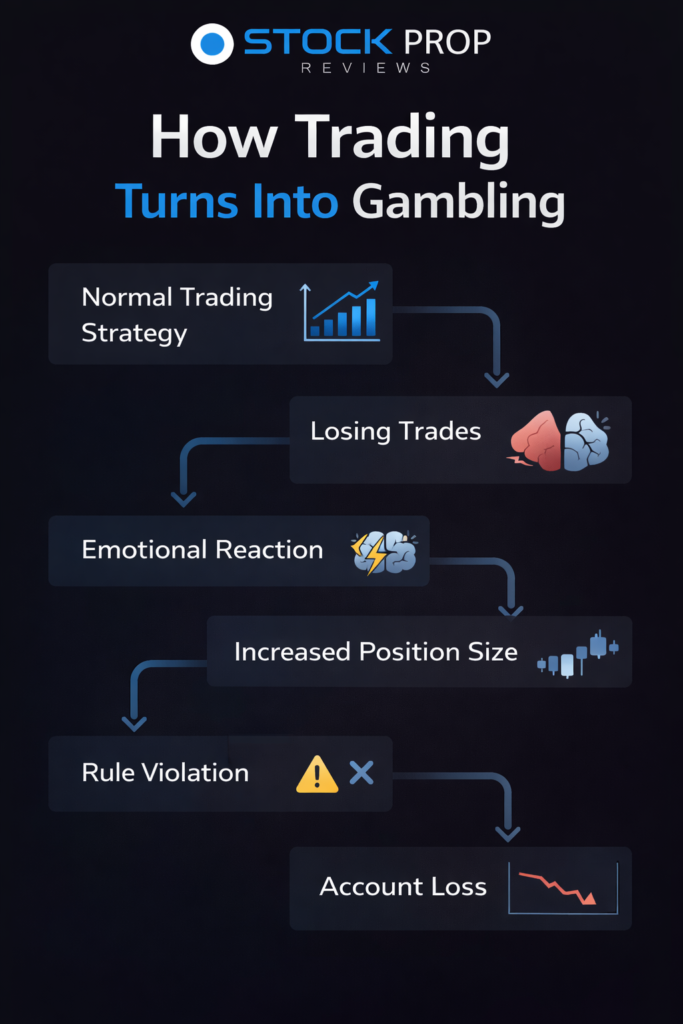
Even when there are strict rules, a lot of traders still act like they’re gambling. The change usually happens when people are under a lot of stress.
After a few losing trades, one common thing happens. The trader raises the risk to get back to the same position size faster instead of keeping it the same. It makes sense at the time. But from a math point of view, it makes it more likely that you will go over your drawdown limits.
Another situation happens after a long winning streak. The trader’s confidence grows, and they start to take bigger positions. One bad trade can wipe out days of profits.
Behavioral finance knows a lot about these patterns. Both loss aversion and overconfidence affect how people make decisions when they are under stress.
The rules of a prop firm quickly show these behaviors.
A Simple Example of Risk Discipline
Consider two traders using exactly the same strategy.
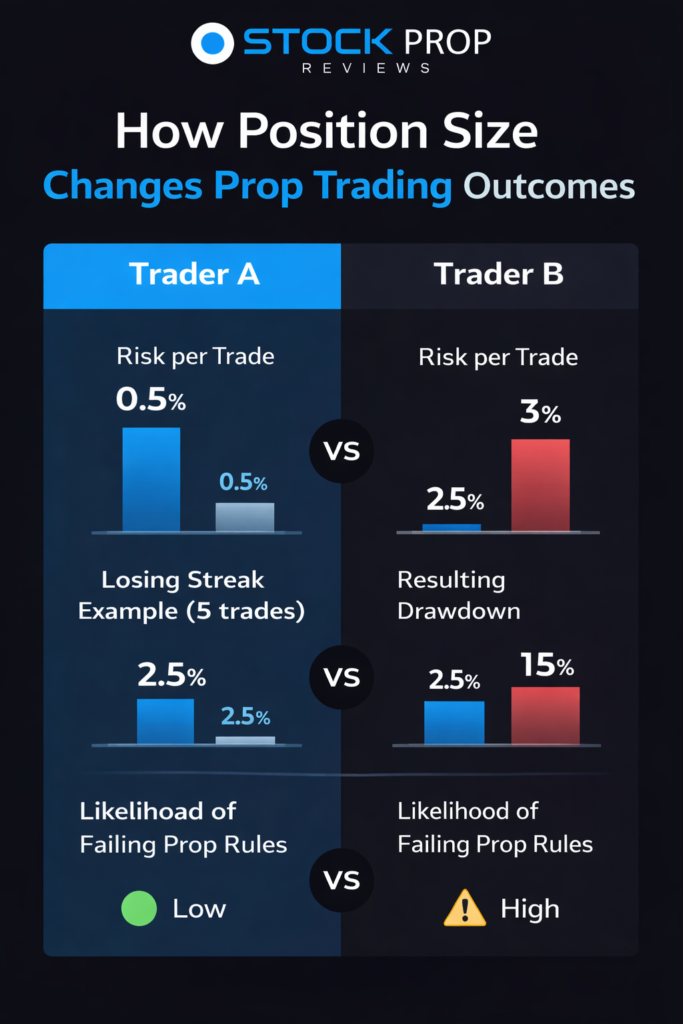
Trader A risks half a percent of the account per trade. Trader B risks three percent.
After five losing trades, the difference becomes obvious.
| Trader | Risk per trade | Drawdown after 5 losses |
| Trader A | 0.5% | 2.5% |
| Trader B | 3% | 15% |
Trader B would likely fail a prop evaluation immediately. The strategy itself did not fail. The position sizing did.
This example illustrates why professional traders focus heavily on risk management rather than prediction accuracy.
What Most Articles About Prop Trading Miss
A lot of the talk about prop trading is about whether companies are real or whether the tests are too hard to pass.
The more important thing is how traders act when they are limited.
The rules of a prop firm are meant to see how consistent you are. They give traders who keep their risk levels steady rewards and punish those who try to make a lot of money quickly.
If a trader usually risks four or five percent of their money on each trade, they could trade their own account for months. In a prop environment, that same behavior breaks the rules right away.
This difference is why some traders think that prop firms are “made to make people fail.” In reality, they are made to filter for good risk management.
Is Prop Trading Closer to Professional Poker?
Professional poker is a better way to compare trading than casino gambling.
Poker players don’t know what’s going to happen. Results in the short term can seem random. But skilled players depend on probability, managing their money, and making good decisions over time.
The same logic applies to trading.
Any outcome can happen with just one trade. After hundreds of trades, the strategy starts to show its edge.
Because of this, professional traders think in terms of trade series instead of individual outcomes.
How Different Prop Firms Structure Risk
Risk structures vary between firms, and those differences can influence trader behaviour.
For example, our analysis in the FTMO review shows a two-phase evaluation model where traders must reach a profit target while respecting daily and maximum drawdown limits. This format encourages consistent trading because a single large position can quickly violate rules.
In contrast, the Topstep review explains a trailing drawdown model used in futures trading. Trailing limits move with account equity and can create different psychological pressure during profitable periods.
These structural differences are explored further in our best prop firms comparison, where drawdown models and rule flexibility play a major role in trader experience.
Understanding these mechanics is important because they influence how strategies perform inside a prop environment.
Why Instant Funding Models Change Trader Psychology
Some firms offer instant funded accounts without evaluation phases. While this approach removes the challenge stage, it also changes trader behaviour.
Without the process of passing an evaluation, traders may treat accounts more casually. When the entry cost is relatively low, some traders view the account as disposable.
This mindset often leads to aggressive trading, similar to buying another ticket after losing a bet.
The behavioural patterns behind this phenomenon are discussed in our analysis of why traders fail small prop accounts, where psychological pressure and risk escalation frequently appear.
The Psychological Side of Prop Trading
Trading psychology is often underestimated. The technical side of strategy development receives far more attention, yet emotional decision making causes many evaluation failures.
Loss aversion is one of the most powerful influences. After a losing trade, the natural instinct is to recover quickly. Traders increase position size or take trades that do not fully meet their strategy criteria.
Overconfidence creates the opposite problem. A strong winning period can convince a trader that market conditions are easy to read. Position sizes gradually increase until a single losing trade reverses progress.
Professional traders learn to treat each trade as one event in a long statistical sequence.
A Note on Regulated Stock Prop Firms
Most online prop firms operate in the CFD or futures space. Another category exists in stock trading environments that resemble traditional proprietary desks more closely.
One example is TradeThePool, which focuses on equities and structured risk frameworks. Some traders prefer this model because stock markets follow a more traditional regulatory structure.
Readers exploring this route should research the rules carefully. TradeThePool provides transparent risk parameters and equity trading access, and readers can receive up to 10 percent discount when purchasing through our TradeThePool link.
The goal is not to promote a specific firm but to highlight that different prop environments exist.
When Trading Truly Becomes Gambling
Trading behaviour crosses into gambling territory when discipline disappears.
Three warning signs usually appear at the same time. The trader no longer follows a defined strategy. Position size changes frequently depending on emotional state. Decisions become reactive rather than planned.
Once that happens, the outcome of each trade becomes essentially random.
At that point the account behaves more like a casino chip than a professional trading account.
Who Should Avoid Prop Trading
Some traders can benefit from prop trading, but it’s not right for everyone.
Traders who have trouble with rule-based systems often find the environment to be annoying. Strict drawdown limits don’t leave much room for making decisions on the spur of the moment.
People who think trading will make them money quickly may also be let down. It can take a long time to finish the evaluation phases, and you need to be patient to make money consistently.
Demo trading or small personal accounts may be a better place for beginners who are still working on their strategies to start.
Alternatives Traders Sometimes Consider
Not all traders go the prop firm route. There are many options available, depending on your goals and level of experience.
Self-funded accounts give you complete freedom, but they put your own money at risk. In institutional settings, traditional proprietary desks are available, but they usually require experience or a good track record.
Another choice is regulated stock prop platforms like TradeThePool, which work more like traditional trading desks. That model might make more sense to traders who are more interested in stocks than derivatives.
Readers who are thinking about going that way can get up to 10% off when they buy through our TradeThePool link. However, the main thing to think about is whether the rules fit the trader’s strategy.
The Real Answer to “Is Prop Trading Gambling?”
Prop trading itself is not gambling. It is a structured environment where traders operate within defined risk rules and profit-sharing agreements.
However, trading behaviour can easily resemble gambling when risk management disappears.
The difference between the two comes down to discipline. Traders who control position size, follow a tested strategy, and think in long statistical sequences approach trading as a probability business.
Those who chase quick profits and increase risk after losses are effectively gambling, regardless of the platform they use.
FAQs
Is it against the law to do prop trading?
No. Prop trading is a type of financial trading. Traders use set risk rules instead of games of chance to guess what will happen in the financial markets.
Why do most traders fail at prop firm challenges?
Most traders fail because they go over their drawdown limits or make their positions bigger after losing money. A lot of it has to do with mental pressure.
Is it possible for trading to give you an edge in statistics?
Yes. Strategies that have good risk-to-reward ratios and are followed through on consistently can lead to positive expected value over many trades.
Do prop firms gain when traders lose?
Companies make money from evaluation fees, but they also need traders who can handle money well and make good decisions. The purpose of risk rules is to find traders who are disciplined.
Is prop trading less risky than gambling?
Traders can make it safer by following strict risk management rules and using a strategy that has been proven to work. If you don’t have discipline, trading can look a lot like gambling.