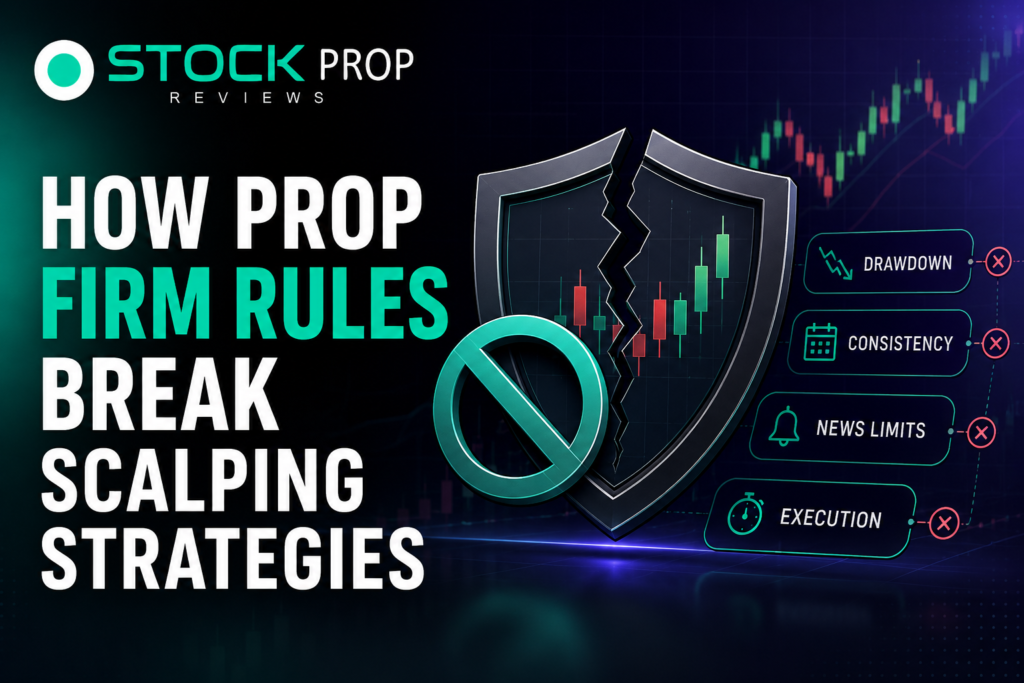
Scalping can make consistent profits when done with discipline but scalping prop firm rules tend to change the game more than traders expect. Many traders enter a funded challenge with a winning personal system and find out that drawdown calculations, consistency rules, execution restrictions or news restrictions make that same system difficult to maintain.
This guide is for forex, indices, gold and futures scalpers who are thinking of trading or are already trading with a prop firm. It is not for the long-term swing traders and investors who keep their trades open for days.
The better question is not whether scalping is allowed, but whether your particular brand of scalping fits the firm’s risk model.
Quick Verdict
Scalping is good with prop firms but only if the firm’s rules match your execution.
Many funded traders mess it up by optimizing entries and not paying attention to the evaluation framework. Such a strategy, which produces small but frequent profits, may become unprofitable when it approaches the daily drawdown limits for repeated occasions, violates the consistency requirements or trades in restricted periods.
Take as much time when selecting a prop firm as you would on spreads, commissions and execution speed.
What Are Scalping Prop Firm Rules?
Scalping prop firm rules are the trading restrictions designed to control risk while allowing traders to use short-term strategies.
These rules typically cover:
- Daily drawdown.
- Maximum total loss
- News trading limits
- Weekend Holding Rules:
- Minimum trading days
- Position Size Expectations
- Requirements for consistency
- Prohibited trading activities
- Policies for Expert Advisor
- Execution constraints High frequency
A firm may advertise that scalping is allowed while still enforcing several conditions that reduce its effectiveness.
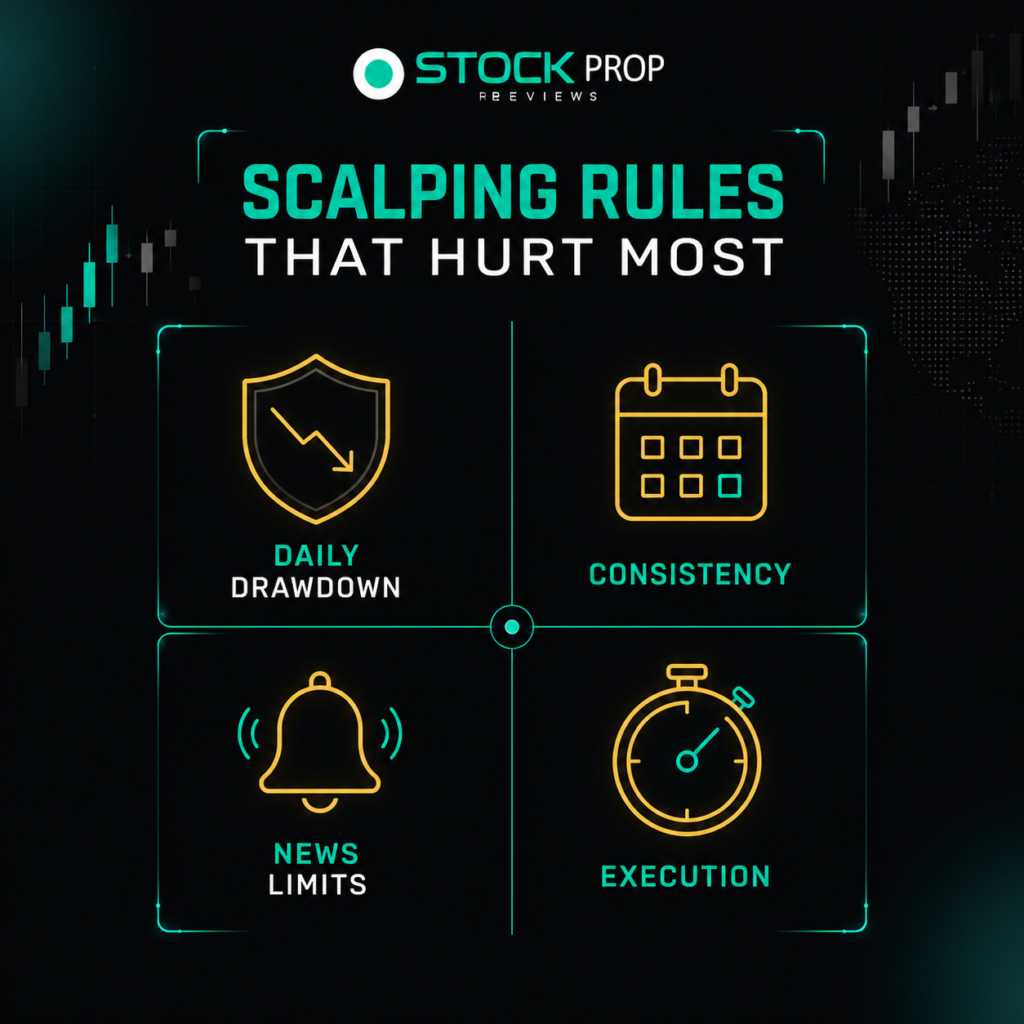
The Rules That Hurt Scalpers the Most
| Rule | Why It Matters for Scalpers | Typical Impact |
| Daily Drawdown | Small losses accumulate quickly | Trading stops before recovery |
| Overall Drawdown | Limits aggressive position sizing | Lower earning potential |
| Consistency Rules | Prevent one large winning day | Slower scaling |
| News Restrictions | Removes high-volatility setups | Fewer quality trades |
| Maximum Exposure | Limits multiple positions | Reduced flexibility |
| Minimum Trading Days | Encourages unnecessary trades | Overtrading risk |
| EA Restrictions | Limits automation | Strategy adjustments required |
| Execution Monitoring | Flags abnormal activity | Possible account review |
The important point is that these rules rarely work in isolation. Several restrictions together often create the biggest challenge.
Why Daily Drawdown Changes Scalping Psychology
Most scalpers take a few losing trades to find momentum.
On a personal account this might be doable because the trader knows the statistical edge over hundreds of trades.
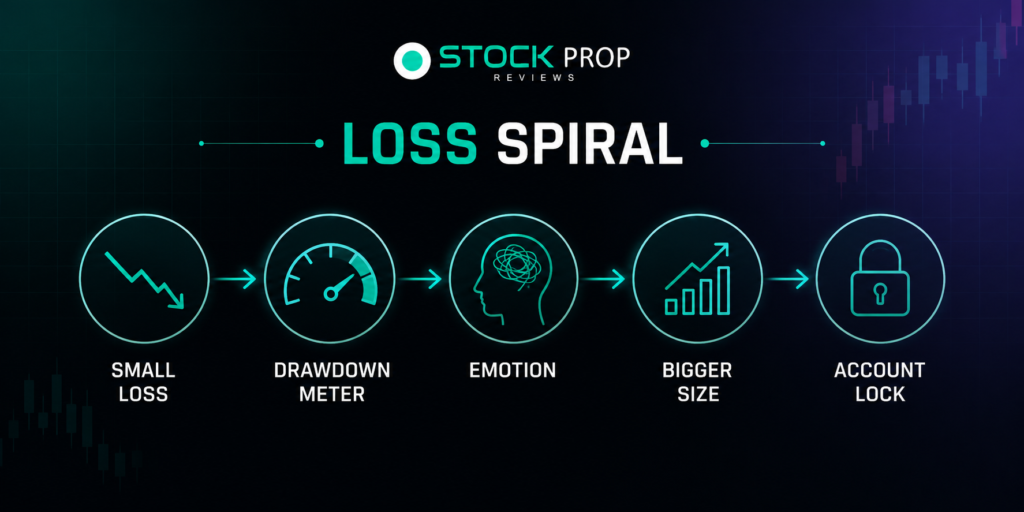
In a funded account daily drawdown changes the decision making.
Let’s say you are a trader risking .5% per trade.
Four losers equals a 2% dip in the account.
If the firm has a daily limit of 3%, then every remaining decision is an emotional one.
So many traders then:
Increase position size for faster recovery.
- Ignore valid configurations.
- Also early exit winners.
- Enter trade with lower value.
- The plan is just the same. The environment has.
This is one reason why experienced scalpers will often risk less on funded accounts than they do on their own capital.
Consistency Rules Can Punish Good Scalping
Some firms dislike traders making most profits in a single day.
For swing traders this may not matter.
For scalpers, however, market conditions vary dramatically.
A trader may identify one excellent session and make 4% before protecting capital during quieter days.
Consistency rules can reduce the value of that disciplined decision by requiring profits to be distributed more evenly.
Ironically, forcing traders to remain active sometimes encourages unnecessary trades.
News Restrictions Remove Some of the Best Opportunities
Many scalpers specialize in volatility.
Major economic releases often create:
- Strong momentum
- High volume
- Clean breakouts
- Large liquidity moves
Several prop firms either prohibit trading around major news events or refuse to count profits generated during restricted periods.
A trader who built an entire strategy around economic releases may suddenly lose their strongest setups.
Always check whether the restriction applies to:
- Opening positions
- Closing positions
- Existing trades
- Specific news events only
The wording varies significantly between firms.
Execution Speed Is Only Part of the Story
Spreads and latency are covered in many articles.
Those factors are important.
But experienced funded traders know that execution quality seldom makes the difference on its own.
More important questions include:
- Does the firm reject certain trading patterns?
- Are rapid entries reviewed manually?
- Is extremely short holding time discouraged?
- Are copy-trading systems prohibited?
- Does the firm define prohibited high-frequency trading?
A broker may execute trades perfectly while the firm’s compliance team later reviews the trading behavior.
Understanding that distinction helps avoid unpleasant surprises.
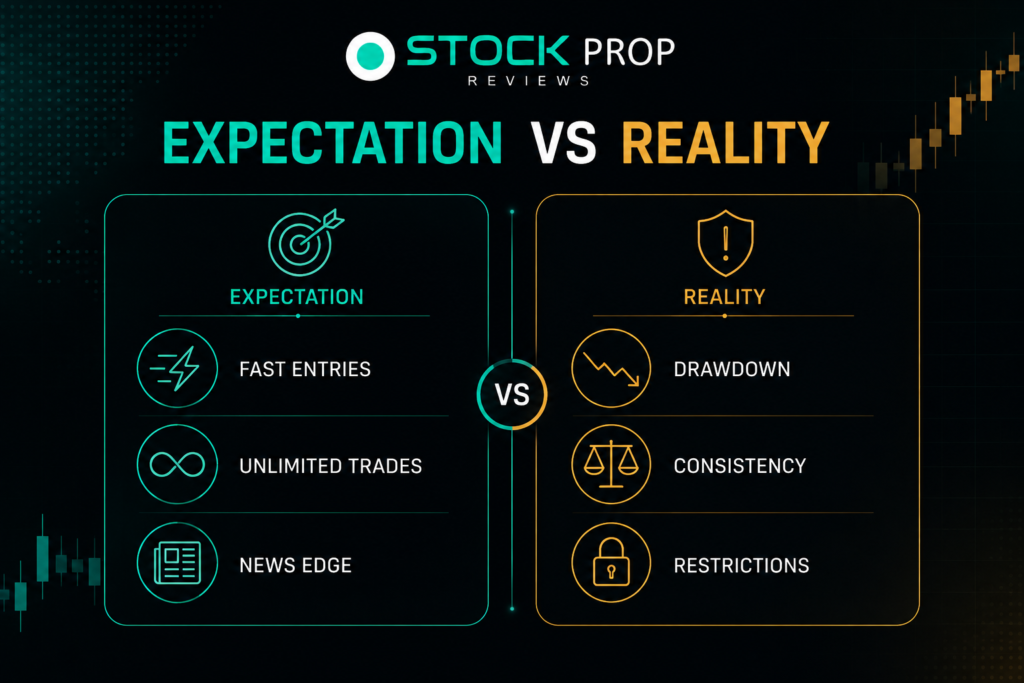
What Most Competitors Don’t Explain
Many guides simply say a prop firm “allows scalping.”
This statement doesn’t mean much.
The better questions are:
Does the Risk Model Match Scalping?
Some companies expect smooth equity curves.
Scalping naturally creates a lot of small fluctuations.
Those expectations may be in conflict.
Can You Recover Naturally?
A healthy scalping strategy experiences losing streaks.
If the drawdown rules prevent statistical recovery, the strategy becomes distorted.
Are Profits Evaluated Differently?
Other companies watch days of extraordinary profits more closely.
Others focus on consistent position sizing.
These reviews do not necessarily indicate wrongdoing, but traders should understand how monitoring works before funding.
Does the Strategy Scale Well?
A strategy that makes 2% a month with limited drawdowns is often easier to scale than one that makes 8% but has too many rule violations.
Short-term challenges are less important than long-term survival.
Real Trading Scenario
Consider two traders using identical entries.
Trader A
- Risks 1% per trade
- Takes 18 trades daily
- Targets 1:1 reward
- Frequently reaches drawdown thresholds
Trader B
- Risks 0.25% per trade
- Takes 8 carefully selected trades
- Stops after reaching daily target
- Avoids emotional recovery trading
After several months, Trader B is far more likely to keep the funded account despite producing fewer spectacular days.
Many experienced funded traders eventually discover that surviving rules is part of the strategy itself.
Common Mistakes Scalpers Make in Prop Firms
Treating the Funded Account Like a Personal Account
Optimal risk management changes the rules.
Usually ignoring them shortens the account life.
Ignoring Rule Updates
Prop firms do change policies once in a while.
Accidental violations happen from not reading updates.
Trading Every Session
Scalpers often think that more trades mean more profits.
The fact is, many funded traders are profitable trading fewer, better sessions.
Chasing Daily Targets
Unnecessary losses are often created by forcing profits ahead of the developing market conditions.
Assuming Every Firm Defines Scalping the Same Way
“Definitions differ.
“A firm may want five-second trades.
Another could look at them one by one.
Always read the trading policy rather than the marketing material.
Strategy Fit Analysis
| Trading Style | Suitability Under Most Prop Firm Rules |
| Ultra-fast scalping | Poor |
| Manual discretionary scalping | Good |
| London session scalping | Good |
| News scalping | Often limited |
| Gold scalping | Moderate |
| Index scalping | Good |
| Automated scalping | Depends on firm |
| High-frequency execution | Often restricted |
The more your strategy depends on speed and frequency, the more carefully you should study the rulebook.
Best For
Prop firms generally suit scalpers who:
- Take less risk per trade
- Stick to the structured trading hours.
- Be disciplined with position sizing.
- Can stop trading once the goals for each day are met.
- Understand the evaluation rules before starting.
Worst For
Scalping funded accounts may not suit traders who:
- Rely on news volatility only.
- Average into a losing trade.
- Sometimes exceed planned risk.
- ALWAYS adjust position size after losses.
- Use automated means not allowed.
Balanced View
Some traders argue that prop firm rules make scalping impossible.
That is not entirely accurate.
Thousands of traders complete funded evaluations using short-term strategies.
The difference is that successful traders adapt their execution to the firm’s framework rather than expecting the framework to adapt to them.
On the other hand, some firms genuinely create environments that are difficult for active scalpers. Tight drawdown limits, vague consistency rules, or unclear execution policies can reduce the statistical edge of an otherwise profitable system.
Neither viewpoint tells the full story.
The outcome depends on the combination of strategy, discipline, and rule structure.
Alternatives for Active Traders
If traditional forex prop firms do not fit your approach, consider alternatives.
A regulated stock prop firm such as TradeThePool offers transparent rules designed around stock trading rather than leveraged forex products. For traders interested in equities, the clearly defined risk framework may be easier to understand before starting an evaluation. Readers can get up to 10% discount when purchasing through our TradeThePool link.
Other alternatives include:
- Futures prop firms with exchange-traded products and hard daily loss limits.
- Companies set up for swing traders where the holding period is more important than the number of trades.
The best choice depends on your strategy rather than marketing claims.
FAQs
Are prop firms allowed to scalp?
No, most firms permit scalping, but restrictions on drawdown, news trading, execution methods or automation may impact the way the strategy performs.
What is the biggest rule that causes scalping failures?
The main difficulty is usually the daily drawdown limit, because frequent trades can quickly add up losses before the strategy can recover.
Can I Use Expert Advisors For Scalping?
Some firms allow them, others ban certain automated strategies or require approval. Always check the firm’s trading policy before using automation.
Can you scalp news?
Depends on the prop firm. Some ban opening of positions during major economic announcements, others only restrict certain events or evaluation stages.
Should new traders use scalping in a prop firm?
High frequency trading is not a good way to start out. For beginners, disciplined risk management is usually a good thing to learn first. Scalping requires quick decision making, emotional control and good knowledge of the firm’s rule book.
Final Thoughts
Successful funded scalping isn’t just about the exact entries. It is about building a strategy that survives the firm’s risk framework over hundreds of trades.
Before purchasing any challenge, compare the drawdown model, the execution policies, the consistency requirements and the trading restrictions. It is those details that often make the difference between a profitable scalping strategy and profitable scalping strategy after funding.
Trade is a platform for traders seeking stock-based opportunities.ThePool is a good research for its regulated structure and transparent rules of risks. Readers can purchase through our TradeThePool link and get up to 10% off.